Robotti & Company Advisors Q1 2016 Letter
Robotti & Company is a New York deep-value boutique founded by Bob Robotti in 1983, specializing in left-for-dead cyclical industries — energy services, building products, shipping — with multi-year holding periods and occasional activist letters. It manages about $650m; Bob is regarded as one of the most steadfast Graham-tradition cyclical value hunters.
In plain words
This article explains why investors often make mistakes after market drops. In early 2016, many people rushed to 'safe' assets like bonds with 1% yields or cash, but the author argues this is risky because those returns are too low. Instead, he highlights a volatile stock called Subsea 7, which could quadruple in five years. The key takeaway: don't let short-term fear drive you into overpriced safety; focus on real value. It's worth reading because it shows how market panic can create hidden opportunities.
Robotti Research Report discusses investor behavioral biases and investment strategies following market volatility in Q1 2016. The core argument is that investors, driven by recent fluctuations, are excessively chasing "safe" assets (such as bond-like stocks). However, history shows that paying too
Theme & Background
This chapter discusses investor behavioral biases and investment strategies following the sharp market volatility in the first quarter of 2016. The report argues that after a "roller-coaster" market, investors, driven by fear and fatigue, excessively pursue "safe" assets (such as bond-like stocks and cash). However, history suggests that such reactions often lead to mispricing and uneconomical investments.
Core Thesis
The author's core investment argument is that both ends of the current market (safe assets and volatile assets) are mispriced — the actual risk of low-volatility securities (e.g., bonds yielding 1% or bond-like stocks) is underestimated, and their upside is severely limited; conversely, the actual economic risk of high-volatility stocks (e.g., Subsea 7) is overestimated, and their valuations have already fully compensated for that risk. The author explicitly rejects the popular view that "buy-and-hold is dead," arguing that market cycles repeat, and investors should avoid rearview-mirror bias, focusing on fundamentals rather than short-term volatility.
Counterintuitive Judgments:
- Investors paying a premium for "safety" (e.g., buying bond-like stocks) actually make the investment uneconomical; historically, MLP investors paid this price a year ago.
- The current "risk/risk-free" dichotomy is flawed: bonds yielding 1% and cash are not truly safe, while the risk of high-volatility stocks (e.g., energy stocks) is exaggerated.
Key Arguments & Data
1. Late-2015 Predictions vs. Q1 2016 Reality (citing a Barron's article):
| Late-2015 Prediction | Q1 Actual Performance |
|---|---|
| U.S. dollar continues to rise | U.S. dollar fell 4.1% |
| Emerging markets are dangerous | Emerging markets rose 5.8% |
| Gold continues to weaken | Gold rose 16.1% |
| Interest rates rise (government bonds fall) | Government bonds rose 6.9% |
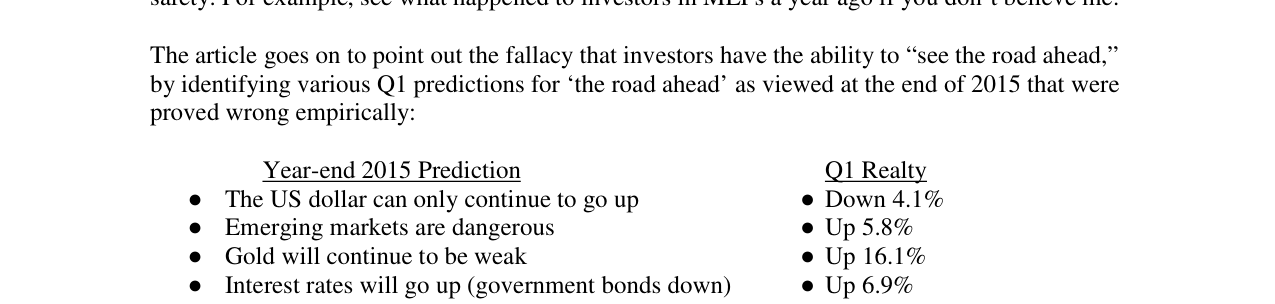
Significant deviation between late-2015 market predictions and Q1 2016 actual performance: the U.S. dollar index fell 4.1%, emerging markets rose 5.8%, gold rose 16.1%, and Treasury yields rose 6.9%
2. Energy Sector Fundamental Trends:
- U.S. crude oil production has fallen by 430,000 barrels per day from its 2015 peak, and the decline rate should accelerate (due to a sharp reduction in new spending).
- Global excess capacity is only slightly above 2% of daily consumption.
- World demand continues to grow (low oil prices historically stimulate demand).
- The market focuses on Iran's potential 500,000 bpd increase but ignores the U.S. production decline — the author views this as a classic "not yet at a tipping point" bias.
3. Subsea 7 Case Study:
- The author believes the stock could reach four times its current price within five years, implying a 25% annualized compound return.
- Comparison: cash or government bonds in a 1% interest rate environment.
Companies/Assets Involved
- Subsea 7: The author is bullish. The stock's current volatility is mistakenly perceived as high risk, but its valuation already fully compensates for economic risk, potentially offering a 25% annualized return over five years.
- MLPs (Master Limited Partnerships): Used as a negative example — investors paid a premium for "safety" a year ago and subsequently suffered losses.
- Energy Stocks (Broadly): The author is bullish. The consensus that "low oil prices will persist longer" will be disproven by reality, leading to a significant price adjustment (similar to the reverse of the 2014 downturn).
Investment Implications
- Avoid paying an excessive premium for "safety": Current prices of bond-like stocks and low-volatility assets are uneconomical, and their actual risks (e.g., rising interest rates, valuation compression) are being ignored.
- Contrarian positioning in high-volatility assets: Stocks with high volatility, such as energy stocks and Subsea 7, have valuations that already reflect overly pessimistic expectations; their actual economic risk is far lower than what price fluctuations suggest.
- Focus on fundamentals, not short-term prices: The contradiction between supply-side contraction in the energy sector (declining U.S. production, reduced new investment) and continued demand growth will drive prices back to equilibrium, though the timing is uncertain.
- Adhere to long-term holding: The buy-and-hold strategy is not dead; market cycles repeat, and short-term volatility should not alter the assessment of quality companies.