Quarterly letter 1Q2016
azvalor Asset Management is a Madrid deep-value boutique founded in 2015 by Álvaro Guzmán de Lázaro and Fernando Bernad, formerly the core of Bestinver's investment team in the Graham tradition. It is known for contrarian concentration in unloved cyclical assets — gold and silver miners, oil services, uranium — buying into panic and exiting once value is realized. Its flagship international fund is about 70% of firm AUM and has more than tripled since inception a decade ago; letters were quarterly from 2016-2022 and semiannual since 2023.
In plain words
This letter explains how Azvalor fund managers handled early 2016. Some stocks they owned shot up so fast—hitting five-year return targets in just three months—that they sold them. Meanwhile, they saw a bubble in bonds (loans you make to governments or companies for interest), with many offering negative returns, meaning you'd lose money holding them. So they shifted cash into deeply undervalued stocks, like Hyundai preferred shares (a special class of stock). Hyundai's cash pile alone was worth more than its entire stock market value. For everyday investors, the takeaway is: don't follow the crowd. Look for solid companies that others are ignoring, and be patient.
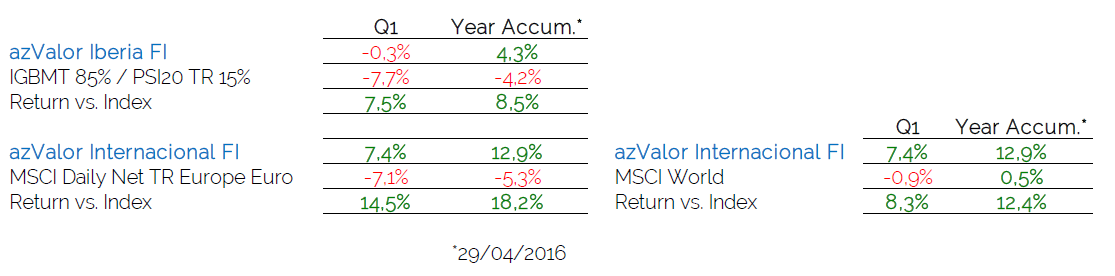
Azvalor's quarterly letter to investors summarizes its fund performance: as of the end of April 2016, Azvalor Iberia's excess return over its benchmark index expanded to over 8 percentage points; Azvalor Internacional shifted from trailing by 2% at the end of January to leading the MSCI World Index
Theme and Background
This section is authored by Álvaro Guzmán de Lázaro Mateos, Chief Investment Officer of Azvalor, and primarily discusses the fund's investment operation logic and market environment assessment in the first quarter of 2016. The report notes that some holdings achieved returns originally expected over five years within just three months, while the bond market exhibits a bubble, and certain value stocks remain severely undervalued.
Core Thesis
The author's core investment argument is: The market has rapidly realized the value of some holdings, warranting decisive reduction; meanwhile, the bond market is in a bubble, with capital shifting from defensive stocks to undervalued assets, and the current stance should be to continue holding undervalued companies. The counterintuitive judgment is that, despite overall market volatility, the fund still identifies certain companies (e.g., Hyundai preferred shares) with "inexplicable undervaluation," where net cash exceeds total market capitalization.
Key Arguments and Data
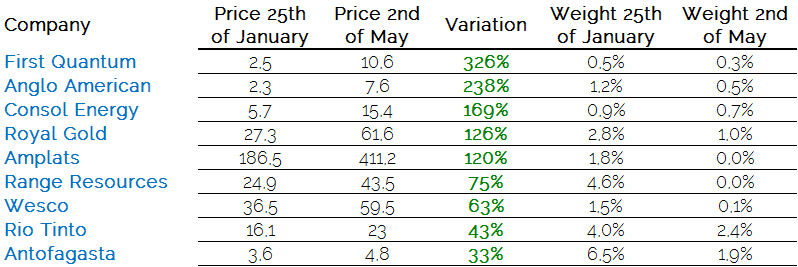
- Rapid Realization: Some commodity exposures achieved five-year expected returns in three months, prompting the fund to halve its commodity exposure.
- Sale of Arcelor Mittal: Share price rose over 50%, while the target price was cut by over 25% due to a rights issue, and alternative investment opportunities (e.g., Técnicas Reunidas) fell 25%, diminishing its relative appeal.
- Técnicas Reunidas: Significantly increased holdings after a profit warning in mid-February, with the purchase price corresponding to less than 7 times estimated recurring profit.
- Mapfre: Substantially increased holdings, with the purchase price effectively valuing most of its international business at zero.
- Bond Market Bubble: Many bonds trade at negative IRR levels, which the author believes will result in losses for current holders.
- Hyundai Preferred Shares: The company has a market cap of 26 trillion Korean won, while net cash and non-operating investments total 29 trillion Korean won, effectively offering a company producing 5 million vehicles annually with a 7% EBIT margin for "free."
Companies/Assets Involved
| Company/Asset | Role | Key Data | Bullish/Bearish |
|---|---|---|---|
| Arcelor Mittal | Fully exited | Share price rose over 50%, target price cut by over 25% due to rights issue | Bearish (sold) |
| Técnicas Reunidas | Significantly increased holdings | Purchase price at less than 7 times estimated recurring profit | Bullish |
| Mapfre | Significantly increased holdings | Purchase price values most international business at zero | Bullish |
| Marie Brizzard | Added to position | Investment thesis unchanged, share price has not performed | Bullish |
| Financière de l’Odet | Added to position | Investment thesis unchanged, share price has not performed | Bullish |
| Hyundai (Preferred Shares) | Newly discovered opportunity | Market cap of 26 trillion Korean won, net cash of 29 trillion Korean won | Bullish |
| Zodiac, Devon, Cabot Oil & Gas, Weir, Panalpina, Richemont | New holdings (over 15 companies) | Good businesses with healthy balance sheets, temporarily penalized by the market | Bullish |
| Bonds | Overall assessment | Many with negative IRR | Bearish |
| Defensive Stocks (Bond Substitutes) | Overall assessment | Subject to artificial buying pressure from QE | Bearish |
Investment Implications
- For Investors: It is recommended to only invest funds that will not be needed for the next 4-5 years, to resist the urge to sell during significant market downturns.
- For the Portfolio: The model portfolio maintains an allocation of 80% Azvalor Internacional / 20% Azvalor Iberia, with potential upside of 70% and 50%, respectively (based on average ROCE of 29% and 17%).
- For Operations: Proceeds from reduced commodity positions after the rally are used to reserve liquidity for "very interesting companies" that are in the final stages of research.