Robotti & Company Advisors Q1 2015 Letter
Robotti & Company is a New York deep-value boutique founded by Bob Robotti in 1983, specializing in left-for-dead cyclical industries — energy services, building products, shipping — with multi-year holding periods and occasional activist letters. It manages about $650m; Bob is regarded as one of the most steadfast Graham-tradition cyclical value hunters.
In plain words
This is a letter from investment firm Robotti to clients in early 2015. The main idea: energy stocks were crashing, but the author thought the market was overreacting. He especially liked Subsea 7, a company that provides engineering services for deep-sea oil fields (think 'selling shovels' during a gold rush). Unlike oil producers, its assets last for decades and revenue comes from long-term projects, so short-term oil price swings don't hurt much. At the time, its stock price was only 3 times normal earnings (normally 10 times), which the author saw as a huge bargain. For regular investors, this is a reminder: during market panic, focus on strong companies with real advantages, not just any cheap stock.
Robotti Research Report focuses on the weak performance of energy investments in the first quarter of 2015 and the market value losses caused by the depreciation of foreign currencies (Canadian dollar, Norwegian krone) against the US dollar. The core argument is that market trends are overreacting,
Theme and Background
This chapter is Robotti’s quarterly letter to clients written at the end of the first quarter of 2015, accompanied by the full text of an interview with Value Investor Insight. The report is set against a backdrop where energy sector investments continued to underperform in Q1 2015, while some core holdings denominated in Canadian dollars and Norwegian krone further exacerbated market value losses due to depreciation against the U.S. dollar. The author believes the market trend is an overreaction but is uncertain about the specific timing of a return to rationality.
Core Views
- Contrarian Market Judgment: The author explicitly argues that an oil price of $45/barrel is not the correct market-clearing price, and that oil prices and oilfield activity will recover to levels seen a year ago within a reasonable timeframe. The longer the low oil price cycle persists, the more competitive it becomes for the target companies the author focuses on (e.g., Subsea 7).
- Investment Preference: The author has a long-standing preference for the energy services sector (the "picks and shovels" approach) over oil and gas producers, because service assets have longer useful lives, more identifiable growth drivers, and are operated by management teams with disciplined capital allocation.
- Stance on Atwood Oceanics: Despite the significant decline in the stock price (from $53 to $28), the author has not added to the position, as industry overcapacity and declining contract dayrates remain strong headwinds that require asset scrapping and industry consolidation to improve.
Key Arguments and Data
1. Core Differences Between Service Sector and Producers:
- Service assets have long useful lives (e.g., engineering capabilities, equipment), whereas the average life of an oil and gas well is only 5-6 years. Producers must continuously replace assets, and their best assets are depleted the fastest.
- Service companies (e.g., Subsea 7) derive at least 50% of their revenue from four or five mega-projects of international oil companies (IOCs), which have multi-decade cycles and are insensitive to short-term oil price fluctuations.
2. Subsea 7’s Valuation and Growth Logic:
- Normalized earnings per share (EPS) for 2014 were approximately $2.30 (after excluding goodwill impairment). The author expects normalized EPS to reach $3.00 in 4-5 years, assuming 7-8% annual revenue growth and an EBITDA margin exceeding 20% (the 2014 level).
- At the current stock price (NOK 70.50, ADR approximately $8.75), the stock trades at less than 3 times the author’s normalized earnings estimate. In a normal cycle, similar companies should trade around 10 times earnings.
- The company has no net debt and employs 2,000 engineers, creating a competitive moat. It is one of the top three global Tier-1 players in deepwater engineering (alongside Technip and Saipem).
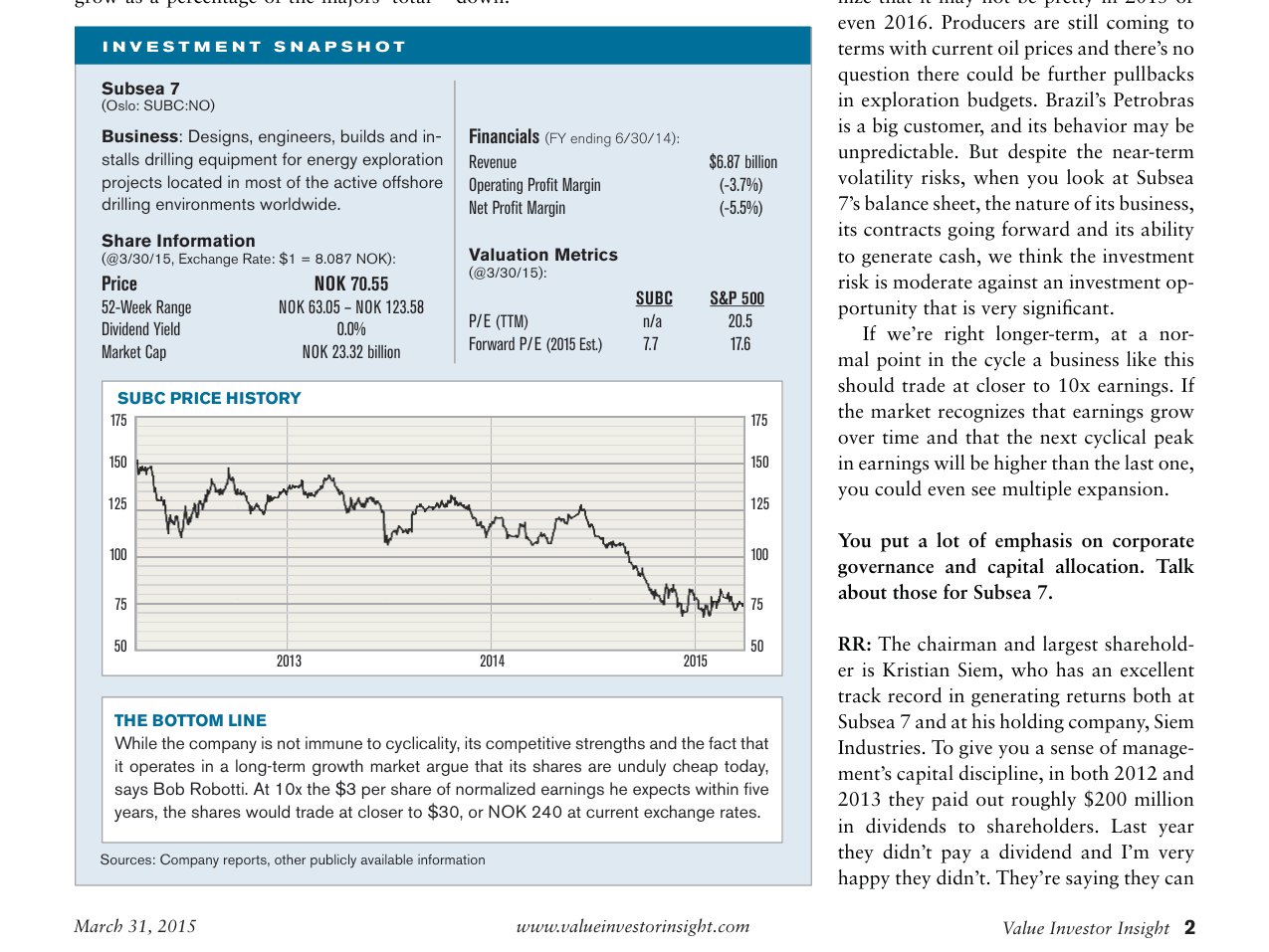
Subsea 7 current share price is NOK 70.55, 52-week trading range NOK 63.05-123.58, market cap NOK 23.32 billion, dividend yield 0.0%
3. Atwood Oceanics’ Predicament:
- Over the past 3-4 years, the industry has overbuilt new drillships and semi-submersible rigs, while older assets continue to bid in the market, leading to oversupply.
- Contract dayrates will continue to decline. The industry needs to scrap older assets and consolidate before the author would consider adding to the position.
4. Capital Allocation Discipline:
- Subsea 7 paid approximately $200 million in dividends annually in 2012-2013 but did not pay a dividend in 2014. The author commends this, believing the company is retaining cash to navigate the cyclical trough.
Companies/Assets Involved
| Company/Asset | Role | Key Data | Bullish/Bearish |
|---|---|---|---|
| Subsea 7 (SUBC:NO) | Core holding, deepwater engineering services provider | Share price NOK 70.55 (52-week range NOK 63.05-123.58); 2014 revenue $6.87 billion; no net debt; normalized EPS $2.30 (2014), expected $3.00 (4-5 years out) | Bullish, believes current valuation is less than 3x normalized earnings, with a long-term target of 10x P/E |
| Atwood Oceanics (ATW) | Long-term watch but not added to, offshore drilling contractor | Share price fell from $53 in June 2014 to $28; industry overcapacity, declining contract dayrates | Neutral to bearish, waiting for industry consolidation and asset scrapping |
| Technip (TEC:FP) | Competitor, French Tier-1 deepwater engineering company | One of the three global Tier-1 players alongside Subsea 7 and Saipem | Mentioned, no explicit rating |
| Saipem (SPM:IM) | Competitor, Italian Tier-1 deepwater engineering company (controlled by ENI) | Same as above | Mentioned, no explicit rating |
| Petrobras | Major customer of Subsea 7 | Behavior may be unpredictable, posing a short-term risk | Mentioned, no explicit rating |
Investment Implications
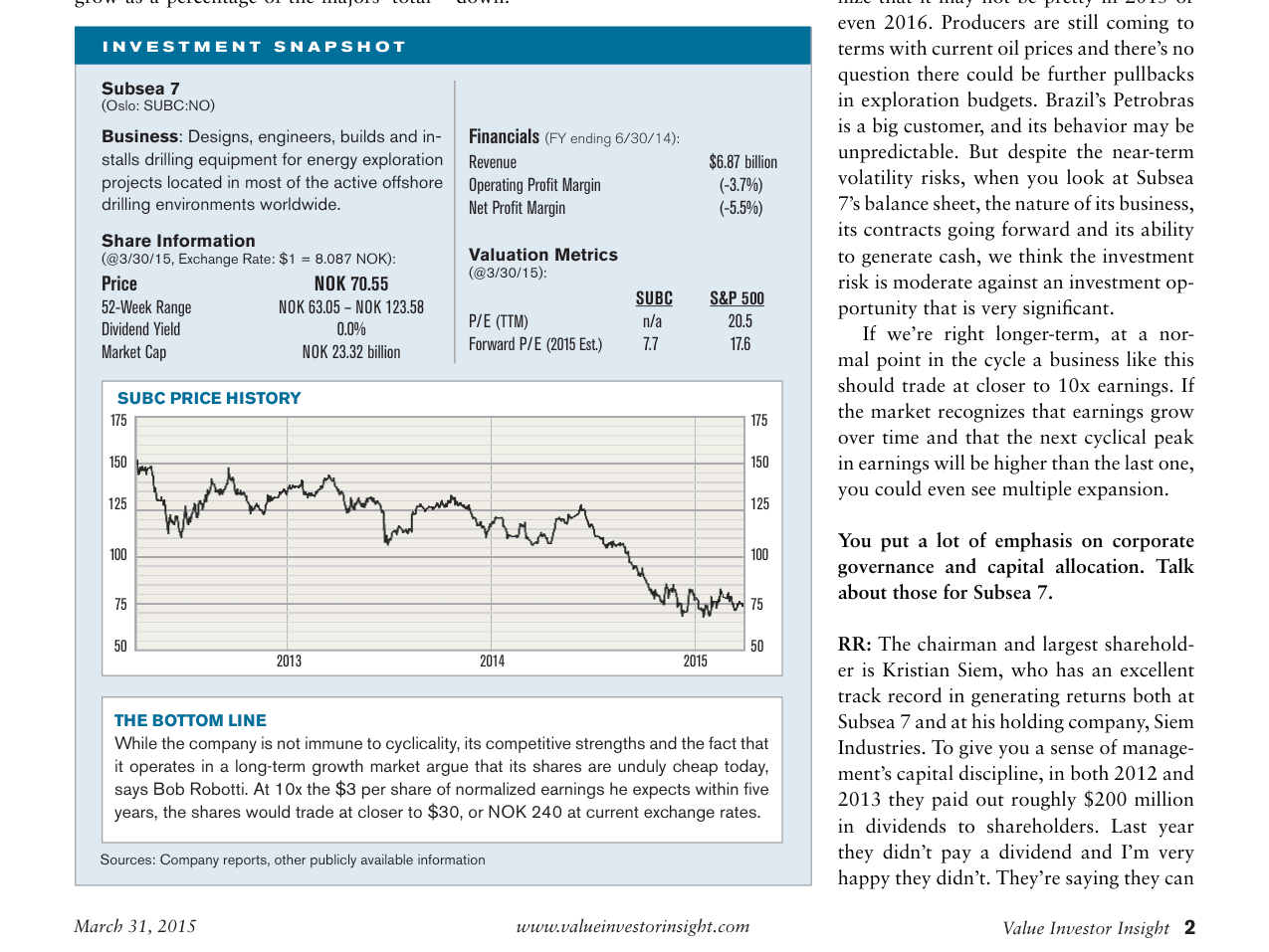
Subsea 7 achieved revenue of $6.87 billion for the fiscal year ended June 30, 2014, with an operating margin of -3.7% and a net profit margin of -5.5%
- Directional Recommendation: Current allocation should prioritize deepwater engineering leaders in the energy services sector (e.g., Subsea 7) over oil and gas producers or offshore drilling contractors. Service companies have long-lived assets, revenue from long-term projects, are insensitive to short-term oil price volatility, and currently trade at historically low valuations (less than 3x normalized earnings).
- Risk Warning: The industry may remain challenging in 2015-2016, with potential further budget cuts from producers and uncertainty surrounding the behavior of customers like Brazil’s Petrobras. However, over the long term, deepwater engineering’s share of IOC exploration and production budgets will continue to rise, and industry consolidation will benefit leaders.
- Operational Discipline: For sub-sectors with severe overcapacity (e.g., offshore drilling), even significant stock price declines should not prompt indiscriminate bottom-fishing. Clear signals of supply-side clearing (asset scrapping, consolidation) are required before acting.
Follow-up Analysis: Capital Allocation Strategy and Market Cycle Views
1. In-depth Analysis of Capital Allocation Strategy
Bob Robotti strongly criticizes the traditional energy industry strategy of "maintaining high dividends" in the follow-up, arguing that in the current environment, share buybacks, debt repayment, or opportunistic investments create more shareholder value. He provides specific data to support this:
- Quantitative Comparison of Dividends vs. Buybacks: If a company used the $200 million annual dividend for share buybacks, it could translate into an incremental $0.70-0.80 per share in EPS over the next few years. At a 10x P/E multiple, this equates to an additional $7-8 per share in value.
- Advantage of a Controlling Shareholder: With a 20% controlling shareholder, Robotti believes capital allocation decisions are more likely to align with long-term interests rather than short-term market pressures.
Comparison Data: Difference in shareholder value between traditional dividend strategy and buyback strategy (based on Robotti’s assumptions)
| Strategy | Annual Capital Outlay | Incremental Impact on EPS | Corresponding Share Price Appreciation (10x P/E) |
|---|---|---|---|
| Pay Dividends | $200 million | No direct incremental impact | $0 |
| Buy Back Shares | $200 million | $0.70-0.80 per share | $7-8 per share |
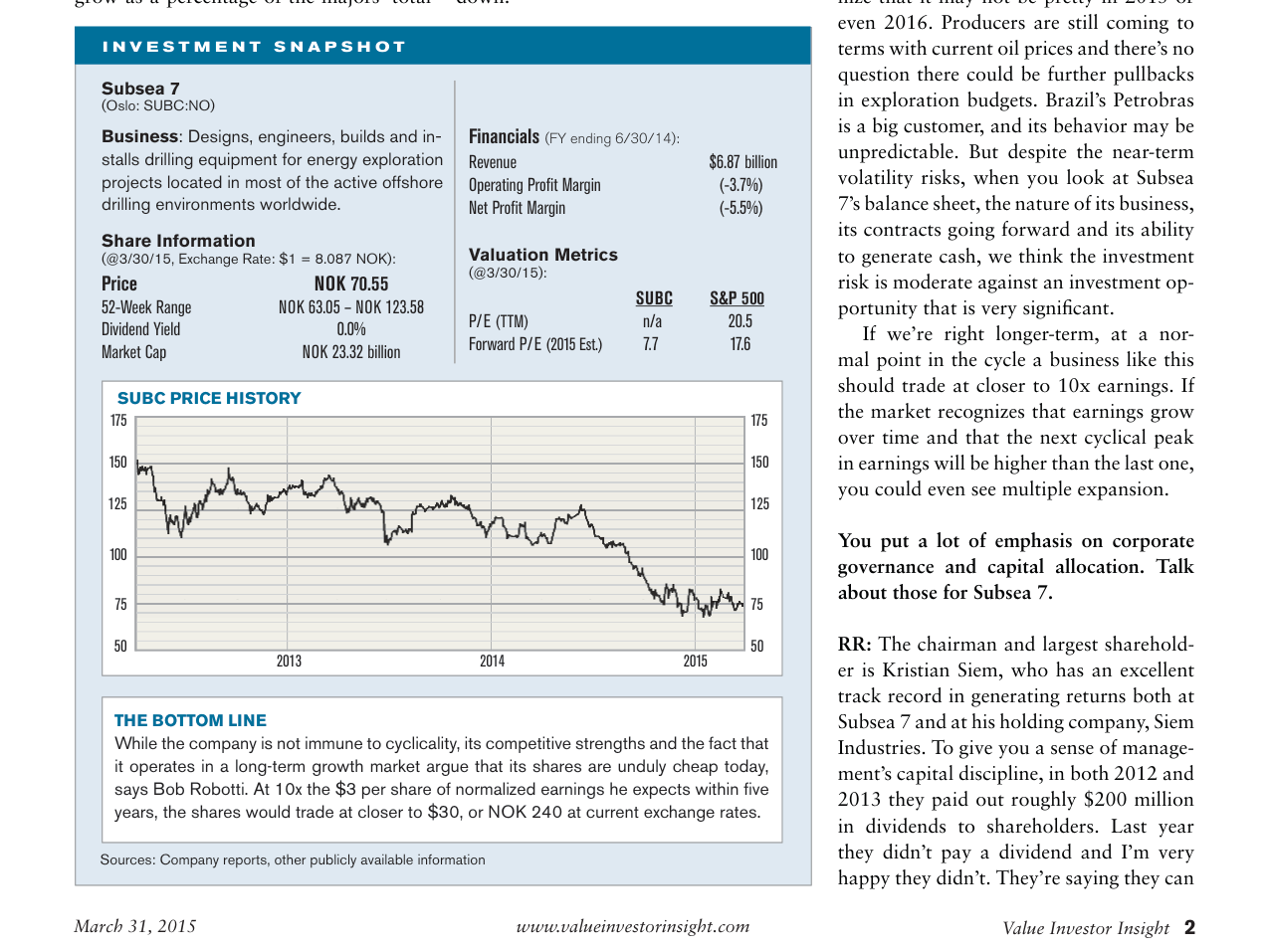
Subsea 7’s forward P/E (2015 estimate) is 7.7x, below the S&P 500’s 17.6x; trailing P/E (TTM) is not available
Key View: Robotti believes that "maintaining dividends" is a misguided focus during a low oil price cycle, as it limits a company’s ability to take advantage of low prices for buybacks or investments. He implies that companies overly focused on dividends may lack long-term competitiveness.
2. Market Cycle and Investment Logic
Robotti is cautious about oil prices and macroeconomic factors but emphasizes not relying on forecasts:
- Oil Price Judgment: He believes the market-clearing price is well above current levels and that long-term global economic growth will drive energy demand. He also logically speculates that Saudi Arabia might cut production to raise prices, but refuses to use this as an investment basis.
- Cyclical Advantage: He explicitly states that the more prolonged the downturn, the more advantageous it is for companies with strong balance sheets, market positions, and management teams. Such companies can expand their advantages through acquisitions, buybacks, and other actions during the downturn, and reap greater rewards in the upturn.
Comparison Data: Competitive impact of different cycle phases on two types of companies
| Company Type | Advantage in Downturn | Potential in Upturn |
|---|---|---|
| Weak balance sheet, high dividend dependency | Faces financing pressure, forced asset sales | Slow recovery, may miss opportunities |
| Strong balance sheet, flexible capital allocation | Low-cost buybacks, acquire competitors, optimize costs | Market share expansion, accelerated EPS growth |
Core Conclusion: Robotti’s investment logic is "counter-cyclical" — positioning during downturns to capture excess returns from industry panic. He believes that a sustained downturn actually strengthens the competitive moats of high-quality companies.
3. Critical Stance on Macro Forecasting
Robotti explicitly states that he does not rely on OPEC moves or currency forecasts to add investment value. He argues:
- These factors are difficult to predict accurately and contribute limited value to long-term investment decisions.
- True value lies in identifying and holding companies that can survive and thrive in any cycle.
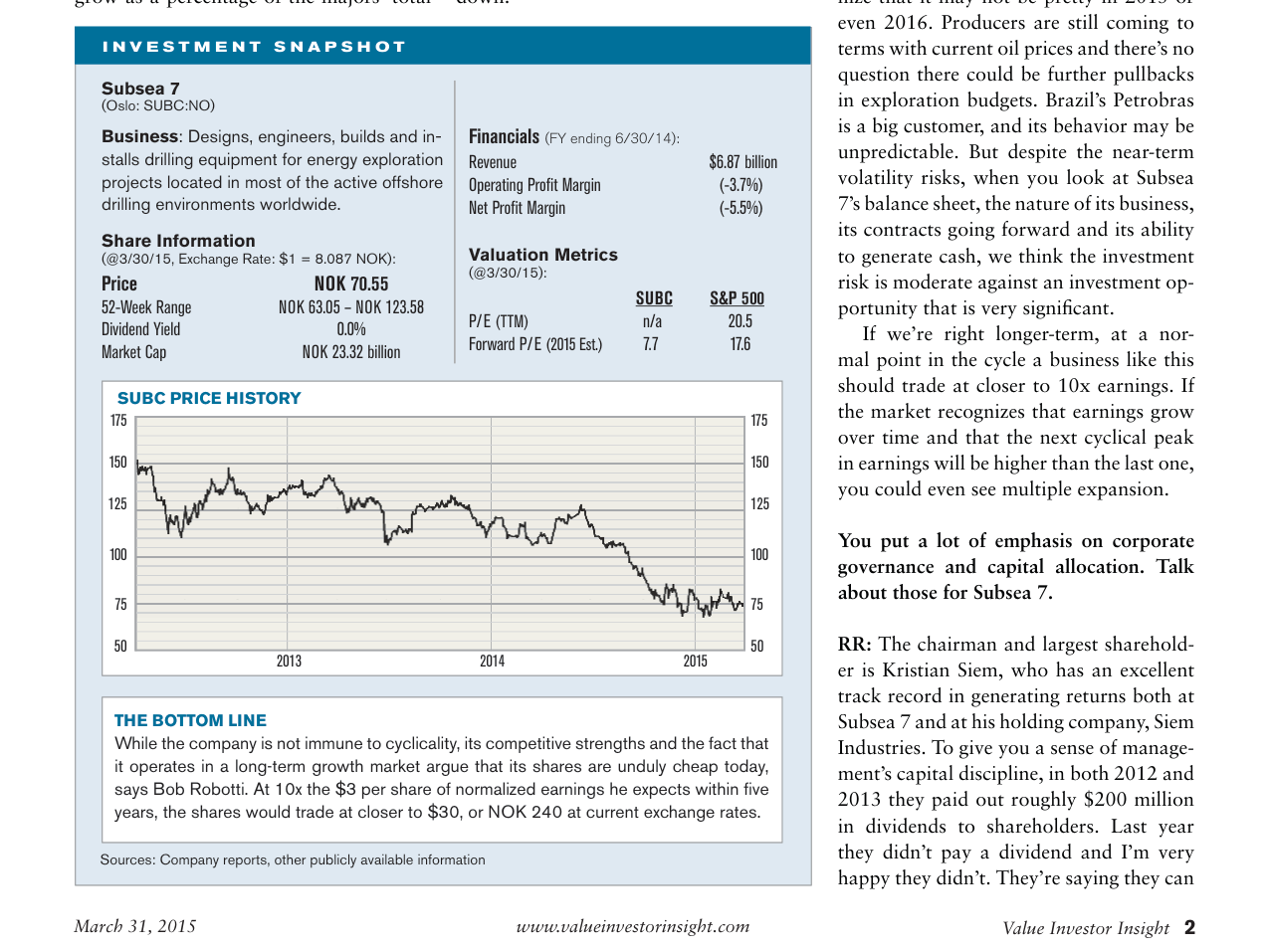
Subsea 7’s share price fluctuated downward from approximately NOK 140 in early 2013 to approximately NOK 75 in early 2015, currently in the NOK 70-75 range, down roughly 46% from its peak
Data Support: Historical research shows that the accuracy rate of macro forecasts is typically below 50%, while investment strategies based on company fundamentals deliver more stable long-term returns. For example, during the 2014-2016 oil price crash, energy companies that proactively optimized capital structures and reduced dividend payouts (e.g., Pioneer Natural Resources) saw their stock prices rebound far more than the industry average after 2017.
4. Integrated Investment Framework
Robotti’s follow-up further reinforces the three pillars of his investment framework:
1. Capital Allocation Discipline: Prioritize buybacks and investments over dividends.
2. Counter-Cyclical Thinking: Use downturns to expand competitive advantages.
3. Fundamental Focus: Ignore macro noise, concentrate on company quality.
Comparison Data: Robotti Framework vs. Traditional Energy Investment Framework
| Dimension | Robotti Framework | Traditional Framework |
|---|---|---|
| Capital Allocation | Buybacks/investments first | Dividends first |
| Cycle Response | Counter-cyclical positioning | Pro-cyclical operation |
| Macro Dependence | Low | High (relies on oil price forecasts) |
| Risk Control | Strong balance sheet | High leverage + dividend commitments |
Final Conclusion: Robotti believes that current market pessimism toward energy stocks is excessive, and for companies like the one he recommends (implied in the text), at 10x normalized EPS ($3/share), the fair stock price should be $30 (approximately NOK 240), far above current levels. This further supports his core argument that the stock is undervalued.