1Q26 Portfolio Activity & Attribution
Patient Capital Management is a Baltimore asset manager founded in 2020 by Samantha McLemore, CFA — Bill Miller's long-time co-manager (working together since 2002, running the flagship Opportunity Equity strategy since 2014). Continuing the Miller-school contrarian tradition, it practices "time arbitrage": exploiting behavioral mispricing to concentrate in controversial growth names (tech, healthcare, Bitcoin-related) at deep discounts to intrinsic value. Its site preserves Bill Miller's complete 1995-2022 market letters, alongside ongoing quarterly letters and webinars.
In plain words
This report shows how a professional investor managed money in early 2026. The market fell, but energy stocks soared after Middle East conflict and a Strait of Hormuz closure pushed oil to $118—double what most expected. The investor also bought Adobe, arguing AI fears are overblown: the company has strong cash flow and buys back stock, with 60% upside possible. Bitcoin is compared to early digital gold, with a market cap only 4% of gold's. Key takeaways: energy can hedge geopolitical shocks, AI panic can create bargains, and bitcoin may have long-term potential but is risky.
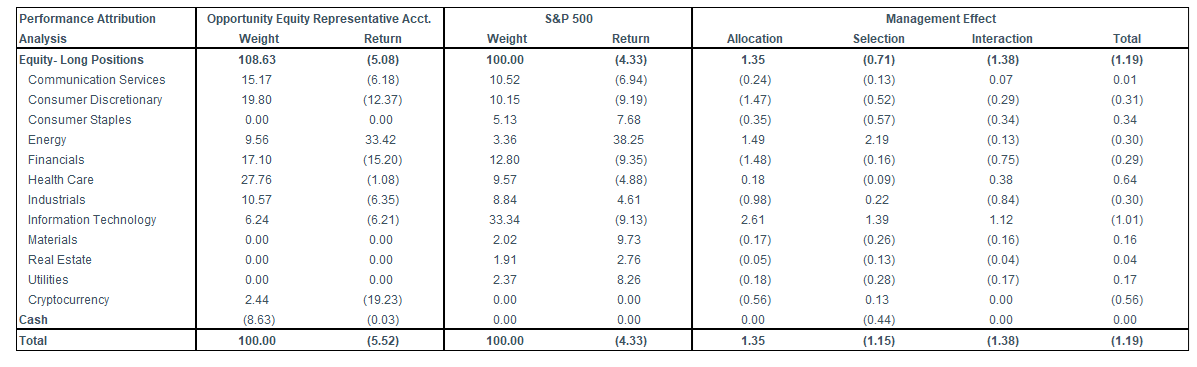
Patient Capital's Patient Opportunity Equity Strategy posted a net return of -5.96% in the first quarter of 2026, underperforming the S&P 500 Index's -4.33%. The performance drag was primarily driven by stock selection and interaction effects, partially offset by allocation effects. The largest posi
Theme and Background
This section reviews the investment performance and portfolio adjustments of the Patient Opportunity Equity Strategy in the first quarter of 2026. After hitting an all-time high in late January, the market reversed sharply, with the S&P 500 index falling 9.8% from its peak and closing the quarter down -4.33%. The market faced multiple pressures, including an AI-triggered "SaaS crash," a liquidity crisis in private credit, and a surge in oil prices due to the Middle East conflict.
Core Thesis
The author's core investment thesis is that the energy sector serves as the portfolio's "antifragile" diversifier, and in an environment of geopolitical uncertainty and supply disruptions, energy is one of the few areas that can benefit from "black swan events." The author emphasizes that the key to investing in energy lies in valuation based on cycle-adjusted returns and normalized prices, rather than short-term price forecasts, and insists on adding positions during periods of pessimism and low expectations. This contrarian judgment was validated in the current quarter by the Middle East conflict and the closure of the Strait of Hormuz.
Key Arguments and Data
- Energy sector outperformed: The strategy held a 2.7x overweight in energy (relative to the S&P 500), and this sector was the quarter's biggest bright spot.
- Oil price expectations were severely off: At the start of the year, consensus expected Brent crude to average $58 per barrel for the full year, but the Middle East conflict and the closure of the Strait of Hormuz pushed Brent to $118 per barrel, the highest since 2022 and nearly double the consensus estimate.
- Portfolio concentration: The portfolio held 36 stocks, with the top ten holdings accounting for 53.4% of assets (vs. 36.5% for the index), and an active share of approximately 93.9%.
- New position in Adobe: The author believes AI concerns about Adobe are overblown. If the company grows earnings at a 7.5% compound annual growth rate over the next five years, the current stock price offers roughly 60% upside. The company has a free cash flow yield of 10% and has net repurchased 21% of its outstanding shares over the past decade.
- Bitcoin comparison: Bitcoin's current market cap is only $1.4 trillion, compared to gold's $33.3 trillion.
Comparison Data Table:
| Metric | Strategy | S&P 500 Index |
|---|---|---|
| Quarterly Net Return | -5.96% | -4.33% |
| Top 10 Holdings Weight | 53.4% | 36.5% |
| Active Share | 93.9% | - |
| Asset | Market Cap ($ Trillion) |
|---|---|
| Bitcoin | 1.4 |
| Gold | 33.3 |
Companies/Assets Involved
- Royalty Pharma plc (RPRX): Largest positive contributor, up 25.6% for the quarter. The world's largest buyer of biopharmaceutical royalties, its structure provides predictable cash flows, delivering low-double-digit unlevered IRRs and high-double-digit levered returns. The author believes the stock remains undervalued.
- Noble Corporation plc (NE) & Seadrill Limited (SDRL): Positive contributors. They operate in a highly consolidated offshore drilling market (only three major players remain), benefiting from tightening onshore drilling supply and offshore becoming an incremental supply source.
- Energy Transfer LP (ET): Positive contributor. One of the largest midstream operators in the U.S., benefiting from rising global demand for U.S. energy exports and pipeline bottlenecks.
- Biogen Inc. (BIIB): Positive contributor.
- UnitedHealth Group (UNH): Largest detractor, contributing -80 basis points.
- Norwegian Cruise Line Holdings Ltd. (NCLH): Detractor, contributing -78 basis points.
- Chime Financial Inc. (CHYM): Detractor, contributing -60 basis points.
- Alphabet Inc. (GOOGL): Detractor, contributing -59 basis points.
- Meta Platforms Inc. (META): Detractor, contributing -55 basis points.
- Adobe Inc. (ADBE): New position. The author is bullish, believing AI concerns are overblown. Its core businesses (Document Cloud, Experience Cloud) have high margins and are less exposed to AI disruption risk, while the Firefly AI platform has begun to monetize.
- iShares Bitcoin Trust ETF (IBIT): New position, replacing the Fidelity Wise Origin Bitcoin Fund (FBTC), maintaining long-term exposure to Bitcoin. The author is bullish, viewing Bitcoin as "early-stage digital gold" with a supply cap of 21 million coins.
- Alibaba Group Holdings Ltd. (BABA): Closed position, as the stock price reached the author's estimated intrinsic value.
- Mattel Inc. (MAT) & Peloton Interactive Inc. (PTON): Closed positions, both small holdings, to free up capital for new ideas.
Investment Implications
- The energy sector should be an "antifragile" allocation in portfolios: In an environment of frequent geopolitical conflicts and supply disruptions, energy is one of the few assets that can hedge systemic risk and generate positive returns. Investors should focus on cycle-adjusted returns and normalized prices rather than short-term oil price forecasts, and add positions counter-cyclically during market pessimism.
- Look for high-quality software companies unfairly punished by AI panic: The Adobe case shows that market fears of AI disruption may be overblown, leading to undervaluation of companies with strong moats and stable cash flows. Investors can seek similar opportunities in the "SaaS crash" with solid fundamentals, high free cash flow yields, and consistent buybacks.
- Bitcoin's long-term allocation value as digital gold: Bitcoin's market cap is only 4.2% of gold's. With the proliferation of institutional-grade investment vehicles (e.g., IBIT), demand is growing while supply is constrained, offering significant long-term upside potential.
Theme & Background
This chapter provides a detailed analysis of the best- and worst-performing stocks in the Patient Opportunity Equity Strategy during the first quarter of 2026. The report notes that the energy sector outperformed due to geopolitical conflicts and supply disruptions, while the healthcare, consumer discretionary, and fintech sectors faced pressure from regulatory changes, internal missteps, and macroeconomic concerns.
Core Thesis
The author’s core investment thesis argues that long-term structural opportunities in the energy sector (supply constraints, stable demand) outweigh short-term price volatility, while short-term negative events in healthcare and consumer sectors (e.g., regulatory changes, management errors) create attractive buying opportunities for long-term investors. The counterintuitive judgment is that despite Norwegian Cruise Line (NCLH) suffering a sharp decline due to internal issues and management turmoil, the author believes its valuation is now significantly below peers, and that new management along with activist investor involvement will steer the company back on track.
Key Arguments & Data
1. Energy Sector (Noble & Seadrill)
- Performance Data: Noble (NE) rose 75.8%, Seadrill (SDRL) rose 31.5%.
- Industry Logic:
- Supply side: Nearly half of deepwater drilling rigs have been scrapped over the past decade, and current capital investment is minimal, limiting supply growth for years to come.
- Industry structure: Since 2019, major players have consolidated to just three.
- Demand side: Onshore oil production growth continues to slow, while offshore drilling plays an increasingly important role in global energy security.
- Company Positioning: Noble returns substantial free cash flow to shareholders through dividends and buybacks; Seadrill has a clean balance sheet and is well-positioned to lead industry consolidation or become an acquisition target.
2. Healthcare Sector (UnitedHealth Group, UNH)
- Performance Data: UNH fell 15.7%.
- Negative Event: CMS initially proposed a 2027 Medicare Advantage reimbursement increase of only 0.09%, far below the market-expected mid-single-digit growth.
- Subsequent Reversal: Entering the second quarter, CMS revised the final payment rate to a 2.48% increase, significantly higher than the initial proposal.
- Author’s View: UNH possesses a unique integrated platform (Optum Health, Optum Rx, Optum Insight), and its long-term profitability and competitive position remain intact. Management targets long-term EPS growth of 13-16%, with recovery expected by 2027. The author added to the position during the decline, noting support from the current 3% dividend yield and ongoing share repurchase program.
3. Consumer Discretionary Sector (Norwegian Cruise Line, NCLH)
- Performance Data: NCLH fell 16.1%.
- Negative Events: Weaker-than-expected 2026 guidance, geopolitical instability in the Middle East, CEO departure, and activist investor Elliott Investment Management building a 10% economic stake and pushing for changes.
- Author’s View: Leverage concerns are considered manageable, and the company can generate substantial free cash flow under normalized operating conditions. NCLH trades at a significant valuation discount to peers, and new management along with activist investors are expected to correct internal missteps. Sea-based vacations still offer a notable cost advantage over land-based travel.
4. Fintech Sector (Chime Financial, CHYM)
- Performance Data: CHYM fell 25.5%.
- Negative Event: Macroeconomic concerns over credit quality led investors to adopt a cautious stance on fintech and consumer credit.
- Author’s View: Chime’s business model is differentiated (its direct-deposit-based model limits credit risk), and as a newly public company, short-term volatility is normal. Its cross-selling opportunities are substantial, the market is vast, and there is a clear path to GAAP profitability.
Comparative Data Table
| Company | Ticker | Q1 Performance | Core Negative Factor | Author’s Core Judgment |
|---|---|---|---|---|
| Noble Corporation | NE | +75.8% | None (benefited from geopolitical conflict) | Supply-constrained, long-term beneficiary of contract rate normalization |
| Seadrill Limited | SDRL | +31.5% | None (benefited from geopolitical conflict) | Clean balance sheet, poised to be consolidator or acquisition target |
| UnitedHealth Group | UNH | -15.7% | CMS initial reimbursement proposal far below expectations | Long-term profitability and competitive position intact, added on weakness |
| Norwegian Cruise Line | NCLH | -16.1% | Guidance below expectations, CEO departure, activist investor involvement | Significant valuation discount, new management and activist investors to drive improvement |
| Chime Financial | CHYM | -25.5% | Macro concerns over credit quality | Differentiated business model, short-term volatility does not reflect fundamental deterioration |
Companies/Assets Involved
- Noble Corporation plc (NE): Bullish. Leading offshore drilling contractor, benefiting from supply constraints and contract rate normalization.
- Seadrill Limited (SDRL): Bullish. Third-largest independent offshore drilling company with a clean balance sheet, poised to lead industry consolidation or become an acquisition target.
- UnitedHealth Group (UNH): Bullish. Industry leader with an integrated platform, long-term EPS growth target of 13-16%, author added on weakness.
- Norwegian Cruise Line Holdings Ltd. (NCLH): Bullish. Significant valuation discount to peers, new management and activist investor (Elliott Investment Management) expected to steer the company back on track.
- Chime Financial Inc. (CHYM): Bullish. Differentiated business model, short-term volatility does not reflect fundamental deterioration, clear long-term path.
Investment Implications
- Energy Sector: Focus on the offshore drilling segment characterized by supply constraints and completed industry consolidation. Companies like Noble and Seadrill are potential candidates for long-term allocation, not short-term trading instruments.
- Healthcare: For industry leaders (e.g., UNH) that experience sharp declines due to short-term regulatory shocks, if their long-term competitive moats and earnings models remain fundamentally intact, it may present a contrarian buying opportunity.
- Consumer Discretionary: For companies underperforming due to internal management errors (e.g., NCLH), if the long-term demand logic (e.g., cost advantage of sea-based vacations) still holds, and new management along with activist investors are involved, it could lead to a revaluation opportunity.
- Fintech: For newly public fintech companies (e.g., CHYM), short-term market sentiment swings can cause stock prices to deviate significantly from fundamentals. Investors should distinguish between short-term macro concerns and the intrinsic value of the company’s long-term business model.