1Q26 Quarterly Market Review
Patient Capital Management is a Baltimore asset manager founded in 2020 by Samantha McLemore, CFA — Bill Miller's long-time co-manager (working together since 2002, running the flagship Opportunity Equity strategy since 2014). Continuing the Miller-school contrarian tradition, it practices "time arbitrage": exploiting behavioral mispricing to concentrate in controversial growth names (tech, healthcare, Bitcoin-related) at deep discounts to intrinsic value. Its site preserves Bill Miller's complete 1995-2022 market letters, alongside ongoing quarterly letters and webinars.
In plain words
This report covers Q1 2026, when Middle East conflict caused oil prices to spike and stock markets to fall. The big news: mega-cap tech stocks (Apple, Nvidia, etc.) dropped sharply, while energy and utility sectors rose. This signals a major shift – investors should move away from relying only on tech giants and consider diversifying into cheaper, stable companies and medium-sized firms. The data shows this rotation clearly, making it worth reading for anyone managing their own portfolio.
Q1 2026 Market Hit by Multiple Shocks: Middle East Conflict Drives Crude Oil to Surge 63% in a Single Month, the Largest Monthly Gain on Record; U.S. Gasoline Prices Rise 35% Month-on-Month; AI Concerns Trigger a 29% Plunge in the Software Sector, a Selloff in Private Credit, and Sharp Style Rotatio
Theme and Background
This chapter reviews the market performance in the first quarter of 2026 under multiple shocks. The core backdrop is a record surge in crude oil prices triggered by the Middle East conflict, combined with sharp sector rotation driven by AI concerns, causing the S&P 500 to fall 9.8% from its peak and close the quarter down 4.4%.
Core Thesis
The report argues that the market is undergoing a profound style shift: Value stocks outperformed growth stocks for the second consecutive quarter, mid-cap stocks led gains, and market breadth improved. Meanwhile, the Federal Reserve is caught in a dilemma between inflation risks and weak consumer confidence, with the probability of a rate cut at only 29%.
Key Arguments and Data
1. Macro Shocks: Middle East Conflict and Inflation
- Crude oil surged 63% in a single month, the largest monthly gain on record; U.S. gasoline prices rose 35% month-over-month.
- February CPI stood at 2.4% (December: 2.7%), while PCE rose to 3.1% (December: 3.0%).
- The unemployment rate was approximately 4.4%, with initial jobless claims rising to 210,000.
- The Consumer Confidence Index was 53.3, below 98% of historical observations.
- Retail sales rose 0.6% month-over-month in February, but surveys indicated potential weakness in March due to rising energy costs.
2. Market Performance: Sector and Style Rotation
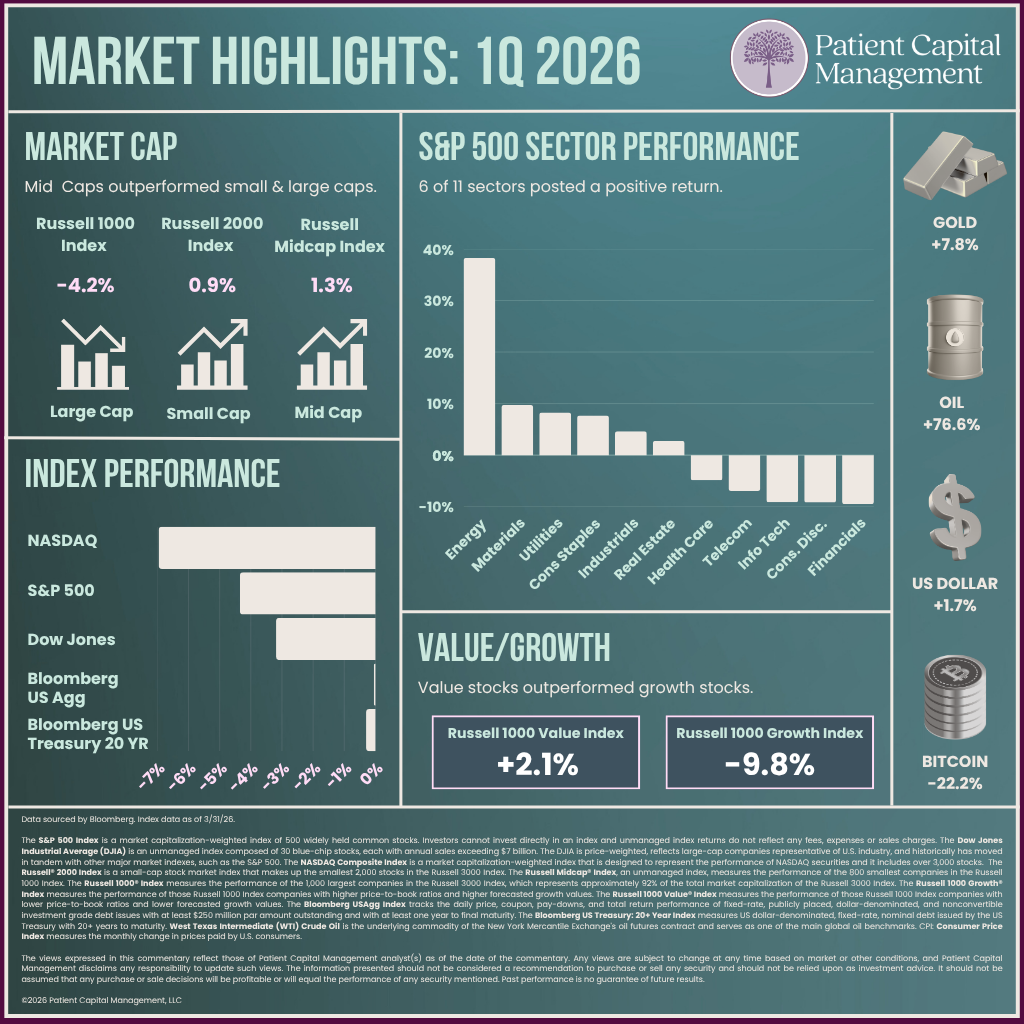
| Index/Sector | Quarterly Return |
|---|---|
| Dow Jones Industrial Average | -3.2% |
| S&P 500 | -4.4% |
| Nasdaq Composite | -7.0% |
| Energy | +38.3% |
| Utilities | +9.7% |
| Materials | +8.3% |
| Financials | -9.5% |
| Consumer Discretionary | -9.2% |
| Russell Mid-Cap | +1.3% |
| Russell 2000 | +0.9% |
| Russell 1000 | -4.2% |
| Russell 1000 Value | +2.1% |
| Russell 1000 Growth | -9.8% |
3. Other Assets
- The 10-year Treasury rose 3.6%, outperforming major equity indices.
- Gold gained 7.8% (up 56% in 2025).
- WTI crude surged 76.6%, while Brent crude rose 94.5%.
- Bitcoin fell 22.2% to $68,194, down 46% from its all-time high at the end of 2025.
4. Improved Market Breadth
- The S&P 500 equal-weight index outperformed the market-cap-weighted index by 500 basis points.
- The equal-weight average return of the Magnificent 7 was -12.1%, underperforming the S&P 500's -4.4%.
- The software sector plunged 29%, and Business Development Companies (BDCs) fell 16% from their January highs.
Companies/Assets Involved
- Magnificent 7 (Alphabet, Amazon, Apple, Meta, Microsoft, Nvidia, Tesla): Overall underperformance, with an equal-weight average return of -12.1%, making them the core target of market rotation.
- Energy Sector: The biggest winner, with a quarterly gain of 38.3%, directly benefiting from the crude oil surge.
- Financials and Consumer Discretionary: The worst-performing sectors, down 9.5% and 9.2%, respectively.
- Bitcoin: Fell for the second consecutive quarter, down 22.2%, with high volatility (the 18th decline of over 30% since 2010).
Investment Implications
- Clear Style Shift: Value stocks have outperformed growth stocks for two consecutive quarters, and mid-cap stocks (Russell Mid-Cap) are leading, indicating the market is moving away from the 2025 tech giant dominance toward broader participation. Investors should reduce concentration in the Magnificent 7 and increase allocations to value and mid-cap stocks.
- Energy and Inflation Hedging: The Middle East conflict has pushed energy prices higher, making the energy sector the clearest upward direction currently. Meanwhile, gold continues its strong performance and can serve as a hedge against inflation and geopolitical risks.
- Beware of High-Valuation Tech and Credit: The software sector's 29% plunge and BDCs' 16% decline highlight the fragility of the AI theme and private credit. With the Fed maintaining high interest rates and a low probability of rate cuts, high-valuation growth stocks and leveraged credit assets face sustained pressure.