2Q25 Quarterly Market Review
Patient Capital Management is a Baltimore asset manager founded in 2020 by Samantha McLemore, CFA — Bill Miller's long-time co-manager (working together since 2002, running the flagship Opportunity Equity strategy since 2014). Continuing the Miller-school contrarian tradition, it practices "time arbitrage": exploiting behavioral mispricing to concentrate in controversial growth names (tech, healthcare, Bitcoin-related) at deep discounts to intrinsic value. Its site preserves Bill Miller's complete 1995-2022 market letters, alongside ongoing quarterly letters and webinars.
In plain words
This report reviews the second quarter of 2025: markets plunged over 20% in April on tariff shocks (a bear market), then staged a sharp V-shaped recovery led by large-cap tech stocks, while small caps and energy lagged. Inflation eased but consumer spending slowed and the labor market softened. For ordinary investors, this means a split market: favor tech leaders, be cautious on small caps and cyclical stocks. Gold and Bitcoin rose as the dollar weakened, offering a hedge against uncertainty.
Market Reversal in Q2 2025 The second quarter of 2025 witnessed a dramatic market reversal: In early April, the S&P 500 fell 21.4% from its peak into bear market territory due to the "Liberation Day" tariff shock, but subsequently rebounded 28.5%—the strongest recovery since 2009—and hit a new all-t
Theme and Background
This chapter reviews the sharp volatility and sector divergence in global financial markets during the second quarter of 2025. After experiencing a bear market triggered by the "Liberation Day" tariff shock, markets quickly rebounded to new highs, while macro data presented conflicting signals of declining inflation and a weakening labor market, adding complexity to the Federal Reserve's policy path.
Core Viewpoint
The author's core judgment is that the market has completed a V-shaped recovery from the tariff shock panic, but the rebound is highly uneven—large-cap tech stocks dominated the recovery, while small-cap stocks and cyclical sectors such as energy significantly lagged. The author suggests that this structural divergence reflects deeper market concerns about interest rate prospects and consumer health, rather than a broad economic recovery.
Key Arguments and Data
- Market Reversal Strength: The S&P 500 fell 21.4% from its April peak into a bear market, then rebounded 28.5%, marking the strongest recovery since 2009, and hit new highs by the end of the quarter.
- Volatility Sharp Swings: The VIX index surged 312.4% in early April, then fell 72.5%, approaching January lows.
- Conflicting Macro Data:
- Inflation continued to decline: Core CPI in May fell to 2.8% year-over-year, and the three-month annualized rate of U.S. PCE dropped to 2.7%.
- Labor market cracks emerged: The unemployment rate rose to 4.2%, and continuing jobless claims reached 1.974 million (highest since 2021), though absolute levels remain historically low.
- Consumer spending weakened: Down 0.1% year-over-year in May, below expectations, which the author believes may reflect demand pulled forward ahead of tariffs.
- Federal Reserve Policy: Rates were held at 4.25-4.50% in June, with the market pricing in 65 basis points of rate cuts for the year.
Performance Comparison of Major Asset Classes (Q2 2025):
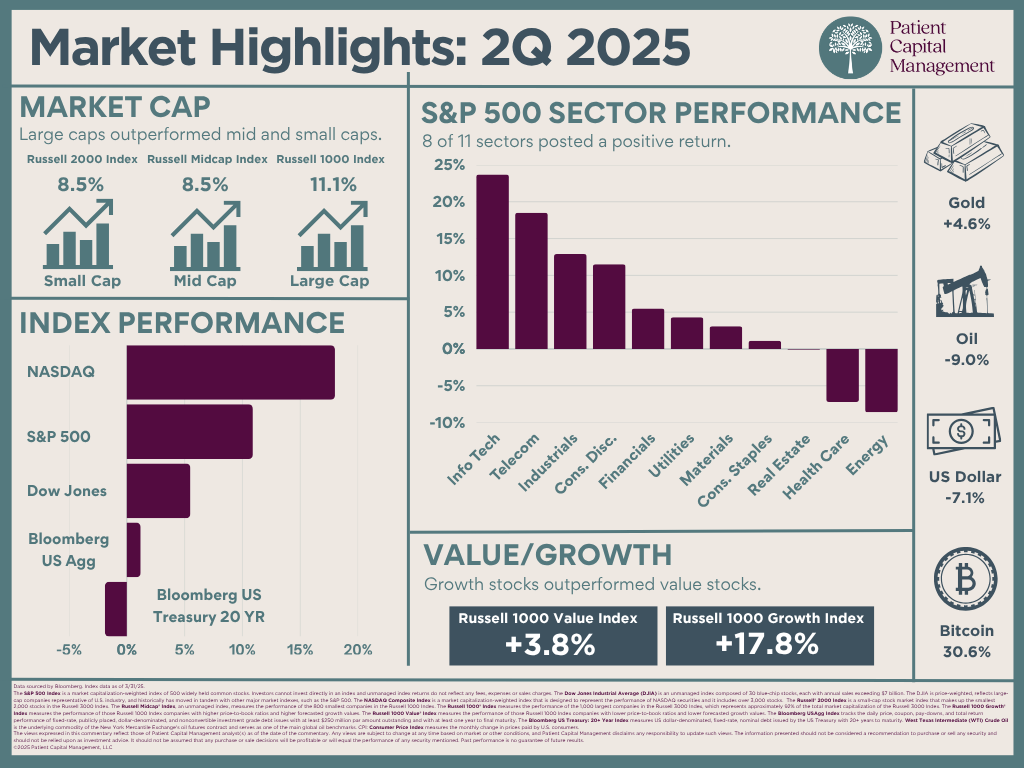
| Asset/Index | Quarterly Return | Key Notes |
|---|---|---|
| Nasdaq Composite Index | +18.0% | Leading |
| S&P 500 Index | +10.9% | Information Technology (+23.7%) and Telecom (+18.5%) led |
| Dow Jones Industrial Average | +5.5% | Lagging |
| Russell 1000 Growth Index | +17.8% | Significantly outperformed value |
| Russell 1000 Value Index | +3.8% | Underperformed |
| Russell 2000 Small-Cap Index | +8.5% | Weakest rebound |
| Energy Sector | -8.6% | Worst performer |
| Healthcare Sector | -7.2% | Second worst performer |
| Bitcoin | +30.6% | Hit all-time high of $111.0k in May, ended quarter at $107.6k |
| Gold | +4.6% | Continued to rise |
| WTI Crude Oil | -9.0% | Year-over-year return -20% |
| Bloomberg U.S. Aggregate Bond Index | +1.2% | Corporate bonds provided positive returns |
| Long-Term U.S. Treasuries | -1.9% | Underperformed |
| U.S. Dollar Index | -7.1% | Continued to decline |
Companies/Assets Involved
- S&P 500 Index: Overall rebound of 10.9%, with Information Technology (+23.7%) and Telecom (+18.5%) leading, while Energy (-8.6%) and Healthcare (-7.2%) were the worst performers.
- Russell Index Series: Growth stocks (Russell 1000 Growth +17.8%) significantly outperformed value stocks (Russell 1000 Value +3.8%); small-cap stocks (Russell 2000 +8.5%) had the weakest rebound, lagging large-caps (Russell 1000 +11.1%).
- Bonds: The U.S. 10-year Treasury yield was roughly flat at quarter-end, with long-term Treasuries (-1.9%) underperforming corporate bonds (Bloomberg Aggregate +1.2%).
- Commodities and Alternative Assets: Gold (+4.6%) extended its rally; Bitcoin (+30.6%) hit a new all-time high; WTI Crude Oil (-9.0%) was weak.
- U.S. Dollar: The U.S. Dollar Index fell 7.1%, providing support for risk assets.
Investment Implications
- Long Large-Cap Tech Growth Stocks: The strong rebound in Information Technology and Telecom sectors indicates that the market still favors high-growth, high-certainty tech leaders amid uncertainty, especially Nasdaq components benefiting from AI trends.
- Avoid Small-Cap and Cyclical Value Stocks: The weakest rebound in small-caps and significant underperformance of value stocks reflect concerns about interest rate-sensitive companies and consumer health. The Energy sector's decline despite geopolitical conflicts suggests greater fundamental pressure.
- Monitor the Contradiction Between Falling Inflation and Weak Consumption: Cooling inflation provides room for rate cuts, but declining consumer spending may signal an economic slowdown. Investors should be wary of the risk that the "soft landing" narrative could be disproven and focus on Fed communication regarding the rate cut path.
- Long Gold and Bitcoin: Alternative assets performed well against a weakening dollar; gold and bitcoin can serve as hedges against currency depreciation and policy uncertainty.