1Q25 Quarterly Market Review
Patient Capital Management is a Baltimore asset manager founded in 2020 by Samantha McLemore, CFA — Bill Miller's long-time co-manager (working together since 2002, running the flagship Opportunity Equity strategy since 2014). Continuing the Miller-school contrarian tradition, it practices "time arbitrage": exploiting behavioral mispricing to concentrate in controversial growth names (tech, healthcare, Bitcoin-related) at deep discounts to intrinsic value. Its site preserves Bill Miller's complete 1995-2022 market letters, alongside ongoing quarterly letters and webinars.
In plain words
In Q1 2025, the US stock market fell 10% from its peak—a normal “correction.” Historically, such dips happen once a year, and the market often bounces back strongly (average 26% gain over the next year). This time, tech and consumer stocks dropped the most, while energy, healthcare, bonds, and gold (up 17%) actually gained. The takeaway for regular investors: don’t panic. Use the dip to add cheaper “value stocks” (those trading below their true worth) and bonds, which can protect your portfolio. The report shows that market wobbles are normal—staying invested pays off.
Patient Capital's 2025 First Quarter Market Review notes that the S&P 500 Index fell 10% from its peak during the quarter, entering a correction for the first time since 2023. However, since 1928, the market has experienced a similar correction on average once per year. The core view is that volatil
Theme and Background
This chapter focuses on the U.S. market correction and sector rotation in the first quarter of 2025. The S&P 500 Index fell 10% from its peak, entering correction territory for the first time since 2023, but the author emphasizes that such corrections are historically normal. The market operated against a backdrop of volatile tariff policies, sticky inflation, and a sharp drop in consumer confidence. The Federal Reserve held interest rates steady, but expectations for rate cuts have significantly increased.
Core Thesis
The author's core judgment is that a 10% correction is a normal market adjustment, not a signal of a trend reversal. The counterintuitive view is that, despite current uncertainty being at historic highs (consumer expectations for business conditions over the next year hit their lowest since 1977), historical data shows that markets typically perform strongly after corrections. Additionally, value stocks significantly outperformed growth stocks, bonds were the best-performing asset among all equity indices, and gold emerged as the biggest winner among safe-haven assets.
Key Arguments and Data
- Correction Frequency: Since 1928, the market has experienced an average of one correction of approximately 10% per year, and the current adjustment aligns with historical patterns.
- Consumer Confidence: The University of Michigan survey shows consumer expectations for business conditions over the next year fell to their lowest since records began in 1977, leading to a higher propensity to save and a contraction in corporate capital expenditure plans (excluding the AI boom).
- Inflation and Employment: The February core CPI fell to 3.1% year-over-year, but the three-month annualized rate of U.S. PCE rose to 2.8%; the unemployment rate rose to 4.1%, and announced layoffs by employers (excluding 2020) were the largest since 2009, with DOGE accounting for only 27%.
- Federal Reserve and Interest Rates: The Fed held rates at 4.25-4.50% in March, with the market pricing in 100 basis points of rate cuts for the full year (up from 50 basis points at the end of December).
- Historical Returns: Following a 10% correction, the average annualized returns over the next 1, 3, and 5 years are 26%, 13%, and 12%, respectively.
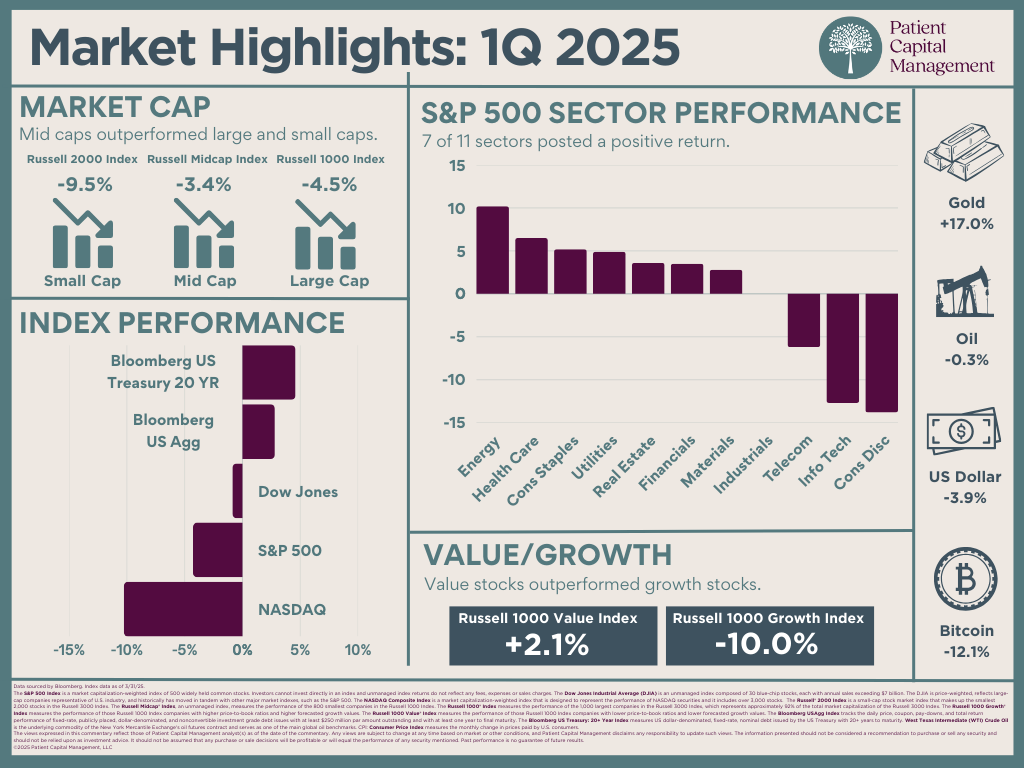
Major Index and Sector Performance (Q1 2025):
| Index/Sector | Quarterly Return |
|---|---|
| NASDAQ Composite Index | -10.3% |
| S&P 500 Index | -4.3% |
| Dow Jones Industrial Average | -0.9% |
| Energy Sector | +10.2% |
| Healthcare Sector | +6.5% |
| Consumer Discretionary Sector | -13.8% |
| Information Technology Sector | -12.7% |
| Russell 2000 (Small-Cap) | -9.5% |
| Russell 1000 (Large-Cap) | -4.5% |
| Russell Mid-Cap | -3.4% |
| Russell 1000 Value Index | +2.1% |
| Russell 1000 Growth Index | -10.0% |
Other Asset Performance:
- The U.S. 10-year Treasury yield fell from 4.6% to 4.2%, long-term Treasuries rose 4.6%, and the Bloomberg Aggregate Bond Index rose 2.8%.
- The U.S. dollar fell 3.9%, gold rose 17.0%, WTI crude oil was roughly flat but down 14.1% year-over-year, and Bitcoin fell from its January all-time high of $106.8k to $82.4k at the end of the quarter.
Companies/Assets Involved
- S&P 500 Index: Overall correction, but Energy and Healthcare sectors led gains, while Consumer Discretionary and Information Technology were the biggest drags.
- Russell 2000 (Small-Cap): Worst performer, down 9.5% for the quarter, underperforming large-cap and mid-cap indices.
- Russell 1000 Value vs. Growth: The Value Index rose 2.1%, while the Growth Index fell 10.0%, with value significantly outperforming.
- Bonds: Long-term U.S. Treasuries rose 4.6%, outperforming all equity indices.
- Gold: Rose 17.0%, becoming one of the strongest assets of the quarter.
- Bitcoin: Fell from $106.8k to $82.4k, underperforming gold.
Investment Implications
- Short-term corrections are buying opportunities: Historical data shows average returns of 26%, 13%, and 12% over the 1, 3, and 5 years following a 10% correction. Investors should use the current uncertainty to add positions on dips.
- Style shift is clear: Value stocks (Russell 1000 Value +2.1%) have significantly outperformed growth stocks (-10.0%). Exposure to high-valuation growth stocks should be reduced in favor of value-oriented assets.
- Defensive sectors preferred: Energy (+10.2%) and Healthcare (+6.5%) led gains, while Consumer Discretionary (-13.8%) and Information Technology (-12.7%) were the biggest drags. Overweighting defensive sectors is recommended.
- Bonds provide a hedge: Long-term Treasuries rose 4.6%, delivering positive returns during the equity market correction. Bond allocations should be increased to balance portfolio risk.
- Gold outperforms Bitcoin: Gold rose 17.0% while Bitcoin fell 22.9%. Amid risk-off sentiment, gold's safe-haven attributes are more recognized, while Bitcoin remains a high-risk asset.