2Q24 Portfolio Activity and Attribution
Patient Capital Management is a Baltimore asset manager founded in 2020 by Samantha McLemore, CFA — Bill Miller's long-time co-manager (working together since 2002, running the flagship Opportunity Equity strategy since 2014). Continuing the Miller-school contrarian tradition, it practices "time arbitrage": exploiting behavioral mispricing to concentrate in controversial growth names (tech, healthcare, Bitcoin-related) at deep discounts to intrinsic value. Its site preserves Bill Miller's complete 1995-2022 market letters, alongside ongoing quarterly letters and webinars.
In plain words
This report explains how Patient Capital's fund performed in the first half of 2024. While big tech stocks like Nvidia soared, the fund thinks many are no longer cheap. So they sold some tech and bought healthcare stocks like Illumina (a gene-sequencing company with 80% market share) and Biogen (an Alzheimer's drug maker). They believe the market is too pessimistic on these firms. The fund lagged the S&P 500 because some holdings (like CVS pharmacy) dropped sharply, but the manager sees long-term value. Worth a read to see how professionals think against the crowd.
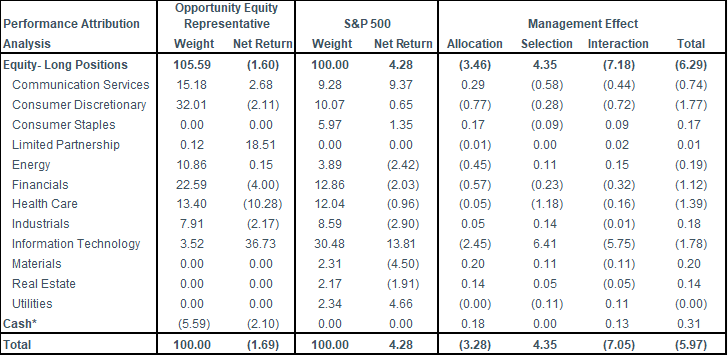
In the first quarter of 2024, the net return of the Patient Opportunity Equity representative account was -1.9%, underperforming the S&P 500 Index's 4.3%. Key detractors included CVS Health, Coinbase Global, Mattel, IAC, and Expedia Group, while Nvidia, Alphabet, Amazon, Biogen, and Energy Transfer
Theme and Background
This chapter reviews the performance and portfolio adjustments of the Patient Opportunity Equity strategy in the first half of 2024. The report notes that the market continues to be dominated by large-cap tech stocks, but the author believes some "Magnificent 7" stocks are approaching fair value, shifting focus to overlooked small- and mid-cap stocks and traditional value stocks, particularly in the healthcare sector.
Core Thesis
The author's core investment thesis is that the market's enthusiasm for large-cap tech stocks is nearing its end, with more "Magnificent 7" stocks no longer undervalued, while the healthcare sector offers numerous overlooked stocks with unique opportunities. The author has increased holdings in healthcare stocks against market consensus and reduced positions in some large-cap tech stocks.
Key Arguments and Data
- Market Performance: In Q1 2024, the strategy posted a net return of -1.9%, underperforming the S&P 500's 4.3%. In Q2, Nvidia contributed 40% of the S&P 500's return, while Apple, Alphabet, and Microsoft contributed 30%, 19%, and 10%, respectively.
- Portfolio Concentration: The portfolio held 39 stocks at period end, with the top 10 accounting for 49% (index: 34.2%) and an active share of approximately 90%.
- Healthcare Opportunities:
- Illumina (ILMN): Holds approximately 80% market share in the genome sequencing market. Acquired Grail for $8 billion in 2021, which caused an annual profit drag of about $600 million. Following the successful divestiture of Grail in June, the company returned to its pure sequencing business, trading at a discount to market multiples.
- Biogen (BIIB): New CEO Christopher Viehbacher has a track record of successful M&A. The market has not fully recognized the slow rollout of its Alzheimer's drug Leqembi, but the author sees significant long-term potential.
- Royalty Pharma (RPRX): As a healthcare investment company with over 20 years of history, it maintains low double-digit internal rates of return (IRR) even in a rising interest rate environment.
- Additions and Exits:
- Added Everi Holdings (EVRI): Acquired IGT's Global Gaming and PlayDigital businesses for $3.8 billion in a cash-and-stock deal. On a pro forma basis, the combined company's 2025 EBITDA is only 4.2x, making the valuation attractive.
- Exited Capital One Financial (COF) and Uber Technologies (UBER) as sources of funding for new ideas.
- Nvidia (NVDA): Holds a 92% market share in data center GPUs. Over the past year, revenue, earnings, and free cash flow grew by 126%, 392%, and 610%, respectively. The B100 chip offers a 2.5x performance improvement with only a 25% cost increase, expected to create new shortages.
Companies/Assets Involved
| Company/Asset | Role | Key Data | Bullish/Bearish |
|---|---|---|---|
| Nvidia (NVDA) | Top contributor | 92% data center GPU market share; revenue up 126%, earnings up 392%, FCF up 610% over the past year | Bullish |
| Alphabet (GOOGL) | Top contributor | Contributed 19% of S&P 500 return in Q2 | Bullish |
| Amazon (AMZN) | Top contributor | Contributed 10% of S&P 500 return in Q2 | Bullish |
| Biogen (BIIB) | Undervalued healthcare stock | New CEO with successful M&A record; slow rollout of Alzheimer's drug Leqembi but strong long-term potential | Bullish |
| Illumina (ILMN) | Undervalued healthcare stock | ~80% genome sequencing market share; returned to pure sequencing business after Grail divestiture; trades below market multiples | Bullish |
| Royalty Pharma (RPRX) | Healthcare investment company | Over 20-year history; low double-digit IRR; growing external royalty financing market | Bullish |
| Everi Holdings (EVRI) | New position | Acquired IGT business; pro forma 2025 EBITDA at 4.2x | Bullish |
| Coinbase (COIN) | Largest detractor | Net contribution -52bps | Bearish |
| CVS Health (CVS) | Largest detractor | Net contribution -51bps | Bearish |
| Mattel (MAT) | Largest detractor | Net contribution -51bps | Bearish |
| IAC (IAC) | Largest detractor | Net contribution -47bps | Bearish |
| Expedia (EXPE) | Largest detractor | Net contribution -41bps | Bearish |
| Capital One Financial (COF) | Exited position | Source of funding for new ideas | Bearish |
| Uber Technologies (UBER) | Exited position | Source of funding for new ideas | Bearish |
Investment Implications
- Increase Healthcare Holdings: The author believes the healthcare sector offers numerous overlooked unique opportunities, recommending attention to stocks like Illumina, Biogen, and Royalty Pharma.
- Reduce Large-Cap Tech Holdings: Some "Magnificent 7" stocks are approaching fair value, suggesting investors shift capital toward small- and mid-cap stocks and traditional value stocks.
- Focus on M&A Opportunities: Everi Holdings' acquisition is undervalued due to market concerns about revenue synergies, but the author believes these concerns are misplaced, recommending attention to such mispriced M&A opportunities.
Theme and Background
This chapter focuses on the best and worst performing stocks in the portfolio during the second quarter. In terms of market environment, AI demand continues to drive the recovery of the cloud computing business, but cost pressures in the healthcare sector (especially Medicare Advantage) have raised market concerns. The report argues that the market has not fully priced in the long-term potential of some AI beneficiaries, while being overly pessimistic about certain companies facing short-term setbacks.
Core Thesis
The author's core investment thesis is: There is a structural mispricing of AI in the market—on one hand, it underestimates Alphabet's true exposure to AI and its valuation appeal, and on the other, it overreacts to short-term risks in traditional value stocks like CVS Health. Counterintuitive judgments include: 1) Excluding loss-making businesses, Alphabet's core business trades at a P/E ratio below the market average; 2) After a 19% share price decline, CVS's risks have been fully priced in, with its 8x P/E and 5% dividend yield providing a margin of safety.
Key Arguments and Data
- Alphabet: Rose 20.8% in Q2, benefiting from strong Q1 results, a $70 billion buyback plan (3% of float), and its first-ever dividend ($0.20 per share, 0.42% yield). The author believes the market underestimates the integration value of its Gemini model in search, YouTube advertising, and cloud services. Core valuation argument: Currently trading at 24x 2024 P/E, but after excluding loss-making and low-margin businesses, the core Google business trades at a P/E below the market multiple.
- Amazon: AWS growth reaccelerated driven by AI demand, as the customer cost optimization period has ended and spending on cloud migration and AI projects has resumed. Long-term growth runway: 80% of global retail sales still occur offline, and 85% of global IT spending remains on-premise. Amazon's dominance in cloud, retail, logistics, and advertising offers a long-term growth path.
- CVS Health: Shares fell approximately 19% due to disappointing Q1 results and a guidance cut. Full-year EPS guidance was lowered by about 16%, almost entirely driven by higher-than-expected Medicare Advantage costs. Valuation appeal: Trades at just 8x the lowered P/E, with a 5% dividend yield and a buyback plan covering 16% of float. The author believes its unique asset portfolio (Aetna, Caremark, Signify Health, Oak Street Health) offers long-term opportunities in the transition to value-based care.
- Coinbase Global: Dragged down by the broader cryptocurrency pullback, but the author believes institutional adoption and crypto exposure are still in early stages, and Coinbase is solidifying its position as the preferred platform in the crypto ecosystem.
- Mattel: Fell in Q2 due to weak revenue, but margins exceeded expectations. The author believes the Barbie movie is just the starting point for its transformation into an IP-driven toy company, with long-term returns on capital and free cash flow set to improve, driving P/E expansion. The current buyback plan covers 16% of float.
Companies/Assets Involved
| Company | Role | Key Data | Bullish/Bearish |
|---|---|---|---|
| Alphabet (GOOGL) | Top 10 portfolio holding, AI beneficiary | Q2 up 20.8%; $70B buyback; 24x 2024 P/E; P/E below market ex-loss businesses | Bullish |
| Amazon (AMZN) | Top 10 portfolio holding, cloud leader | AWS growth reaccelerating; 80% retail offline; 85% IT spend on-premise | Bullish |
| CVS Health (CVS) | Core portfolio holding, healthcare integrator | Q2 down 19%; EPS guidance cut 16%; 8x P/E; 5% dividend yield; 16% buyback | Bullish (risks priced in) |
| Coinbase Global (COIN) | Portfolio holding, crypto platform | Declined with crypto pullback | Bullish (early stage) |
| Mattel (MAT) | Portfolio holding, toy IP transformation | Q2 revenue weak but margins beat; 16% buyback | Bullish (early transformation) |
Investment Implications
- AI theme requires selectivity: Not all "Magnificent 7" stocks are reasonably valued. Alphabet, due to the market underpricing its AI exposure and its below-market multiple ex-loss businesses, is one of the most attractive AI plays currently.
- Cloud computing offers clear long-term structural opportunity: Amazon's AWS is resuming growth driven by AI demand, and the massive headroom for global IT spending to shift to the cloud (85% still on-premise) provides a clear long-term growth trajectory.
- Contrarian opportunity in healthcare: CVS has suffered a sharp decline due to Medicare Advantage cost issues, but an 8x P/E and 5% dividend yield offer sufficient margin of safety. Its unique asset portfolio holds long-term value in the transition to value-based care, and short-term execution issues may be overly punished by the market.
- Focus on small/mid-cap and traditional value stocks: The report suggests that as some "Magnificent 7" stocks approach fair value, capital may rotate into overlooked small/mid-cap and value stocks, such as Mattel and CVS.
Theme and Background
This section primarily discusses the performance, portfolio structure, and attribution analysis of the Patient Opportunity Equity representative account in the first quarter of 2024. The report indicates that the account achieved a net return of -1.9%, significantly underperforming the S&P 500 index's 4.3% over the same period, and details the stocks that contributed the most and detracted the most from performance.
Core Viewpoint
The author's core investment thesis is: The portfolio's overweight and underweight strategies failed to effectively capture market upward momentum during the quarter, leading to significant underperformance relative to the benchmark. The report implies that the main reasons for the lagging performance were the portfolio's overweight positions in sectors such as Consumer Discretionary, Communication Services, Financials, Energy, and Health Care, along with extreme zero-weight allocations to Real Estate, Utilities, Materials, and Consumer Staples. Counterintuitively, despite holding popular tech stocks like Nvidia and Alphabet, the overall portfolio was still dragged down by the negative performance of other holdings.
Key Arguments and Data
- Performance Comparison: The representative account's net return was -1.9%, compared to the S&P 500 index return of +4.3%, underperforming by 6.2 percentage points.
- Attribution Analysis: The negative contribution from the top five detractors (CVS Health, Coinbase Global, Mattel, IAC, Expedia Group) outweighed the positive contribution from the top five contributors (Nvidia, Alphabet, Amazon, Biogen, Energy Transfer).
- Portfolio Structure:
- The portfolio held 39 positions at period end, with the top ten holdings accounting for 49% (vs. 34.2% for the index) and an active share of approximately 90%, indicating a highly concentrated active management style.
- In terms of sector allocation, the portfolio was overweight in Consumer Discretionary, Communication Services, Financials, Energy, and Health Care, and had zero weight in Real Estate, Utilities, Materials, and Consumer Staples.
- Trading Activity: Added Everi Holdings, reduced positions in Capital One Financial and Uber.
Companies/Assets Involved
| Company/Asset | Role | Key Data | Bullish/Bearish |
|---|---|---|---|
| CVS Health | Major Detractor | One of the top five detractors | Bearish (performance drag) |
| Coinbase Global | Major Detractor | One of the top five detractors | Bearish (performance drag) |
| Mattel | Major Detractor | One of the top five detractors | Bearish (performance drag) |
| IAC | Major Detractor | One of the top five detractors | Bearish (performance drag) |
| Expedia Group | Major Detractor | One of the top five detractors | Bearish (performance drag) |
| Nvidia | Major Contributor | One of the top five contributors | Bullish (performance contribution) |
| Alphabet | Major Contributor | One of the top five contributors | Bullish (performance contribution) |
| Amazon | Major Contributor | One of the top five contributors | Bullish (performance contribution) |
| Biogen | Major Contributor | One of the top five contributors | Bullish (performance contribution) |
| Energy Transfer | Major Contributor | One of the top five contributors | Bullish (performance contribution) |
| Everi Holdings | New Position | Added this quarter | Bullish (new buy) |
| Capital One Financial | Reduced Position | Reduced this quarter | Bearish (reduction) |
| Uber | Reduced Position | Reduced this quarter | Bearish (reduction) |
Investment Implications
For investors, this report highlights a key risk: A highly concentrated active management strategy can generate significant excess losses in specific market environments. When the portfolio's sector allocation (e.g., zero weight in defensive sectors like Real Estate and Utilities) deviates sharply from the market's upward direction (e.g., tech-led gains), even holding some strong stocks may not offset the drag from other positions. Investors should be wary of the volatility inherent in such extreme allocation strategies and assess whether they align with their own risk tolerance.