Quarterly Market Review 2Q 2024
Patient Capital Management is a Baltimore asset manager founded in 2020 by Samantha McLemore, CFA — Bill Miller's long-time co-manager (working together since 2002, running the flagship Opportunity Equity strategy since 2014). Continuing the Miller-school contrarian tradition, it practices "time arbitrage": exploiting behavioral mispricing to concentrate in controversial growth names (tech, healthcare, Bitcoin-related) at deep discounts to intrinsic value. Its site preserves Bill Miller's complete 1995-2022 market letters, alongside ongoing quarterly letters and webinars.
In plain words
This report looks at the extreme split in the US stock market during the second quarter of 2024. A handful of giant tech stocks (like Microsoft, Nvidia, Apple, each worth over $3 trillion) soared, lifting the major indexes, but most other stocks—small companies, value stocks, and cyclical sectors like materials and industrials—fell. For ordinary investors, this means the market is very top-heavy and risky; don't just chase the indexes. It's worth reading because such a sharp divide is rare, and understanding it can help you avoid getting caught in a narrow rally.
In the second quarter of 2024, the market experienced its first correction of over 5% since the October 2023 low, but the S&P 500 quickly rebounded and set nine new highs, breaking through the 5,500-point level. Its first-half performance ranked as the 15th best since 1927. Market divergence was pro
Theme and Background
This chapter focuses on the extreme divergence in the U.S. market during the second quarter of 2024: large-cap tech stocks drove indices to new highs, while small-cap stocks, value stocks, and most sectors faced pressure. The report explains the structural "winner-takes-all" characteristics of the market through changes in macro indicators such as interest rates, inflation, and money supply.
Core Thesis
The author's core judgment is that the market has entered a binary "have and have-not" divergence phase, with the concentration of large-cap growth stocks (especially mega-cap tech giants with market caps exceeding $3 trillion) reaching its highest level since 1980, while small-cap stocks, value stocks, and most cyclical sectors continue to bleed. Counterintuitively, despite the unemployment rate rising to 4.0% and core PCE falling to 2.6%—its lowest since March 2021—the Federal Reserve has kept interest rates unchanged, yet the market is pricing in one to two rate cuts starting in September. The author suggests this expectation diverges from the Fed's dot plot (which indicates only one cut).
Key Arguments and Data
- Extreme Market Concentration: The top five holdings in the S&P 500 account for 27% of the index (the highest since 1980), with Microsoft, Nvidia, and Apple each surpassing a $3 trillion market cap.
- Contradictory Macro Indicators: M2 money supply turned positive for the first time in 16 months, but the unemployment rate rose to 4.0%; the 10-year U.S. Treasury yield fell from 4.7% to 4.4%, while core PCE dropped to 2.6%.
- Sector and Style Performance: Information Technology (+13.8%) and Telecommunications (+9.4%) led gains, while Materials (-4.5%) and Industrials (-2.9%) lagged; Growth stocks (+8.3%) significantly outperformed Value stocks (-2.2%).
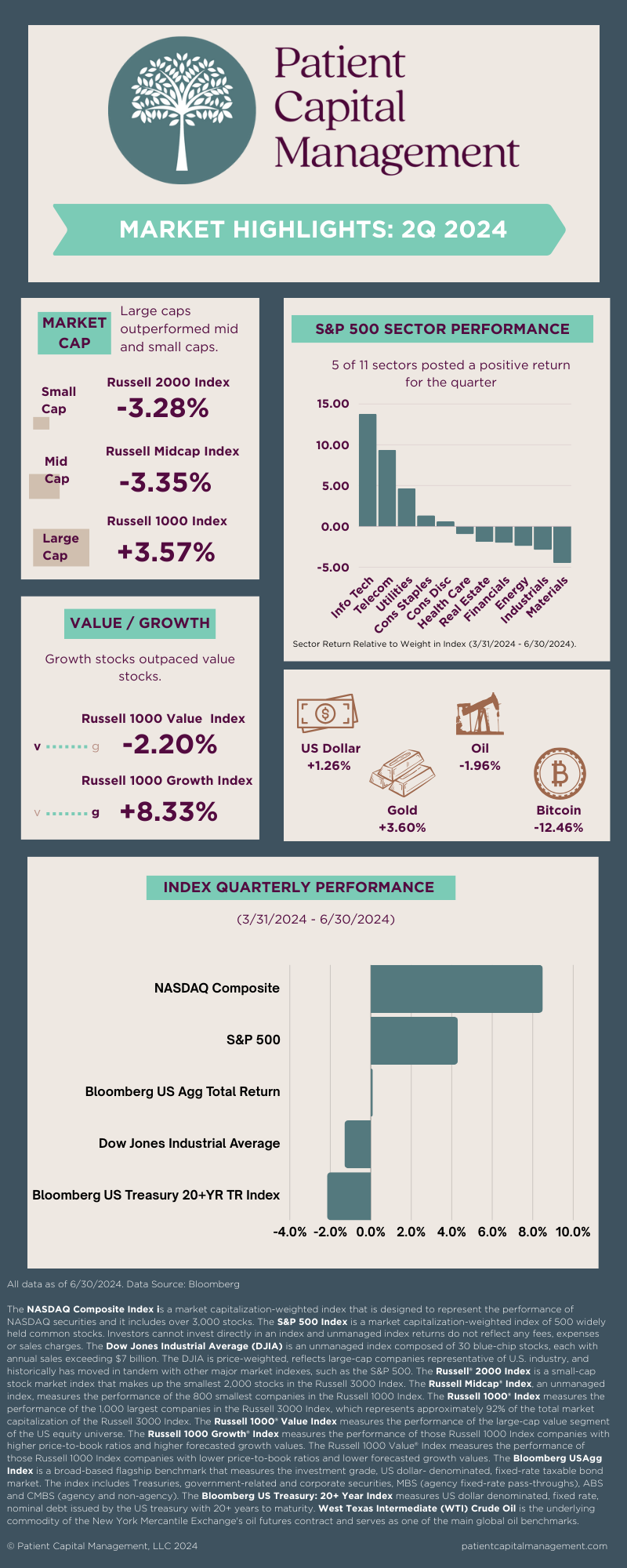
| Asset Class / Index | 2024 Q2 Return |
|---|---|
| Nasdaq Composite Index | +8.5% |
| S&P 500 | +4.3% |
| Dow Jones Industrial Average | -1.3% |
| Russell 1000 (Large-Cap) | +3.6% |
| Russell 2000 (Small-Cap) | -3.3% |
| Russell 1000 Growth | +8.3% |
| Russell 1000 Value | -2.2% |
| Bloomberg Aggregate (U.S. Corporate Bonds) | +0.1% |
| 20+ Year U.S. Treasury Bonds | -2.2% |
| U.S. Dollar Index | +1.3% |
| Gold | +3.6% |
| WTI Crude Oil | -2.0% |
| Bitcoin | -12.5% |
Companies/Assets Involved
- Microsoft Corp. (MSFT), Nvidia Corp. (NVDA), Apple Inc. (AAPL): Each has a market cap exceeding $3 trillion, serving as the core drivers of extreme market concentration. The report implies a bullish stance (as representatives of large-cap growth stocks).
- Russell 2000 (Small-Cap Stocks): Fell 3.3% in the quarter, continuing to face pressure; the report implies a bearish view.
- 20+ Year U.S. Treasury Bonds: Declined 2.2%, underperforming corporate bonds; the report implies a bearish view on long-duration Treasuries.
Investment Implications
- Directional Judgment: In the near term, continue to overweight large-cap growth stocks (especially the Information Technology and Telecommunications sectors) while avoiding small-cap stocks, value stocks, and cyclical sectors such as Materials and Industrials.
- Interest Rate-Sensitive Assets: If the Fed delivers a rate cut in September, long-duration Treasuries may face pressure (current pricing has partially reflected this), while corporate bonds appear relatively more favorable.
- Macro Hedging: Gold (+3.6%) and the U.S. Dollar (+1.3%) have performed steadily amid interest rate volatility and can be considered as portfolio anchors; Bitcoin (-12.5%) is highly volatile and unsuitable as a core allocation.