4Q23 Portfolio Activity and Attribution
Patient Capital Management is a Baltimore asset manager founded in 2020 by Samantha McLemore, CFA — Bill Miller's long-time co-manager (working together since 2002, running the flagship Opportunity Equity strategy since 2014). Continuing the Miller-school contrarian tradition, it practices "time arbitrage": exploiting behavioral mispricing to concentrate in controversial growth names (tech, healthcare, Bitcoin-related) at deep discounts to intrinsic value. Its site preserves Bill Miller's complete 1995-2022 market letters, alongside ongoing quarterly letters and webinars.
In plain words
This report shows how a fund manager shifted his portfolio in late 2023. He believes markets overreacted to bad news for some stocks. Banks, for example, are required to set aside money for future loan losses (a rule called CECL), but since unemployment is low, those reserves could eventually boost profits. Shoe brand Crocs (P/E ratio of 8.5 vs peers' 14) and gene-sequencing firm Illumina (its core business remains strong after spinning off a money-losing unit) were sold off too much. Key takeaway for everyday investors: don't panic-sell; look for companies whose underlying business is still solid but whose stocks are cheap due to temporary fears.
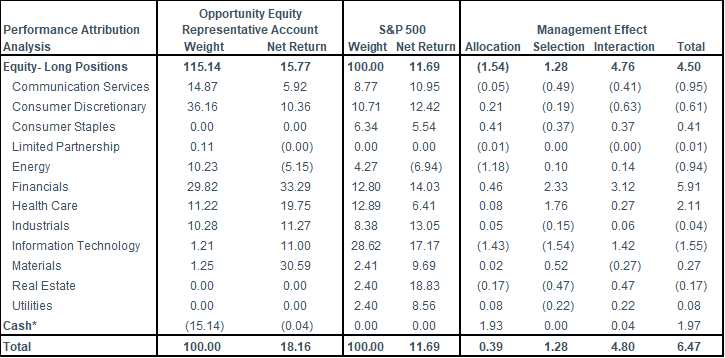
Patient Capital's Patient Opportunity Equity Strategy delivered a net return of 17.6% in the fourth quarter of 2023, outperforming the benchmark S&P 500 Index (11.7%). Excess returns were driven by the interaction, stock selection, and allocation effects in the three-factor attribution model. The la
Theme and Background
This chapter reviews the performance and portfolio adjustments of the Patient Opportunity Equity Strategy in the fourth quarter of 2023. The market environment shifted from concerns over a "hard landing" in the third quarter to expectations of a "soft landing" in the fourth quarter, as the Federal Reserve held interest rates steady and signaled three rate cuts in 2024, driving a significant market rebound.
Core Views
The author argues that the market has priced in a "recession" scenario for certain assets, but fundamentals have not deteriorated, creating contrarian investment opportunities. Specifically:
- Financial Sector: The CECL accounting standard forces banks to set aside reserves based on full-cycle losses. Current unemployment rates are far below the levels implied by these reserves. If unemployment remains low, reserve releases could become a fundamental tailwind.
- Consumer and Technology: Some consumer brands (e.g., Crocs) and healthcare technology companies (e.g., Illumina) have been excessively sold off due to short-term negative factors. Their valuations already reflect the most pessimistic expectations, yet core businesses remain robust.
Key Arguments and Data
- Performance Attribution: The portfolio delivered a net return of 17.6% in the fourth quarter, outperforming the S&P 500 (11.7%). Excess returns came from interaction, stock selection, and allocation effects.
- Portfolio Concentration: The top ten holdings accounted for 52.1% of assets (index: 30.9%), with an active share of approximately 102.6%.
- Financial Sector Logic: CECL requires banks to set aside loss provisions based on assumed unemployment rates (higher than current actual levels). If unemployment stays low, reserve reversals will boost profits.
- Individual Stock Cases:
- Crocs (CROX): Since 2017, sales CAGR of 20%, operating margin of 27%. The HEYDUDE brand drag caused a stock price decline. Current P/E is only 8.5x (peers: 14.3x, historical average: 15x), with an FCF yield of 13%.
- Royalty Pharma (RPRX): Stock price fell to $26.21 (below IPO price of $28), but revenue and EBITDA have grown significantly. Variable-rate debt accounts for only 21%, with an average debt cost of 5%. The 2023 transaction IRR is in the low double digits.
- Illumina (ILMN): Stock price dropped from $524 to $92. Core business (excluding Grail) has an operating margin of 22% (only 8% including Grail). Grail consumes over $600 million in cash annually. Post-divestiture, the company will become a pure-play genomic sequencing leader with an approximately 80% market share.
Comparison Data Table:
| Metric | Crocs (CROX) | Peer Average | Historical Average |
|---|---|---|---|
| P/E | 8.5x | 14.3x | 15x |
| FCF Yield | 13% | — | — |
| Metric | Illumina Core Business | Illumina Including Grail |
|---|---|---|
| Operating Margin | 22% | 8% |
| Annual Cash Burn | — | >$600 million |
Companies/Assets Involved
- Citigroup Inc. (C): Bullish. CEO Jane Fraser is driving a restructuring, targeting a tangible common equity return of 11-12% by 2025-2026, cutting unprofitable divisions and middle management.
- UBS Group AG (UBS): Bullish. Acquired Credit Suisse at an 80% discount. The market is focused on short-term integration risks, but long-term return potential is undervalued.
- OneMain Holdings Inc. (OMF): Bullish. Nearly a century of credit cycle management experience, dividend yield of 8%, prudent risk control.
- Coinbase Global Inc. (COIN): Bullish. Anticipation of Bitcoin ETF approval is driving industry attention, and the company benefits from building a crypto platform.
- Karuna Therapeutics Inc. (KRTX): Position closed for profit. Acquired by Bristol-Myers Squibb at $330/share (53% premium).
- Crocs Inc. (CROX): Newly added, bullish. Core brand has consumer staple attributes. HEYDUDE issues are priced in, with low valuation and high FCF.
- Royalty Pharma plc (RPRX): Newly added, bullish. Rate concerns are overblown. Debt structure is robust, transaction IRR remains attractive, P/E is only 8x.
- Illumina Inc. (ILMN): Newly added, bullish. Post-Grail divestiture, margins and cash flow will improve significantly. Current valuation reflects pessimistic expectations.
- Underperformers: Mattel (MAT), Canada Goose (GOOS), Kosmos Energy (KOS), Alibaba (BABA), S4 Capital (SFOR LN) (not analyzed in detail).
Investment Implications
- Overweight Financial Sector: The bank reserve release logic is a medium-term catalyst. Focus on Citigroup and UBS—the former has clear restructuring progress, while the latter's acquisition discount is not yet fully priced in.
- Contrarian Positioning in Consumer and Healthcare: Crocs and Illumina are undervalued due to short-term negatives. Core business moats remain intact, and current valuations provide a margin of safety.
- Focus on Rate-Sensitive Assets: Rate concerns for Royalty Pharma are overdone. Its fixed-rate debt structure (most maturing after 2030) and stable transaction IRR make it attractive.
- Reduce or Avoid: The portfolio has zero allocation to real estate, utilities, and consumer staples, reflecting caution toward rate-sensitive and high-valuation sectors.
Theme and Background
This section primarily discusses Patient Capital's specific portfolio adjustments, new purchases, and detailed analysis of the top five contributors and detractors in the fourth quarter of 2023. In terms of market environment, the energy sector presents structural opportunities due to supply constraints and demand shifts, while the technology and consumer sectors show divergence driven by M&A, industry cycles, and macroeconomic pressures.
Core Views
The author's core investment thesis is: Against the backdrop of constrained supply and recovering demand in the deepwater drilling market, Seadrill Limited (SDRL) possesses strong free cash flow generation capacity and shareholder return potential, making it a high-conviction allocation in the energy sector. Meanwhile, the author believes the market overprices short-term risks for certain detractors (e.g., Kosmos Energy), overlooking their long-term asset value and cash flow potential.
Counterintuitive judgments:
- Although Mattel (MAT) declined due to concerns over toy industry demand, the author argues that the success of the Barbie movie marks the starting point of the company's transition to an IP-driven model, with future margins expected to expand through cost cuts and fixed-cost leverage.
- Canada Goose (GOOS) has seen its valuation fall to levels comparable to non-luxury peers. The author believes the market's skepticism about its brand reputation is excessive, and the company is optimizing its structure through layoffs and buybacks.
Key Arguments and Data
1. Investment rationale for Seadrill (SDRL):
- Nearly half of the global deepwater drilling fleet has been scrapped over the past decade, leading to supply constraints.
- Industry consolidation has made the market more rational, while onshore oil production faces pressure, renewing focus on offshore production.
- The company emerged from bankruptcy in February 2022 with a net cash position, limited capital expenditure needs, and strong free cash flow yields.
- It has committed to allocating 50% of free cash flow to dividends and buybacks, having repurchased 8% of outstanding shares since September 2023.
- As old contracts expire and new contracts are signed at higher day rates, operating profit and free cash flow are expected to expand significantly.
2. Top five contributors' performance:
| Company | Ticker | Quarterly Net Contribution (bps) | Quarterly Gain |
|---|---|---|---|
| Expedia Group | EXPE | 325 | 47.3% |
| Coinbase Global | COIN | 255 | 131.7% |
| Karuna Therapeutics | KRTX | 169 | 87.2% |
| OneMain Holdings | OMF | 146 | - |
| Citigroup | C | 143 | - |
3. Top five detractors' performance:
| Company | Ticker | Quarterly Net Contribution (bps) | Key Reason |
|---|---|---|---|
| Mattel | MAT | -85 | Concerns over toy industry demand |
| Canada Goose | GOOS | -72 | Lowered annual guidance, luxury spending under pressure |
| Kosmos Energy | KOS | -59 | Decline in energy prices, upward revision of capex expectations, Tortue project delays |
| Alibaba | BABA | -43 | - |
| S4 Capital | SFOR LN | -35 | - |
4. Key data comparisons:
- Expedia: Repurchased 11% of outstanding shares over the past year; if valuation converges with Booking Holdings (BKNG), implied upside exceeds 50%.
- Coinbase: Bitcoin rose 57% over the same period, while Coinbase gained 131.7%; positive EBITDA in three quarters of 2023, with full-year expectations of "meaningfully positive adjusted EBITDA."
- Kosmos Energy: Production expected to grow 30% year-over-year in 2024, with capex declining 20% year-over-year; at $90 Brent oil, free cash flow over the next five years would exceed current market cap; reserve life exceeds 20 years (nearly double the industry average).
- Canada Goose: Cut 10% of non-store employees while continuing share buybacks.
Companies/Assets Involved
- Seadrill Limited (SDRL): New purchase, deepwater drilling specialist, net cash position, benefiting from supply constraints and demand recovery, bullish.
- Expedia Group (EXPE): Largest contributor, technology transformation complete, valuation discount to BKNG, ongoing buybacks, bullish.
- Coinbase Global (COIN): Second-largest contributor, driven by Bitcoin ETF expectations, industry survivor, bullish.
- Karuna Therapeutics (KRTX): Acquired by Bristol-Myers Squibb at $330/share (53% premium), position exited.
- Mattel (MAT): Detractor, success of Barbie movie (global box office $1.38 billion) marks starting point of IP transformation, bullish.
- Canada Goose (GOOS): Detractor, weak luxury spending, but valuation has fallen to non-luxury levels, bullish.
- Kosmos Energy (KOS): Detractor, short-term production delay risks, but long-term asset value undervalued, bullish, potential acquisition target.
- Ovintiv (OVV): Exited to concentrate energy exposure.
- DXC Technologies (DXC): Exited as a source of funds.
- Splunk (SPLK): Exited due to acquisition.
Investment Insights
- Structural opportunities in the energy sector: The deepwater drilling market has entered a rational cycle due to supply scrapping and industry consolidation. Seadrill (SDRL), with its net cash position, high FCF yield, and commitment to 50% shareholder returns, is worth attention. Kosmos Energy (KOS)'s long-term LNG assets and cash flow potential are undervalued by the market, with the current share price offering a margin of safety.
- Divergence in consumer and technology sectors: Expedia (EXPE)'s technology transformation and buybacks provide significant valuation recovery potential; Coinbase (COIN) dominates amid crypto industry consolidation, but profit-taking after Bitcoin ETF approval warrants caution. Short-term pressures on Mattel (MAT) and Canada Goose (GOOS) may create long-term buying opportunities, but industry demand and company execution need monitoring.
- Merger arbitrage opportunities: The Karuna (KRTX) case shows that when M&A premiums are reasonable and the market has not fully priced them in, certain returns can be captured. Similar logic can apply to other potential acquisition targets (e.g., Kosmos).
Theme and Background
This chapter primarily explains the concept of the "Interaction Effect" in the attribution analysis of excess returns for the Patient Capital portfolio, and clarifies the counterintuitive phenomena that may arise when third-party attribution software calculates industry allocation effects. Additionally, the chapter concludes with definitions of terms used in the report, performance calculation methods, and disclaimers.
Core Viewpoint
The author argues that the interaction effect is the most complex and sometimes counterintuitive part of attribution analysis. It measures the excess returns generated by a fund manager's combination of industry allocation decisions and stock selection decisions, essentially serving as an indicator for evaluating the "accuracy of the manager's convictions." The author specifically notes that the calculation methods of third-party attribution software may cause short-term allocation effects (e.g., from recent months) to overwhelm long-term effects, leading to the counterintuitive result of "overweighting an outperforming industry, yet the industry allocation effect being negative."
Key Arguments and Data
- Definition of Interaction Effect: Attributed to the combination of "industry allocation decisions" and "stock selection decisions," used to measure the accuracy of a fund manager's convictions.
- Software Methodology Issues: Third-party attribution software may calculate counterintuitive industry effects. For example, even if the portfolio has a weighted average overweight position in an outperforming industry over the period, the software may still show a negative industry allocation effect. This is because, in the software's calculation method, allocation effects from recent months can overwhelm those from earlier periods, especially over longer time frames.
- Performance Data Explanation: Returns in the report are net returns after deducting fees and include cash. The total portfolio return reflects the sum of returns generated by price changes, dividends, or other income sources from holdings in a representative account.
- Benchmark Explanation: The S&P 500 Index is a market-capitalization-weighted index. Investors cannot directly invest in the index, and index returns do not reflect any fees, expenses, or sales charges.
- Accounting Standards: The CECL (Current Expected Credit Loss) accounting standard, effective after December 15, 2019, requires banks to set aside reserves based on expected losses.
- Term Definitions:
- Price-to-Earnings Ratio (P/E Ratio): The weighted average price-to-earnings ratio of the portfolio's holdings.
- EBITDA: Earnings before interest, taxes, depreciation, and amortization.
- Free Cash Flow (FCF): Cash remaining after operating and maintaining capital assets.
- Free Cash Flow Yield: The ratio of free cash flow per share to market value per share.
- Compound Annual Growth Rate (CAGR): The average annual growth rate over a specific period.
Companies/Assets Involved
This chapter does not involve specific companies or assets; it primarily discusses the methodology of attribution analysis and general terms used in the report.
Investment Implications
- Understand the Limitations of Attribution Analysis: Investors should not mechanically rely on the industry allocation effect values provided by third-party attribution software, especially over longer time periods. The software's calculation methods may cause short-term effects to distort long-term judgments, so cross-validation with the fund manager's actual holdings and industry performance is necessary.
- Focus on the Signal Significance of the Interaction Effect: The interaction effect is an indicator of the fund manager's combined "timing and stock-picking" ability. If the interaction effect is consistently positive, it suggests that the manager's coordinated decisions on industry allocation and stock selection are effective; conversely, it may indicate contradictions in their decision-making logic.
- Be Alert to the Impact of Accounting Policy Changes: The CECL accounting standard requires banks to set aside reserves based on expected losses rather than actual losses, which may cause banks to reflect risks in advance before unemployment rises. If actual unemployment is lower than expected, banks will release reserves, thereby benefiting fundamentals. This mechanism is key to understanding the investment logic of the financial sector.