3Q23 Portfolio Activity and Attribution
Patient Capital Management is a Baltimore asset manager founded in 2020 by Samantha McLemore, CFA — Bill Miller's long-time co-manager (working together since 2002, running the flagship Opportunity Equity strategy since 2014). Continuing the Miller-school contrarian tradition, it practices "time arbitrage": exploiting behavioral mispricing to concentrate in controversial growth names (tech, healthcare, Bitcoin-related) at deep discounts to intrinsic value. Its site preserves Bill Miller's complete 1995-2022 market letters, alongside ongoing quarterly letters and webinars.
In plain words
This report shows how a professional investor moved money in late 2023: they bought energy, airlines (like Delta), and CVS when prices dropped due to fear, while selling a troubled company (Farfetch). For regular investors, it means don't panic-sell during market dips—instead, look for solid businesses with strong cash flow that are temporarily cheap. Worth reading because it explains how to spot bargains and avoid traps, using real examples.
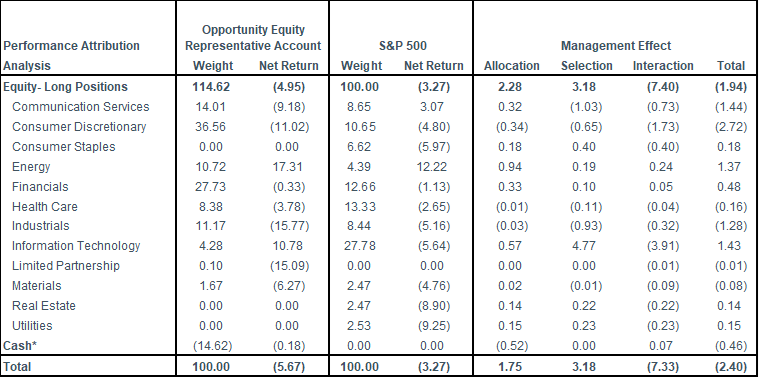
Patient Capital's Opportunity Equity strategy posted a net return of -6.0% in the third quarter of 2023, underperforming the S&P 500 Index's -3.3%. Three-factor attribution analysis indicates that interaction effects were the primary drag on performance, partially offset by allocation effects and st
Theme and Background
This chapter focuses on the performance attribution and portfolio adjustments of Patient Capital's Opportunity Equity strategy in the third quarter of 2023. The market environment was shaped by declining inflation and low unemployment, fueling concerns over Federal Reserve policy missteps and a "higher for longer" interest rate environment. The consumer discretionary sector was hit hardest by expectations of consumer weakness, while the energy sector outperformed due to OPEC production cuts and demand growth.
Core Thesis
The author argues that market volatility creates opportunities for long-term investors to "monetize volatility," generating excess returns by trimming winners at highs and adding to losers at lows. The core judgment is that long-term investment opportunities in the energy sector remain attractive, while travel-related stocks (such as airlines) are significantly undervalued at current valuations.
Key Arguments and Data
- Energy Sector: Underperformed in the first half of the year, but the strategy added positions counter-cyclically, benefiting from the rebound in the third quarter. The author believes investment in supply remains subdued, companies maintain strict capital discipline, free cash flow is robust, and geopolitical factors present upside risks.
- Travel Sector: Performed strongly in the first half but declined sharply in the third quarter due to market fears of a hard landing. The author argues the industry can withstand weakness, and current valuations are at historical lows.
- Individual Stock Cases:
- Delta Air Lines (DAL): Valuation is at a cyclical trough, yet return on invested capital (ROIC) is in the mid-teens, free cash flow is strong, and earnings per share growth is expected to be high single-digit to low double-digit. The author believes it is significantly mispriced.
- Expedia Group (EXPE): The market underestimates the transformation results from brand consolidation (three major brands), a unified technology stack, and the loyalty program (OneKey). The company continues to repurchase shares.
- Splunk (SPLK): Acquired by Cisco at $157 per share (a 31% premium), validating the author's acquisition thesis.
- Mattel (MAT): The Barbie movie grossed over $1.4 billion globally, driving an IP-driven transformation.
- Farfetch (FTCH): Liquidated due to increased debt and poor execution.
- New Position CVS Health (CVS): The stock has fallen nearly 40% from its highs, with valuation at a cyclical trough, a P/E ratio of 8.2x (vs. peers at 12.2x), and a dividend yield of 3.5%. The author believes its high-quality assets, including Aetna and Caremark, combined with short-term headwinds (such as the fading of COVID-related benefits and negative news), present a buying opportunity.
Companies/Assets Involved
| Company/Asset | Role | Key Data | Bullish/Bearish |
|---|---|---|---|
| Splunk Inc. (SPLK) | Largest Positive Contributor | Acquired by Cisco at $157/share (31% premium) | Bullish (acquisition thesis realized) |
| Ovintiv Inc. (OVV) | Largest Positive Contributor | No specific data provided | Bullish (energy sector) |
| UBS Group (UBS) | Largest Positive Contributor | No specific data provided | Bullish |
| Energy Transfer LP (ET) | Largest Positive Contributor | No specific data provided | Bullish (energy sector) |
| Mattel Inc. (MAT) | Largest Positive Contributor | Barbie movie global box office >$1.4B | Bullish (IP transformation) |
| Farfetch Ltd (FTCH) | Largest Negative Contributor | Increased debt, poor execution | Bearish (liquidated) |
| S4 Capital plc (SFOR LN) | Largest Negative Contributor | No specific data provided | Bearish |
| Delta Air Lines Inc. (DAL) | Largest Negative Contributor | ROIC mid-teens, EPS growth high single-digit to low double-digit | Bullish (significantly undervalued) |
| United Airlines Holdings Inc. (UAL) | Largest Negative Contributor | No specific data provided | Bullish (travel sector) |
| Norwegian Cruise Line Holdings Ltd. (NCLH) | Largest Negative Contributor | No specific data provided | Bullish (travel sector) |
| CVS Health Corp. (CVS) | New Position | P/E 8.2x (peers 12.2x), dividend yield 3.5% | Bullish (value undervalued) |
Investment Implications
- Energy Sector: Despite short-term volatility, supply constraints, capital discipline, and free cash flow generation make the sector attractive for long-term investment, with geopolitical risks potentially driving prices higher.
- Travel Sector: Current valuations already reflect hard landing expectations, but industry fundamentals (such as airlines' cost pass-through ability and Expedia's transformation) are undervalued, potentially offering contrarian buying opportunities.
- CVS Health: Short-term headwinds (e.g., fading COVID-related business, PBM contract losses) have led to an oversold stock, but its integrated healthcare strategy (Aetna, Caremark, primary care) and low valuation (8.2x P/E) provide a margin of safety, making it suitable as a defensive allocation.
Theme and Background
This chapter details Patient Capital’s specific portfolio adjustments in the third quarter of 2023, including new positions, re-entries, and exits, and analyzes the drivers of the top five positive and negative contributors for the quarter. The market backdrop is characterized by concerns over the consumer discretionary sector driven by a “higher for longer” interest rate environment, while the energy sector showed relative strength.
Core Thesis
The author’s core investment argument is to exploit “time arbitrage” opportunities from short-term market risks by buying undervalued assets while decisively exiting companies with deteriorating fundamentals. Contrarian judgments include favoring Kosmos Energy (KOS) in the energy sector for its growth potential and LNG assets, rather than the market’s prevailing focus on short-term production risks; viewing 2U Inc. (TWOU) convertible bonds as attractive for high yields despite high leverage and debt risks; and continuing to hold S4 Capital (SFOR LN), believing its long-term market share expansion opportunities are overshadowed by short-term macro pressures.
Key Arguments and Data
- Kosmos Energy (KOS): 2024 production is expected to grow 30% year-over-year, with capital expenditure declining 30% year-over-year, and free cash flow yield exceeding 25%. Based on Brent crude at $90/barrel, free cash flow over the next five years is projected to surpass the current market capitalization. Reserve life exceeds 20 years, nearly double the industry average.
- 2U Inc. (TWOU): The company has a leverage ratio of 5x, with approximately $760 million in debt maturing in 2025/2026. The convertible bond yield to maturity is nearly 38%, and the author believes the bonds could convert to equity under adverse scenarios.
- DXC Technology (DXC): Expected to generate $800 million in free cash flow, with a free cash flow yield of 18%, and has committed to a $1 billion share buyback program in fiscal 2024 (representing 22% of outstanding shares).
- S4 Capital (SFOR LN): Reduced headcount by 5% in the first half of 2023, with a long-term EBITDA target of 20%. The total addressable market (TAM) is $110 billion, and the company holds only a 0.8% share.
- UBS Group (UBS): Following the acquisition of Credit Suisse, wealth management operations are expected to account for 68% of invested assets, making it the global leader. The author estimates earnings per share of $4-6 within 3-5 years, corresponding to a P/E ratio of 4-6x, with a dividend yield of 2.2%.
Comparative Data Table:
| Company | Key Metric | Value | Notes |
|---|---|---|---|
| Kosmos Energy | 2024 Production Growth | +30% YoY | Capital expenditure down 30% |
| Kosmos Energy | Free Cash Flow Yield | >25% | Based on Brent crude at $90/barrel |
| 2U Inc. | Convertible Bond Yield to Maturity | ~38% | Matures in May 2025 |
| DXC Technology | Free Cash Flow | $800 million | Free cash flow yield 18% |
| DXC Technology | Buyback Program | $1 billion | Represents 22% of outstanding shares |
| UBS Group | Estimated EPS | $4-6 | Within 3-5 years, corresponding to 4-6x P/E |
| S4 Capital | Market Share | 0.8% | TAM of $110 billion |
Companies/Assets Involved
- Kosmos Energy (KOS): New position. Bullish, based on growth, LNG assets, and a free cash flow inflection point. The author views it as a potential acquisition target.
- 2U Inc. (TWOU): New small position in convertible bonds. Bullish, believing the high yield compensates for risk and that the company can achieve refinancing before debt maturity.
- DXC Technology (DXC): Re-entry. Bullish, based on strong free cash flow and shareholder returns (buybacks).
- Taylor Morrison Home Corporation (TMHC): Exited. Reached intrinsic value; seeking better alternatives.
- Stitch Fix Inc. (SFIX): Exited. Used as a funding source for tax-loss harvesting.
- Farfetch Ltd (FTCH): Exited. Persistent cash flow disappointments, expanding debt balance, and the first instance of severe balance sheet risk.
- Splunk Inc. (SPLK): Largest positive contributor (+110 bps). Acquired by Cisco at $157/share (31% premium), closing in September 2024.
- Ovintiv Inc. (OVV): Positive contributor (+67 bps). Benefited from rising oil prices and production growth, with 50% of free cash flow allocated to shareholder returns.
- UBS Group (UBS): Positive contributor (+62 bps). Wealth management business expansion following the Credit Suisse acquisition, with cheap valuation.
- S4 Capital (SFOR LN): Largest negative contributor (-127 bps). Management lowered guidance, but the author believes the risk-reward ratio is highly attractive.
- Delta Air Lines Inc. (DAL): Negative contributor (-113 bps). Not analyzed in detail, but falls under the consumer discretionary sector.
- United Airlines Holdings Inc. (UAL): Negative contributor (-86 bps). Same as above.
- Norwegian Cruise Line Holdings (NCLH): Negative contributor (-77 bps). Same as above.
Investment Insights
- Energy Sector: Focus on exploration and production companies with growth potential and LNG assets, such as Kosmos Energy, where a free cash flow inflection point could yield significant returns. Market overreaction to short-term production risks presents buying opportunities.
- High-Yield Bonds: When credit risk is manageable, high yields to maturity (e.g., 2U’s 38%) can offer attractive risk-adjusted returns, but caution is needed regarding leverage and debt maturity timelines.
- Value Tech Stocks: Companies like DXC Technology, despite facing growth challenges, offer downside protection through strong free cash flow and aggressive buyback programs, making them suitable for value investors.
- Caution with High-Leverage Companies: The Farfetch case illustrates that when cash flow persistently deteriorates and debt swells, decisive exits are necessary to avoid principal loss.
- Long-Term Perspective: Companies like S4 Capital, though pressured by short-term macro headwinds, have significant market share expansion potential. Patient holding or buying on dips may yield excess returns.
Theme and Background
This chapter focuses on the two most extreme positions in Patient Capital's third-quarter 2023 holdings: Delta Air Lines (one of the largest positive contributors) and Farfetch (the largest negative contributor). The report uses these cases to elaborate on its assessment of structural improvements in the airline industry and reflections on the loss of risk control in high-debt growth stocks.
Core Views
- Bullish on Delta Air Lines: The author believes the market has significantly misunderstood Delta, still viewing it as a cyclical, bankruptcy-prone airline, whereas Delta has actually transformed into a resilient global high-end consumer brand. Its pricing power, business model, and return on capital all outperform historical levels.
- Bearish on / Exiting Farfetch: The author acknowledges that the previous long-term investment thesis has failed. The company severely lacks financial discipline, with surging debt and persistently negative cash flow, leading to a fundamental deterioration in its risk profile. Despite progress in strategic partnerships, operational and financial performance has been disappointing. The author has already utilized losses for tax-loss harvesting and continues to evaluate whether to fully exit.
Key Arguments and Data
Delta Air Lines (DAL)
- The stock fell 24% from its July high in the third quarter, dragged down by rising unit costs (CASM) due to higher commodity prices.
- Historically, airlines have been able to pass on higher fuel costs to customers with a lag.
- Key evidence of transformation:
- Loyalty program with American Express: $6.5 billion in compensation revenue in 2023, targeting $10 billion by the end of the contract in 2028.
- Over the next one to two years, premium and ancillary service revenue is expected to account for 65-70% of total revenue.
- The company should consistently generate mid-teens returns on capital (around 15%).
- Cumulative free cash flow is projected at approximately $11 billion from 2023 to 2025, equivalent to half of the current market capitalization.
- The company will increase dividends while repaying debt and eventually resume share buybacks.
Farfetch (FTCH)
- The stock was the largest drag on the portfolio in the third quarter, with results significantly below expectations and a heavier debt burden.
- Drew down $600 million in term loan debt over the past year.
- True free cash flow (operating cash flow minus capital expenditures) has been persistently delayed.
- Annual interest expense reaches $100 million.
- Expected cash balance at year-end is only $753 million, with ongoing cash burn, compounded by recession risks, and $1 billion in debt maturing in 2027.
- New CFO Tim Stone took office in September, but the author believes this is insufficient to turn the situation around.
Comparison Data
| Metric | Delta Air Lines (DAL) | Farfetch (FTCH) |
|---|---|---|
| Q3 Stock Performance | Down 24% from highs | Largest negative contributor to the portfolio |
| Core Risk | Rising fuel costs (pass-through possible) | Surging debt, cash burn, interest burden |
| Cash Flow Outlook | Cumulative FCF of ~$11 billion (half of market cap) from 2023-25 | Free cash flow persistently negative |
| Debt Situation | Repaying debt | Added $600 million in loans over the past year, $1 billion maturing in 2027 |
| Business Model Resilience | Premium brand + loyalty program + ancillary revenue | Strategic partnerships progressing, but lacking operational and financial discipline |
| Author's Judgment | Market misunderstanding, bullish | Long-term thesis invalidated, considering exit |
Companies/Assets Involved
- Delta Air Lines (DAL): Core holding, bullish. The author believes the market underestimates its structural improvements, including pricing power, loyalty program revenue, rising premium service share, stable return on capital, and expanding free cash flow.
- Farfetch (FTCH): Largest negative contributor, bearish/reducing position. The author admits the investment thesis has failed, with debt and interest burdens spiraling out of control, persistently negative cash flow, and questionable long-term target achievement. Losses have been used for tax-loss harvesting.
- American Express: Indirectly mentioned as a partner in Delta's loyalty program. Paid $6.5 billion in compensation in 2023, targeting $10 billion by 2028.
Investment Implications
- Re-pricing opportunity in the airline industry: The author believes the market's cyclical bias toward airline stocks may be excessive. Companies like Delta, which have transformed into premium consumer brands with stable loyalty revenue and strong free cash flow generation, have room for valuation recovery. Investors should focus on airlines' revenue structure (premium/ancillary revenue share) and the extent to which free cash flow covers market capitalization.
- Beware of the "death spiral" in high-debt growth stocks: The Farfetch case shows that even with smooth strategic partnerships and customer expansion, if financial discipline is lacking, debt surges, and free cash flow remains persistently negative, a company's risk profile can deteriorate sharply. Investors should closely monitor: whether free cash flow is positive, debt maturity structure, interest coverage ratio, and whether management has financial discipline. When the risk profile fundamentally changes, decisive stop-loss action should be taken rather than waiting for the thesis to be validated.