1Q23 Portfolio Activity and Attribution
Patient Capital Management is a Baltimore asset manager founded in 2020 by Samantha McLemore, CFA — Bill Miller's long-time co-manager (working together since 2002, running the flagship Opportunity Equity strategy since 2014). Continuing the Miller-school contrarian tradition, it practices "time arbitrage": exploiting behavioral mispricing to concentrate in controversial growth names (tech, healthcare, Bitcoin-related) at deep discounts to intrinsic value. Its site preserves Bill Miller's complete 1995-2022 market letters, alongside ongoing quarterly letters and webinars.
In plain words
This report breaks down how Patient Capital's Opportunity Equity fund beat the S&P 500 in early 2023 by betting on consumer, finance, and industrial stocks, plus smart picks like Meta and Coinbase. For everyday investors, the key takeaway is their contrarian move: buying UBS when bank stocks tanked (expecting it to double), and betting on Meta's cost-cutting and Peloton's loyal subscribers. They also explain why energy stocks like Ovintiv and Chesapeake are down now but could rebound long-term. The lesson? Active management, contrarian bets, and focusing on fundamentals can pay off.
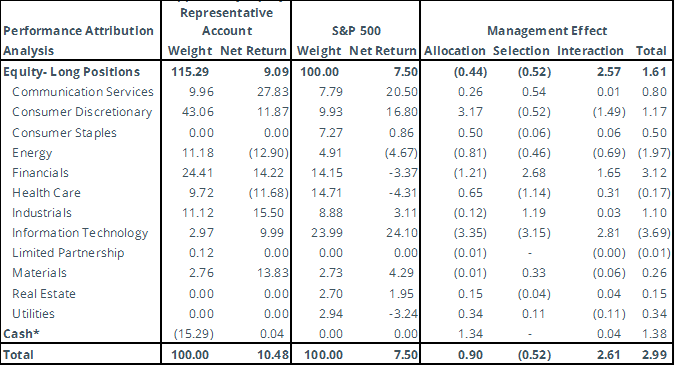
Patient Capital's Opportunity Equity strategy achieved a net fee total return of 9.84% in the first quarter of 2023, outperforming the S&P 500 Index's 7.50%. According to a three-factor attribution model analysis, allocation effects and interaction effects contributed to the excess returns, while st
Theme and Background
This chapter provides a detailed analysis of the portfolio activity and performance attribution for the Opportunity Equity strategy under Patient Capital in the first quarter of 2023. The report focuses on how the strategy achieved excess returns through sector allocation and stock selection, and introduces new purchases and liquidations during the quarter.
Core Thesis
The author’s core investment thesis is that through active sector allocation (overweighting consumer discretionary, financials, industrials, etc.) and precise stock selection (e.g., Meta Platforms, Coinbase Global), the strategy successfully outperformed the benchmark index in Q1 2023. The report emphasizes that although the stock selection effect was a slight drag, the allocation effect and interaction effect together contributed to excess returns. A counterintuitive judgment is that during the sell-off in the banking sector, the author viewed it as an opportunity to buy UBS Group on the dip, expecting its stock price to potentially double.
Key Arguments and Data
- Performance: The Opportunity Equity strategy achieved a net fee total return of 9.84% in Q1 2023, outperforming the S&P 500 Index’s 7.50%.
- Attribution Analysis: Using a three-factor attribution model, the allocation effect and interaction effect contributed to excess returns, while the stock selection effect was a slight drag.
- Sector Allocation: The fund overweighted consumer discretionary, financials, industrials, communication services, materials, and energy; underweighted real estate, utilities, consumer staples, information technology, and healthcare.
- Portfolio Concentration: At quarter-end, the fund held 40 positions, with a top 10 concentration of 47.8% (index: 27.4%) and an active share of approximately 108.2%.
- New Purchase of UBS Group: Leveraging the banking sell-off in early March, the fund established a position at an 80% discount to February valuations. UBS achieved a 17.5% RoCET1 (return on common equity tier 1 capital) in 2021, at the upper end of its long-term target range of 15-18%. After acquiring Credit Suisse, wealth management will account for 68% of invested assets, making it the second-largest global wealth manager after Morgan Stanley. The author expects earnings per share (EPS) to exceed $4, corresponding to a valuation below 5x P/E.
- Re-purchase of Peloton Interactive: The company is optimizing its cost structure, innovating sales models (e.g., selling through Amazon, Dick’s Sporting Goods), and focusing on achieving profitability. Monthly customer churn is just over 1%, comparable to the wireless industry.
- Re-purchase of Precigen: An early-stage biopharmaceutical company whose PRGN-2012 program showed strong Phase 1 trial results in January, potentially becoming the first "off-the-shelf" AdenoVerse immunotherapy.
- Liquidations: Exited Silvergate Capital using up days before the bank announced its closure; liquidated DXC Technologies to raise capital for new investment opportunities.
Comparative Data Table:
| Metric | Opportunity Equity Strategy | S&P 500 Index |
|---|---|---|
| Q1 2023 Total Return (Net of Fees) | 9.84% | 7.50% |
| Top 10 Holdings Concentration | 47.8% | 27.4% |
| Active Share | 108.2% | - |
| Top Contributors | Net Contribution (Basis Points) |
|---|---|
| Meta Platforms (META) | 201 |
| Coinbase Global (COIN) | 177 |
| Taylor Morrison Home (TMHC) | 120 |
| Amazon.com (AMZN) | 105 |
| Alibaba Group (BABA) | 83 |
| Top Detractors | Net Contribution (Basis Points) |
|---|---|
| Ovintiv (OVV) | -148 |
| Precigen (PGEN) | -49 |
| Chesapeake Energy (CHK) | -48 |
| ADT (ADT) | -37 |
| Puretech Health (PRTC LN) | -34 |
Companies/Assets Involved
- Meta Platforms (META): Largest contributor. 2023 was designated the "Year of Efficiency," with full-year OPEX guidance reduced by $8 billion and a 25% workforce reduction. Advertiser conversion rates grew 20% year-over-year, Reels drove strong engagement, and daily active users hit an all-time high. Share repurchase authorization increased to $51 billion (approximately 10% of the then-market cap). Bullish.
- Coinbase Global (COIN): Second-largest contributor, net contribution of 177 basis points. Bullish.
- Taylor Morrison Home (TMHC): Third-largest contributor, net contribution of 120 basis points. Bullish.
- Amazon.com (AMZN): Fourth-largest contributor, net contribution of 105 basis points. Bullish.
- Alibaba Group (BABA): Fifth-largest contributor, net contribution of 83 basis points. Bullish.
- UBS Group (UBS): New purchase. Established a position at an 80% discount to February valuations during the banking sell-off. After acquiring Credit Suisse, it will become the second-largest global wealth manager. Expected EPS exceeds $4, with a valuation below 5x P/E. Bullish, with an expectation of the stock price doubling.
- Peloton Interactive (PTON): Re-purchased. Optimizing costs, expanding sales channels, with monthly customer churn just over 1%. Bullish, believing the stock price is well below its brand value.
- Precigen (PGEN): Re-purchased (small position). An early-stage biopharmaceutical company whose PRGN-2012 program showed strong Phase 1 results in the RRP indication. Bullish (but as a small, exploratory position).
- Silvergate Capital (SI): Liquidated. Exited using up days before the bank closed. Bearish.
- DXC Technologies (DXC): Liquidated. Exited to fund new ideas. Bearish.
- Ovintiv (OVV): Largest detractor, net contribution of -148 basis points. Bearish (underperformed).
- Chesapeake Energy (CHK): Detractor, net contribution of -48 basis points. Bearish (underperformed).
- ADT (ADT): Detractor, net contribution of -37 basis points. Bearish (underperformed).
- Puretech Health (PRTC LN): Detractor, net contribution of -34 basis points. Bearish (underperformed).
Investment Implications
- Contrarian Investment Opportunities: During systemic sell-offs in the banking sector, investors can focus on financial institutions with strong fundamentals and merger integration advantages (e.g., UBS), using market panic to build positions at a discount.
- Focus on the "Efficiency" Theme: For large tech companies (e.g., Meta), when management clearly shifts toward cost control and efficiency improvements, it can lead to significant earnings improvements and upside in stock prices.
- Brand and Subscription Value: For companies like Peloton with highly sticky subscription users and strong brands, even if they face short-term growth slowdowns, their long-term value may be underestimated, especially after cost structure optimization.
- Value of Active Management: A high active share (108.2%) and concentrated top 10 holdings (47.8%) indicate that the strategy generates excess returns by deviating from index allocations. Investors should focus on the fund manager’s judgment in sector rotation and stock selection.
Theme and Background
This chapter focuses on the performance of the Patient Capital Opportunity Equity strategy’s top holdings in the first quarter of 2023, with a detailed analysis of the best-performing stocks (Coinbase, Taylor Morrison) and the worst-performing stocks (Ovintiv, Chesapeake Energy, Precigen). The report also discusses the long-term supply-demand imbalance in the energy sector, the impact of the sharp decline in natural gas prices, and progress in clinical data for a biotechnology company.
Core Views
The author’s core investment thesis is as follows:
- Coinbase’s inflection point to profitability will come earlier than market expectations: The company has shifted from “cyclical breakeven” to “profitable under all market conditions,” with $5.5 billion in liquidity, enabling profitability without external financing.
- Taylor Morrison benefits from structural supply shortages: Although interest rate volatility affects the short-term market, the housing market remains structurally undersupplied relative to household formation. As consumers adapt to the new interest rate environment, home sales will normalize.
- Long-term bullish on the energy sector: Despite a 50% short-term decline in natural gas prices, the report argues that long-term supply-demand imbalances, growth in natural gas exports, China’s reopening, and increased demand from the EU will drive a price recovery. Additionally, unprecedented shareholder return discipline among energy companies will constrain supply.
- Precigen is undervalued: Its PRGN-2012 has shown strong Phase 1 data in RRP patients, potentially qualifying for accelerated approval. With a $75 million financing, the company has extended its cash runway to the end of 2024.
Key Arguments and Data
- Coinbase: Stock price rose 91% in the quarter (down 86% in 2022), with a correlation to Bitcoin exceeding 85% (Bitcoin up 72% in Q1). The company cut 20% of its workforce, prioritizing the elimination of low-probability projects. It holds $5.5 billion in liquidity, higher than other loss-making growth companies.
- Taylor Morrison: Benefited from the decline in interest rates from their October 2022 peak. Its land acquisition strategy is selective and superior to peers. Supply chain improvements have kept margins resilient, and a return to historical production cycles will drive working capital improvements.
- Ovintiv: Acquired EnCap’s Core Midland Basin assets for $4.275 billion while selling Bakken assets for $825 million. Production growth is flat in 2023, with 50% of excess cash allocated to debt repayment and 50% returned to shareholders.
- Chesapeake Energy: A 50% drop in natural gas prices weighed on the stock. The company has sold most of its oil-bearing assets, retaining only the South Eagle Ford asset. It has hedged 55-60% of 2024 production. It plans to generate $6 billion in cumulative free cash flow from 2023 to 2027, equivalent to 58% of its current market capitalization.
- Precigen: The stock rose in January on strong Phase 1 data for PRGN-2012 but subsequently declined. A $75 million equity financing extended the cash runway to the end of 2024. Multiple other pipeline data readouts are expected in 2023.
Comparative Data Table:
| Company | Quarterly Performance | Key Financial/Operational Data | Author’s Assessment |
|---|---|---|---|
| Coinbase | +91% | Down 86% in 2022; Bitcoin correlation >85%; Liquidity $5.5B; 20% workforce reduction | Profitability inflection point earlier than expected |
| Taylor Morrison | Rebound | Interest rates fell from Oct 2022 peak; Land strategy superior to peers; Supply chain improvements | Structural supply shortage; sales to normalize |
| Ovintiv | Drag | $4.275B acquisition of Midland assets; $825M sale of Bakken; Flat production | Long-term supply-demand imbalance; prices to become more favorable |
| Chesapeake Energy | Drag | Natural gas prices down 50%; 55-60% of 2024 production hedged; Planned FCF of $6B (58% of market cap) | Long-term demand growth; supply discipline persists |
| Precigen | Decline | Strong Phase 1 data for PRGN-2012; $75M financing; Cash runway to end of 2024 | Undervalued biotechnology company |
Companies/Assets Involved
- Coinbase Global (COIN): Bullish. Core logic includes profitability transformation, ample liquidity, and high correlation with Bitcoin.
- Taylor Morrison Home Corp. (TMHC): Bullish. Structural supply shortage, land strategy advantages, and supply chain improvements.
- Ovintiv Inc. (OVV): Bullish (despite short-term drag). Acquisition-driven expansion, shareholder return discipline, and long-term supply-demand imbalance.
- Chesapeake Energy Corp. (CHK): Bullish (despite short-term drag). Long-term bullish on natural gas prices, shareholder return plan, and supply discipline.
- Precigen Inc. (PGEN): Bullish. Strong clinical data, accelerated approval pathway, and sufficient cash runway.
Investment Implications
- Overweight Coinbase: The report argues that the market underestimates the speed and certainty of its profitability transformation, with $5.5 billion in liquidity providing a safety cushion.
- Overweight Taylor Morrison: The structural supply shortage in the housing market is a long-term trend, and short-term interest rate volatility does not alter the core thesis.
- Overweight the energy sector (Ovintiv, Chesapeake): The sharp decline in natural gas prices is a short-term phenomenon; long-term supply-demand imbalances and shareholder return discipline will drive a price recovery. The report emphasizes that “unprecedented shareholder returns” imply sustained supply discipline.
- Overweight Precigen: As an undervalued biotechnology company, the accelerated approval pathway for PRGN-2012 and multiple data readouts in 2023 serve as catalysts.