Valuing AI: Extreme Bubble, New Golden Era, or Both
GMO is a Boston asset manager co-founded in 1977 by Jeremy Grantham with Richard Mayo and Eyk Van Otterloo, known for valuation-driven dynamic asset allocation built on long-horizon mean reversion. Grantham is famous for calling historic bubbles, warning publicly ahead of both the 2000 dot-com crash and the 2008 financial crisis. Flagship publications include the GMO Quarterly Letter (now written by Asset Allocation co-heads Ben Inker and John Pease), Grantham's Viewpoints essays and the 7-Year Asset Class Forecast.
In plain words
GMO experts warn that AI stocks are in a bubble similar to past railroad and internet manias. They say AI is a real breakthrough, but investors are overpaying based on extreme optimism, forgetting that every major tech boom ends with a crash. This article uses historical data to show the pattern. For ordinary investors, chasing AI stocks now is risky; better to wait for the bubble to burst before buying.
A GMO research report notes that the U.S. stock market has remained in a bubble zone since its peak in December 2021 (defined as prices deviating more than two standard deviations above long-term real trends). Despite a bear market in 2022 (with the S&P 500 falling 25%, growth stocks dropping 35%, a
Theme and Background
This section, co-authored by Jeremy Grantham and Edward Chancellor, aims to argue that the current U.S. stock market—particularly AI-related assets—is in a historic bubble. The report draws parallels between the AI bubble and bubbles triggered by major technological innovations such as 19th-century railroads, 20th-century electricity, radio, and the internet. It contends that although AI is "the most remarkable innovation of the past 100 years," the market frenzy and overinvestment it has sparked will inevitably lead to a severe downturn.
Core Views
- The U.S. stock market has been in bubble territory since its peak in December 2021, defined as prices deviating from long-term real trends by more than two standard deviations. Despite the bear market in 2022 (the S&P 500 fell 25%, growth stocks dropped 35%, and the Magnificent 7 declined nearly 50%), the launch of ChatGPT in December 2022 acted like a "multistage rocket," reversing the market's decline.
- AI is a classic "innovation bubble": Historical patterns show that major technological innovations (railroads, electricity, radio, the internet) often first generate massive bubbles, followed by overinvestment and severe market downturns. AI is repeating this pattern in a "rapid and forceful" manner.
- Current large language models (LLMs) are still immature, suffering from "hallucination" issues (fabricating seemingly plausible research and citations). However, the report emphasizes that, just as past innovations ultimately surpassed the wildest dreams of early speculators after their bubbles burst, AI may undergo a similar cycle.
- The market is "extrapolating" current conditions: Investors treat record profits, rapid AI progress, and a strong economy as permanent states. History shows that when confidence wanes, a bubble burst leads to a sharp economic downturn, collapsing profits, and severe valuation contraction.
Key Arguments and Data
1. Historical bubble comparisons: GMO has studied over 300 "two-standard-deviation" bubbles and found that in large developed stock markets, such bubbles (1929, 1972, 2000) eventually reverted to their original trends. The U.S. housing market (2006) was a "three-standard-deviation" bubble, the largest in the largest U.S. asset class.
2. Classic features of the current bubble:
- After frenzied speculation (meme stocks), the most speculative stocks collapsed;
- Quality stocks significantly outperformed the market;
- The 2022 bear market was interrupted by ChatGPT, but the bubble has not fully burst.
3. Valuation data:
- December 1974 bear market bottom: P/E ratio of 7.5x;
- October 1929: P/E of 21x (a record at the time);
- 1972: P/E of 21x;
- March 2000: P/E of 35x (historical record);
- Current: Investors multiply record profits by high P/E ratios, extrapolating into the future.
4. Current state of AI technology: The "hallucination" problem in LLMs is severe, with fabricated research and citations difficult for non-experts to detect. However, the report suggests this may be the "initial stage" of AI progress.
Companies/Assets Involved
- Magnificent 7: Fell nearly 50% in the 2022 bear market but rebounded due to the AI frenzy. The report views them as a core component of the bubble and is bearish on them.
- SPAC bubble (2020-21): Used as a reference for recent tech bubbles, drawing analogies to the current AI bubble.
- GMO itself: The report is authored by GMO co-founder Jeremy Grantham and Edward Chancellor, representing their personal views.
Investment Implications
- Bearish on the U.S. stock market, especially AI-related assets: The report argues that the current bubble has not yet burst, but "most investors will suffer significant losses in the future." The trigger for the bubble's burst may be the exhaustion of investor confidence, leading to an economic downturn, collapsing profits, and valuation contraction.
- Beware of "extrapolation" risk: The market treats current record profits, AI progress, and a strong economy as permanent states, but history shows such extrapolation is dangerous. Investors should avoid chasing highs and wait for opportunities after the bubble bursts.
- Focus on historical patterns: Major technological innovations (e.g., railroads, the internet) ultimately achieved outcomes surpassing the wildest dreams of early speculators after their bubbles burst, but the process was painful. AI may be similar, but the current phase carries far more risk than opportunity.
Theme and Background
This chapter examines the extreme optimistic narratives that accompanied major historical technological breakthroughs (railways, radio, the internet) in their early stages, and how these narratives fueled asset bubbles. The author compares the current frenzy surrounding AI with these historical cases, pointing out that the intensity and polarization of the AI narrative are unprecedented.
Core Argument
The author’s central thesis is: AI is the technology accompanied by the most compelling narrative in history, but the coexistence of extreme optimism and extreme fear is precisely a hallmark of bubble formation. The counterintuitive judgment is that although AI may become a general-purpose technology akin to electricity, the current market pricing already incorporates extreme expectations of "heaven or hell," and this polarized sentiment itself is a danger signal.
Key Arguments and Data
The author supports the argument through historical comparisons and contemporary examples:
1. Exaggeration in Historical Technology Narratives:
- Railways (19th century): Newspapers at the time claimed railways would "double human lifespan (in terms of the ability to acquire and disseminate information)" and predicted that "the entire world would become one big family, speaking the same language, obeying uniform laws, and worshipping the same god."
- Radio (1904): Tesla predicted that "the entire Earth would become a giant brain, with every part able to respond." RCA became the hottest stock on Wall Street during the Jazz Age (see Figure 1: RCA stock price experienced a surge followed by a crash from 1922 to 1946).
- Internet (1990s): Negroponte claimed that "digital life" would reduce human dependence on time and place; Gilder predicted that within five years, "the poorest slum child would have access to an education surpassing today’s suburban prep schools," and asserted that "Harvard would go bankrupt."
2. Extremity of the AI Narrative:
- Optimists: Sam Altman (OpenAI CEO) stated that AI would make "solving climate issues, establishing space colonies, and discovering all of physics" routine; a report from the Dustin Moskovitz Foundation claimed AI could lead to "the economy doubling every 2-3 years"; Zuckerberg said AI would bring about a "new era for humanity."
- Pessimists: Elon Musk called AI "one of the greatest dangers to humanity"; Geoff Hinton predicted AI would "cause mass unemployment and a surge in profits, making the rich richer and the poor poorer"; Yoshua Bengio compared AI to nuclear weapons, suggesting it could "lead to human extinction."
3. Narrative Transmission Mechanism: The author cites William Bernstein’s view that narratives are "pathogens that spread the disease of bubbles in society," and that new technologies themselves often serve both as objects of speculation and as media for spreading frenzy.
Companies/Assets Involved
| Company/Person | Role | Key Data/View | Bullish/Bearish |
|---|---|---|---|
| RCA (Radio Corporation of America) | Historical case | Stock price surged then crashed from 1922 to 1946 (Figure 1) | Bearish (bubble case) |
| OpenAI (Sam Altman) | Representative of AI optimists | Predicted AI would solve climate, space, and physics problems | Bullish (but author views as bubble narrative) |
| Meta (Mark Zuckerberg) | Representative of AI optimists | Claimed AI would bring a "new era for humanity" | Bullish (but author views as bubble narrative) |
| Tesla/SpaceX (Elon Musk) | Representative of AI pessimists | Called AI "one of the greatest dangers to humanity" | Bearish (but author views as market sentiment indicator) |
| Geoff Hinton | Representative of AI pessimists | Predicted AI would cause mass unemployment and wealth inequality | Bearish |
| Yoshua Bengio | Representative of AI pessimists | Compared AI to nuclear weapons, suggesting it could "lead to human extinction" | Bearish |
Investment Implications
- Beware of narrative-driven bubbles: Historically, extreme optimistic narratives around railways, radio, and the internet ultimately led to market crashes (RCA stock price collapse, internet bubble burst). The current AI narrative surpasses any previous technology in intensity and polarization, and investors should be wary that market pricing may already over-discount extreme expectations.
- Focus on the "selling asteroid insurance" logic: The author cites the metaphor of "selling asteroid insurance"—if AI truly leads to disaster, no one will come to claim; but if AI succeeds, the insurance premium is pure profit. This implies that current market pricing for AI may simultaneously incorporate both "heaven" and "hell" extreme scenarios, and this uncertainty itself is a risk.
- Avoid linear extrapolation: Although AI may become a general-purpose technology like electricity, history shows that major innovations often first go through a bubble burst (e.g., railway overinvestment, internet bubble) before truly transforming the economy. Current valuations of AI companies may have already discounted years of future growth.
Theme and Background
This chapter focuses on the core catalytic role of "loose monetary policy and credit conditions" in major speculative frenzies throughout history. The report argues that speculative manias are not accidental but are highly correlated with low interest rates, cheap credit, and abundant liquidity, which provide fertile ground for asset bubbles.
Core Argument
The author's central thesis is: A loose monetary environment is a prerequisite for speculative frenzies. It inflates valuations by lowering discount rates, encourages leverage and capital expenditure, creates an illusion of "unlimited capital," and fosters moral hazard (e.g., the central bank "put"). The current (2020–2021) "everything bubble" is a classic manifestation of this pattern. Although interest rates have risen, they remain historically low relative to GDP growth and inflation, and wartime-scale fiscal deficits continue to support corporate profits.
Key Arguments and Data
- Mechanism Explanation: Low discount rates inflate valuation multiples, particularly benefiting long-duration growth stocks; cheap credit encourages corporations and investors to increase leverage, amplifying capital expenditure and valuations; the perception that central banks will support markets during turmoil (moral hazard) emboldens speculators to take risks.
- Historical Cases:
- British Railway Mania (1840s): The Bank of England lowered its lending rate to 2% (a historical low at the time), sparking "frenzied speculation and a spirit of adventure" (as noted by contemporary observer John Fullarton).
- Dot-com Bubble (1998): Fed Chairman Greenspan cut interest rates in response to the Long-Term Capital Management (LTCM) crisis, giving rise to the concept of the "Greenspan put."
- Everything Bubble (2020–2021): Interest rates were slashed to zero, and the Fed purchased trillions of dollars in securities, an event Charlie Munger called "the most dramatic event in world financial history."
- Current Environment: Although interest rates have risen, they "remain historically low relative to GDP growth or inflation"; the scale of fiscal deficits is "previously seen only in wartime," continuing to support corporate profits and domestic spending.
Comparative Data Table (Based on the original text):
| Historical Period | Key Interest Rate / Policy | Market Phenomenon | Consequence / Characteristic |
|---|---|---|---|
| British Railway Mania (1840s) | Bank of England rate lowered to 2% (historical low) | Railway stocks surged | Prevalence of speculation and risk-taking |
| Dot-com Bubble (1998) | Greenspan cut rates for the LTCM crisis | Tech stocks soared | Emergence of the "Greenspan put" |
| Everything Bubble (2020–2021) | Rates at zero, Fed purchased trillions in securities | Bubble across all asset classes | Munger called it "the most dramatic in world financial history" |
| Current (at time of report) | Rates still below GDP growth/inflation; wartime-scale fiscal deficits | Corporate profits and domestic spending supported | Loose environment persists, bubble risk remains |
Companies/Assets Involved
- British Railway Companies (1840s): As a historical case, their stocks experienced speculative frenzy in a low-interest-rate environment.
- Long-Term Capital Management (LTCM): Its near-collapse in 1998 due to high leverage triggered the Fed's rate cut, indirectly fueling the dot-com bubble.
- No other specific companies mentioned: This chapter does not analyze current specific companies but focuses on the macro environment and historical patterns.
Investment Implications
- Beware of the persistence of bubbles in a loose environment: Although interest rates have risen from zero, they remain low relative to economic fundamentals, and fiscal stimulus is unprecedented. This suggests the market may not have fully priced in bubble risks. Investors should monitor the impact of central bank policy shifts (e.g., rates persistently exceeding economic growth) on high-valuation growth stocks.
- Historical patterns warn of the "bubble-bust" cycle: Speculative frenzies fueled by loose money often end in overinvestment and severe downturns (e.g., railways, the internet). Current AI-related assets (e.g., large language model companies) may be in a similar early stage, warranting caution against valuation bubbles and subsequent correction risks.
- Focus on moral hazard and policy dependency: The existence of a central bank "put" may encourage investors to ignore fundamental risks. If future central banks are forced to tighten due to inflationary pressures, markets will face a dual squeeze from valuations and leverage.
Theme and Background
This chapter examines a notable divergence in the U.S. market: investors are extremely optimistic, while ordinary consumers are deeply pessimistic. The report cites historical cases of speculative manias (e.g., the 19th-century railroad bubble) to argue that current market sentiment is disconnected from fundamentals, with speculative activity reaching unprecedented levels.
Core Thesis
The report contends that the current U.S. market exhibits an emotional gap between investors and consumers, driven by excessive inequality. Investors—particularly retail participants—fueled by low transaction costs and high-leverage instruments, display historic speculative fervor, while ordinary consumers remain persistently pessimistic due to inflation and high prices. This divergence is a hallmark of bubbles.
Key Arguments and Data
- Consumer Sentiment: The University of Michigan Consumer Sentiment Index is near historic lows, inflation continues to rise, and a record proportion of consumers remain concerned about high prices.
- Investor Sentiment: Investor confidence surveys are at historic highs; NYSE margin debt has hit record levels; U.S. household equity holdings as a share of wealth are at an all-time high.
- Surge in Speculative Activity:
- From 2022 to 2025, Robinhood Markets' assets grew more than fourfold.
- Zero-day-to-expiry options (0DTE) account for over 60% of all S&P 500 options trading volume.
- The GameStop meme stock frenzy and sustained cryptocurrency rallies.
- Historical Comparison: During the first railroad bubble of 1836–37, the media labeled opponents of railroads as "madmen," after which railroad stocks fell by half—yet railroads ultimately transformed the world. The report suggests the current AI frenzy may follow a similar trajectory.
Companies/Assets Involved
| Company/Asset | Role | Key Data | View |
|---|---|---|---|
| Robinhood Markets | Representative retail speculation platform | Assets grew over 4x from 2022 to 2025 | Tool facilitating speculation |
| GameStop | Retail speculation case study | 2021 meme stock frenzy | Iconic speculative event |
| S&P 500 zero-day options | Speculative instrument | Account for over 60% of all options trading volume | Proliferation of short-term speculation |
| Cryptocurrencies | Speculative asset | Sustained price increases | Extension of speculative behavior |
Investment Implications
- Beware of Sentiment Divergence: The coexistence of extreme investor optimism and deep consumer pessimism is often a signal that the market is near a peak. Historically, when speculative instruments (e.g., zero-day options, margin debt) reach extreme levels, the risk of a market correction rises significantly.
- Monitor Leverage Risk: High levels of margin debt and zero-day options indicate increased market fragility; a reversal in sentiment could trigger rapid deleveraging.
- Long-Term Perspective: The report suggests that while the current AI frenzy may mirror the short-term crash of the railroad bubble, over the long term, genuine innovation (e.g., AI) may ultimately surpass even the wildest dreams of early speculators. Investors should distinguish between short-term bubbles and long-term trends.
Theme and Background
This chapter uses historical comparisons to argue that every major technological innovation has been accompanied by a surge in promotional publications and media, creating a symbiotic phenomenon of "new technology and excessive hype." The author uses this to illustrate that the current media frenzy around AI is not an exception but a repetition of historical patterns.
Core Argument
The author argues that when a new technology emerges, publications and media outlets specifically created to "champion" it experience explosive growth. These outlets often lack critical perspective and become drivers of technology bubbles. The current level of media frenzy around AI is already highly similar to that seen during the 19th-century railway boom, the early 20th-century automobile era, and the 1990s internet bubble.
Key Arguments and Data
- Railway Era (1840s):
- In the early 1840s, there were only three railway journals (led by the authoritative Railway Times).
- In the "mania year" of 1845: new railway newspapers were launched almost every week, including 14 weeklies (published twice weekly at peak), 2 dailies, 1 evening paper, and 1 morning paper.
- The Economist and The Times of London both added extensive railway supplements.
- Railway journals "puffed" dubious new railway projects in exchange for hundreds of thousands of pounds in weekly prospectus advertising fees.
- Automobile Era: Specialized publications emerged, such as The Horseless Age (USA) and Autocar (UK, still in publication today).
- Internet Bubble:
- Iconic publication: Wired magazine.
- Short-lived tech magazines: The Industry Standard, Red Herring, Business 2.0.
- The Financial Times rebranded itself as a "new economy newspaper."
- A surge in online investment forums (e.g., Motley Fool, Waaco Kid Hot Stocks Forum).
- AI Bubble (Current):
- Specialized publications: The Information, The Rundown AI, AI Magazine, etc.
- Platform saturation: X, TikTok, Facebook, and Substack are flooded with AI content (either generated by AI or about AI).
- Top podcasts/influencers: Lex Fridman, Dwarkesh Patel, Steve Bartlett, and the All In podcast heavily focus on AI topics.
- Academic papers: arXiv sees 100 new AI-related papers daily (the author notes "many are likely written by AI").
- Mainstream media: Major global media outlets are covering AI progress, risks, and various "dramas" involving key figures like Altman, Zuckerberg, and Musk.
Historical Comparison Table:
| Technology Wave | Representative Promotional Media | Key Characteristics |
|---|---|---|
| Railways (1840s) | Railway Times, 14 weeklies, 2 dailies | Hundreds of thousands of pounds in weekly ad fees; "puffing" dubious projects |
| Automobiles | The Horseless Age, Autocar | Birth of specialized publications; some still in circulation today |
| Internet (1990s) | Wired, The Industry Standard, Red Herring | Proliferation of short-lived magazines; traditional media rebranding |
| AI (Current) | The Information, The Rundown AI, 100 daily arXiv papers | Full coverage across platforms, podcasts, academic papers, and mainstream media |
Companies/Assets Involved
This chapter does not directly analyze specific listed companies but mentions key figures in the AI field and their companies:
- Altman (OpenAI CEO): Referenced as a central figure in AI progress and "dramas."
- Zuckerberg (Meta CEO): Also listed as a key figure in the AI space.
- Musk (Tesla/X CEO): Listed as a key figure in the AI space.
Investment Implications
Through historical analogies, the author suggests that the current media frenzy and excessive hype around AI are classic precursors to bubble formation. Investors should be wary of:
1. Divergence Between Media Noise and Investment Value: Historically, when media outlets dedicated to "singing the praises" of a technology proliferate, it often signals that the technology has entered a phase of speculative overheating, rather than being an optimal time for rational investment.
2. Beware of Interest-Driven "Puffing": Just as railway journals traded editorials for advertising fees, current AI content creators (podcasters, influencers, and even academic paper authors) may have similar conflicts of interest. Their views should not be relied upon as a sound basis for investment decisions.
3. Risk of Bubble Burst: While the technology itself may have long-term revolutionary potential (as railways ultimately changed the world), the media frenzy phase typically corresponds to market peaks, which may be followed by severe price corrections.
Theme and Background
This chapter explores the unique performance of the AI boom in capital markets. Unlike historical bubbles such as railways, automobiles, and the internet, where a large number of companies flooded public markets, the current AI capital raising is primarily concentrated in private markets, though debt markets have begun to participate deeply. Through historical comparisons, the report reveals the peculiarities of the AI investment boom in terms of financing structure.
Core Thesis
The author argues that the AI capital frenzy has not yet triggered an IPO wave in public markets, but the "quacking of ducks" in private and debt markets is already extremely loud. This pattern of "private market boom, public market relative calm" stands in stark contrast to every major innovation bubble in history, such as the South Sea Bubble, the railway mania, and the internet bubble. The report suggests that this delayed public market explosion may imply greater potential risks—when giants like OpenAI and Anthropic eventually go public, it could trigger a more intense wave of speculation than ever before.
Key Arguments and Data
1. Pattern of Company Emergence in Historical Bubbles:
- 1720 South Sea Bubble: Nearly 200 "bubble companies" were formed, including absurd ventures like "carrying on an undertaking of great advantage, but nobody to know what it is"
- British Railway Mania: Hundreds of new railway companies were established, with "railway scrip" traded by paying only 10% of the share capital
- 1890s: Thousands of automobile companies were founded in Europe and the United States
- Internet Bubble: A tsunami of IPOs, with the 2021 SPAC frenzy setting new records for public listings
2. Private Market Dominance in Current AI Financing:
- In 2025, 60% of U.S. venture capital flowed into AI, with AI startups raising over $200 billion in total
- Key financing cases (in USD):
| Company | Founded | Financing History |
|---|---|---|
| OpenAI | 2015 | $1 billion in 2015 → $1 billion in 2019 → $6.6 billion in 2024 → $40 billion in 2025 |
| Anthropic | 2021 | $124 million seed round → $580 million in 2022 → $450 million in 2023 → $750 million in 2024 → $16.5 billion in 2025 (also reported to be raising another $10 billion) |
| Ilya Sutskever | 2025 | Raised $1 billion immediately after leaving OpenAI (based solely on past achievements) |
3. Deep Involvement of Debt Markets:
- From 2023 to 2025, annual issuance of AI and data center-related debt surged from $166 billion to $625 billion
- Specific cases:
- SoftBank committed to borrowing $10 billion initially for the $500 billion Stargate data center project
- Meta's $30 billion Hyperion data center was financed through an off-balance-sheet SPV managed by Blue Owl Capital
- Data center-related ABS (asset-backed securities) grew 19-fold between 2022 and 2025
Companies/Assets Involved
- OpenAI: AI leader, raised $40 billion in 2025, rumored to be preparing for an IPO (bullish signal, but valuation risk is extremely high)
- Anthropic: Runner-up in the consumer chatbot race, raised $16.5 billion in 2025, also rumored for an IPO (bullish but wary of valuation bubbles)
- Ilya Sutskever: Former chief scientist at OpenAI, raised $1 billion on personal brand (reflecting the market's frenzied pursuit of AI talent)
- SoftBank: Participating in the Stargate project through borrowing, leveraging AI infrastructure investments (bullish on AI infrastructure, but with significant debt risk exposure)
- Meta: Financing a $30 billion data center through an off-balance-sheet SPV to circumvent balance sheet constraints (bullish on AI computing power, but financial transparency is questionable)
- Blue Owl Capital: Alternative asset manager overseeing Meta's data center SPV (benefiting from AI infrastructure financing demand)
Investment Implications
1. Beware of the Private Bubble Spilling into Public Markets: Current AI financing is heavily concentrated in private markets, but IPO rumors surrounding OpenAI and Anthropic suggest the bubble may soon "go public." Historical patterns indicate that when the most sought-after private companies enter public markets, it often marks the peak of speculative frenzy.
2. Monitor Risk Accumulation in Debt Markets: AI-related debt issuance has nearly quadrupled in three years, and ABS has grown 19-fold. This leveraged expansion could replicate the structural risks of the 2008 subprime crisis. Investors should be wary of the credit quality of data center securitization products.
3. Consider the "Delayed Effect" of Historical Bubbles: During the railway mania, partial payment systems allowed speculators to participate with minimal leverage; in current AI financing, tools like SPVs and private credit similarly amplify leverage. When public markets finally open, it could trigger volatility even greater than the internet bubble.
4. Short AI-Related Bonds/ABS: For investors with higher risk tolerance, consider shorting AI and data center-related debt instruments, especially complex structured ABS products.
Theme and Background
This section examines the current state of the valuation bubble in the U.S. stock market amid the AI frenzy. The report points out that current market valuations have deviated extremely from historical normal levels, and that during the bubble, investors have suspended normal valuation assessment standards, instead embracing the "new paradigm" narrative. This is highly consistent with the characteristics of several major historical bubbles (e.g., 1929, 2000).
Core Thesis
The author's core argument is: Current U.S. stock market valuations have entered an extreme bubble territory, and investors have suspended normal valuation assessment standards. Specifically:
- All historically effective valuation metrics indicate that U.S. stocks are extremely overvalued: The CAPE (Cyclically Adjusted Price-to-Earnings ratio) stands at 40x, second only to the peak of the 2000 dot-com bubble; the Buffett Indicator (market cap/GDP) is at an all-time high; and a record proportion of stocks are trading at over 10x price-to-sales.
- During the bubble, investors enjoy excess returns but refuse to lower future return expectations. The only plausible explanation is their belief in faster future earnings growth—a classic hallmark of the "new era" narrative.
- Counterintuitive judgment: Although the market experienced a significant decline in 2022 (S&P 500 down 25%, growth stocks down 35%), the AI frenzy (ChatGPT launched in December 2022) acted like a "multi-stage rocket," reversing the downtrend and allowing the bubble to persist and even expand.
Key Arguments and Data
1. Historical Valuation Comparison: CAPE rose from below 5x in the 1920s to a peak of 32.6x in 1929; U.S. stocks did not surpass this level until 1997. The peak of the 2000 dot-com bubble was 43.5x (still unsurpassed). During the "everything bubble" of 2021, it reached 38.6x, and currently stands at 40x.
2. Current Extreme Valuation Indicators:
- The Buffett Indicator (market cap/GDP) is at an all-time high.
- A record proportion of U.S. stocks are trading at over 10x price-to-sales (see Exhibit 6, data from 1965-2025).
- Specific examples: Palantir (AI surveillance company) trades at over 100x price-to-sales; Tesla trades at over 300x price-to-earnings, but earnings are down 61% year-over-year, with negative revenue growth.
3. Market Concentration:
- U.S. companies constitute over 70% of the MSCI World Index.
- JPMorgan estimated in September 2024 that 44% of the S&P 500's market cap (more than a quarter of the global total market cap) is contributed by 30 AI-related stocks.
- The current top eight global companies by market cap are: Nvidia, Apple, Google, Microsoft, Amazon, Meta, Broadcom, TSMC. Of these, only Apple is not an active AI participant.
4. Private Market Valuations are More Extreme:
- OpenAI: Valuation rose from $30 billion in January 2023 to the current $750 billion.
- Anthropic: Valuation rose from $4 billion in April 2022 to the current $350 billion.
- Meta's Zuckerberg once offered $1 billion to poach OpenAI's former CTO, Mira Murati. After being rejected, she founded a new company valued at $12 billion, but its specific business has not yet been disclosed.
| Valuation Metric | Historical Average/Peak | Current Level |
|---|---|---|
| CAPE (Average since 1880) | 17.6x | 40x |
| 1929 CAPE Peak | 32.6x | - |
| 2000 CAPE Peak | 43.5x (All-time high) | - |
| 2021 CAPE Peak | 38.6x | - |
| Buffett Indicator (Market Cap/GDP) | - | All-time high |
| Proportion of Stocks Trading at >10x Price-to-Sales | - | Record high (since 1965) |
Companies/Assets Involved
| Company/Asset | Role | Key Data | Bullish/Bearish |
|---|---|---|---|
| Palantir | AI surveillance company, extreme valuation case | Trades at over 100x price-to-sales | Bearish (valuation bubble) |
| Tesla | Musk's flagship company, deteriorating earnings | Trades at over 300x P/E, earnings down 61% YoY, negative revenue growth | Bearish (severe disconnect between valuation and fundamentals) |
| OpenAI | Highest-valued private company in AI | Valuation rose from $30B to $750B (Jan 2023 - present) | Bearish (most severe private market bubble) |
| Anthropic | High-valuation private AI company | Valuation rose from $4B to $350B (Apr 2022 - present) | Bearish (private market bubble) |
| Mira Murati's New Company | AI startup with undisclosed business | Valuation of $12 billion | Bearish (FOMO-driven, no substantive business disclosed) |
| Top 8 Global Companies (Nvidia, Apple, Google, Microsoft, Amazon, Meta, Broadcom, TSMC) | Core beneficiaries of the AI frenzy | Account for a very high proportion of global market cap; only Apple is not an active AI participant | Neutral to Bearish (concentration risk, overvaluation) |
Investment Implications
1. Beware of Valuation Mean Reversion Risk: The report cites the example of 2000, when GMO predicted a -1.9%/year real return for the S&P 500 over the next decade, but the actual return was -3.5%/year (more pessimistic than predicted). Current valuation levels are comparable to 2000, and historical patterns show that high valuations are typically followed by low or even negative returns.
2. Avoid Chasing the AI "New Paradigm" Narrative: During a bubble, investors suspend normal valuation standards and believe in the "new era" story. However, history (railroads, electricity, radio, the internet) proves that major innovations often first spawn a massive bubble, which subsequently leads to overinvestment and severe market downturns.
3. Focus on Private Market Risk: The valuation inflation of private AI companies far outpaces that of the public market (OpenAI from $30B to $750B in two years), and there is a lack of transparency (e.g., Mira Murati's company received a $12B valuation without disclosing its business). FOMO (Fear Of Missing Out) has overwhelmed risk awareness.
4. Diversify Allocations: The U.S. market accounts for over 70% of global indices, and AI-related stocks are highly concentrated (30 stocks represent 44% of the S&P 500's market cap). Investors should be wary of concentration risk in a single market/theme.
Theme and Background
This chapter focuses on the current technological immaturity of generative AI. By reviewing historical cases where major technological innovations (such as the telephone, electricity, automobiles, railways, and radio) were questioned or even misjudged in their early stages, the report argues that AI is in a similar early development phase, with its ultimate applications and commercial value still uncertain.
Core Argument
The author’s central thesis is: AI is an immature technology, and its “wonder” does not equal “utility.” The report emphasizes that the key to successful technological innovation lies in practical application (use), not the technology’s inherent impressiveness (wonder). The current market frenzy over AI may overlook fundamental flaws, such as the “hallucination” problem of large language models (LLMs), the lack of long-term memory and feedback capabilities, and slow commercialization progress.
Key Arguments and Data
The report supports its view with historical cases and current data:
- Historical Misjudgment Cases:
- In 1876, the telephone was dismissed as an “electronic toy” by the president of Western Union.
- In 1977, a co-founder of DEC believed that “there is no reason anyone would want a computer in their home.”
- In 1998, economist Paul Krugman predicted that the economic impact of the internet would be “no greater than the fax machine.”
- Early Bubble Cases:
- The “Brush Bubble” in the 1880s: Shares of the carbon arc lamp company Anglo-American Brush rose sevenfold, only for the bubble to burst when its economics proved inferior to gas lighting.
- Edison exaggerated the maturity of electric lighting technology to secure funding, regarded as a pioneer of “fake it till you make it.”
- Technological Path Uncertainty:
- In 1900, steam-powered and electric vehicles outsold internal combustion engine cars by a wide margin, but electric vehicles lost ground due to high costs and limited range—issues that remain unresolved to this day.
- Current AI Limitations:
- Multiple top experts question the near-term feasibility of artificial general intelligence (AGI): Yann LeCun argues that a completely new architecture is needed; OpenAI co-founder Sutskever states that “the scaling era is over”; mathematician Terence Tao doubts that “true AGI” can be achieved with existing AI tools.
- Key Data: A July 2025 MIT study found that only 5% of enterprise generative AI pilot projects showed measurable improvements in revenue or profitability.
- Risk Warning: The past decade has seen remarkable progress in AI capabilities, but the business and investment plans of many major players require this pace of progress to continue for years. If AI development stalls now or in the coming years, valuations based on these promises will become hollow.
Companies/Assets Involved
- Anglo-American Brush Company: A historical case; the carbon arc lamp company’s stock rose sevenfold before the bubble burst.
- OpenAI: Co-founder Sutskever holds a pessimistic view on the prospects of “scaling.”
- Unnamed but Implied AI Giants: The report suggests that if AI technology progress slows, valuations of companies relying on AI promises will face risks.
Investment Implications
- Beware of the AI Bubble: The report implies that the current AI investment frenzy may repeat historical technology bubbles (e.g., railways, electricity, the internet), where early overinvestment is often followed by severe downturns.
- Focus on Utility, Not Concepts: Investors should concentrate on whether AI can deliver actual revenue or profit improvements, rather than the “wonder” of the technology itself. The MIT study shows only 5% of pilot projects have substantive effects, indicating that commercialization is far from mature.
- Technological Path Risk: LLMs may not be the correct path to AGI. If technological breakthroughs stall, current high valuations lack support.
Theme and Background
This section focuses on the pervasive phenomenon of excessive capital investment during technology bubbles and how such investment depresses potential returns. Using the 19th-century British railway bubble and the 2000 internet bubble as historical references, the report contrasts the current AI investment frenzy, pointing out that investors often overlook the risks of intensifying competition and insufficient returns due to excessive optimism during new technology waves.
Core Thesis
The author’s central argument is that AI investment could become the largest capital investment bubble in history, as the scale of current capital deployment far exceeds historical levels, yet revenue and profits have yet to materialize. The counterintuitive judgment is that, despite AI being hailed as a revolutionary innovation, historical patterns show that major technological breakthroughs are often accompanied by overinvestment and destructive competition in their early stages, ultimately leading to a sharp decline in returns.
Key Arguments and Data
1. Historical Case: British Railway Bubble (1840s)
- Railway investment peaked at 7% of British national income, nearly exhausting the country’s savings.
- For the newly built 8,000 miles of railway to achieve the expected 10% return, total industry revenue and passenger traffic would have needed to grow more than fivefold in five years (starting from a base of 34 million passengers).
- After the bubble burst, there were 3 railway lines between London and Peterborough and another 3 between Leeds and Manchester, leading to a sharp decline in returns.
2. Historical Case: Internet Bubble (2000)
- Telecom companies claimed internet traffic doubled every 100 days, but Odlyzko and colleagues at AT&T Labs found actual traffic doubled every 12 months—the market forecast overestimated annual growth by 8 times.
- This resulted in a massive glut of fiber optic networks, leading to WorldCom’s bankruptcy (the largest in U.S. history at the time).
3. Current AI Investment Scale
- In 2025, the combined capital expenditures of Amazon, Alphabet, Meta, and Microsoft are nearly $300 billion.
- Hyperscalers’ capital expenditure as a share of U.S. GDP is 1.3% (2025), expected to rise to 1.6% in 2026.
- Morgan Stanley forecasts cumulative U.S. data center spending will reach $3 trillion by 2029 (accounting for 10% of annual U.S. GDP); McKinsey predicts $5 trillion by 2030.
- AI investment has already far exceeded the level of TMT spending in 1999-2000.
4. AI Profitability Challenges
- OpenAI’s projected 2025 revenue is $12 billion, with an operating loss of $8 billion; the loss is expected to double to $17 billion in 2026 and double again to $35 billion in 2027.
- Total AI industry revenue in 2025 is estimated at less than $50 billion, while investment exceeds $1 trillion.
- OpenAI is valued at $750 billion, but massive revenue growth is needed to support this valuation.
- New Chinese entrants like DeepSeek suggest that AI may not form a monopoly but could instead become a commodity, similar to broadband and mobile phone services.
| Historical Bubble | Peak Investment as % of GDP | Key Data | Outcome |
|---|---|---|---|
| British Railway (1840s) | 7% | 8,000 miles of railway needed 5x revenue growth in 5 years | Multiple parallel lines, returns collapsed |
| Internet (2000) | Lower | Traffic growth overestimated by 8x | Fiber glut, WorldCom bankruptcy |
| AI (2025-2026) | 1.3%-1.6% | Investment $1 trillion+ vs. revenue <$50 billion | Losses widening, competition intensifying |
Companies/Assets Involved
- Amazon, Alphabet, Meta, Microsoft: Combined capital expenditures of nearly $300 billion in 2025, the primary drivers of AI investment. The report suggests they are trapped in a “prisoner’s dilemma,” collectively overinvesting.
- OpenAI: Projected 2025 revenue of $12 billion, loss of $8 billion; valuation of $750 billion. The report is bearish on its profit outlook, expecting losses to continue widening.
- DeepSeek (Chinese AI newcomer): Cited as a factor that could break AI’s monopoly and push AI toward commoditization, intensifying competitive pressure.
- WorldCom (historical case): Bankrupt during the internet bubble, the largest U.S. bankruptcy at the time.
Investment Implications
- Beware of return risks in AI infrastructure investment: The current scale of capital deployment (1.3%-1.6% of GDP) is approaching historical bubble levels, but revenue has yet to catch up. Investors should avoid blindly chasing AI hardware and infrastructure-related assets.
- Watch for profit erosion from intensifying competition: AI may evolve from a monopolistic technology into a commodity, similar to broadband and mobile phone services, which will compress industry profit margins. New entrants like DeepSeek accelerate this trend.
- Historical patterns point to bubble burst risk: Both the railway and internet bubbles show that overinvestment is often followed by severe market declines and corporate bankruptcies. The current high valuations in AI (e.g., OpenAI’s $750 billion) lack cash flow support and carry high risk.
- Long-term opportunities emerge after the bubble bursts: The report suggests that, just as the internet bubble eventually gave rise to genuine value, AI may undergo a similar cycle. Investors can wait for valuations to return to rationality before positioning.
Theme and Background
This chapter focuses on the widespread fraud and unethical behavior common in bubble cycles. The author cites historical cases (such as the South Sea Bubble, the Railway Bubble, and the Internet Bubble) and classic economic discourses (Bagehot, Galbraith), arguing that the term "bubble" itself originates from fraud, and that every major speculative frenzy has been accompanied by extensive financial fabrication and questionable accounting practices. In the current AI ecosystem, the author believes similar signs have emerged.
Core Thesis
The author's central judgment is that bubbles and fraud (bezzle) are inseparable, and that fraudulent behavior is concealed during the bubble's expansion phase, only to be fully exposed after the burst. The current AI sector already exhibits "half-truth" style overly optimistic forecasts and questionable financial practices, including:
- Major cloud service providers (Meta, Google, Microsoft) have significantly extended the depreciation periods for AI servers and chips (from 3 years to 5.5–6 years), while rapid chip technology iteration may shorten actual useful lives.
- The "circular investment" model within the AI ecosystem (e.g., Nvidia investing in OpenAI, OpenAI purchasing Nvidia products; Amazon investing in Anthropic, Anthropic using AWS; Microsoft holding a 27% stake in OpenAI and providing it with cloud services) closely resembles the "circular financing" of the Internet Bubble era.
Key Arguments and Data
| Historical Case | Fraud/Questionable Behavior | Key Figures/Companies |
|---|---|---|
| South Sea Bubble (1720) | The South Sea Company itself was a fraud; the vast majority of bubble companies were scams | South Sea Company |
| Railway Bubble | "Railway King" George Hudson capitalized expenses and paid dividends from capital | York & North Midland |
| Internet Bubble | Accounting scandals (WorldCom, Enron), vendor financing (Nortel, Lucent), circular financing (fiber capacity swaps) | WorldCom, Enron, Nortel, Lucent |
Questionable Financial Practices in the Current AI Sector (Data Comparison):
| Company | 2020 Server/AI Chip Depreciation Period | 2025 Depreciation Period | Change |
|---|---|---|---|
| Meta | 3 years | 5.5 years | +2.5 years |
| 3 years | 6 years | +3 years | |
| Microsoft | 3 years | 6 years | +3 years |
Circular Investment Chain (as described by the author):
- Nvidia invests in OpenAI → OpenAI commits to $100 billion in Nvidia product purchases (2025) → Supports Nvidia's stock price and its own holding value
- Amazon invests in Anthropic → Anthropic commits to using AWS as its primary cloud provider
- Microsoft holds a 27% stake in OpenAI → OpenAI uses Microsoft Azure → Azure revenue is used to purchase Nvidia chips
Companies/Assets Involved
| Company | Role | Key Data | Bullish/Bearish |
|---|---|---|---|
| Meta | Extended depreciation period | Depreciation from 3 years to 5.5 years | Bearish (questionable financial practices) |
| Extended depreciation period | Depreciation from 3 years to 6 years | Bearish | |
| Microsoft | Extended depreciation period; holds OpenAI stake | Depreciation from 3 years to 6 years; 27% stake | Bearish (circular investment) |
| Nvidia | Invests in OpenAI and becomes its supplier | OpenAI commits to $100 billion in purchases by 2025 | Bearish (conflict of interest) |
| OpenAI | Accepts Nvidia investment and commits to purchases; uses Azure | $100 billion purchase commitment | Bearish (relies on circular funding) |
| Anthropic | Accepts Amazon investment and commits to using AWS | Uses AWS as primary cloud provider | Bearish |
| Amazon | Invests in Anthropic | Major investor | Bearish (circular investment) |
Investment Implications
- Beware of financial window-dressing in the AI sector: The practice of major cloud providers extending depreciation periods may artificially inflate short-term profits, masking real capital expenditure pressures. Investors should focus on the impact of depreciation policy changes on free cash flow and ROIC.
- Identify circular investment risks: Cross-shareholdings and purchase commitments forming closed loops, such as Nvidia-OpenAI-Microsoft and Amazon-Anthropic, may inflate revenues and obscure true demand. If one link breaks (e.g., OpenAI's financing hits a snag), the entire chain could collapse.
- Historical patterns serve as a warning: Every major technology bubble has been accompanied by an expansion of the "bezzle," which is only fully exposed after the burst. The current overly optimistic forecasts and questionable financial practices in the AI sector are typical characteristics of a late-stage bubble. Investors should reduce exposure to AI concept stocks or short companies with excessively high valuations and questionable financial practices (e.g., Nvidia, Meta, Microsoft).
Theme & Background
This chapter focuses on the "shakeout phase" of the AI bubble, the period following a bubble burst characterized by bankruptcies, scandals, price wars, and industry consolidation. The report notes that while AI investment currently continues to drive U.S. corporate profit growth, historical patterns show that the post-bubble shakeout phase often leads to overinvestment, valuation collapses, and shifts in industry leadership.
Core Thesis
The author argues that the AI investment frenzy may be nearing its end, with signs of a shakeout phase emerging. The counterintuitive judgment is that the massive current investment in AI infrastructure (e.g., data centers) may fail to generate expected returns, because a large portion of capital expenditure (e.g., Nvidia's chip sales) is immediately booked as profit, while buyers' costs must be amortized over the long term. Once market sentiment reverses, valuations and profits will collapse in tandem.
Key Arguments & Data
1. Typical Patterns of Historical Bubble Shakeouts:
- British railway stocks fell over 65% in the latter half of the 1840s.
- Edison Electric's stock surged from under $200 in early 1879 to over $3,000 in 1880, only to fall back below $200 the following year.
- General Motors and RCA experienced similar trajectories around the 1929 crash.
- The Nasdaq index lost nearly 80% of its value during the internet bubble; the SPAC index suffered a similar decline between March 2021 and February 2023.
2. Fragility of the Current AI Investment Bubble:
- Meta's AI spending spree has turned it from a net cash position of approximately $30 billion in 2023 to a current net debt of $7 billion.
- CoreWeave (listed in March 2025) has seen its stock price fall over 50% from its peak.
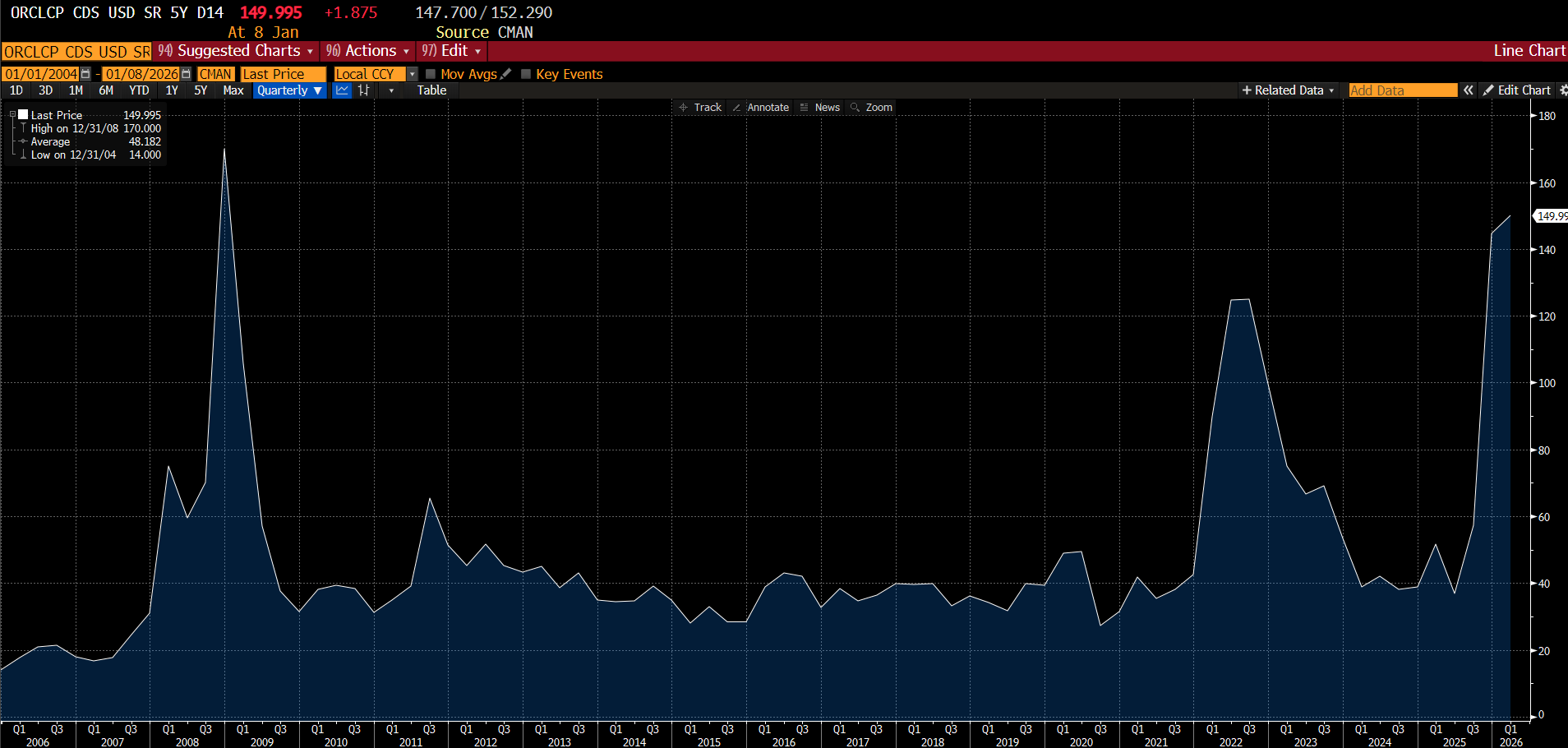
- Oracle has net debt exceeding $100 billion, burned $12 billion in cash in Q3 2025, and its CDS spread widened from 40 basis points in September to 140 basis points in December, with its stock price falling roughly 40% over the same period.
- Blue Owl (which provides loans to data center projects for Oracle, OpenAI's Stargate, and Meta's Hyperion) has seen its stock price fall 20% since summer 2025.
3. AI Investment Begins to Self-Limit:
- DRAM prices rose 172% year-over-year in Q3 2025 and continue to climb.
- Commodity prices for copper, silver, etc., are rising; U.S. electricity prices have increased 39% over the past five years (far exceeding inflation).
- BlackRock warns that excessive AI investment could push up long-term interest rates (bubbles often burst after rates rise).
Companies/Assets Involved
| Company/Asset | Role & Key Data | Bullish/Bearish |
|---|---|---|
| Nvidia | Currently the world's most valuable company by market cap, exceeding the entire Japanese stock market; most of its profits come from data center construction, but returns depend on continued AI progress. | Bearish (valuation relies on bubble persistence) |
| Meta | Shifted from net cash of $30 billion in 2023 to net debt of $7 billion currently; AI investment has led to financial deterioration. | Bearish |
| CoreWeave | Listed in March 2025; stock price down over 50% from peak; data center operator facing market pressure. | Bearish |
| Oracle | Net debt over $100 billion; burned $12 billion in cash in Q3 2025; CDS spread surged; stock price down 40%. | Bearish |
| Blue Owl | Provides loans to data center projects for Oracle, OpenAI, and Meta; stock price down 20% since summer 2025. | Bearish |
| Cisco | Briefly the world's most valuable company by market cap during the internet bubble, but took 25 years to return to its peak (and only then due to another tech bubble). | Historical case (warning for Nvidia) |
| Apple/Amazon | Apple's market cap exceeds $4 trillion, but founder Steve Jobs was forced out in 1985 due to losses; Amazon's stock fell over 90% during the internet bubble. | Historical case (innovative companies are not immune to bubbles) |
Investment Implications
- Beware of the bursting of the AI infrastructure investment bubble: Current massive capital expenditures (e.g., data centers, chips) may fail to generate expected returns. Once market sentiment reverses, valuations and profits will collapse in tandem. Investors should avoid chasing stocks like Nvidia and Oracle that are overly dependent on AI investment.
- Focus on financially sound industry winners: After the shakeout phase, companies with strong balance sheets tend to prevail, while highly leveraged firms (e.g., Oracle, CoreWeave) face bankruptcy risk.
- Rising interest rates are a catalyst for bubble bursts: AI investment is pushing up costs for DRAM, electricity, etc., which could trigger higher interest rates, further suppressing valuations. Investors should be wary of interest-rate-sensitive assets.