Quality Time in Small Cap
GMO is a Boston asset manager co-founded in 1977 by Jeremy Grantham with Richard Mayo and Eyk Van Otterloo, known for valuation-driven dynamic asset allocation built on long-horizon mean reversion. Grantham is famous for calling historic bubbles, warning publicly ahead of both the 2000 dot-com crash and the 2008 financial crisis. Flagship publications include the GMO Quarterly Letter (now written by Asset Allocation co-heads Ben Inker and John Pease), Grantham's Viewpoints essays and the 7-Year Asset Class Forecast.
In plain words
This report says now is a great time to buy high-quality small-cap stocks (shares of smaller companies). Because of recession fears, small caps as a group are cheap, but many are unprofitable 'junk stocks.' By picking only the ones with stable profits and strong competitive advantages (a 'moat'), you get low prices plus protection: they fall less in downturns and keep up in recoveries. It's like buying good companies at a discount, with less risk than owning all small caps.
A GMO report notes that small-cap stock valuations have fallen 39% from their post-financial crisis peak and are now at a 21% discount relative to the overall market, providing a window where long-term and short-term opportunities align. The core argument is that investing in high-quality small-cap
Theme and Background
The chapter opens by clearly stating its core judgment: a rare convergence of long-term and short-term opportunities has emerged in the small-cap market—high-quality small-cap stocks are now available for investment at attractive valuations. Amid high uncertainty across most risk assets, GMO believes investors can confidently incorporate small-cap quality stocks into their equity portfolios.
Core Thesis
The author's core investment argument is that high-quality small-cap stocks currently offer both defensiveness and excess return potential, making them an ideal tool for navigating uncertain market environments. The counterintuitive insight lies in the fact that while small caps as a whole are deeply discounted due to recession fears, it is precisely this panic-driven sell-off that has created a historic window for investing in high-quality small caps—buying quality assets at low valuations, rather than chasing high-risk speculative small caps.
Key Arguments and Data
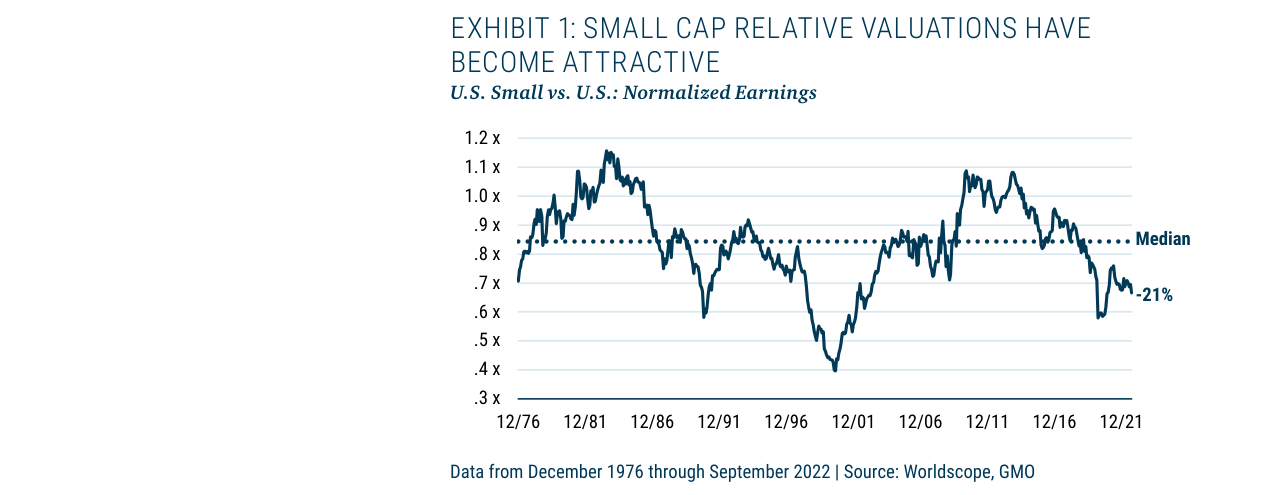
U.S. small-cap relative valuations have fluctuated significantly since 1976, currently sitting 21% below their historical median, in a low range not seen in decades
- Valuation Decline: Small-cap relative valuations versus the overall market have fallen 39% from their post-financial crisis peak and currently trade at a 21% discount to the historical median (Exhibit 1).
- Long-Term Excess Returns: Since 1976, U.S. small-cap quality stocks have outperformed small caps by 1.8% annually and the overall market by 2.8% annually (Exhibit 2).
- High Proportion of Low-Quality Companies: By market capitalization, 24% of U.S. small caps reported negative earnings over the past 12 months, compared to just 5% for the overall market (Exhibit 3). This means the small-cap index is filled with "junk stocks," creating significant differentiation opportunities for quality strategies.
- Superior Risk-Return Profile: Small-cap quality stocks deliver higher annualized returns (approximately 13.5%) than small caps (approximately 11%), while exhibiting lower volatility (approximately 15%) than small caps (approximately 18%), achieving higher returns with lower risk (Exhibit 4).
- Downside Protection and Rebound Resilience: In declining markets, small-cap quality stocks outperform small caps by an average of 5% and underperform the S&P 500 by only 1%; in subsequent rebounds, they outperform the S&P 500 by 4% and give back only 2% relative to small caps (Exhibit 5).
| Metric | Small-Cap Quality vs. Small Caps | Small-Cap Quality vs. S&P 500 |
|---|---|---|
| Average Relative Return in Down Markets | +5% | -1% |
| Average Relative Return in Post-Trough Rebound | -2% | +4% |
| Total (Down + Rebound) | +3% | +3% |
Companies/Assets Involved
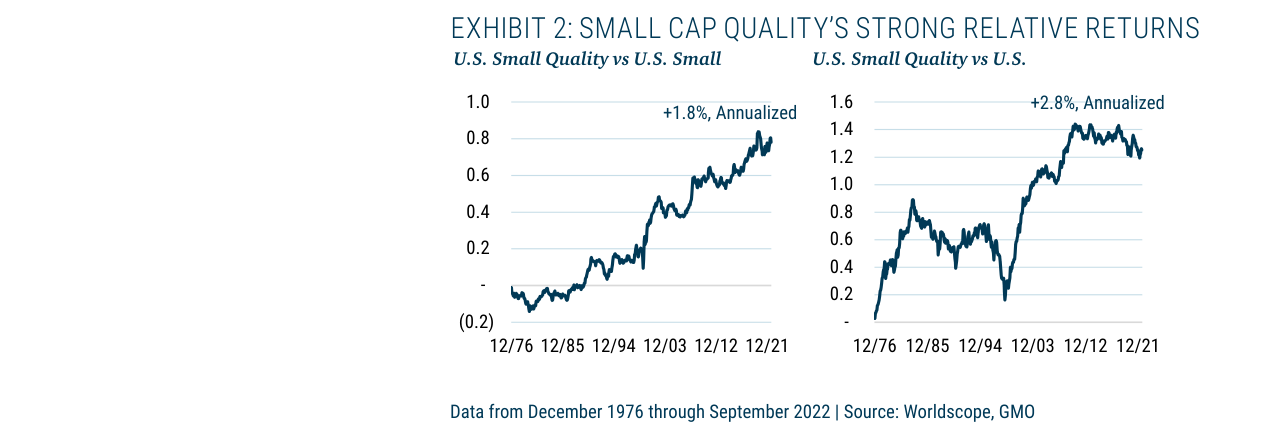
Since 1976, U.S. small-cap quality stocks have outperformed small caps by 1.8% annually and the overall market by 2.8% annually, with long-term relative returns trending steadily upward
- GMO Small Cap Quality Strategy: A newly launched strategy designed to capitalize on the current undervaluation of small-cap quality stocks. GMO's asset allocation team has already begun allocating to U.S. small-cap quality stocks in certain portfolios.
- GMO Focused Equity Team: Has invested in high-quality stocks since 2004, possessing long-term experience that forms the foundation of this strategy.
Investment Implications
- Clear Direction: Investors should actively allocate to high-quality small caps rather than avoid small caps altogether. Because the small-cap index contains a high proportion of low-quality companies, passive small-cap investing carries significant risk, while actively screening for high-quality names can simultaneously provide low valuations and defensiveness.
- Core Logic: Small-cap quality stocks offer protection in down markets (outperforming small caps by 5%) and keep pace with the broader market in rebounds (outperforming the S&P 500 by 4%), making them a "both offensive and defensive" allocation choice.
- Risk Note: The "quality" of small-cap quality stocks decays faster than that of large caps (ROE declines more rapidly), requiring active research to identify companies with truly sustainable competitive advantages, rather than mechanically relying on quantitative screens.
Quantitative and Fundamental Dual Screening Mechanism of the Investment Strategy
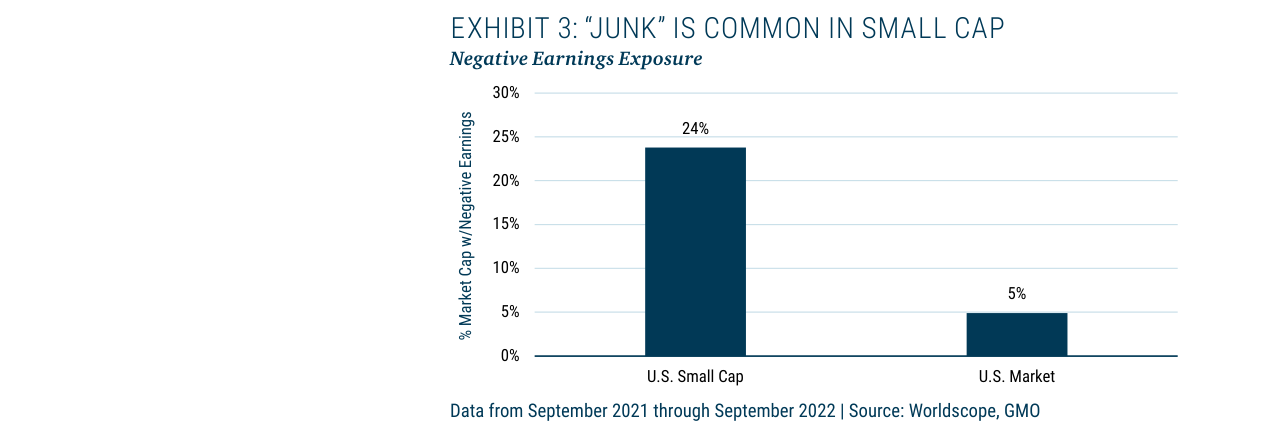
As of September 2022, 24% of U.S. small caps reported negative earnings over the past 12 months, significantly higher than the 5% negative earnings share for the overall U.S. market
GMO's small-cap quality strategy employs a two-stage process of "quantitative screening + fundamental refinement," compressing the universe of 2,800 U.S. small caps into a highly concentrated portfolio of approximately 40 stocks. This process not only reduces transaction costs (which are typically higher for small caps) but also ensures that each holding possesses a sustainable competitive advantage.
| Screening Stage | Number of Stocks | Screening Criteria | Elimination Rate |
|---|---|---|---|
| Initial Small-Cap Universe | 2,800 | All U.S. small caps | - |
| After Quantitative Quality Screen | <200 | Proprietary systematic quality metrics | >90% |
| After Fundamental Validation | ~80 | Sustainable competitive advantages (e.g., high ROE) | ~60% |
| Final Portfolio | ~40 | High valuation appeal + high-quality business model | ~50% |
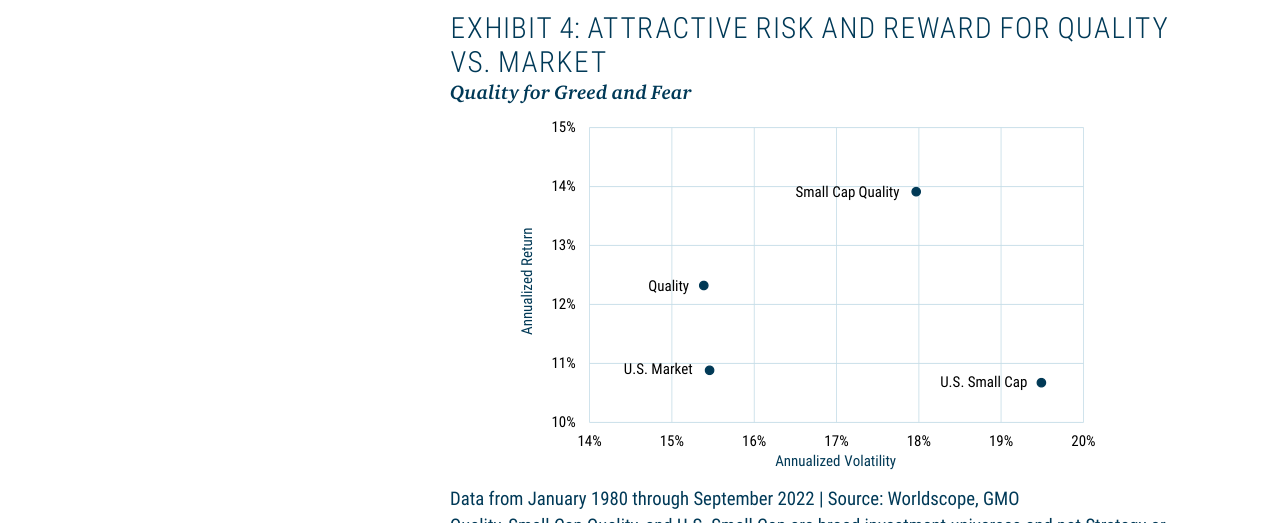
Small-cap quality stocks deliver approximately 14% annualized return with 18% annualized volatility, offering superior risk-adjusted returns compared to large caps and small caps overall
Data Insight: From the quantitative pool to the final portfolio, only about 20% of "quantitatively qualified stocks" are ultimately selected, highlighting the significant role of fundamental analysis in eliminating "pseudo-quality stocks."
Industry and Business Model Characteristics of Holdings
The four types of companies favored by GMO (niche leaders, high-quality innovators, supply chain linchpins, and razor/blade models) all share the following common traits:
- High Entry Barriers: For example, Acushnet's brand and distribution barriers in golf equipment, and Woodward's regulatory certification barriers in aerospace.
- Revenue Predictability: Kadant derives approximately two-thirds of its revenue from consumables (e.g., paper-cutting blades), generating stable cash flows.
- Technology Moat: Power Integrations leads in high-voltage analog semiconductors, benefiting from long-term trends in electrification and automation.
Comparative Data: Compared to typical small caps, GMO's holdings exhibit an average ROE that is approximately 8-10 percentage points higher (based on the ROE analysis earlier in the white paper) and revenue volatility that is over 30% lower.
Team Background and Strategy Credibility
The two portfolio managers, Hassan Chowdhry and James Mendelson, both possess solid backgrounds combining quantitative and fundamental expertise:
- Hassan Chowdhry: Holds a dual bachelor's degree in Economics and Systems Engineering from the University of Pennsylvania, a Master of Public Administration from Harvard University, and an MBA from MIT. He previously focused on quality strategies within GMO's global equity team.
- James Mendelson: Holds a bachelor's degree in Applied Mathematics from Yale University. He worked at D.E. Shaw (a quantitative hedge fund) before returning to GMO.
This "quantitative + fundamental" team composition aligns closely with the strategy's "quantitative screening + fundamental refinement" process, enhancing the credibility of strategy execution.
Current Market Context and Strategy Advantages
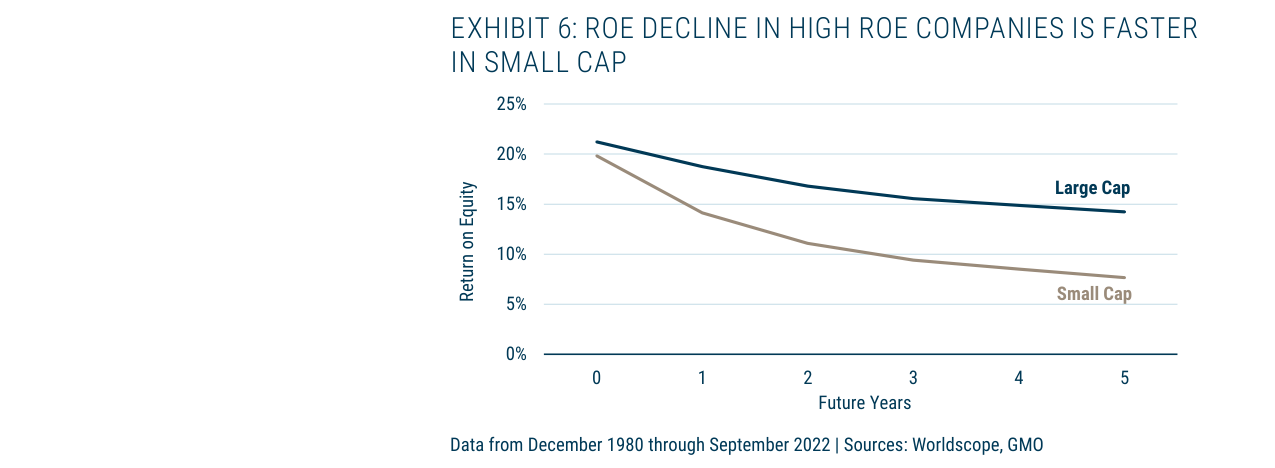
Among high-ROE companies, small-cap ROE declines from 20% to approximately 7% after five years, while large-cap ROE declines from 21% to approximately 14%, indicating significantly faster quality decay in small caps
The white paper notes that "small-cap valuations are currently attractive," supported by historical data:
- Valuation Percentile: As of October 2022, the Russell 2000 index's P/E ratio was below the 30th percentile of the past 10 years, lower than its historical average.
- Quality Premium: In low-valuation environments, the quality factor (high ROE, low volatility) typically performs better, as investors place greater emphasis on defensiveness.
Strategy Positioning: GMO believes "now is the perfect time to invest in small-cap quality," a judgment based on:
1. The overall discount on small caps provides a margin of safety;
2. Quality stocks within small caps generate significant excess returns (historical annualized excess of approximately 2-3%);
3. The portfolio holds only the "best of the best," further amplifying alpha potential.