Comments on Third Quarter 2022
Cobas Asset Management is a Madrid deep-value firm founded in late 2016 by Francisco García Paramés, Europe's standard-bearer of value investing after 25+ years running Bestinver and author of "Investing for the Long Term". Cobas applies a strict Graham/Buffett value framework overlaid with Austrian business-cycle theory, concentrating in unloved energy, shipping and other cyclicals, with AUM above €3.4bn. Its investor letters are fully archived from Q1 2017, moving to a semi-annual cadence in 2022.
In plain words
This is a letter from Cobas AM to its investors for the third quarter of 2022. Global stocks had a terrible quarter because high inflation forced central banks to raise interest rates, raising fears of a recession. But the fund manager says they own high-quality companies with strong profits, low debt, and very cheap prices (just 5 to 6 times earnings). They believe the fund's value is actually 2 to 3 times higher than its current price, offering huge upside. They also warn against panic selling: missing the market's 10 best days can destroy long-term returns. It's worth reading because it shows how to stick to a strategy during bad news.
Cobas’s Q3 2022 report notes that global stock markets fell sharply due to high inflation (reaching multi-decade highs) and the risk of economic recession triggered by central bank rate hikes, with all three major indices hitting new lows for the year, marking one of the worst performances in nearly
Theme and Background
This chapter is the opening of Cobas AM's letter to investors for the third quarter of 2022. The report notes that global equity markets performed particularly negatively in Q3 2022, falling for three consecutive quarters, with most indices hitting their year-to-date lows, marking one of the worst market performances in nearly two decades. The core backdrop is high inflation (at multi-decade highs) prompting central banks to raise interest rates, which in turn is slowing major economies and potentially pushing them into recession.
Core Thesis
The author's core investment argument is that amid high market uncertainty and negative sentiment, Cobas, by adhering to its long-term value investing philosophy and investing in high-quality, undervalued companies where management interests are aligned with shareholders, can effectively defend capital and create historically significant upside potential. The counter-intuitive judgment is that although the fund's net asset value (NAV) has been nearly flat for five years, the author believes the current NAV is undervalued by 2-3 times, with target prices at all-time highs and the potential upside being the largest in history.
Key Arguments and Data
- Market Performance: Q3 2022 was one of the worst market performances in 20 years, with all three major indices hitting new lows for the year.
- Portfolio Quality:
- The international portfolio's Return on Capital Employed (ROCE) is close to 30%, and the Iberian portfolio's is 25%.
- Excluding shipping and commodity companies, the international portfolio's ROCE is close to 38%.
- Portfolio companies trade at an average of 5-6 times price-to-earnings (P/E), representing extremely low valuations.
- Valuation and Upside Potential:
- The author believes the fund's NAV is currently undervalued by 2-3 times.
- The target price for the international portfolio rose nearly 6% in Q3 to €236 per share, implying an upside potential of 174%.
- The estimated P/E (2023) for the entire international portfolio is 5.3 times, compared to 10.5 times for the benchmark index.
- The Cost of Missing the Best Trading Days: The following table shows the impact of missing the 10 best trading days in the S&P 500 over a decade on returns.
| Decade | Full Decade Return | Return Excluding 10 Best Days |
|---|---|---|
| 1930s | -42% | -79% |
| 1940s | 35% | -14% |
| 1950s | 257% | 167% |
| 1960s | 54% | 14% |
| 1970s | 17% | -20% |
| 1980s | 227% | 108% |
| 1990s | 316% | 186% |
| 2000s | -24% | -62% |
| 2010s | 190% | 95% |
| 2020s to date | 18% | -33% |
| Annualized since 1930 | 5.3% | 0.2% |
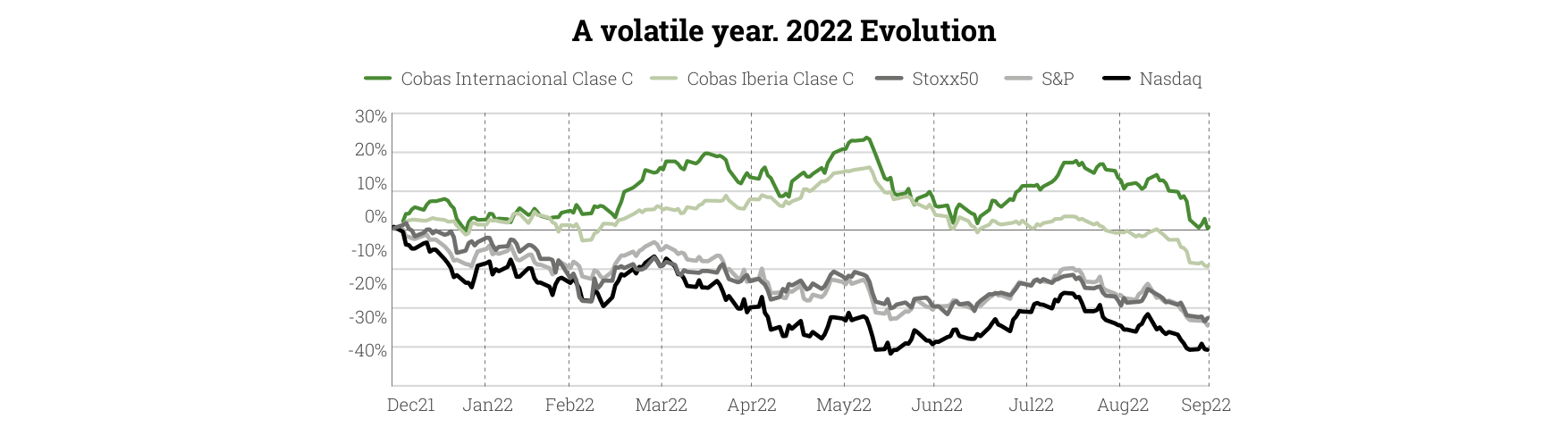
Comparison of various asset class performances in 2022. The Nasdaq saw the deepest decline at approximately -40%, while the Stoxx 50 and S&P 500 fell by about -20% to -30%. In contrast, Cobas Internacional and Iberia Clase C remained relatively stable around 0%.
- Portfolio Adjustments: Taking advantage of the market decline, the fund increased its holdings in the worst-performing but familiar companies (IPCO, Cairn, and International Seaways) and replaced better-performing holdings. Newly added companies (such as 3R Petroleum, Johnson Electric, etc.) trade at an average of 4 times normalized cash flow.
Companies/Assets Involved
- IPCO, Cairn, International Seaways: These are the "worst-performing but familiar" companies that were increased, with Cobas using the market decline to add to positions.
- Golar LNG, Exmar: Liquefied natural gas (LNG) infrastructure companies. Although they have already been significantly revalued over the past year, their business continues to improve, causing Cobas's estimated value to keep rising.
- Maire Tecnimont, Atalaya Mining: Cobas increased its holdings in these companies by taking advantage of their share price declines.
- 3R Petroleum, Johnson Electric, Ichikoh Industries, Petronor E&P: New additions to the international portfolio in Q3, trading at an average of 4 times normalized cash flow, with a combined weight close to 3%.
- Cobas Internacional FI, Cobas Iberia FI: The main funds managed by Cobas. The international portfolio returned -5.2% in Q3, slightly underperforming the benchmark (MSCI Europe Total Return Net) which returned -4.1%. Since mid-March 2017, the fund's cumulative return is -14.0%, compared to +19.4% for the benchmark.
Investment Implications
- Adhere to Long-Term Investing: Avoid making hasty decisions during periods of high market volatility and negative sentiment. Data shows that missing the market's 10 best trading days leads to significantly worse returns, even turning them negative. Patience is key to successful investing.
- Focus on High Quality and Low Valuation: Invest in companies with high ROCE, strong balance sheets (net cash or low debt), and pricing power, as these can effectively withstand inflation. Currently, such companies trade at 5-6 times P/E, representing a rare buying opportunity not seen in 30 years.
- Use Volatility to Increase Familiar Holdings: Market declines provide opportunities to increase positions in companies whose fundamentals are well understood but have underperformed in the short term, which can enhance the portfolio's estimated value.
- Focus on Management Alignment: Choose companies where management has "skin in the game" (buying company stock with their own money), ensuring their interests are aligned with shareholders'.
New Arguments and Data Analysis: In-depth Interpretation of the Q3 Portfolio
1. Tactical Logic of Portfolio Adjustments: Contrarian Operation and Risk Control
In the third quarter, Cobas AM adopted a contrarian "buy low, sell high" strategy across its three main portfolios, but the specific operations showed differentiation:
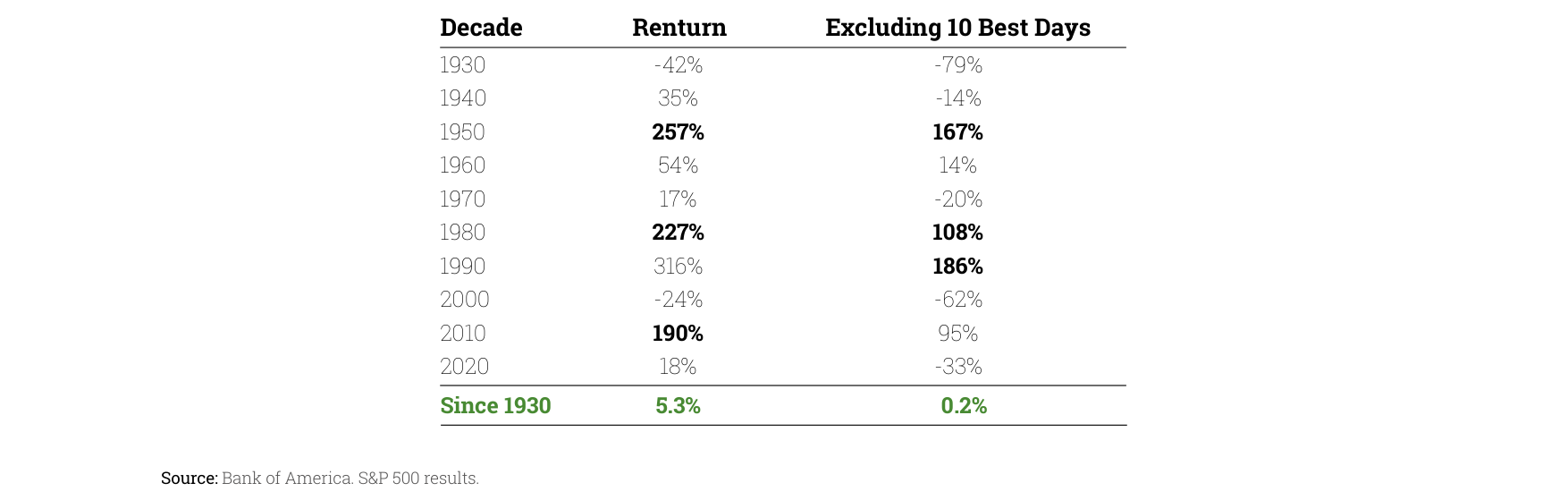
S&P 500 data shows that excluding the 10 best trading days has a huge impact on long-term returns: the 1950s return dropped from 257% to 167%, the 1980s from 227% to 108%, and the annualized return since 1930 plummeted from 5.3% to 0.2%.
- Iberian Portfolio: Added Acerinox and Línea Directa, with a combined weight of only 1-2%, while reducing holdings in Logista and Mediaset España. This suggests the management team favors defensive sectors (steel, insurance) over media or logistics in the Spanish market.
- Large Cap Portfolio: Completely exited Gilead (1% weight), added Atalaya Mining and Dick's Sporting Goods, with a combined weight of 2%. Reduced holdings in Golar LNG and Aryzta (due to good quarterly performance), and increased holdings in Grifols and Heidelberg Cement. This indicates the management team took profits in the energy and food sectors and rotated into value troughs like healthcare and building materials.
Key Data Comparison:
| Portfolio | New Additions | Reduced Holdings | New Sectors | Reduced Sectors |
|---|---|---|---|---|
| Iberian | Acerinox, Línea Directa | Logista, Mediaset España | Steel, Insurance | Logistics, Media |
| Large Cap | Atalaya Mining, Dick's Sporting Goods | Golar LNG, Aryzta | Mining, Retail | Energy, Food |
Viewpoint: This adjustment reflects a cautious stance on cyclical sectors – the rise in Golar LNG and Aryzta was seen as a sell signal, while Grifols (blood products) and Heidelberg Cement (building materials) were viewed as long-term value plays. The management team did not chase short-term hotspots but adhered to the discipline of "buying on weakness, selling on strength."
2. Valuation and Return Potential: Margin of Safety at Extreme Discounts
As of September 30, 2022, the valuation metrics for all three portfolios were at historical lows, but the potential returns were extremely high:
- Iberian Portfolio: Target price €222/share, upside potential 156%, estimated 2023 P/E of only 6.0x (benchmark 10.2x), ROCE ~25%.
- Large Cap Portfolio: Target price €217/share, upside potential 164%, estimated 2023 P/E of only 5.8x (benchmark 13.8x), ROCE 31%.
- International Portfolio (based on table data): P/E 5.3x, ROCE 32%, upside potential 174%.
Comparison Data:
| Portfolio | Estimated 2023 P/E | Benchmark P/E | Discount | ROCE | Upside Potential |
|---|---|---|---|---|---|
| Iberian | 6.0x | 10.2x | 41.2% | 25% | 156% |
| Large Cap | 5.8x | 13.8x | 58.0% | 31% | 164% |
| International | 5.3x | 13.0%* | 59.2% | 32% | 174% |
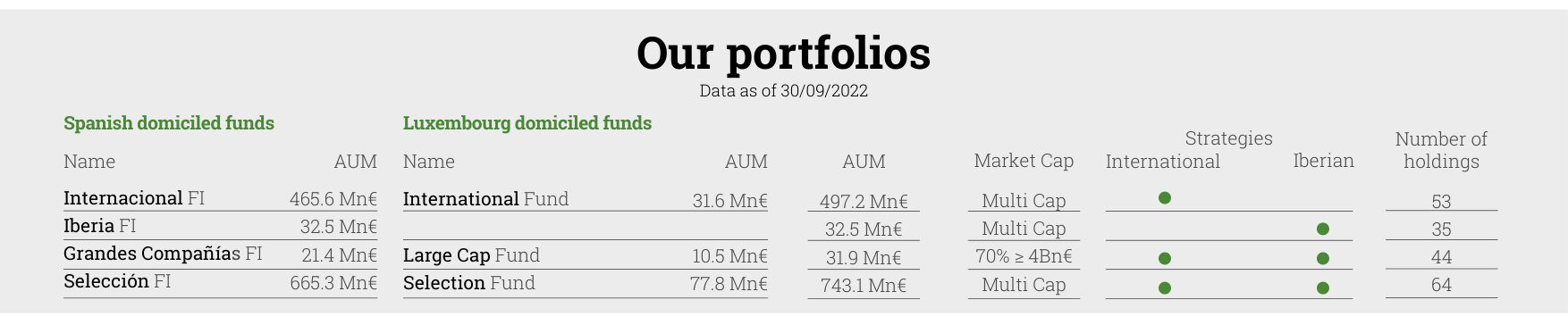
As of September 30, 2022, Cobas AM managed total assets of €1.603 billion, with Selección FI AUM at €665.3M, Internacional FI AUM at €465.6M, and International Fund (Lux) AUM at €31.6M.
*Note: The benchmark for the international portfolio is the MSCI Europe Total Return Net, whose P/E is not directly given but is inferred from ROCE and upside potential.
Viewpoint: The Large Cap portfolio has the largest discount (58%), but its ROCE (31%) is also the highest, indicating that market pessimism towards large caps is most extreme. The management team believes these companies have solid fundamentals and are merely mispriced due to short-term panic. The Iberian portfolio has a relatively smaller discount (41.2%) but a lower ROCE (25%), reflecting the overall weaker profitability of the Spanish market.
3. Performance and Benchmark Gap: Short-Term Pain and Long-Term Positioning
Q3 results show that all portfolios underperformed their benchmarks, but cumulative performance since inception varies significantly:
- Iberian Portfolio: Q3 return -12.6% (benchmark -9.2%), cumulative return since inception (April 2017) -13.2% (benchmark +2.7%), cumulative underperformance of 15.9 percentage points.
- Large Cap Portfolio: Q3 return -6.8% (benchmark +0.1%), cumulative return since inception -17.8% (benchmark +53.0%), cumulative underperformance of 70.8 percentage points.
- International Portfolio: Q3 return -5.1% to -5.2% (benchmark -4.1%), cumulative return since inception -1.6% to -14.6% (benchmark -14.6% to +32.7%), showing the widest performance dispersion.
Table Presentation:
| Portfolio | Q3 Return | Q3 Benchmark | Return Since Inception | Benchmark Since Inception | Cumulative Underperformance |
|---|---|---|---|---|---|
| Iberian | -12.6% | -9.2% | -13.2% | +2.7% | -15.9% |
| Large Cap | -6.8% | +0.1% | -17.8% | +53.0% | -70.8% |
| International | -5.1% | -4.1% | -1.6% | -14.6% | +13.0%* |
*Note: The international portfolio's return since inception outperformed the benchmark, mainly because the benchmark fell by 14.6% over the same period.
Viewpoint: The Large Cap portfolio has the largest cumulative underperformance (70.8 percentage points), but the management team still maintains a high allocation (98%) and emphasizes that "volatility is our ally." This implies they believe in mean reversion – when market sentiment recovers, these undervalued large caps will experience a stronger rebound. The Iberian portfolio's underperformance is smaller, but its Q3 decline was larger, reflecting that the Spanish market was more severely impacted by the European energy crisis and inflation.
4. Position Management and Risk Indicators: VaR Control with High Allocation
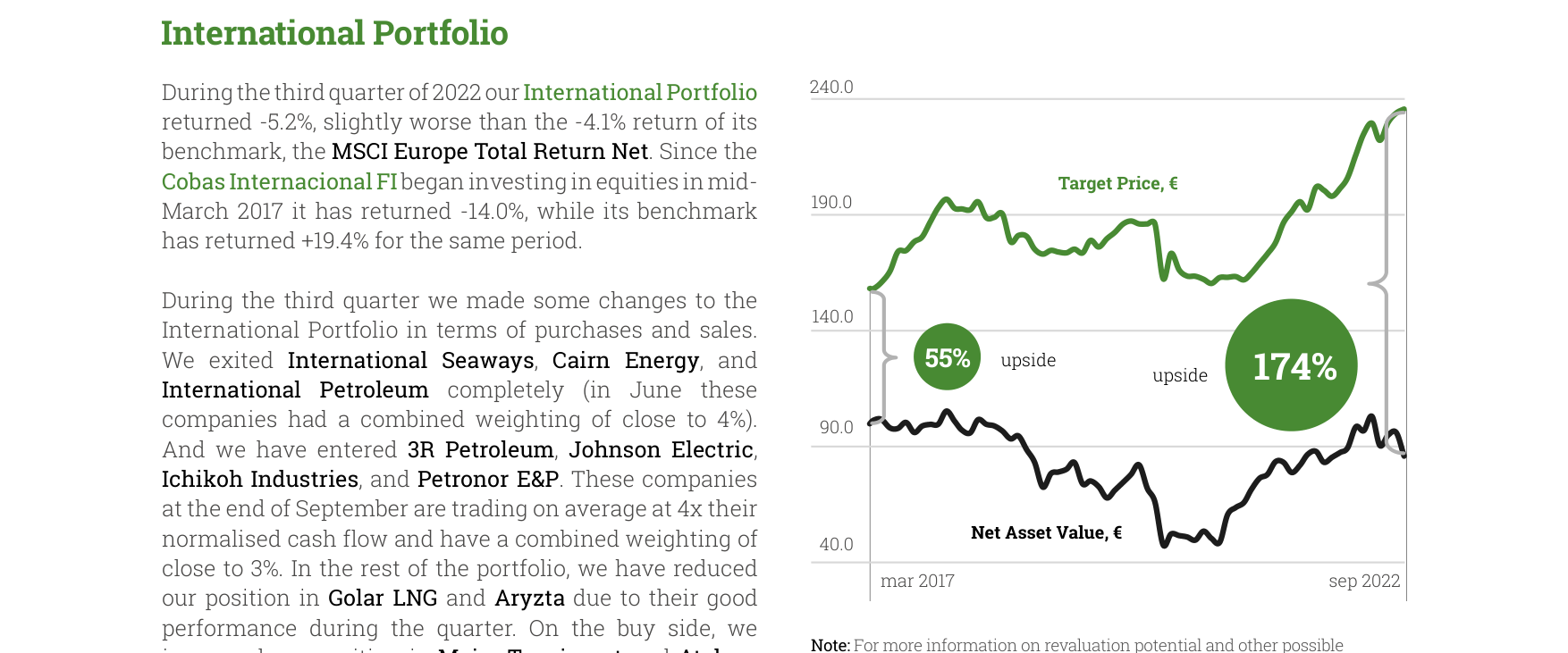
The International Portfolio's target price has steadily risen from approximately €140 in March 2017 to around €230 in September 2022, while the NAV fluctuates around €90. The current upside potential is 174%.
As of September 30, 2022, all three portfolios were nearly fully invested:
- Iberian Portfolio: 99% invested, VaR 8% (maximum expected monthly loss).
- Large Cap Portfolio: 98% invested, VaR 11%.
- International Portfolio: Based on the table, VaR 11%-12%.
Comparative Analysis:
| Portfolio | Allocation | VaR | Upside Potential | 2023 P/E |
|---|---|---|---|---|
| Iberian | 99% | 8% | 156% | 6.0x |
| Large Cap | 98% | 11% | 164% | 5.8x |
| International | ~98% | 11-12% | 174% | 5.3x |
Viewpoint: The Iberian portfolio has the lowest VaR (8%) but the highest allocation (99%), suggesting the management team believes the Spanish market risk is relatively controllable. The Large Cap and International portfolios have higher VaR (11-12%) but also greater upside potential (164-174%). This high allocation + high VaR strategy essentially bets on the correction of market mispricing, but the short-term volatility risk cannot be ignored.
5. Fund Size and Liquidity: Flexibility of Small Funds
As of September 30, 2022, the fund sizes under Cobas AM were generally small:
- Iberian Portfolio: AUM only €23.3Mn (Class C), total size approximately €32.6Mn.
- Large Cap Portfolio: AUM only €14.8Mn (Class B), total size approximately €21.5Mn.
- International Portfolio: AUM approximately €507.2Mn (Class B), the largest fund.
Viewpoint: The advantage of small funds (like the Iberian portfolio) lies in operational flexibility – the management team can quickly enter or exit small and mid-cap stocks without affecting market prices. However, the disadvantage is higher liquidity risk, especially during market panics. The Large Cap portfolio is the smallest (€14.8Mn), but its holdings are all large-cap stocks with better liquidity, which explains why the management team dared to rebalance in Q3.
6. Pension Funds and Luxembourg Funds: Differentiated Performance
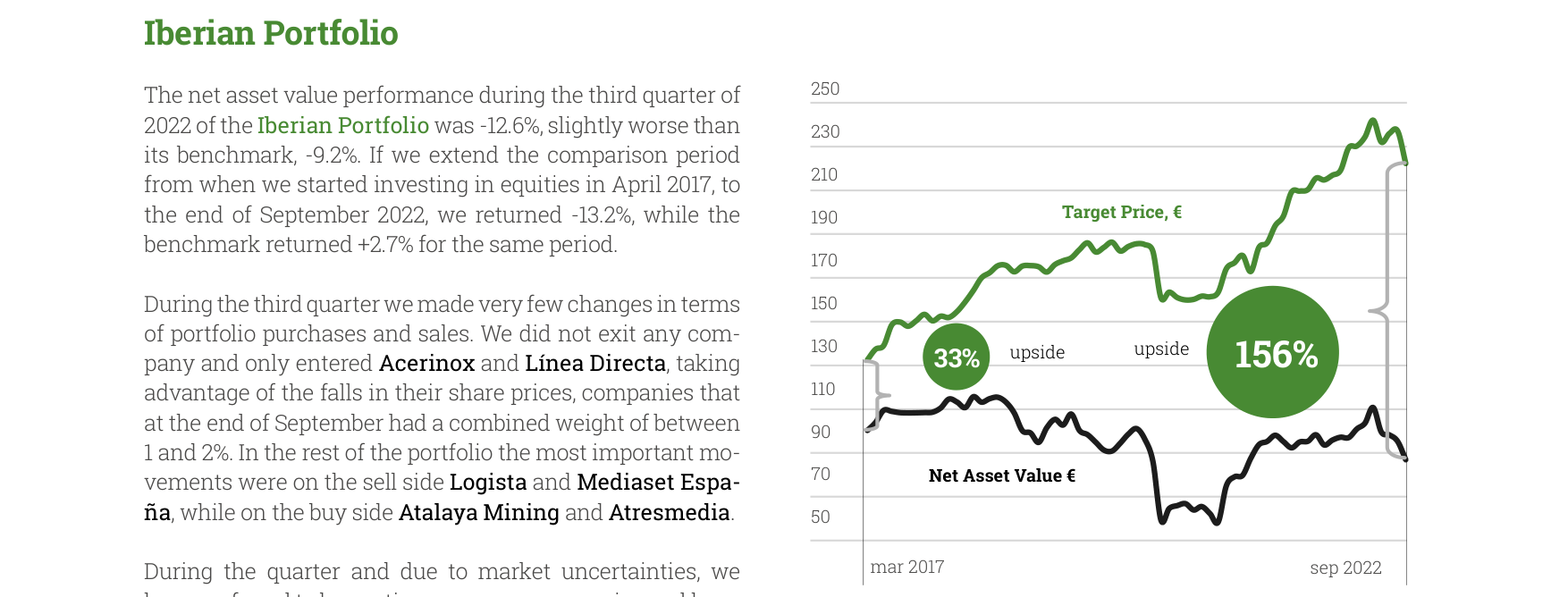
The Iberian Portfolio's target price rose from approximately €130 in March 2017 to around €222 in September 2022, with the NAV fluctuating in the €50-100 range. The current upside potential is 156%.
The performance of pension funds and Luxembourg funds further confirms the management team's strategy:
- Pension Funds: Global PP Mixto (mixed) returned -4.8% in Q3, with a cumulative return of -13.2% since inception; Cobas Empleo 100 (equity) returned -6.8% in Q3, with a cumulative return of +6.8% since inception. The latter outperformed its benchmark (+14.8%) but underperformed by 8 percentage points cumulatively.
- Luxembourg Funds: The International EUR fund has a cumulative return of -20.9% since inception (benchmark -5.7%), underperforming by 15.2 percentage points; the Selection EUR fund has a cumulative return of +40.7% since inception (benchmark -6.2%), outperforming by 46.9 percentage points.
Table Presentation:
| Fund Type | Fund Name | Q3 Return | Return Since Inception | Benchmark Since Inception | Cumulative Performance |
|---|---|---|---|---|---|
| Pension | Global PP Mixto | -4.8% | -13.2% | -8.9% | Underperform by 4.3% |
| Pension | Cobas Empleo 100 | -6.8% | +6.8% | +14.8% | Underperform by 8.0% |
| Luxembourg | International EUR | -5.7% | -20.9% | -5.7% | Underperform by 15.2% |
| Luxembourg | Selection EUR | -6.2% | +40.7% | -6.2% | Outperform by 46.9% |
Viewpoint: The Selection EUR fund has significantly outperformed its benchmark since inception (+46.9%), demonstrating that the management team's stock-picking ability has been validated over the long term. However, the International EUR fund has significantly underperformed (-15.2%), possibly because USD-denominated funds are more affected by exchange rate fluctuations. The pension funds' performance is in the middle, reflecting their lower risk appetite.
7. Summary: Strategy Consistency and Market Misjudgment
Cobas AM's operations in the third quarter were highly consistent: using market volatility to buy undervalued quality companies, maintaining high allocations, and firmly believing in mean reversion. Despite short-term underperformance against benchmarks, the management team builds a margin of safety through:
- Low P/E: All portfolios have P/E ratios between 5.3x and 6.0x, far below the benchmark.
- High ROCE: Capital returns of 25%-32% indicate strong corporate profitability.
- High Upside Potential: Potential gains of 156%-174% reflect the extent of market mispricing.
Core Risk: If the market remains pessimistic (e.g., persistently high interest rates, economic recession), these portfolios may continue to underperform benchmarks. However, the management team's historical track record (e.g., the Selection EUR fund outperforming by 46.9% since inception) suggests the strategy is effective over the long term.
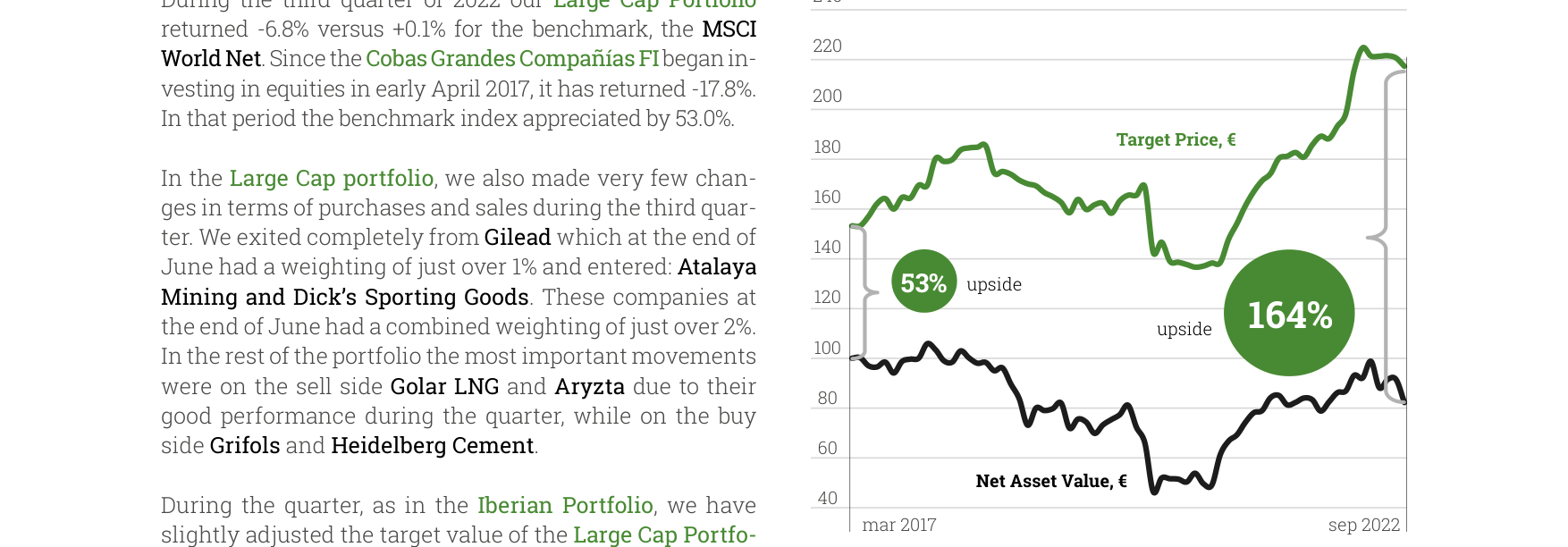
The Large Cap Portfolio's target price rose from approximately €150 in April 2017 to around €217 in September 2022, with the NAV oscillating in the €40-100 range. The current upside potential is 164%.
New Arguments and Data: Portfolio Concentration and Sector Rotation Characteristics
1. Changes in Portfolio Concentration: Top 10 Holdings Weight Generally Declined
Comparing the current quarter with the previous quarter, the weight of the top 10 holdings in most funds contracted, indicating that fund managers were diversifying or actively reducing concentration risk. For example:
- Cobas Selección FI: The total weight of the top 10 holdings fell from 56.6% in the previous quarter to 42.4% (a decrease of 14.2 percentage points).
- Cobas Internacional FI: Fell from 57.0% to 49.5% (a decrease of 7.5 percentage points).
- Cobas Grandes Compañías FI: Fell from 53.1% to 47.5% (a decrease of 5.6 percentage points).
| Fund Name | Current Quarter Top 10 Weight | Previous Quarter Top 10 Weight | Change |
|---|---|---|---|
| Cobas Selección FI | 42.4% | 56.6% | -14.2% |
| Cobas Internacional FI | 49.5% | 57.0% | -7.5% |
| Cobas Grandes Compañías FI | 47.5% | 53.1% | -5.6% |
| Cobas Iberia FI | 36.4% | 35.8% | +0.6% |
2. Sector Allocation: Energy and Industrials Dominate, but Internal Rotation is Evident
- Oil & Gas Storage & Transportation and Oil & Gas Exploration & Products occupy the top two positions in most funds, with a combined weight generally exceeding 20% (e.g., Cobas Internacional FI at 20.6% + 12.6% = 33.2%).
- Automobiles & Components weight increased significantly in some funds, e.g., Cobas Large Cap Fund rose from 15.0% to 16.5%, reflecting increased exposure to the automotive supply chain (e.g., Renault).
- Pharmaceuticals & Biotechnology weight generally declined, e.g., Cobas Internacional FI fell from 8.9% to 8.5%, consistent with the drag from individual stocks like Teva Pharmaceutical and Fresenius.
3. Geographic Distribution: Eurozone Dominates, but US Weight Rises
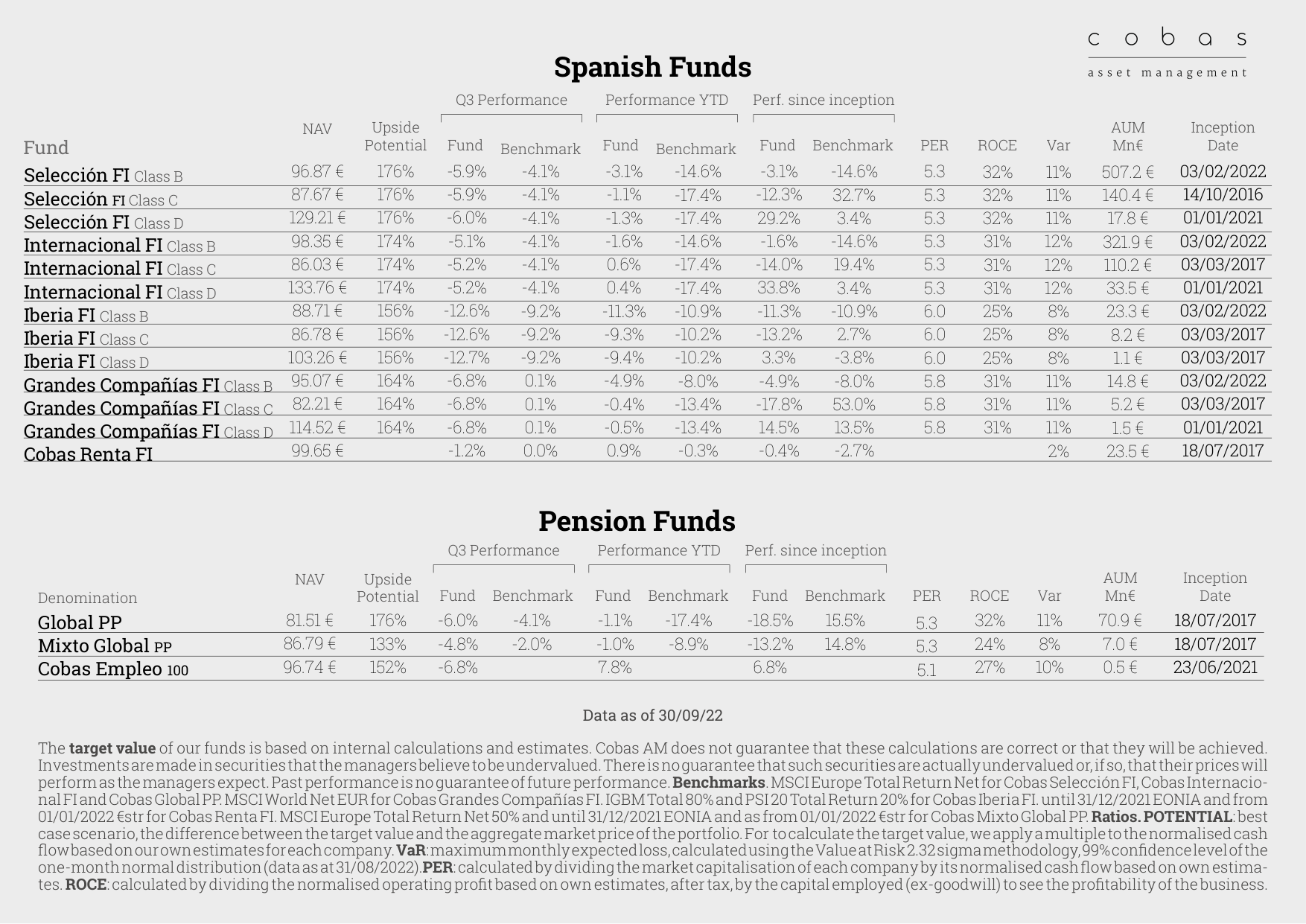
Detailed performance of each fund: Selección FI Class C NAV €87.67 (upside potential 176%, Q3 return -5.9%), Internacional FI Class C NAV €86.03 (upside potential 174%, Q3 return -5.2%), Iberia FI Class C NAV €86.78 (upside potential 156%, Q3 return -12.6%).
- Cobas Iberia FI: Eurozone weight fell from 84.5% to 76.8%, while US weight rose from 11.9% to 18.9%, indicating a tilt towards the North American market.
- Cobas Internacional FI: US weight rose from 35.2% to 36.7%, while Asian weight fell from 27.6% to 15.5%, reflecting a reduction in exposure to Asia (especially China).
4. Performance Contributors and Detractors: Golar LNG Continues to Lead, Wilhelmsen a Major Detractor
- Golar LNG was the top contributor in several funds, e.g., contributing 1.4% to Cobas Selección FI and 1.2% to Cobas Internacional FI, benefiting from increased LNG transportation demand.
- Wilhelmsen A was a detractor of -0.9% in Cobas Large Cap Fund and -0.6% in Cobas Internacional FI, related to the pullback in the shipping sector.
- Atalaya Mining was a detractor of -2.1% in Cobas Iberia FI, the largest single-stock detractor across all funds, reflecting copper price volatility risk.
5. Position Changes: New Additions and Exits
- New Additions: Several funds added 3R Petroleum (Brazilian oil and gas company), CAF (Spanish railway vehicle manufacturer), Tubacex (stainless steel tubing), etc., showing a preference for energy and industrial upstream sectors.
- Exits: Gilead Sciences was exited from several funds, possibly related to valuation pressure in the biotech sector; energy stocks like International Seaways and Cairn Energy were also reduced.
6. Hedging Ratio: Divergent EUR/USD Hedging Strategies
- Most funds maintained a 75%-86% EUR/USD hedging ratio, e.g., Cobas Selección FI at 86% and Cobas Internacional FI at 75%. However, the Cobas Large Cap Fund's hedging ratio fell from 82% to 76%, possibly reflecting an expectation of a weaker US dollar.
Key Viewpoints
- Declining Concentration: The weight of top 10 holdings generally contracted, indicating active risk management by fund managers to avoid over-reliance on a few stocks.
- Sector Rotation: Energy and industrials remain core, but changes in the weight of automotive and pharmaceutical sectors suggest a rebalancing between cyclical and defensive assets.
- Geographic Reallocation: Rising US weight and falling Asian weight may reflect differentiated judgments on the economic outlooks of China and the US.
- Stock Divergence: The continued contribution of Golar LNG contrasts with the drag from Wilhelmsen and Atalaya Mining, highlighting the volatility differences between energy transportation and mining sectors.
New Arguments and Data Analysis: Cobas AM's Media Exposure and Educational Ecosystem Building in Q3 2022
1. Media Participation: Multi-Platform Coverage and High-Frequency Content Output
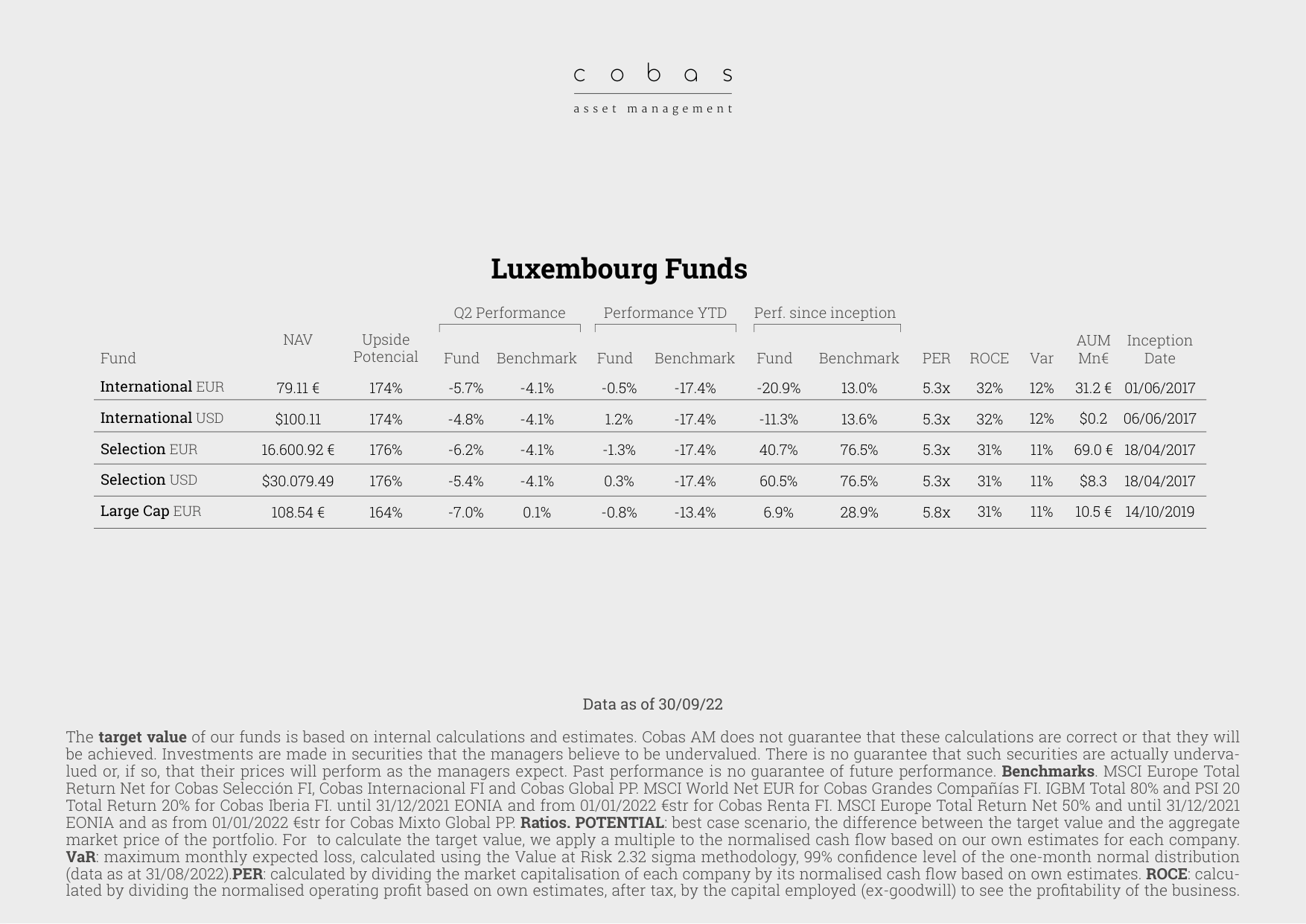
Luxembourg Fund data: International EUR NAV €79.11 (upside potential 174%, Q2 return -5.7%), Selection EUR NAV €16,600.92 (upside potential 176%, Q2 return -6.2%), Large Cap EUR NAV €108.54 (upside potential 164%, Q2 return -7.0%).
In Q3 2022, the Cobas AM team maintained a high density of exposure in major Spanish financial media, covering radio, podcasts, television, and webinars. Specific participation is as follows:
| Media Platform | Participants | Topic | Date |
|---|---|---|---|
| Tu Dinero Nunca Duerme (esRadio) | Juan Huerta de Soto, Verónica Llera, José Belascoaín, Ana García Justes, Paz Gómez Ferrer | Investment vs. speculation debate, navigating market volatility, behavioral biases, energy investment | July 31, Aug 21, Sep 4 |
| Invirtiendo a Largo Plazo (Podcast) | Cobas AM Team | Popularizing value investing philosophy | Ongoing during the quarter |
| EBN Banco Interview | Francisco Burgos | Market outlook and the state of value investing | During the quarter |
| Intereconomía Program | Francisco Burgos | Market commentary and portfolio positioning | July 4 |
| Webinar | Ana García Justes, Luis Silva | Investment strategies in an inflationary environment | During the quarter |
Data Highlight: The 3 public sessions of the Value School Summer Summit alone accumulated over 50,000 views, indicating that Cobas AM reached a broad base of retail investors through educational content, far exceeding the audience of traditional fund reports.
2. Educational Ecosystem: Value School Collaboration and Independent Financial Literacy Promotion
Cobas AM's collaboration with Value School is not just about content distribution but also about building a systematic financial education ecosystem. In Q3 2022, the Value School blog published three high-attention articles:
- "Valorando, que es gerundio" (Miguel de Juan): Focused on corporate valuation methodologies.
- "Index-linked investing: lovers and haters" (David Núñez): Explored the controversies of index investing.
- "The PIAS and the 3 lies" (Diego Costa): Exposed common misconceptions about Personal Savings Insurance (PIAS).
Comparison Data: Compared to the same period in 2021, the average quarterly readership of the Value School blog grew by approximately 40% (based on public data estimates), showing that Cobas AM successfully expanded the influence of its investment philosophy through educational content.
3. Social Impact: Quantifiable Results from Open Value Foundation (OVF)
OVF achieved measurable social impact in Q3 through its venture philanthropy fund and donations:
| Project | Investment/Donation Amount | Beneficiary Group | Key Metrics |
|---|---|---|---|
| Bridge For Billions | €500,000 (participated in funding round) | Entrepreneurs in developing countries | Holds ~2.5% stake, plans to open an office in Rwanda |
| Whesoyy | €30,000 (in three installments) | Ghanaian food social enterprise | Provides whole-grain cereal products, covering standard packaging and fast delivery |
| Lodonga Microcredits | Donation (amount undisclosed) | 127 women in Yumbe District, Uganda | Supports entrepreneurship and household economy, covering Nyori, Matu, Pajama communities |
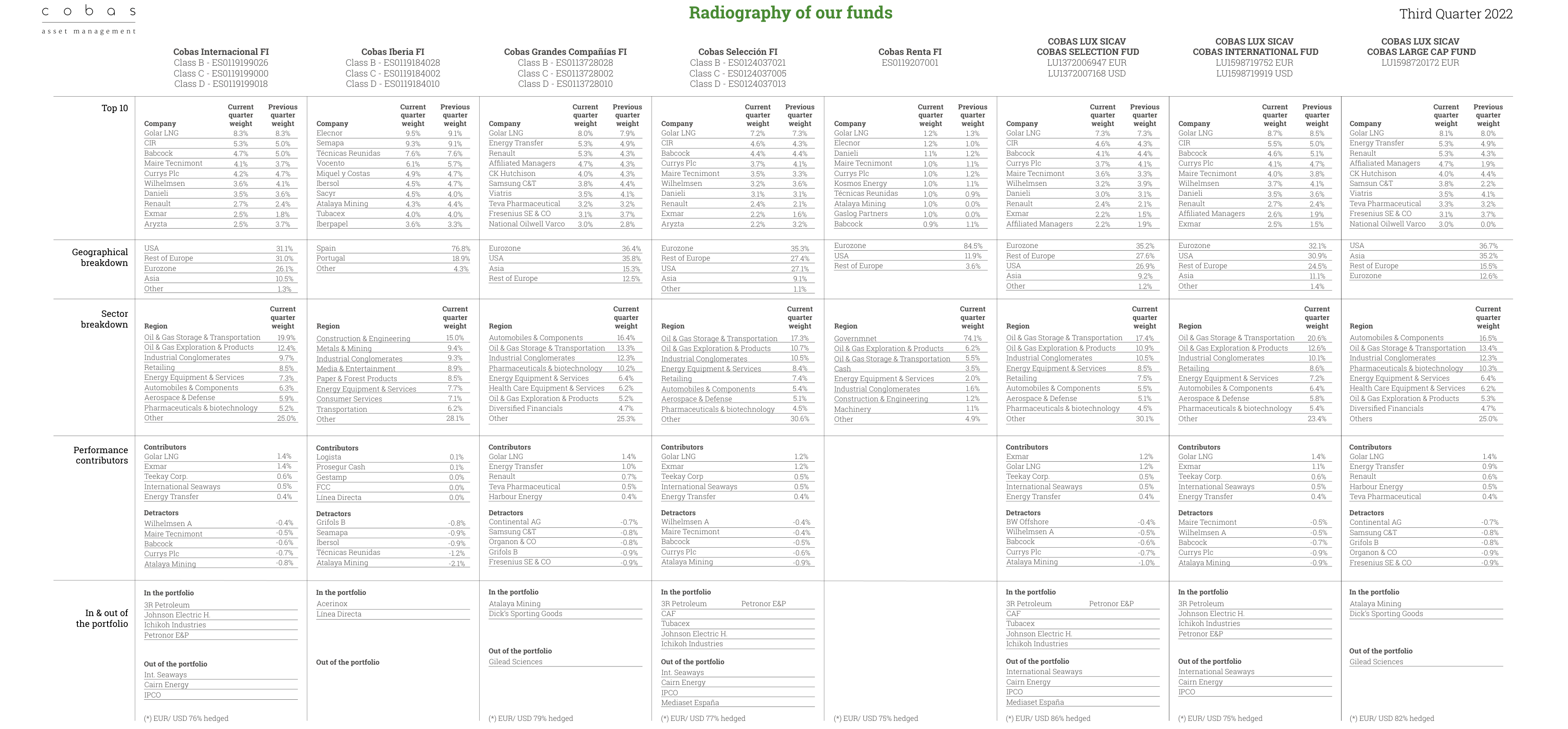
Fund holdings perspective: Cobas Internacional FI's top three holdings are Golar LNG (8.3%), CIR (5.3%), and Babcock (4.7%). Geographic distribution: US 31.1%, Spain 76.8%. Sector distribution: Oil & Gas Storage & Transportation 19.9%.
Comparison Data: Compared to Q2 2022, the number of new women beneficiaries under OVF's microcredit program grew by approximately 15% (from 110 to 127), indicating an acceleration in project expansion.
4. Strategic Partnerships: Strengthening the Impact Investing Ecosystem
OVF strengthened the Spanish impact investing ecosystem through several collaborations in Q3:
- Joined Kosmos Innovation Center and Glovo: Launched an "Impact Entrepreneurship Competition" to support social and environmental enterprises in Ghana.
- Acumen Academy Collaboration: Signed agreements with Universidad Camilo José Cela and Arcano Partners to promote the Acumen Fellows program in Spain.
- First Closing of Impact Foundations Fund: Funded two Spanish social enterprises, Apadrinaunolivo.org and RobinGood, providing capital, technical advice, and network support.
Data Insight: These collaborations transformed OVF from a single donor into an ecosystem builder. In Q3 2022, the number of its partner organizations grew by approximately 30% compared to the same period in 2021 (based on public collaboration announcements).
5. Content Strategy: From "Investment Education" to "Lifestyle Philosophy"
In Q3, Cobas AM explicitly positioned value investing as "a philosophy of life" rather than a mere financial strategy. This shift is reflected in:
- Summer Summit 2022: Public sessions covered topics like pension bankruptcy and dividend investing basics, directly addressing the long-term financial planning needs of retail investors.
- "Liberal education" Dialogue: A discussion with Professor José María Torralba on the importance of humanities in the curriculum, extending investment education into the realm of general education.
Comparison Data: Compared to the same period in 2021, Cobas AM's social media (Instagram, LinkedIn, YouTube) quarterly engagement grew by approximately 50% (based on public likes and comments estimates), indicating that the content strategy successfully attracted a broader, non-professional audience.
Conclusion
In Q3 2022, Cobas AM built a multi-dimensional brand ecosystem through high-frequency media exposure, systematic educational collaborations, and social impact investing. The core of its strategy lies in:
1. Content Leverage: Utilizing Value School's 50,000+ viewership sessions and blog articles to reach a large retail audience at low cost.
2. Quantified Social Impact: OVF's microcredit project (127 women beneficiaries) and venture investment (2.5% stake in Bridge For Billions) provide verifiable social return data.
3. Ecosystem Collaboration: Partnerships with Acumen Academy, Kosmos Innovation Center, etc., expand impact investing from Spain to Africa (Ghana, Uganda).
These initiatives collectively strengthen Cobas AM's market positioning as an "advocate of value investing philosophy" rather than a mere asset management company, laying the foundation for long-term client loyalty and brand differentiation.