Taking on the ‘blob’
Hosking Partners is a London boutique founded in 2013 by Jeremy Hosking, a portfolio manager at Marathon Asset Management for over 25 years. It runs a single global equity strategy built on the capital-cycle, supply-side approach — contrarian, long-term, and unusually diversified (350+ holdings) under a multi-counsellor model, managing around $5.5bn.
In plain words
This piece says public companies are drowning in compliance costs, letting private equity buy them cheap. Hosking Partners argues shareholders should team up to push companies back to business. Their example is Foxtons, a London estate agent whose value fell from £1bn to £100m. Hosking owns about 13% and ousted the chairman. The new chair bought 500,000 shares and hired a former exec. If cost cuts and a trading recovery work, profit could hit £60m, giving nearly 5x return at 8 times earnings.
At a Glance
One-sentence summary: The author believes that listed companies are being weighed down by compliance costs, allowing private equity to "bottom-fish," while activist shareholder interventions (such as the Foxtons case) can unlock undervalued potential. [Cautiously optimistic]
- Hosking points out that the time listed company boards spend on compliance has exceeded that on managing core businesses, leading to value being exploited by private equity through "compliance arbitrage."
- Foxtons' enterprise value has shrunk from £1 billion to approximately £100 million. Hosking has accumulated around 13% of shares and doubled its stake during the COVID-19 rights issue.
- By rallying shareholder pressure, Hosking successfully pushed for the resignation of Foxtons Chairman Ian Barlow, who was replaced by seasoned property executive Nigel Rich.
- New Chairman Rich has purchased 500,000 shares and appointed former executive Peter Rollings as a non-executive director, focusing on regaining market share.
- If cost cuts and a trading recovery succeed, Foxtons' pre-tax profit could exceed £60 million, yielding an investment return of nearly 5 times based on a P/E ratio of 8x.
Public Companies Are Being Crushed by Compliance Costs, Private Equity Seizes the Opportunity to "Buy the Dip"
The article points out that listed companies face stringent scrutiny from proxy advisors, institutional investors, environmental groups, and other parties, diverting management focus from core business to compliance responses, creating a phenomenon of "lost public companies." The author's original statement is that "boards of public companies spend more time responding to the ever longer compliance agenda than in stewarding the core business," meaning that "boards of directors of public companies spend more time dealing with an ever-lengthening compliance agenda than they do managing the core business." This "compliance arbitrage" creates an opening for private equity (PE)—they take these lost public companies private, refocus them on core operations, and then re-list them at higher valuations to sell back to public investors. Hosking argues that public equity investors should resist being "taken for a ride" through active shareholder coalition actions.
Foxtons: From a £1 Billion Brand to a £100 Million Residual Value
Foxtons is a classic case study of Hosking's active intervention strategy. Founded by Jon Hunt in 1981, this London real estate brokerage once achieved roughly twice the profitability of its peers and an average selling price 8% higher, thanks to its seller-centric business model. However, eight years after going public, the original corporate objectives gradually became blurred. After its 2013 IPO, the share price peaked at 376 pence, corresponding to an enterprise value of £1 billion (approximately 20 times pre-tax profit). Today, pre-tax profit stands at only £15-20 million, and the enterprise value has shrunk to around £100 million. Hosking sees this £90 million value destruction as an opportunity, having accumulated approximately 13% of the shares over the past two years and doubling his stake at 40 pence per share during a COVID-related rights issue in May 2020.
Driving Board Change: CEO Compensation Severely Decoupled from Performance
Hosking points out that the Foxtons board not only failed to take responsibility for the decline in performance but also continuously increased the compensation of CEO Nic Budden, who took office in 2014. In 2020, Budden's total compensation reached £1.6 million, while the board's collective shareholding was less than 1%. The author's original statement is that "no private equity firm would have permissioned such rewards for failure," meaning "no private equity firm would have allowed such a reward mechanism for failure." Starting in early 2021, Hosking launched a board lobbying campaign, including three letters to all directors and joining forces with other major shareholders (representing about one-third of the share capital) to apply pressure. Ultimately, in July 2021, Chairman Ian Barlow announced his resignation, and two months later, veteran real estate executive Nigel Rich took over.
Investment Implications
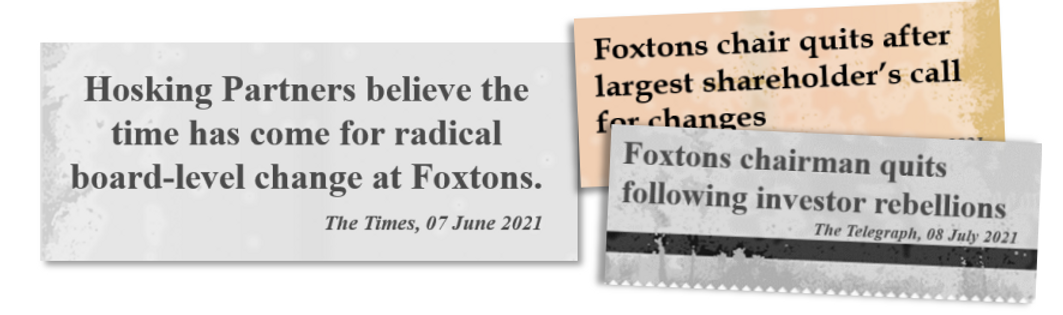
Hosking uses the Foxtons case to demonstrate his "active shareholder" strategy: piercing through the "Blob" (the fog created by external pressures) by uniting shareholder power to restore the company's core value. Readers should note that this is a perspective from a position holder—Hosking already holds approximately 13% of Foxtons shares, and his analysis naturally carries a narrative motivation to drive change.
New Chairman Brings Value Creation and Market Focus
The report notes that Mr. Rich, former CEO of Hongkong Land and Chairman of Hamptons International and Segro PLC, has been appointed Chairman of Foxtons. His extensive experience and value-creation mindset are expected to drive the company back to its core business. He appointed Peter Rollings, a former Foxtons executive from the Jon Hunt era, as a non-executive director on December 1. The author states, "This appointment should lead to an aggressive focus on regaining market share." Rich has demonstrated confidence through concrete actions—buying 500,000 shares over the past six weeks, while Rollings has also recently increased his stake. If Rich succeeds in revitalizing Foxtons, the return on his investment could be substantial.
Cost Cuts and Trading Recovery Could Drive Nearly 5x Returns
The report argues that by cutting excessive central costs (a key feature of the "Blob") and restoring historical trading levels, Foxtons' pre-tax profit could exceed £60 million. The current enterprise value is only £100 million, and the company has a net cash balance sheet. The author emphasizes that the embedded value of the customer base alone exceeds the current equity value, stating, "conservatively we believe the embedded value of the customer base alone accounts for more than the current equity value." This customer base (over 700,000 MyFoxtons portal users) is considered one of the best digital footprints in the UK residential real estate sector, a value that potential acquirers would not overlook. While the company is unlikely to return to its historical peak P/E ratio of 20x, applying an 8x P/E to restored earnings would yield an investment return of nearly 5x.
Investment Implications
The report uses Foxtons as an example to argue that active shareholder engagement can counter the "Blob" (the inflation of compliance and agency costs) and unlock value for small and mid-cap listed companies. The author believes that without such active intervention, this value will continue to flow to the private equity space. Readers should note that Hosking Partners holds a position in Foxtons, and the analysis reflects a stakeholder perspective—the optimistic estimate of return potential (nearly 5x) is based on a series of assumptions (cost cuts, trading recovery, 8x P/E), and the report explicitly acknowledges that "success is not assured."
Position Moves
| Ticker | Direction | Author's One-Sentence View | Key Data |
|---|---|---|---|
| Foxtons | Add | Active shareholder intervention can unlock undervalued potential, with return potential close to 5x | Cumulative stake ~13%; increased holdings at 40 pence in May 2020; current enterprise value ~£100 million; pre-tax profit target exceeding £60 million |