Tandem
Hosking Partners is a London boutique founded in 2013 by Jeremy Hosking, a portfolio manager at Marathon Asset Management for over 25 years. It runs a single global equity strategy built on the capital-cycle, supply-side approach — contrarian, long-term, and unusually diversified (350+ holdings) under a multi-counsellor model, managing around $5.5bn.
In plain words
This report uses a 'capital cycle' framework (watching if too much money flows into an industry, which kills profits) to find opportunities. The author is optimistic, arguing that capital-intensive sectors like shipping, mining, and oil have seen so little investment for a decade that supply is tight, making profits last longer than markets expect. Three key holdings: Pacific Basin (a shipping firm with a low P/E of 3.2 and insider buying), Alcoa (an aluminum producer benefiting from China's energy crisis reducing exports), and ConocoPhillips (an oil company with constrained new supply, extending its profit run).
At a Glance
One-sentence summary: Based on the capital cycle framework, the author believes that the recovery in returns for capital-intensive industries (shipping, mining, oil, banking) will be more durable than the market expects, with a [bullish] stance.
- A batch of capital-intensive companies in the portfolio (e.g., Pacific Basin, Alcoa, ConocoPhillips) performed strongly this quarter, attributed to the capital cycle reversal following prolonged underinvestment.
- The author emphasizes that supply constraints (long asset lives, ESG restrictions, dried-up financing) extend the profit cycle, and current low P/E ratios (e.g., Pacific Basin's forward P/E of just 3.2x) present contrarian buying opportunities.
- The largest holdings remain high-stability return companies (Amazon, Alphabet, Costco, TSMC), reflecting a flexible and diversified "fox, not hedgehog" strategy.
- China's energy crisis and ESG policies jointly suppress supply in traditional energy and mining, benefiting developed-market capacity that has survived Chinese competition, such as Alcoa.
- The author explicitly avoids companies that "rely solely on distant future expected returns," focusing instead on supply-side improvement opportunities verifiable through the capital cycle.
Capital-Intensive Stocks Led This Quarter, Driven by Capital Cycle Reversal
Quarterly Performance Highlights: A group of capital-intensive companies in the portfolio (shipping, mining, oil, banking) delivered strong performance, including Pacific Basin, Diana Shipping, Teck, Freeport, First Quantum, Alcoa, ConocoPhillips, Apache, Canadian Natural Resources, Avis Budget (even before its "meme stock" surge), Ferroglobe, Bank of America, and Wells Fargo. The report argues that the common thread among these stocks is that low long-term returns on capital led to underinvestment, and returns have now unexpectedly rebounded—a trend foreseeable through capital cycle analysis, rather than simply attributed to inflation or supply chain news.
Capital Cycle Framework: Recovery in Low-Return Sectors as Core Opportunity
Capital Cycle Logic: High-return sectors attract new entrants → competition intensifies → returns decline (sometimes below the cost of capital) → investment decreases, capital stock ages, consolidation/exit occurs → supply improves → returns recover. Meanwhile, stock market sentiment fluctuates in tandem: optimism when returns are high, share price declines as competition intensifies, prices bottom when returns hit a trough, and then rise as expectations recover. The author notes that opportunities for capital cycle investors come from two main areas: first, the market overestimating the speed of decline in returns for certain high-return companies; second, the market underestimating the likelihood of recovery in depressed sectors (when supply-side improvements have already occurred).
The author states: "What makes the capital cycle so versatile as a tool is that as well as providing a framework for investing in companies with low but volatile returns which are likely to recover sooner than the market credits, it also highlights the opportunity in companies with high and stable returns which enjoy barriers to the supply of new capacity which will mean that those returns will resist the gravity of mean reversion for longer than their share price suggests." This means: the versatility of the capital cycle tool lies in that it not only provides a framework for investing in companies with low but volatile returns that may recover sooner than the market credits, but also highlights opportunities in companies with high and stable returns, where barriers to new capacity supply mean those returns will resist the gravity of mean reversion for longer than their share price suggests.
Portfolio Structure: Coexistence of Capital-Intensive and High-Stable-Return Companies
Portfolio Actions (specific buys/sells not disclosed, only composition described): The portfolio has a higher proportion of capital-intensive stocks than most peers, but its largest holdings include Amazon, Alphabet, Tinkoff Credit, Costco, and TSMC—companies with higher and more stable returns. The author self-assesses: "We are foxes, not hedgehogs" (implying flexibility and diversity rather than a single strategy). What the author explicitly avoids are companies with no positive returns in the past, relying solely on distant future expected returns ("we leave those to smarter investors").
Historical Overinvestment Led to Long-Term Overcapacity, Recent Supply-Side Improvement
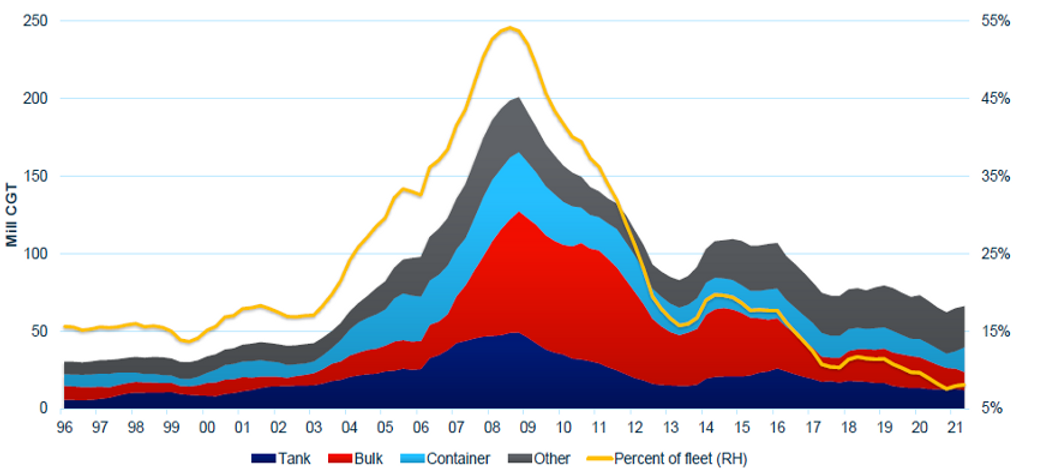
Historical Context of Capital-Intensive Stocks: The low returns of many companies trace back to before the global financial crisis—cheap and abundant capital, a China-driven commodity "super cycle," and wasteful capital allocation by management, leading to massive overexpansion and overcapacity. Asset lifespans are long: mines require a decade of approvals and capital expenditure before production, and ship orders take at least two years from order to delivery with a 20-year service life. In the shipping industry, for example, the global ratio of new ship orders to the existing fleet has been declining for a decade from a 50% peak, but the absolute fleet size continued to grow until recent years, when new ship growth only matched or fell below demand growth.
China Factor and ESG Jointly Suppress Supply, Benefiting Existing Capacity
China's Aluminum Industry and Energy Crisis: China, driven by economic self-sufficiency strategy, has prioritized investment in aluminum, using stranded coal assets in the west to generate power for aluminum production, both for domestic consumption and export, destroying international competitors' capital returns over the past two decades. China's commitment to peak carbon emissions by 2030 and reduce carbon intensity by 65% over the same period may signal a turning point. The recent energy crisis in China has brought short-term benefits to Alcoa (reduced Chinese aluminum exports). The author believes that the root of China's power shortage lies in long-term underinvestment in traditional global energy, with the mistaken belief that renewable energy could quickly, cleanly, and cheaply replace it. Capital Cycle and ESG Synergy: Industries are punished for poor historical investment performance and simultaneously restricted due to excessive emissions—the result is the same: longer periods of high returns. Constrained reliable power supply, combined with post-pandemic demand recovery, has boosted returns for LNG, coal, and developed-market aluminum smelters that survived Chinese competition. Similar dynamics are also evident in the silicon market (via investment in Ferroglobe).
Capital Flows to Asset-Light Industries, Essentially a Penalty for Capital Waste
Market Narrative Analysis: Over the past decade, capital has been attracted to asset-light industries (where intangible assets are hard to replicate and demand growth offsets overcapacity concerns). Investment commentators might describe this as "growth" beating "value" or "quality" beating "cyclicals," but the author believes this is essentially the market penalizing certain industries and their management for wasting capital, while rewarding those that achieve higher valuations (or at least promise to do so) through prudent capital management.
Appendix: Position Moves
| Position | Action | Key Logic & Data |
|---|---|---|
| Pacific Basin | Hold & Observe | Dry bulk shipping, benefiting from capital cycle reversal, return recovery after prolonged low returns |
| Diana Shipping | Hold & Observe | Same as above |
| Teck | Hold & Observe | Mining, benefiting from return recovery after historical underinvestment |
| Freeport | Hold & Observe | Same as above |
| First Quantum | Hold & Observe | Same as above |
| Alcoa | Hold & Observe | Aluminum, benefiting from reduced Chinese exports due to energy crisis and global underinvestment in traditional energy |
| ConocoPhillips | Hold & Observe | Oil, benefiting from supply constraints and post-pandemic demand recovery |
| Apache | Hold & Observe | Same as above |
| Canadian Natural Resources | Hold & Observe | Same as above |
| Avis Budget | Hold & Observe | Car rental, strong performance (even before the meme stock surge) |
| Ferroglobe | Hold & Observe | Silicon, benefiting from similar supply-constrained dynamics |
| Bank of America | Hold & Observe | Banking, benefiting from return recovery in capital-intensive industries |
| Wells Fargo | Hold & Observe | Same as above |
| Amazon | Hold & Observe | High-stability return company, one of the largest holdings |
| Alphabet | Hold & Observe | Same as above |
| Tinkoff Credit | Hold & Observe | Same as above |
| Costco | Hold & Observe | Same as above |
| TSMC | Hold & Observe | Same as above |
Capital Cycles Determine Return Duration, Asset Life Is the Key Variable
The length of low-return periods in capital-intensive industries depends on asset life, supply constraints, and external shocks. The author argues that the "antidote" to low returns is low returns themselves—prolonged underinvestment eventually pushes up returns on remaining capital. However, the wavelength of capital cycles varies by industry, primarily influenced by asset life (time needed to depreciate old capacity), with three additional prolonging factors: 1) Premature bottom-fishing by private equity (e.g., the mid-2010s influx of new capacity in the shipping industry extended the downturn by several years); 2) Supply constraints can actually accelerate the recovery of returns (e.g., only two manufacturers of U.S. logging equipment remain, leading to long lead times for new capacity delivery; European papermaker UPM-Kymmene proactively closed plants ahead of schedule); 3) Dried-up financing channels (Nordic specialized banks in shipping went bankrupt or closed shipping divisions), government regulation (cancellation of North American oil and gas pipelines, restrictions on new drilling), and geopolitics (regionalization of supply chains reducing global capacity) all constitute supply barriers.
The Capital Cycle Framework Provides a Basis for Contrarian Investing, Not Blind Bottom-Fishing
The core value of capital cycle analysis lies in providing confidence to accumulate positions when industry returns hit bottom, distinguishing contrarian investing from value traps. The author emphasizes that contrarian thinking alone risks falling into value traps, but combined with bottom-up capital cycle analysis, it enables betting at the moment when "odds are most favorable and the situation is about to reverse." The author's original words: "To be right too early is to be wrong, we say that you will never own a stock at the bottom unless you are prepared to be early" (meaning: "Those commentators who say 'being right but too early is being wrong'—we believe that unless you are prepared to enter early, you will never buy a stock at the bottom"). Diversified portfolios and long-term performance fee structures provide room for such patience.
Current High Returns Are Not Fleeting; Supply Constraints Extend the Profit Cycle
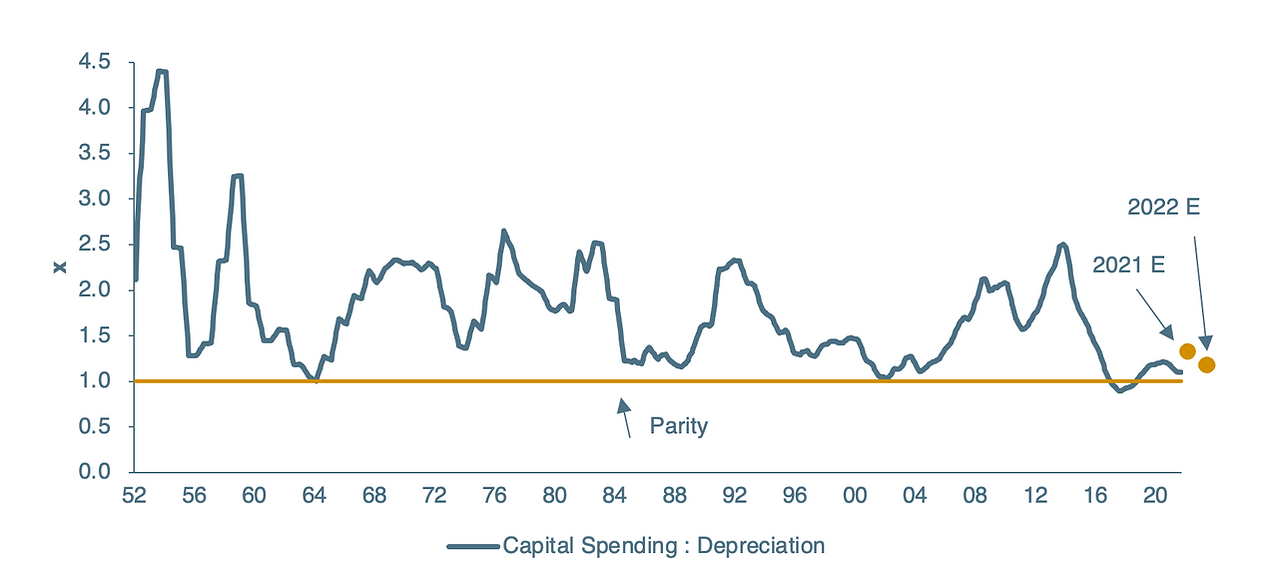
The market views current earnings of cyclical stocks as a one-off pulse, but supply constraints mean high returns may last longer than valuations reflect. The author notes that short-term performance-oriented participants tend to attribute current earnings to "headline factors" like inflation, energy prices, and port congestion, while Hosking focuses on a more fundamental question: What are the constraints on new capital entry? What is the outlook for capacity expansion? Analysts try to forecast future demand to the decimal point, but the author prefers to make rough estimates of supply based on observable phenomena such as capital market activity, capital expenditure projects, and hiring announcements—these signals can indicate the arrival or absence of new supply in advance.
Performance comparison: The author uses Chart 4 to show that the capital expenditure/depreciation ratio for developed market mining stocks is at historical lows, confirming sustained underinvestment on the supply side.
Supply Constraints Create Valuation Anomalies: Buy at Low P/E, Wait for Mean Reversion
If supply constraints (i.e., barriers to entry) mean high returns will persist longer, then current low valuations present an opportunity. The author explains the cyclical stock valuation paradox: P/E is extremely low at peak profits (the market believes earnings are unsustainable), and extremely high or even negative at trough profits. However, if supply constraints cause returns to persist longer before reverting to the mean (with an inevitable overshoot to the downside thereafter), a valuation anomaly exists to exploit.
Key stock: Pacific Basin (dry bulk shipping)
- Thesis: Bullish; the author explicitly cites it as a "vivid portfolio case."
- Evidence: Forward P/E of only 3.2x; the chairman just spent $500,000 to increase his stake by 9%. The author's original words: "This kind of insider behaviour should be catnip to the patient outside investor" (meaning: "Such insider behavior should be as enticing as catnip to patient outside investors").
- Risk: Not explicitly stated, but the shipping industry's capital cycle history shows that return recovery can be prematurely ended by new capacity.
Position Moves
| Ticker | Direction | Author's One-Sentence View | Key Data |
|---|---|---|---|
| Pacific Basin | Hold & Watch | Dry bulk shipping, core case of capital cycle reversal, strong insider buying signal | Forward P/E 3.2x; Chairman increased stake by 9% |
| Alcoa | Hold & Watch | Aluminum benefits from China's energy crisis reducing exports, global underinvestment in traditional energy | China's carbon neutrality pledge may limit aluminum exports |
| ConocoPhillips | Hold & Watch | Oil, supply constrained (pipeline cancellations, drilling restrictions) coupled with post-pandemic demand recovery | Developed market mining capex/depreciation ratio at historical lows |
| Ferroglobe | Hold & Watch | Silicon market, similar supply-constrained dynamics | Specific data not disclosed |
| Amazon | Hold & Watch | High-stability return company, one of the largest holdings, benefits from supply barriers | Specific data not disclosed |
| Alphabet | Hold & Watch | Same as above | Specific data not disclosed |
| Costco | Hold & Watch | Same as above | Specific data not disclosed |
| TSMC | Hold & Watch | Same as above | Specific data not disclosed |
| Tinkoff Credit | Hold & Watch | Same as above | Specific data not disclosed |
| Bank of America | Hold & Watch | Banks, benefiting from recovery in returns from capital-intensive industries | Specific data not disclosed |
| Wells Fargo | Hold & Watch | Same as above | Specific data not disclosed |
| Avis Budget | Hold & Watch | Car rental, strong performance (even before the meme stock surge) | Specific data not disclosed |