The End of the Beginning or the Beginning of the End?
Hosking Partners is a London boutique founded in 2013 by Jeremy Hosking, a portfolio manager at Marathon Asset Management for over 25 years. It runs a single global equity strategy built on the capital-cycle, supply-side approach — contrarian, long-term, and unusually diversified (350+ holdings) under a multi-counsellor model, managing around $5.5bn.
In plain words
This report warns that chasing unicorn companies like Uber is risky—they burn cash and have inflated valuations. Instead, it sees value in overlooked traditional industries like airlines and banks. For example, Uber lost $800 million in Q1 2019 alone, while the US airline industry earned $77.2 billion over a decade and returned $39 billion to shareholders. Big banks cut customer service costs from $1,000 to under $800 using digital tech.
At a Glance
One-sentence summary: The author adopts a [cautious/bearish] stance on the current innovation cycle, arguing that the high valuations in the unicorn sector are a product of the "conjunction fallacy," while the unit economics of traditional industries (aviation, banking) are systematically undervalued, with the next batch of winners hiding within them.
- Citing Sir John Templeton's view that "technology changes the world but not human nature," the author points out that investors often lose money in the late stages of an innovation cycle, and the current unicorn IPO frenzy is a speculative release.
- Using Amazon as an example, the author believes that current winners (FAANG, etc.) face the law of large numbers, and future growth will require entry into capital-intensive sectors, leading to declining incremental returns on capital.
- The author warns of the "conjunction fallacy" trap for unicorn companies like Uber: Uber posted an $800 million loss in Q1 2019, while Amazon burned only $800 million from its inception to self-sufficiency—the two are not comparable.
- The author is bullish on the aviation and banking sectors: U.S. airlines generated $77.2 billion in net profit over the past decade and returned $39 billion to shareholders, while ride-hailing companies have cumulatively burned $15 billion; large banks have reduced customer service costs from $1,000 to below $800 through digital technology.
- The author predicts that as the innovation cycle matures, the market will undergo a sharp correction in the valuation mismatch between current winners and losers, and the value stock rebound will be very intense.
At a Glance
Investment Returns in Innovation Cycles Concentrate in Early Stages; Society Ultimately Benefits, but Late-Stage Investors Often Suffer Losses
The author cites the late Sir John Templeton's August 2000 view that technology has changed the world but "not changed human nature." The author considers this judgment highly prescient. The advancement of disruptive technological innovation follows a fixed path, known as the "innovation cycle": investment returns concentrate in the early stages of the cycle, and before technological maturity arrives, society becomes the ultimate beneficiary—disruptive innovation wins, but late-stage investors often lose. The core observation is that human psychology is inherently inclined to linearly extrapolate current trends, thus often overestimating the impact of adopting new disruptive technologies. Meanwhile, a group of "disruptive superhumans" deliberately reinforces this forward-looking bias, leveraging a psychological phenomenon called the "conjunctive fallacy." They explicitly invoke Amazon's business template of "losing money today, dominating the market tomorrow," selling new shares at high prices in private markets or through IPOs.
The Unicorn Industry Relies on Growth Narratives and Subjective Valuations, Avoiding Public Market Scrutiny
The "Unicorn Industry" refers to fast-growing (though not necessarily young) technology companies with a combined valuation of approximately $700 billion, each valued at over $1 billion. Their selection metric is growth, and the narrative is "Blitzscaling." In this world, "moving fast and breaking things" is the path to the promised land of a winner-takes-all economy. Since these companies incur losses rather than profits, their valuations are not based on traditional earnings or cash flow multiples, but on a set of subjective and self-referential assumptions. These valuations are manipulated by a growing group of private equity/venture capital managers who charge high fees and trade companies among themselves in "up-only" rounds—no one wants a valuation markdown.
This Report Proposes Four Core Arguments
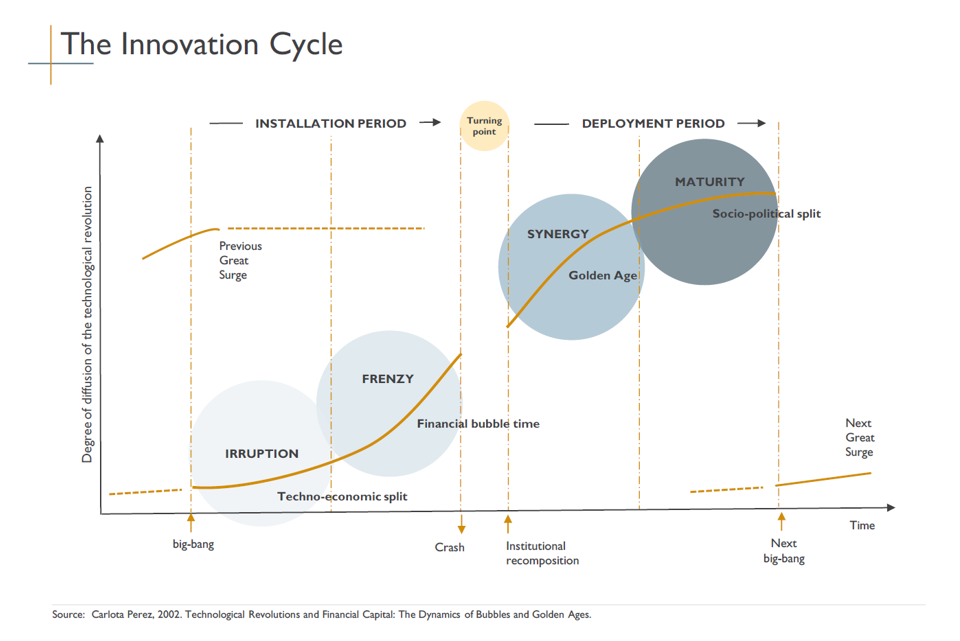
The author argues that examining the current position in the innovation cycle and the behavior of the unicorn industry offers instructive insights for public equity investors. The report presents four arguments:
1. "The past is prologue": Human nature ensures we repeat past behaviors; this innovation cycle and the resulting investor behavior are no different from previous ones.
2. Innovation cycles create winners: But at the current scale and valuation, today's winners may have become mathematical victims of their own success.
3. The unicorn industry's rush to IPO is evidence of speculative release: The conjunctive fallacy distorts valuations in both private and public markets.
4. The next batch of stock market winners is hiding in plain sight: The frenzy surrounding pioneers of the innovation cycle obscures a group of mature companies with low valuations, strong unit economics, and adoption of new technologies.
The Case of Railroad Tycoon George Hudson: Heroes Turn Villains in the Innovation Cycle as Capital Inflows Lead to Deteriorating Returns
The author uses the example of 19th-century British railroad tycoon George Hudson to illustrate how early success in an innovation cycle attracts competing capital, ultimately leading to overbuilding and fraud. At his peak, Hudson was known as the "Railway King," an early practitioner of blitzscaling business strategies—more than a century before LinkedIn founder Reid Hoffman coined the term. His Midland Railway expanded rapidly, encompassing highly profitable and (in the short term) monopolistic routes between London and the industrial heart of the East Midlands. However, this early financial success triggered a wave of competing capital, leading to railroad construction expanding into increasingly marginal and less profitable lines. Hudson ultimately collapsed under the need to issue more shares to support highly capital-intensive projects, even resorting to paying dividends out of capital—a form of securities fraud.
The Innovation Cycle Pattern Repeats Throughout History; Technological Progress Is Not Smooth
The author notes that similar patterns emerged in the U.S. during the revolutions in lighting, telephony, oil, and the PC and internet revolutions of the late 20th century. The core observation is that technological progress is not smooth. As Schumpeter argued, the creative destruction unleashed by entrepreneurship, and the subsequent investment frenzy, is "lumpy." Nevertheless, the promise of the future has always been capital's greatest temptation. The author borrows economist Carlota Perez's framework to illustrate these cycles with charts. If this framework holds true today, it raises critical questions for public equity investors: Where are we in the current innovation cycle? To what extent has the stock market underestimated or overestimated the impact of this cycle? Are there valuation distortions in disruptive companies that could reverse? Finally, are there unrecognized beneficiaries of the cycle?
Current Winners Face the Law of Large Numbers and Growth Bottlenecks
The author argues that while current winners such as FAANG and BATS possess deep moats and high returns on assets, their market capitalizations and market shares have already subjected them to the mathematical challenges of the law of large numbers. Future growth will require entry into capital-intensive sectors, and incremental returns on capital will decline.
- Performance Comparison: This chapter does not directly compare current-period returns with benchmarks but instead focuses on a qualitative analysis of the future growth potential of current winners.
- Key Stocks: The author uses Amazon as an example, noting that its foray into fresh grocery retail (requiring a multi-billion-dollar cold chain supply chain) epitomizes the "shift from the internet economy to the real economy." The author states, "Not only will huge amounts of capital be required to grow from this point, but lower returns will be expected on this incremental capital as compared to prior capital allocation decisions." This means: "Not only will huge amounts of capital be required to grow from this point, but lower returns will be expected on this incremental capital as compared to prior capital allocation decisions."
- Valuation Analysis: Through hypothetical calculations, the author points out that if current winners maintain their historical growth rates, the sum of their terminal market capitalizations would exceed one-third of the projected U.S. GDP for 2022. Citing the "total stock market capitalization/GDP" indicator favored by Warren Buffett, the author notes that a ratio around 75% is reasonable for the overall market, while below 50% indicates significant undervaluation (typically corresponding to bear market bottoms), implying that current valuations are in extreme territory.
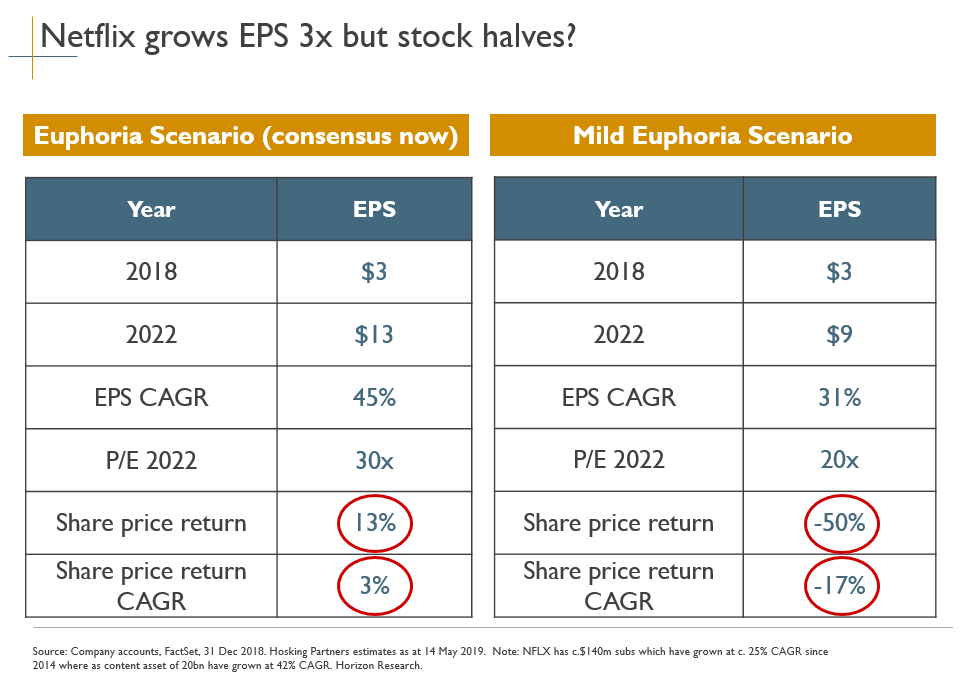
- Risk Warning: Using Netflix as an example, the author assumes that if its earnings only triple (rather than quadruple as per Bloomberg consensus expectations) and its valuation falls to a P/E of 20x (Facebook's current level), the stock price would be cut in half. This directly highlights the risk of "growth expectations falling short."
The Unicorn IPO Boom Is a Speculative Release; the Conjunctive Fallacy Is a Trap
The author warns that the wave of unicorn IPOs is evidence of speculative release, and investors are highly susceptible to the conjunctive fallacy—overestimating the probability of a complex narrative (e.g., "the Amazon of transportation") while underestimating simple base rates.
- Market/Macro Judgment: Stance [Bearish]. The author believes that the probability of current winners becoming good investments in the future is very low, while the probability of many unicorn IPOs becoming poor investments is very high.
- Key Stocks: The author uses Uber as an example, comparing its development path with Amazon's. The author states, "We question the extent to which Amazon is a relevant template here: between 1995 and 2002 Amazon burned through $0.8bn before turning free cash flow positive and becoming self-funding. In contrast, Uber lost $0.8bn in the first quarter of 2019 alone." This means: "We question the extent to which Amazon is a relevant template here: between 1995 and 2002 Amazon burned through $0.8bn before turning free cash flow positive and becoming self-funding. In contrast, Uber lost $0.8bn in the first quarter of 2019 alone." The author emphasizes that Amazon started with low-capital, low-difficulty categories like books and gradually expanded, while Uber from the outset attacked the most capital- and labor-intensive transportation industry without moats such as employees or owned assets. The author predicts that Uber may be forced to shift to an asset-heavy model like Amazon, but its cash flow situation will be far worse than Amazon's.
- Position Moves: This chapter does not mention specific position changes, but through comparative analysis, it implies an avoidance or bearish stance toward unicorns like Uber.
- Risk Warning: The author points out that private markets maintain high valuations for unicorns through opaque valuation methods and complex financial structures (e.g., "up-only" rounds), but public markets will not be as forgiving. Using WeWork as an example, the author notes that its "community-adjusted EBITDA" metric turned a $1.4 billion GAAP loss into a $725 million profit, a classic case of creative accounting.
At a Glance
The next batch of winners is hiding in traditional industries.
The author argues that in the current innovation cycle, the market has mistakenly rewarded unicorn companies pursuing loss-driven market dominance strategies, while truly sustainable, profitable traditional industries with technology integration potential (such as airlines and banks) have been overlooked, creating opportunities for patient investors.
- Performance Comparison: This chapter does not directly provide fund performance but supports its argument by comparing industry data.
- Position Moves: This chapter does not mention specific position moves but clearly identifies the industry directions favored by the author.

Airlines: Unit Economics Far Superior to Ride-Hailing Companies
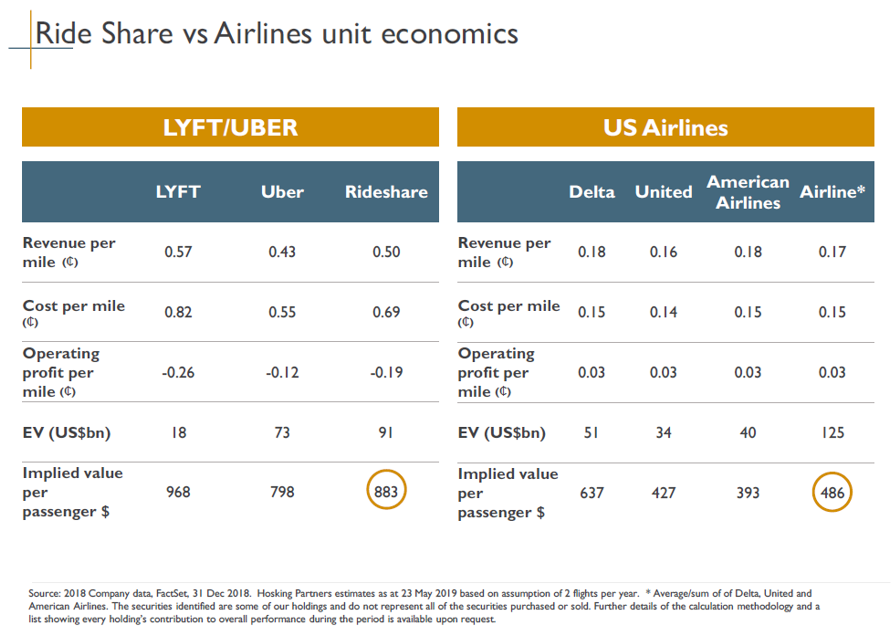
The author demonstrates the significant advantage of traditional industries in unit economics by comparing the financial data of the airline industry with ride-hailing companies.
- Argument (Bullish on Airlines): Despite different valuation methods, the current unit economics of the US airline networks appear to be vastly superior to that of the ride-hailing companies.
- Evidence:
- Ride-Hailing Companies (Uber & Lyft): Over a decade of operations, they have cumulatively raised $30 billion in capital and burned through approximately $15 billion.
- US Airline Industry: Over the same period, it achieved a net profit of $77.2 billion, returned $39 billion to shareholders through buybacks and dividends, and invested tens of billions in fleet renewal.
- Market Valuation Paradox: The market assigns a low implied terminal value multiple of only 7-9 times earnings to the airline industry, which serves a larger customer base.
- Overlooked Value: The above analysis does not account for the substantial acquisition value embedded in airline loyalty programs and credit card businesses.
- Technology Integration: The airline industry is undergoing a "silent technology and productivity innovation cycle." Since 2000, the number of full-time employees in the US airline industry has decreased from approximately 520,000 to 440,000, while revenue passenger miles (RPMs) have grown from 525 billion to over 1 trillion.
- Author's Quote: "the current unit economics of the US airline networks appear to be vastly superior to that of the ride share companies."
Banking: Digital Technology Boosts Efficiency, Costs Continue to Decline
The author believes that major US banks have significantly improved productivity and reduced service costs by adopting digital and mobile banking technologies.
- Argument (Bullish on Large Banks): Traditional banks are acting as "fast followers," absorbing technologies pioneered by winners of the innovation cycle to repair industry profitability.
- Evidence:
- Branch Rationalization: Since the financial crisis, Bank of America has closed nearly 2,000 branches.
- Deposit Growth: Over the same period, its deposit base has grown by an average of $43 billion annually.
- Cost Reduction: The cost of serving customers, measured by non-interest income divided by the number of customers, has fallen from $1,000 in 2009 to below $800 today.
- Author's Judgment: The profitability repair in the airline and banking industries is largely attributable to the integration of new technologies pioneered by the winners of the current innovation cycle, a "fast follower" strategy.
Market Assessment: Valuation Mispricing Set for a Sharp Correction
The author holds a [cautious/bearish] view on the current market structure, arguing that the high valuations of unicorn industries are a product of the "conjunction fallacy," while the value of traditional industries is systematically undervalued.
- Divergence from Consensus: The market is chasing loss-making unicorn companies, which the author considers "modern-day George Hudsons," whose strategies are at best overly optimistic.
- Core Logic: The most profitable routes in the innovation cycle (search and social) have been monopolized, and the remaining routes require massive capital. Unicorn industries attempt to use Amazon's "conjunction fallacy" to justify their losses, but this is a mistake.
- Opportunity: All the bubbles are diverting attention away from industries with strong profitability, durable unit economics, and ongoing technology integration (e.g., food retail, airlines, large banks). These industries remain subject to traditional valuation paradigms, which happen to be inapplicable to unicorn industries.
- Outlook and Risk Warning: The underperformance of value stocks relative to growth stocks has set a record for the longest stretch. As the innovation cycle matures and technology diffuses further, the market will reassess the valuation mispricing between current winners and losers. The author warns: "If history is any guide, the snapback on this rubber band will be violent."
Position Moves
| Ticker | Direction | Author's One-Sentence View | Key Data |
|---|---|---|---|
| Amazon | Hold & Observe | A current winner, but faces the law of large numbers; entering heavy-asset sectors like fresh grocery retail will drag down incremental returns on capital | Burned $800 million from 1995 to 2002 before becoming self-sufficient; hypothetical calculations suggest its terminal market cap could exceed one-third of U.S. GDP |
| Netflix | Hold & Observe | High risk of growth expectations falling short; if earnings only triple and the valuation reverts to 20x P/E, the stock could be cut in half | Consensus expects earnings to quadruple; the author assumes a triple |
| Uber | Not specified (avoid/bearish) | The Amazon template does not apply; it started by attacking the capital-intensive transportation industry, lacks a moat, and its cash flow is far inferior to Amazon's | Lost $800 million in Q1 2019; raised $30 billion and burned $15 billion over ten years of operations |
| WeWork | Not specified (avoid/bearish) | A classic case of creative accounting; "Community Adjusted EBITDA" turned a $1.4 billion GAAP loss into a $725 million profit | $1.4 billion GAAP loss vs. $725 million adjusted profit |
| U.S. Airlines | Not specified (bullish) | Unit economics are far superior to ride-hailing companies; the market assigns only 7-9x earnings, implying a low terminal value, and fails to account for the value of loyalty programs | $77.2 billion in net profit over ten years, returning $39 billion to shareholders; headcount reduced from 520,000 to 440,000, while RPMs rose from 525 billion to over 1 trillion |
| U.S. Large Banks | Not specified (bullish) | By integrating digital technology as "fast followers," costs continue to decline and profitability is recovering | Closed nearly 2,000 branches; deposits grew by an average of $43 billion annually; customer service costs fell from $1,000 to below $800 |