Comments on First Quarter 2021
Cobas Asset Management is a Madrid deep-value firm founded in late 2016 by Francisco García Paramés, Europe's standard-bearer of value investing after 25+ years running Bestinver and author of "Investing for the Long Term". Cobas applies a strict Graham/Buffett value framework overlaid with Austrian business-cycle theory, concentrating in unloved energy, shipping and other cyclicals, with AUM above €3.4bn. Its investor letters are fully archived from Q1 2017, moving to a semi-annual cadence in 2022.
In plain words
This report covers Cobas's investment moves in early 2021. The key takeaway: value stocks (companies with steady profits but low prices) are making a comeback as interest rates rise. Cobas saw several of their holdings get buyout offers—though below their own estimates, it shows the market is noticing these hidden gems. They also sold some winners to buy even cheaper stocks. For regular investors, this means: when rates go up, focus on companies that actually make money, not just those promising future growth.
The Cobas research report discusses key company transactions in the investment portfolio for the first quarter of 2021 and the recovery trend in value investing. The core argument is that although the acquisition offers received by Hoegh LNG and Semapa were below their valuations (Hoegh LNG's offer
Theme and Background
This section discusses the multiple significant corporate transactions that occurred in the Cobas portfolio during the first quarter of 2021, as well as the trend of value investing strategies beginning to recover against the backdrop of inflation expectations and interest rate normalization. The author argues that although some acquisition offers were below their valuations, these transactions validate the underlying value of the portfolio.
Core Views
- Value investing is reversing its downturn: Since the approval of the COVID-19 vaccine in November 2020, the performance of value investing has begun to improve, benefiting from inflation expectations and interest rate normalization, which have made companies with uncertain future earnings less attractive.
- Corporate earnings are the sole determinant of long-term stock prices: The author emphasizes that companies capable of consistently generating profits and free cash flow will benefit in an environment of interest rate normalization.
- Acquisition offers, though below valuations, reflect portfolio value: The acquisition offers received by Hoegh LNG and Semapa were opportunistic and below Cobas’s valuations, but they indicate that the market is beginning to pay attention to these undervalued assets.
Key Arguments and Data
- Fund net asset value growth: The net asset values of the International Portfolio and the Iberian Portfolio both achieved +20% growth in the first quarter of 2021, continuing the strong momentum since November 1, 2020 (the date the first COVID-19 vaccines were approved).
- Impact of interest rate normalization: As inflation expectations rise, interest rates have begun to increase, making companies that “may not be profitable for years or even ever” less attractive. In contrast, companies in the Cobas portfolio, which generate profits and free cash flow, benefit relatively.
- Active corporate transactions: Corporate transactions affecting undervalued companies intensified during the quarter, involving two significant acquisition offers (Hoegh LNG and Semapa) and three major transactions in the International Portfolio.
Companies/Assets Involved
| Company/Asset | Role/Event | Key Data | Bullish/Bearish |
|---|---|---|---|
| Hoegh LNG | Received acquisition offer | Offer below Cobas’s valuation, but the special shareholders’ meeting has approved it, forcing the fund to sell at the indicated price | Bullish (believes valuation is higher, but forced to sell) |
| Semapa | Received acquisition offer | Offer below Cobas’s valuation | Bullish (believes valuation is higher) |
| Golar | Sold subsidiary Hygo | Significant impact on a major holding in the Cobas portfolio | Neutral (transaction completed, proceeds to be reinvested) |
| Aryzta | Sold North American division | A major transaction within the International Portfolio | Neutral (transaction completed, proceeds to be reinvested) |
| International Seaways | Merged with Diamond S Shipping | A major transaction within the International Portfolio | Neutral (transaction completed, proceeds to be reinvested) |
| Diamond S Shipping | Merged with International Seaways | Same as above | Neutral |
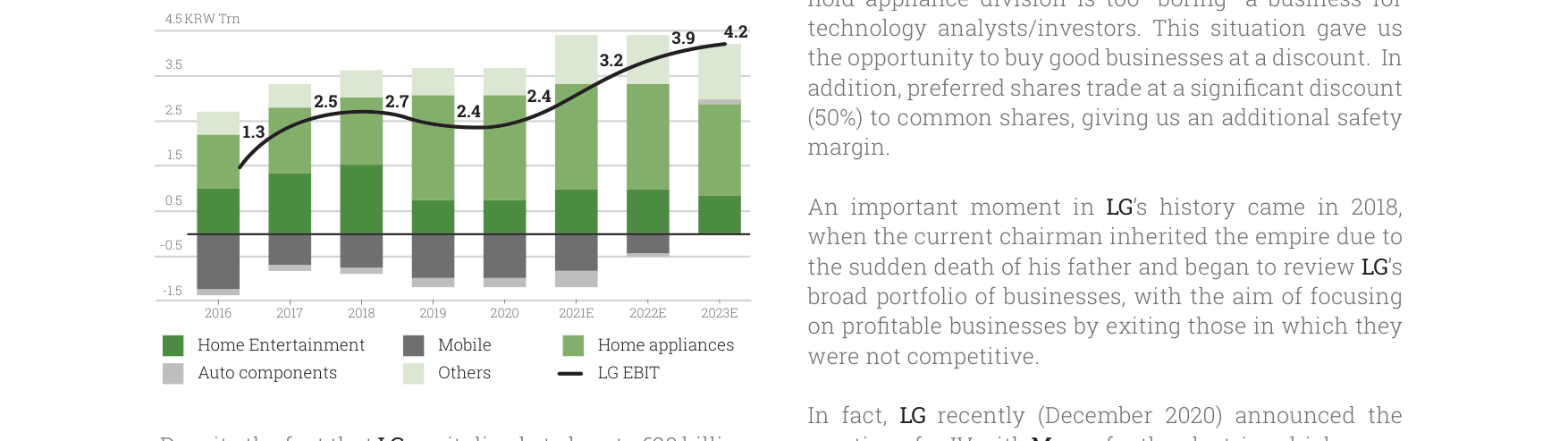
LG Electronics’ EBIT grew from KRW 1.3 trillion in 2016 to an expected KRW 4.2 trillion in 2023, with the home appliance business contributing the most
Investment Implications
- Focus on the recovery of value stocks: As interest rates normalize, investors should shift toward companies that can generate stable profits and free cash flow in the present, rather than relying on high-valuation growth stocks that may only become profitable years later.
- Use acquisition premiums to exit: When an undervalued company receives an acquisition offer, even if the offer is below one’s own valuation, it should be seen as a signal of market value recognition. The recovered capital can then be reallocated to other similarly promising targets in the portfolio.
- Contribution from Asian investments: Investments in Asia over the past four years have added value to the fund through relative excess returns, warranting investor attention to value opportunities in the region.
Theme and Background
This chapter focuses on the takeover offers received by two companies in the Cobas portfolio (Hoegh LNG and Semapa), as well as the asset sale transaction of Golar LNG. By comparing the offer prices with Cobas's internal valuations, the report reveals market pricing deviations and discusses how to respond to undervalued takeover bids within a value investing framework.
Core Thesis
The author's core judgment is that the takeover offers received by Hoegh LNG and Semapa are both significantly below their intrinsic values, leading Cobas to vote against or refuse to participate. The counterintuitive aspect is that, despite the seemingly substantial premium (36% for Hoegh LNG), the author believes this remains far below the true value. Meanwhile, although the asset sale price for Golar LNG is reasonable, the market's valuation of its remaining business is nearly zero, which instead creates a contrarian investment opportunity.
Key Arguments and Data
- Hoegh LNG: The founding family (holding ~50%) partnered with Morgan Stanley Infrastructure Partners to launch a delisting offer at NOK 23.5 per share, a 36% premium over the pre-announcement closing price. However, Cobas believes this price does not reflect the company's true value and therefore voted against it.
- Semapa: The Queiroz Pereira family, through its holding company Sodim, launched an offer to acquire the 28% of shares it did not already own, raising the bid from €11.4 per share to €12.17 per share. Based on objective data (Navigator's market capitalization and Semapa's debt), Cobas estimates the value at approximately €14 per share. If further accounting for Secil (a cement company with an average EBITDA of around €90 million over the past six years) and the difference between Navigator's target price and market capitalization, the reasonable valuation could reach €20 per share, far exceeding the offer price.
- Historical Case: The author references the earlier Camaieu case, where three progressively higher offers were received between 2006 and 2007, and the company ultimately agreed to sell on the third offer (close to its valuation), illustrating the discipline of adhering to valuation standards.
- Golar LNG: After selling Hygo to New Fortress Energy (NFE), Golar received approximately $950 million in cash and NFE stock, while its current market capitalization is only about $1 billion. This implies that the market's valuation of its remaining business (floating LNG liquefaction and transportation infrastructure) is nearly zero. The author believes the value of this business far exceeds what the current stock price reflects.
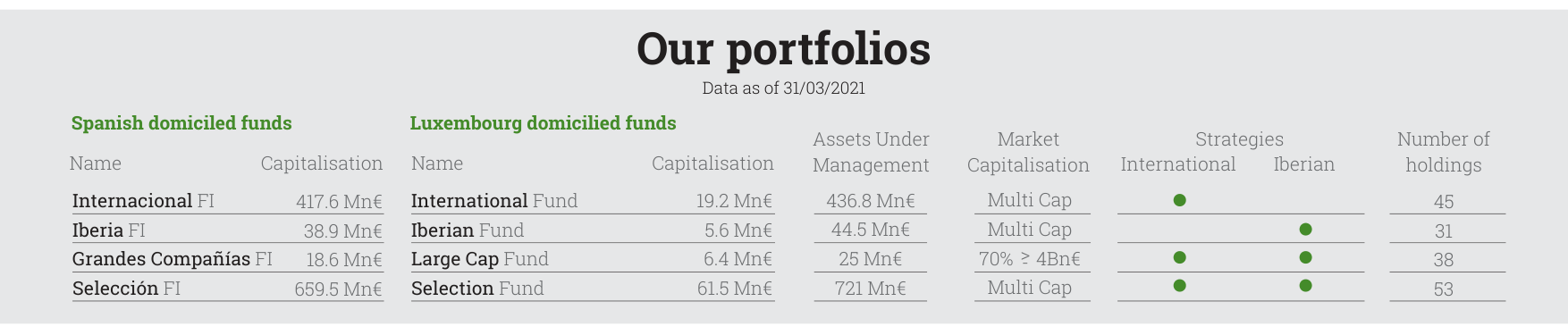
As of March 31, 2021, Cobas AM's total assets under management reached €1.468 billion, with Selección FI being the largest fund (€659.5 million)
| Company | Offeror | Offer Price | Cobas Valuation | Premium/Deviation |
|---|---|---|---|---|
| Hoegh LNG | Hoegh family + Morgan Stanley | NOK 23.5/share | Not disclosed specifically, but considered far below true value | 36% premium, still rejected |
| Semapa | Queiroz Pereira family (Sodim) | €12.17/share | ~€14/share (conservative); €20/share (including Secil, etc.) | Undervalued by approximately 15%-39% |
| Golar LNG | New Fortress Energy (buyer) | Sale of Hygo for $950 million | Remaining business valued at zero by the market | Transaction price reasonable, but market pricing is wrong |
Companies/Assets Involved
- Hoegh LNG (International portfolio ~2%): A global leader in floating LNG regasification infrastructure. Bearish on the offeror's bid; Cobas voted against it.
- Semapa (Iberian portfolio ~9%): A Portuguese holding company with a 69% stake in Navigator and the Secil cement business. Bearish on the offeror's bid; Cobas refused to participate.
- Golar LNG (International portfolio): Sold Hygo to NFE at a reasonable price. Bullish on its remaining business (floating LNG liquefaction and transportation), believing the market severely undervalues it.
- Camaieu (Historical case): A French clothing retailer that received three takeover offers before finally agreeing to sell at a price close to its valuation.
Investment Implications
- Reject Undervalued Offers: When a takeover bid is significantly below intrinsic value, investors should adhere to valuation discipline by voting against or refusing to sell, waiting for a more reasonable price to emerge (as demonstrated by the Camaieu case).
- Exploit Market Pricing Errors: The Golar LNG case shows that after an asset sale, the market may become overly pessimistic about the remaining business, leading to extreme valuation distortions. Investors should focus on such opportunities where the "remaining business is valued at zero by the market," especially when management is focused on simplifying the structure.
- Monitor Majority Shareholder Behavior: Offers initiated by families or major shareholders often involve conflicts of interest (as seen with Hoegh and Semapa), and their bids may fall below the fair value that minority shareholders are entitled to. Independent evaluation is necessary.
Theme & Background
This chapter focuses on three major M&A transactions in the Cobas portfolio (Golar, Aryzta, and International Seaways with Diamond S Shipping) and how these deals validate its value investing thesis. The report argues that these transactions represent a correction of the market's undervaluation of the companies' asset values and help unlock potential value.

International Portfolio net asset value has grown with fluctuations since March 2017, with a current target price of €169, implying upside potential of 121%
Core Thesis
The author's core judgment is that these M&A transactions (including stock-for-stock mergers and asset sales) reflect a "mispricing of price versus value" and will ultimately help the companies "crystallize" their asset values. Even though some acquisition offers fall below Cobas's valuations, they indicate that the portfolio's underlying value is gaining market recognition. The counterintuitive point is that the author believes the transactions themselves—rather than waiting for higher offers—are the key path to value realization.
Key Arguments & Data
1. Golar (approximately 7% weighting): As a major operator in the LNG value chain, announced a merger in the first quarter aimed at "crystallizing" asset value. The report does not provide specific transaction details but emphasizes that the investment thesis continues to improve.
2. Aryzta (approximately 6% weighting): Sold its North American business, confirming that management changes mark a turning point for the company. Post-transaction, the company will focus on Europe and Asia (markets with the highest value creation). As vaccination progresses in Europe, the economic reopening is expected to drive recovery in hotel and restaurant sales, boosting revenue and margins.
3. International Seaways (INSW, approximately 3%) and Diamond S Shipping (DSSI, approximately 1%): The two tanker companies announced a stock-for-stock merger on March 31. Post-merger:
- It will become the second-largest US-listed tanker company by vessel count (over 100 ships) and the third-largest by capacity, with a balanced crude/product tanker mix (70/30).
- The author cites three reasons for optimism about the deal:
- Fleet complementarity enables broader customer service and cost synergies, with expected synergies of $23 million, which, capitalized at 10x, represents over 20% of the combined company's market capitalization.
- The stock-for-stock transaction does not increase financial leverage.
- The higher market capitalization and greater liquidity post-merger, combined with INSW's management track record, should help narrow its discount to net asset value relative to peers.
Companies/Assets Involved
| Company | Weighting | Role & Key Data | Bullish/Bearish |
|---|---|---|---|
| Golar | ~7% | LNG operator, announced merger to crystallize asset value | Bullish (investment thesis improving) |
| Aryzta | ~6% | Sold North American business, focusing on Europe and Asia; expects economic reopening to drive sales recovery | Bullish (management change is a turning point) |
| International Seaways (INSW) | ~3% | Tanker company, merging with DSSI via stock swap; post-merger fleet exceeds 100 vessels, third-largest by capacity | Bullish (synergies, no leverage, discount narrowing) |
| Diamond S Shipping (DSSI) | ~1% | Tanker company, merging with INSW; exchange ratio broadly matches asset value | Bullish (fair transaction) |
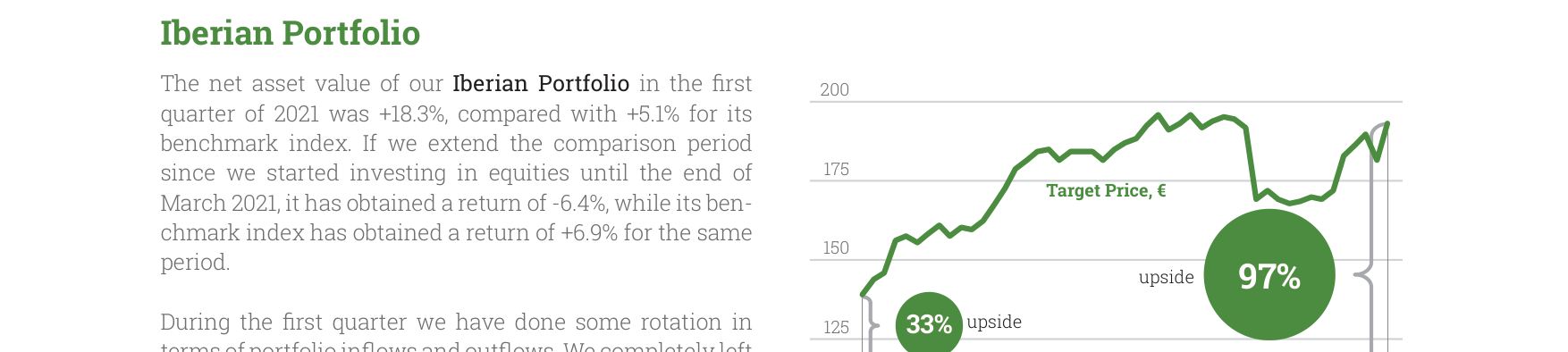
Iberian Portfolio net asset value has risen with fluctuations since March 2017, with a current target price of €184, implying upside potential of 97%
Investment Implications
- Investors should watch for opportunities where value companies unlock asset value through M&A transactions, especially when the market undervalues them.
- In the tanker industry, scale effects and cost synergies from mergers (e.g., the $23 million synergies from INSW/DSSI) are key drivers of value enhancement, and the stock-for-stock structure avoids leverage risk.
- Aryzta's asset sale suggests that a management overhaul followed by a focus on core markets (Europe, Asia) could mark an inflection point in profitability. Investors can monitor the economic reopening's boost to hotel and restaurant demand.
Theme and Background
This chapter primarily reviews the performance, portfolio adjustments, and valuation changes of Cobas AM's three major portfolios (International, Iberian, and Large Cap) in the first quarter of 2021. The report emphasizes that although all portfolios still lag behind their benchmark indices since inception, they achieved significant excess returns this quarter. The overall portfolio valuations remain extremely low (P/E between 6.7x and 7.5x), implying substantial upside potential.
Core Views
- Clear signal of value investing recovery: All three portfolios significantly outperformed their benchmark indices in Q1 2021 (International +20% vs +8.4%; Iberian +18.3% vs +5.1%; Large Cap +17% vs +9.2%), indicating a market style rotation toward value stocks.
- Portfolio valuations remain at historical lows: Despite the rise in stock prices, the overall portfolio P/E is only 6.7x-7.5x, far below the benchmark indices' 16.9x-20.3x. The author believes the market has not yet fully priced in their earnings recovery potential.
- Active rebalancing to lock in profits and deploy into new opportunities: The report used the strong rebound in some holdings (e.g., G-III, ICL, Acerinox) to take profits and redirected capital into newly purchased discounted targets (e.g., Dassault Aviation, Energy Transfer, Galp), enhancing the overall target value of the portfolios.
Key Arguments and Data
- International Portfolio: Target price raised by 5% to €169/share, implying 121% upside. The portfolio's estimated 2021 P/E is 6.8x (benchmark 16.9x), with an ROCE of 28% (38% excluding shipping and commodity companies). During Q1, BMW and Golar LNG Partners were fully sold (combined weight <1%). New positions were initiated in Dassault Aviation, Energy Transfer, TEVA, and CGG (combined weight ~4.5%). Dixons and Atalaya were increased, while G-III and ICL were reduced.
- Iberian Portfolio: Target price raised by 4% to €184/share, implying 97% upside. The portfolio's estimated 2021 P/E is 7.5x (benchmark 17.1x), with an ROCE of 29%. During Q1, Acerinox, Catalana Occidente, Prisa, and Gestamp were fully sold (combined weight ~5.5%). New positions were initiated in Galp and Grifols B (combined weight ~2.5%). Mapfre and Tubacex were increased, while Alba and Meliá were reduced.
- Large Cap Portfolio: Target price raised by 13% to €167/share, implying 114% upside. The portfolio's estimated 2021 P/E is 6.7x (benchmark 20.3x), with an ROCE of 29%. During Q1, BMW, Glencore, LEAR, Capri, OCI, ThyssenKrupp, and Arcelor were fully sold (combined weight ~15%). New positions were initiated in AMG, CIR, Grifols B, Fresenius, Mapfre, China Mobile, Hyundai Mobis, and Energy Transfer (combined weight ~16%). BAT and Aryzta were increased, while ICL and Porsche were reduced.
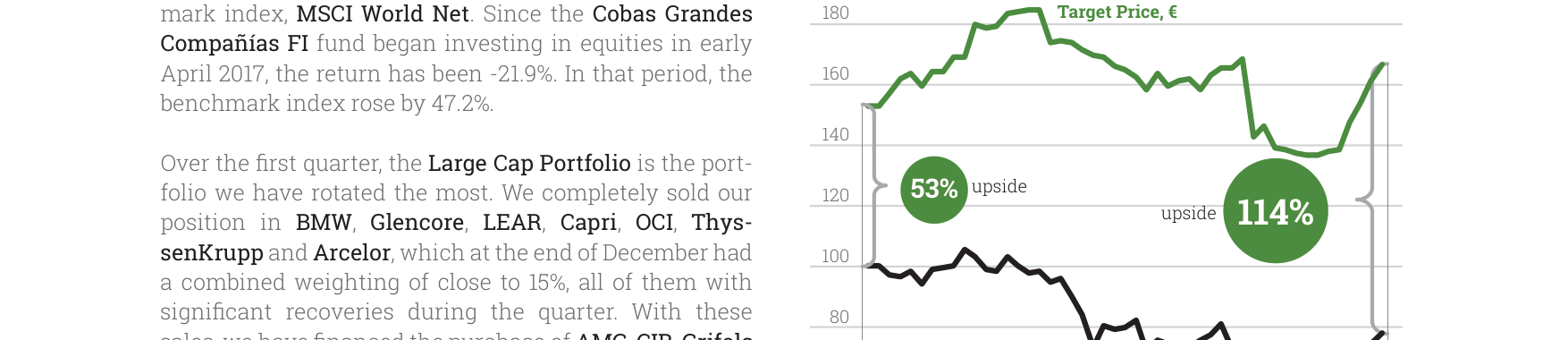
Large Cap Portfolio net asset value has grown with fluctuations since March 2017. The current target price is €167, with upside potential of 114%
| Metric | International Portfolio | Iberian Portfolio | Large Cap Portfolio |
|---|---|---|---|
| Q1 Return | +20.0% | +18.3% | +17.0% |
| Benchmark Return | +8.4% (MSCI Europe) | +5.1% (Iberian Index) | +9.2% (MSCI World) |
| Return Since Inception | -23.7% | -6.4% | -21.9% |
| Benchmark Return Since Inception | +25.1% | +6.9% | +47.2% |
| Target Price (€/share) | 169 | 184 | 167 |
| Implied Upside | 121% | 97% | 114% |
| Estimated 2021 P/E | 6.8x | 7.5x | 6.7x |
| Benchmark P/E | 16.9x | 17.1x | 20.3x |
| ROCE | 28% | 29% | 29% |
| Position Level | 99% | 98% | 99% |
Companies/Assets Involved
- International Portfolio: New purchases: Dassault Aviation, Energy Transfer, TEVA, CGG; Increased: Dixons, Atalaya; Reduced: G-III, ICL; Fully sold: BMW, Golar LNG Partners.
- Iberian Portfolio: New purchases: Galp, Grifols B; Increased: Mapfre, Tubacex; Reduced: Alba, Meliá; Fully sold: Acerinox, Catalana Occidente, Prisa, Gestamp.
- Large Cap Portfolio: New purchases: AMG, CIR, Grifols B, Fresenius, Mapfre, China Mobile, Hyundai Mobis, Energy Transfer; Increased: BAT, Aryzta; Reduced: ICL, Porsche; Fully sold: BMW, Glencore, LEAR, Capri, OCI, ThyssenKrupp, Arcelor.
Investment Implications
- Focus on the systemic re-rating opportunity for value stocks: The low P/E and high ROCE characteristics of Cobas's portfolios, combined with their strong Q1 performance, suggest the market may be rotating from growth to value stocks. Investors can look for companies with similar valuation discounts (P/E < 8x, ROCE > 25%) that also show recent earnings improvement or asset restructuring logic.
- Use rebounds for rebalancing: Cobas sold many holdings that had rallied strongly in Q1 (e.g., ICL, Acerinox, Arcelor) and bought new targets. This suggests that for value stocks, investors should not hold them until valuations fully recover. Instead, they should take partial profits after significant price rebounds and rotate into other still-undervalued assets.
- Monitor LG Electronics' spin-off value: The report specifically notes that LG Electronics, due to its exit from the mobile phone business and the formation of an electric vehicle parts joint venture with Magna, has seen its stock price rise over 100% since December 2020. Its preferred shares trade at a 50% discount to common shares, offering an additional margin of safety. Investors can study the standalone valuation potential of LG Electronics' business segments post-spin-off.