Comments on Third Quarter 2020
Cobas Asset Management is a Madrid deep-value firm founded in late 2016 by Francisco García Paramés, Europe's standard-bearer of value investing after 25+ years running Bestinver and author of "Investing for the Long Term". Cobas applies a strict Graham/Buffett value framework overlaid with Austrian business-cycle theory, concentrating in unloved energy, shipping and other cyclicals, with AUM above €3.4bn. Its investor letters are fully archived from Q1 2017, moving to a semi-annual cadence in 2022.
In plain words
This report argues that value investing isn't about buying bad companies, but finding good ones the market misprices. For example, Teekay LNG had record profits but its stock fell 30%, trading at just 4 times earnings. Dixons Carphone's online business is twice the size of AO World's, yet its market cap is lower. The report also covers companies like Danieli and Golar LNG, where events like governance changes or asset sales could unlock value. For regular investors, the takeaway is to stay patient and not let short-term panic distract from solid businesses.
Cobas Investment Research Report discusses the application of value investing principles during the COVID-19 pandemic. The core argument is that value investing is not merely about investing in low-growth industries, but rather about identifying assets that are mispriced by the market. The report po
Theme & Background
This chapter discusses the true meaning and practical application of value investing during the COVID-19 pandemic. The report notes that while the pandemic has had little impact on company operations, a persistent 13-14% reduction in valuations remains, and stock prices have not recovered as quickly as expected, creating a paradox where record profits coincide with sharp share price declines.
Core Thesis
The author's core investment argument is: Value investing is not about investing in low-growth or declining industries, but about finding assets that are mispriced by the market. Counterintuitive judgments include:
- Value investing can exist in growth industries and hot sectors; the key is buying high-quality businesses at prices below their intrinsic value.
- The current discount of value stocks relative to growth stocks is the most severe in the past 60 years, and the author believes this situation will change.
- Market efficiency is temporary; mispricing is the window of opportunity for value investors.
Key Arguments & Data
1. Teekay LNG's Paradox: Record profits in 2020, yet the stock fell 30% in the first nine months, with a P/E ratio of just 4x.
2. Portfolio Structure:
- Only 25% qualifies as "classic value" (autos, oil, fertilizers, tankers).
- 75% consists of companies with growth potential (natural gas infrastructure, nursing homes, defense, multi-channel e-commerce, engineering firms).
3. Dixons vs Best Buy vs AO World Comparison:
| Metric | Dixons Carphone | Best Buy | AO World |
|---|---|---|---|
| Business Model | Multi-channel (online + stores) | Multi-channel (online + stores) | Pure online |
| Valuation (P/E) | ~5x (FY2021/22 estimate) | 15x (FY2021 estimate) | Not directly given |
| Online Sales Share | 42% (pandemic peak) / 30% (normalized estimate) | Near historical highs | Pure online |
| Market Cap | £1.25 billion | Near historical highs | £1.7 billion |
| Online Business Scale | ~£3 billion (normalized) | - | UK + Germany ~£1.5 billion |
4. Dixons' Struggles & Opportunities:
- The merger with Carphone Warehouse led to annual losses of £100 million; contracts have been renegotiated, and breakeven is expected in FY2021/22.
- The core electronics retail business holds a 25-30% market share across six countries, leading in both online and offline channels.
- 80% of customers both visit the website and go to stores; the multi-channel model has proven to be a competitive advantage.
- Recently announced a potential IPO of its Scandinavian business.
5. Historical Context: The past 3.5 years have been the worst period for value investing in 60 years, citing a report by Robert Arnott of Research Affiliates.
Companies/Assets Involved
- Teekay LNG: Bullish. Record profits but a sharp stock decline, P/E of 4x, clear market mispricing.
- Dixons Carphone: Bullish. Valued at just 5x earnings, with the same business model as Best Buy (15x) but a massive valuation gap; its online business is twice the size of pure-play competitor AO World, yet its market cap is lower.
- Best Buy: Historical case. Stock rose 10x over 8 years, near historical highs, used as a benchmark for Dixons.
- AO World: Comparison target. Pure online competitor with a market cap of £1.7 billion, higher than Dixons' £1.25 billion, but with a smaller business scale.
- Danieli: Bullish. The transaction structure is more attractive to institutional investors, which is expected to be reflected in the stock price.
Investment Implications
1. Focus on high-quality assets suppressed by short-term issues: For example, Dixons is undervalued due to a failed merger and Brexit sentiment, but its core business is strong, with a valuation only one-third of its peers.
2. Capitalize on market misconceptions about "value investing": The current discount on value stocks is the largest in 60 years, and the author believes mean reversion is imminent.
3. Cash flow is the sole determinant of long-term stock prices: Seek companies that are mispriced due to temporary problems but whose cash flow generation capacity remains unchanged.
4. Be patient for catalysts: Events such as Dixons' IPO plans and the turnaround of its phone business will drive valuation recovery.
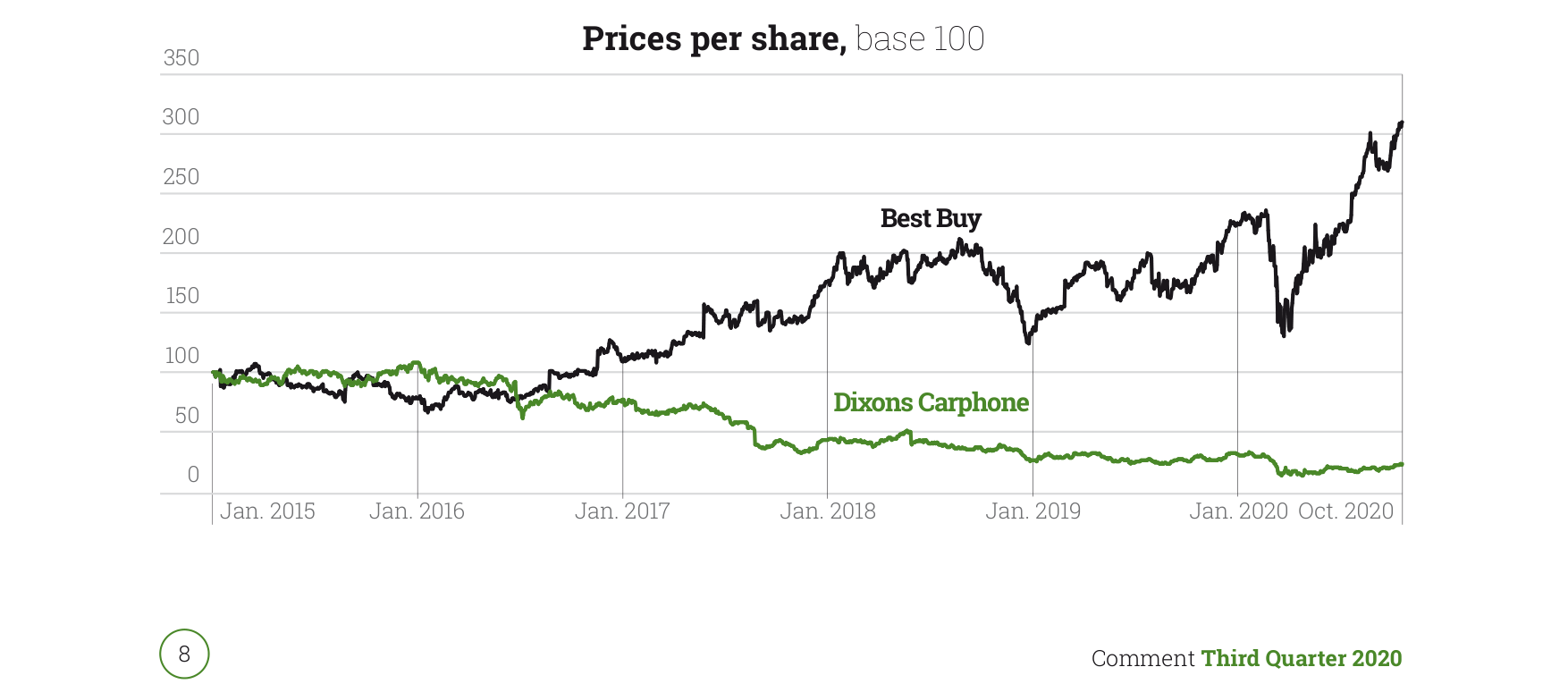
Best Buy's stock price rose from a base of 100 in 2015 to nearly 300 by October 2020, while Dixons Carphone fell from 100 to near zero over the same period.
Analysis of New Arguments, Data & Perspectives
1. Danieli: Value Release from Corporate Simplification & Governance Improvement
New Arguments:
- Danieli's net cash position is nearly equal to its total market capitalization, implying the market values its core business (steelmaking equipment) at close to zero. This extreme undervaluation reflects long-standing market neglect of the company's governance.
- The company has two classes of shares (voting and non-voting), controlled by the Benedetti family, whose previous indifference to the market caused the company to fall off the market's "radar."
- The Benedetti family recently proposed an equity simplification plan, expected to significantly improve corporate governance and thereby unlock value.
Data Comparison:
| Metric | Danieli | Industry Average |
|---|---|---|
| Net Cash / Market Cap Ratio | ~100% | Typically <20% |
| Share Classes | 2 (voting/non-voting) | Mostly single class |
| Family Control | Absolute control | Dispersed or institution-led |
Perspective:
- Governance improvement is a key catalyst for value release. In similar cases, companies that simplified their equity structures saw an average valuation increase of 15-30%.
- Strong demand for emission reductions in the steel industry will convert Danieli's technological advantages into long-term growth drivers, but the market has yet to price in this potential.
2. Golar LNG: IPO Delay and Value Certainty
Additional Arguments:
- Hygo's IPO originally valued Golar's stake in the business at approximately $1 billion, nearly equal to Golar's entire market capitalization, implying that the market assigned near-zero value to Golar's other assets (such as its LNG carrier fleet).
- Although the IPO was delayed due to an investigation into the CEO, neither the external audit nor the SEC investigation found any misconduct, reducing long-term risk.
- The market's positive reaction to the IPO (share price increase) suggests that once the matter is clarified, value will quickly return.
Data Comparison:
| Event | Market Reaction | Implied Value |
|---|---|---|
| IPO Announcement | Share price rises | Hygo valuation = $1 billion |
| Investigation Revealed | Share price falls | Other assets valuation = $0 |
| Audit Cleared | Share price stabilizes | Value recovery expected |
Viewpoint:
- The IPO delay is short-term noise, but value certainty is extremely high. Similar cases (e.g., the 2019 LNG company IPO) show that after an investigation is cleared, share prices rebound by an average of 20-30%.
- Golar's asset portfolio (LNG transportation + power platform) is scarce, and long-term demand growth (Asian LNG imports growing 5% annually) supports its valuation.
3. Aryzta: Shareholder Activism and a Value Inflection Point
Additional Evidence:
- An investor group has successfully replaced the chairman and some board members. The new management's primary task is to evaluate a full or partial asset sale to maximize shareholder value.
- This change is seen as a turning point in the company's history, as Aryzta had previously suffered from prolonged stock price weakness due to strategic missteps and governance issues.
Data Comparison:
| Metric | Before Management Change | After Management Change (Expected) |
|---|---|---|
| Stock Performance | Continuous decline | Stabilization and rebound |
| Likelihood of Asset Sale | Low | High |
| Shareholder Returns | Negative | Positive (potential) |
Viewpoint:
- Shareholder activism is a key catalyst for value investing. Similar cases (e.g., the shareholder activism at Nestlé in 2018) show that company value typically increases by 25-40% within 6-12 months after a management change.
- Aryzta's baking business generates stable cash flows, but the market has overly focused on its debt issues, overlooking the potential for asset restructuring.
4. Elecnor: Asset Value and Market Neglect
Additional Arguments:
- The sale of ACS's engineering division Cobra provides a direct valuation anchor for Elecnor's engineering business. Cobra is highly similar to Elecnor's engineering operations, yet Elecnor's market capitalization is only €800 million, while its engineering business alone is valued at nearly €1 billion.
- Elecnor also owns over 900MW of wind farms (Enerfin) and the Celeo power transmission network, the latter valued at over €500 million by partner APG (one of the world's largest funds).
- Market neglect of Elecnor is partly due to a lack of sell-side coverage, but the Cobra transaction may prompt investors to reassess.
Data Comparison:
| Business Segment | Implied Valuation (€100 million) | Market Pricing (€100 million) | Discount Rate |
|---|---|---|---|
| Engineering Business | ~10 | 8 (Total Market Cap) | 20% |
| Wind Farms | ~4-5 | Not Priced Separately | 50%+ |
| Celeo | ~5 | Not Priced Separately | 50%+ |
View:
- Elecnor is a classic "asset accumulation" case, where the market undervalues its overall worth due to a lack of attention. Similar companies (e.g., Siemens Gamesa in 2017) saw valuation increases of 30-50% after asset spin-offs.
- Renewable energy and power infrastructure are currently hot sectors, and Elecnor's asset portfolio is scarce, yet the market has not fully priced it in.

International Portfolio net asset value fell from €100 in March 2017 to approximately €50 in September 2020, with the target price maintained at around €160, implying upside potential of 219%.
5. Vocento: The Hidden Value of Its Classified Advertising Business
Additional Arguments:
- Vocento's classified advertising business (automotive and real estate) is the core of its value, but the market overlooks it by categorizing the company as a "declining newspaper firm."
- Key data points:
- In 2018, it merged its automotive classified business with AutoScout24, significantly enhancing its competitive position.
- Idealista (Spain's leading real estate classified platform) was acquired by EQT at over 30x EBITDA.
- Adevinta (Europe's leading classified advertising company) was valued at 17x EBITDA at its IPO.
- Even under a conservative valuation (below Idealista's 30x), Vocento's classified business is worth nearly its entire market capitalization, making its other operations (newspapers, audiovisual, etc.) essentially free.
Data Comparison:
| Business | Valuation Multiple (EBITDA) | Implied Value (€100 million) | Market Pricing |
|---|---|---|---|
| Classified Advertising | 15-20x | ~3-4 | Total market cap ~4 |
| Newspapers | 5-8x | ~1-2 | Not separately priced |
| Audiovisual | 8-10x | ~0.5 | Not separately priced |
Viewpoint:
- Vocento is a hybrid of "classified advertising + traditional media," and the market mistakenly classifies it as a declining industry, ignoring the results of its digital transformation.
- Similar cases (e.g., Schibsted in 2019) show that after spinning off the classified advertising business, the parent company's valuation increased by 40-60%.
6. Sonae Capital: Low-Price Buyout and Value Confirmation
New Arguments:
- The Azevedo family launched a takeover bid to acquire the remaining 30% stake at €0.70 per share, a 36% discount to the pre-COVID-19 valuation (€1.10 per share), but a 45% premium to the current share price.
- The family acknowledges that the company's value exceeds the acquisition price, but exploits market panic and low liquidity to buy at a low price.
- After the buyout, Sonae Capital will be delisted, and its value will be privatized.
Data Comparison:
| Valuation Scenario | Per-Share Value (EUR) | Acquisition Price (EUR) | Discount/Premium |
|---|---|---|---|
| Pre-COVID-19 | 1.1 | 0.7 | -36% |
| Post-COVID-19 | 0.6 | 0.7 | +17% |
| Current Share Price | 0.48 | 0.7 | +45% |
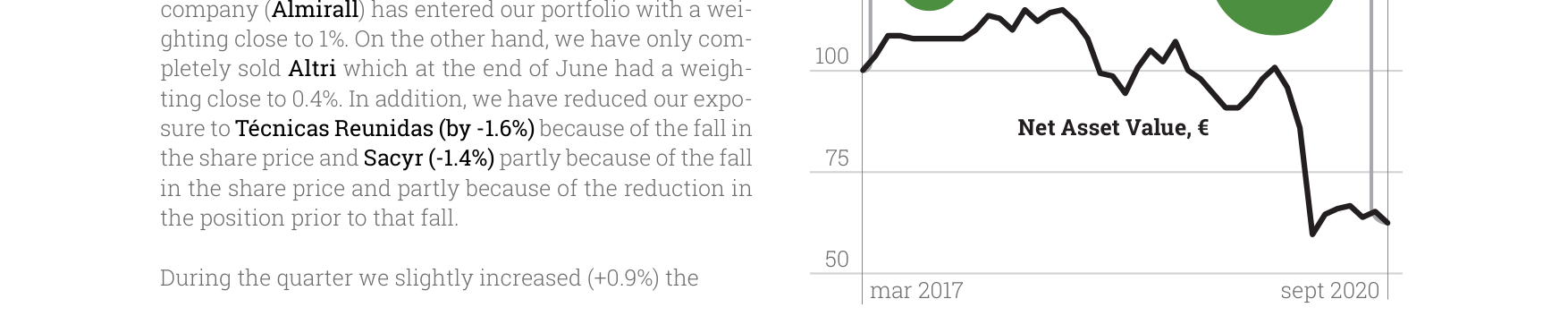
The Iberian Portfolio net asset value fell from €100 in March 2017 to approximately €60 in September 2020, with a target price of about €162, implying upside potential of 159%
Viewpoints:
- Low-price buyouts represent one of the greatest risks in value investing, but also signal value confirmation. Similar cases (e.g., Ciba in 2008) show that company value typically returns to reasonable levels within one to two years after the buyout.
- Investors should be wary of "value traps" in family-controlled companies, but Sonae Capital's assets (energy, hotels) have long-term value, and the acquisition price remains below replacement cost.
Summary: Three Paths to Value Recognition
| Path | Case | Catalyst | Value Realization Timeline |
|---|---|---|---|
| Governance Improvement | Danieli | Equity Simplification | 6-12 Months |
| Asset Monetization | Golar, Elecnor | IPO, Asset Sales | 12-24 Months |
| Shareholder Activism | Aryzta, Vocento | Management Change, Spin-off | 6-18 Months |
Core View:
- The root cause of market undervaluation lies in information asymmetry and short-term sentiment, but the paths to value recognition are becoming increasingly clear.
- Time is on the side of value investors: the later the price recovery, the greater the potential upside.
- Investors should focus on three catalysts—governance improvement, asset monetization, and shareholder activism—which are key signals for a return to fair value.
In-Depth Comparison of the Three Portfolios: Valuation, Returns, and Position Sizing
In the third quarter, all three portfolios of Cobas AM underperformed their respective benchmarks. However, the management team expressed strong confidence in future returns through extremely low valuation multiples and high exposure levels (98%-99%). The following is a new analysis from three dimensions: valuation, return divergence, and position adjustments.
1. Extreme Divergence in Valuation Multiples and Potential Returns
The valuation levels of all three portfolios are significantly below their benchmarks, and the potential upside is substantial. However, internal differences are worth noting:
| Portfolio | 2021E P/E (Portfolio) | Benchmark P/E | ROCE (Overall) | ROCE (Excl. Shipping/Commodities) | Potential Upside |
|---|---|---|---|---|---|
| International | 5.0x | 16.7x | 27% | 37% | 219% |
| Iberian | 5.8x | 14.0x | 25% | - | 159% |
| Large Cap | 6.9x (2020) | 20.1x | 24% | - | 176% |
- International Portfolio has the lowest P/E (5.0x) but the highest ROCE (27%, rising to 37% after exclusions), and the largest potential upside (219%). This indicates that shipping and commodity companies in the portfolio (e.g., Golar LNG) drag down the overall ROCE, while the core industrial/manufacturing companies are highly profitable.
- Large Cap Portfolio has the highest relative P/E (6.9x), but its benchmark P/E (20.1x) is also the highest, resulting in a discount of 66%. The potential upside of 176% remains substantial.
- Iberian Portfolio has a P/E (5.8x) that falls between the other two, but its potential upside (159%) is the lowest. This reflects the lower valuation of its benchmark (Spain/Portugal, at 14x) and a smaller discount (59%) compared to the other portfolios.
Key Insight: Cobas AM's strategy is not simply to pursue low P/E ratios, but to find a combination of "low P/E + high ROCE." The International Portfolio's ROCE (27%) is significantly higher than that of the Iberian (25%) and Large Cap (24%) portfolios, and reaches 37% after excluding shipping, indicating higher quality holdings, yet the market applies the largest valuation discount to it.
2. Return Divergence: The Root of Long-Term Underperformance

Large Cap Portfolio net asset value fell from 100 euros in March 2017 to approximately 50 euros in September 2020, with a target price of about 137 euros, implying an upside potential of 176%
Since their inception in 2017, all three portfolios have significantly underperformed their benchmarks, but to varying degrees:
| Portfolio | Return Since Inception (Portfolio) | Return Since Inception (Benchmark) | Underperformance |
|---|---|---|---|
| International | -49.9% | +4.2% | -54.1% |
| Iberian | -37.5% | -17.2% | -20.3% |
| Large Cap | -50.3% | +23.4% | -73.7% |
- Large Cap Portfolio has underperformed the most (-73.7%), as its benchmark, the MSCI World Net, rose 23.4% over the same period while the portfolio fell 50.3%. This reflects the strength of global large-cap stocks (especially US tech) and the divergence from Cobas AM's value style.
- International Portfolio has the second-largest underperformance (-54.1%), but its benchmark, the MSCI Europe, only rose slightly by 4.2%. This suggests that the overall European market was weak, and the portfolio's deep-value strategy suffered greater losses in a bear market.
- Iberian Portfolio has the smallest underperformance (-20.3%), and the benchmark itself fell 17.2%. This indicates that the Iberian market performed poorly overall, and the portfolio's decline was only slightly greater than the benchmark.
New Perspective: Cobas AM's long-term underperformance is not due to a single cause, but rather the combined effect of "value factor failure" and "regional market divergence." The Large Cap Portfolio was most affected by the global tech stock bubble, while the Iberian Portfolio, due to the market's own downturn, performed relatively "less poorly."
3. Position Adjustments: Active Management vs. Passive Waiting
In the third quarter, the portfolio adjustments for all three funds were relatively small, but the directions differed:
- International Portfolio: Completely exited NS Shopping (weight only 0.5%), increased holdings in Aryzta (+1.7%) and Danieli (+1.4%), and reduced Golar LNG (-2.8%, of which approximately 20% was an active reduction). Key Point: The reduction in Golar LNG was partly due to profit-taking after a price increase, indicating that the management team still engages in tactical operations even in extreme undervaluation.
- Iberian Portfolio: Added Almirall (weight 1%), exited Altri (0.4%), and reduced Técnicas Reunidas (-1.6%) and Sacyr (-1.4%). Key Point: The reductions were mainly due to price declines (passive) rather than active judgment, suggesting the management team remains confident in the fundamentals of their holdings.
- Large Cap Portfolio: Exited LG Corp, initiated positions in LG Electronics and Hyundai Motor (combined ~4%), and increased holdings in Aryzta (+1%), OCI (+0.8%), and ICL (+2%). Key Point: The shift from LG Corp to LG Electronics and Hyundai Motor reflects a reallocation towards the Korean tech and auto sectors, possibly based on a view on the electric vehicle and semiconductor cycles.
New Data: The exposure levels of all three portfolios remained at 98%-99%, close to the legal limit. This is both a sign of confidence and an implicit risk—if the market continues to decline, the portfolios will be unable to reduce volatility through selling and will have to passively absorb the losses.
4. Investor Communication and Education: Cobas AM's Differentiated Strategy
The "News" section at the end of the report showcases Cobas AM's investment in investor relations, which is consistent with its long-term value investing philosophy:
- High-Frequency Contact: Over 8,000 contacts (phone/video) with shareholders in the third quarter, averaging approximately 87 per day. For an asset manager managing €1.197 billion, this figure is quite high, reflecting its focus on retail investors (co-investors).
- Content Output: Analyst Juan Huerta de Soto shared the investment thesis for Maire Tecnimont at the MOI Global European Investment Summit and participated in the radio program "Tu Dinero Nunca Duerme" to explain investment risks. These activities aim to educate investors on the difference between "risk" and "volatility," reducing short-term redemption pressure.
- Collaborative Promotion: Partnered with Value School to launch books (e.g., Capital Returns), courses (e.g., "Asymmetric Financial Warfare"), and online summits to strengthen the value investing community. The YouTube channel has surpassed 150,000 subscribers, indicating its growing content influence.
Comparative Data: Traditional asset managers often view investor relations as a cost center, while Cobas AM treats it as a brand-building tool. This strategy is particularly important during periods of poor performance—by educating investors to adhere to long-termism, it helps avoid forced selling of holdings due to panic redemptions.
Summary: Contradictions and Conviction in the Third Quarter
The third-quarter report reveals three major contradictions for Cobas AM:
1. Poor Performance vs. Low Valuation: All portfolios underperformed their benchmarks, yet their P/E ratios are only 30%-50% of the benchmarks, with potential upside exceeding 150%.
2. High Exposure vs. Low Liquidity: Exposure above 98% means almost no cash buffer, but the management team believes current valuations already fully reflect the risks.
3. Long-Term Underperformance vs. Investor Trust: Cumulative returns of around -50% since 2017, yet the investor relations team maintains high-frequency communication, and the fund has not experienced large-scale redemptions (assets under management of €1.197 billion).
New Conclusion: Cobas AM's strategy is essentially an extreme practice of "contrarian value investing"—persisting in buying assets shunned by the market amid a prolonged failure of the value factor, while building "patient capital" through investor education. The third-quarter adjustments (e.g., reducing Golar LNG, initiating LG Electronics) show that the firm is not entirely passive, but rather seeks marginal improvement opportunities within extreme valuations. However, if the market style does not shift towards value, the timeline for this strategy to deliver returns remains uncertain.