Covid-19, Climate Change, And The Need For A New Marshall Plan*
GMO is a Boston asset manager co-founded in 1977 by Jeremy Grantham with Richard Mayo and Eyk Van Otterloo, known for valuation-driven dynamic asset allocation built on long-horizon mean reversion. Grantham is famous for calling historic bubbles, warning publicly ahead of both the 2000 dot-com crash and the 2008 financial crisis. Flagship publications include the GMO Quarterly Letter (now written by Asset Allocation co-heads Ben Inker and John Pease), Grantham's Viewpoints essays and the 7-Year Asset Class Forecast.
In plain words
This report argues that rich countries' economic growth has slowed down, and with climate change and COVID-19, we need a big government spending plan like the post-WWII Marshall Plan—but for green infrastructure (like clean energy and electric buses). For regular investors, this means future opportunities may shift to these areas, and we shouldn't worry too much about government debt because interest rates are very low, making borrowing cheap. It's worth reading because it explains why now might be a good time to invest in green industries.
GMO Chief Investment Strategist Jeremy Grantham points out that the world faces the dual challenges of a climate crisis and the COVID-19 pandemic, urgently requiring large-scale public investment akin to the Marshall Plan to upgrade energy, transportation, and industrial infrastructure. The report a
Theme and Background
This chapter discusses the predicament of long-term economic growth slowdown in developed countries, rising income inequality, the climate crisis, and the overlapping impact of the COVID-19 pandemic. The author, Jeremy Grantham, argues that the current environment of negative real interest rates offers a once-in-several-decades window for large-scale public investment. He believes the new U.S. administration should launch a green infrastructure fiscal stimulus plan akin to the Marshall Plan.
Core Views
- Contrarian Market Judgment: Concerns over debt levels are exaggerated; what truly matters is the interest coverage ratio rather than the debt ratio. The current negative real interest rates make government borrowing costs extremely low, presenting the optimal time to initiate large-scale fiscal stimulus.
- Core Investment Thesis: GDP growth in developed countries has declined from over 4% annually to less than 2%, a trend further threatened by climate change and the pandemic. Large-scale public works (green infrastructure) are necessary to reverse the downward momentum of the economy. This approach can address the climate crisis, boost the economy, and maintain U.S. geopolitical advantages.
Key Arguments and Data
1. Long-Term Economic Growth Slowdown: Real GDP growth in developed countries has fallen from over 4% in the 1960s to less than 2% currently (as shown in Exhibit 1 data). This trend is masked by the short-term boom of a few tech companies like FAANG.
2. Debt Concerns Exaggerated: The author argues that debt is double-entry bookkeeping, with every $1 of debt corresponding to $1 of credit. Current negative real interest rates make long-term risk-free borrowing costs extremely low, making the interest coverage ratio the key metric.
3. Lessons from 2009: The U.S. mistakenly allocated resources in 2009-2010 to bail out insolvent banks (rather than addressing liquidity issues), which violated the spirit of capitalism. This time, infrastructure should lead the fiscal plan.
4. Returns on Green Infrastructure: The global green transition requires decades and tens of trillions of dollars in investment, but the returns on green infrastructure investment are substantial. If financed at negative real interest rates, it would be "the best business deal in history."
5. U.S.-China Comparison: The U.S. has only 400 electric buses, while China has 400,000 (a 100-fold difference). Green energy and industry will become key areas of future geopolitical competition.
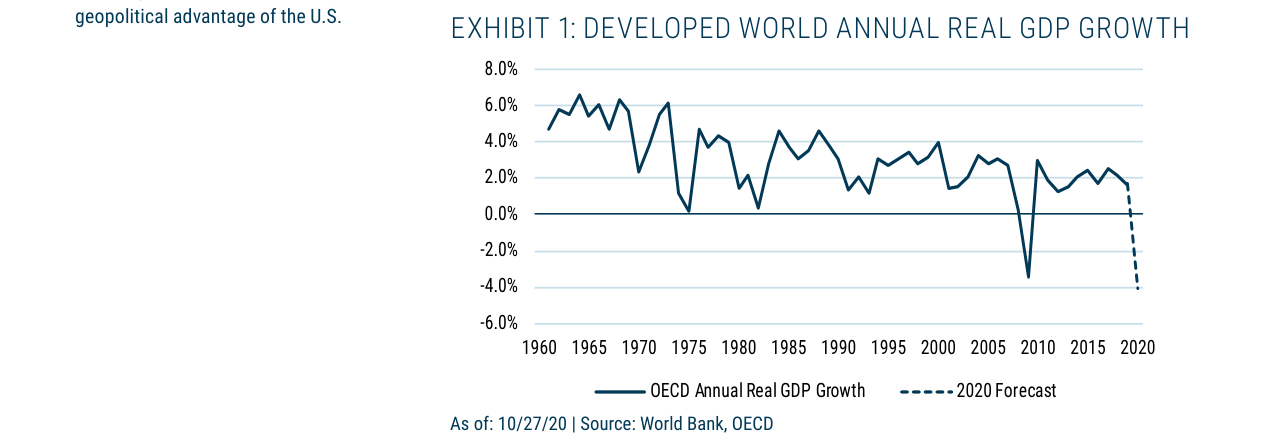
Annual real GDP growth in developed countries has steadily declined from over 6% in the 1960s to less than 2% in recent years, with a forecast drop to approximately -4% in 2020.
Companies/Assets Involved
- FAANG-type Companies: Their short-term boom masks deeper issues in the U.S. economy, but the author does not specifically name or rate them.
- China: Its leading position in energy and industrial technology is increasingly solidified, and the U.S. needs to catch up through infrastructure plans.
- Banks (2009 Bailout Targets): The author criticizes the bailout, arguing that market mechanisms should have been allowed to function.
Investment Implications
- Macro Direction: Favorable toward investments related to green infrastructure (energy, transportation, industrial upgrades), which are considered attractive over the long term in a negative real interest rate environment.
- Risk Warnings: Be cautious of structural slowdowns in developed country economic growth; avoid overemphasizing debt ratios while neglecting interest coverage ratios. Pay attention to changes in the competitive landscape between the U.S. and China in green technology.
- Policy Expectations: If the U.S. launches large-scale fiscal stimulus, it will benefit sectors such as industrials, construction, and clean energy. However, short-term inflationary pressures and interest rate volatility risks should be noted.