Sri Lanka: You Will Come Back for More
Hosking Partners is a London boutique founded in 2013 by Jeremy Hosking, a portfolio manager at Marathon Asset Management for over 25 years. It runs a single global equity strategy built on the capital-cycle, supply-side approach — contrarian, long-term, and unusually diversified (350+ holdings) under a multi-counsellor model, managing around $5.5bn.
In plain words
This report argues that severe economic crises in emerging markets, like Sri Lanka's 2022 debt default, can create great investment opportunities. After the crisis, some companies were valued far below what it would cost to rebuild them—for example, one hotel group's market value was only 11% of its replacement cost. As the economy recovers, these stocks can rebound sharply. For ordinary investors, it's a reminder not to chase overhyped markets (like India) and instead look for assets that are genuinely cheap after a crisis. Worth reading for concrete examples of 'buying when others are fearful.'
Hosking Partners, in its June 2025 report Sri Lanka: You'll Be Back for More, takes the emerging-market cyclical crisis as its entry point and argues that Sri Lanka's current economic distress presents a contrarian investment opportunity. The report cites Edward Chancellor's "seven fat years, seven
Theme and Background
This chapter explores the cyclical patterns of investing in emerging markets (EM) and uses Sri Lanka’s economic distress following its 2022 sovereign debt crisis as a case study to argue for contrarian investment opportunities. The report points out that the economies and investment returns of emerging market countries are highly cyclical, and crises often provide excellent entry points.
Core Arguments
The author’s core arguments include:
- The best trigger for emerging market investment is a national-level economic crisis, rather than long-term narratives based on a "new era" or "convergence theory".
- A "country-level capital cycle" after a crisis creates high returns: capital flight, deleveraging, and falling real wages cause valuations of existing high-quality companies to fall far below replacement cost. Once the economy recovers, valuations rebound extremely quickly.
- Caution is warranted for high-valuation "new era" markets such as India at present.
- Long-term returns depend on two key factors: alignment of management’s interests with minority shareholders (capital allocation capability), and whether the political class is willing to implement deep supply-side reforms (rather than repeating Argentina’s mistakes).
Key Arguments and Data
This chapter supports its views with the specific case of Sri Lanka and extensive data:
Key data from the Sri Lanka crisis:
- Before the crisis, foreign investors accounted for 45% of trading volume on the Colombo Stock Exchange (CSE); by 2021, this had fallen to just 5%.
- The sharp depreciation of the Sri Lankan rupee led to inflation of 40%, and the central bank raised interest rates to 30%.
- Private credit as a percentage of GDP fell from 40% to 25% within two years.
- Total stock market capitalization bottomed out at $9 billion, down 70% in USD terms, with a market-cap-to-GDP ratio of only 11%.
- The author invested tens of millions of dollars in 2023, becoming one of the largest foreign equity investors in the market.
Valuation vs. replacement cost (in USD):
| Company | Enterprise Value (EV) | Replacement Cost | EV/Replacement Cost Ratio |
|---|---|---|---|
| Aitken Spence | $110 million | $1.0 billion | 0.11x |
| John Keells | $840 million | $3.5 billion | 0.24x |
| Tokyo Cement | $50 million | $200 million | 0.25x |
- Aitken Spence: The replacement cost of its hotel portfolio is approximately $1.0 billion, but the author bought at an enterprise value of $140 million in early 2023, equating to a cost of only about $45,000 per room (compared to John Keells’ new hotel at $300,000 per room). Its historical P/E ratio was below 1x.
- Tokyo Cement: Sri Lanka’s largest cement supplier, bought by the author at about one-quarter of the cost of building new capacity, with asset utilization at only 30%. Based on a conservative "normalized" earnings estimate, its P/E ratio was below 1x. For comparison, global cement leader Holcim trades at over 12x P/E.
- Dialog Axiata: Through the acquisition of rival Airtel Lanka, the mobile telecom market consolidated from four players to three, and Dialog’s subscriber base exceeds the sum of the other two. This is expected to replicate the earnings improvement path seen in India after its mobile market consolidation.
- Current state of economic recovery: GDP growth rate exceeds 5%, inflation has fallen to 0%. GDP per capita in USD terms has recovered from a trough of $3,500 in 2022 to $4,500 (+30%).
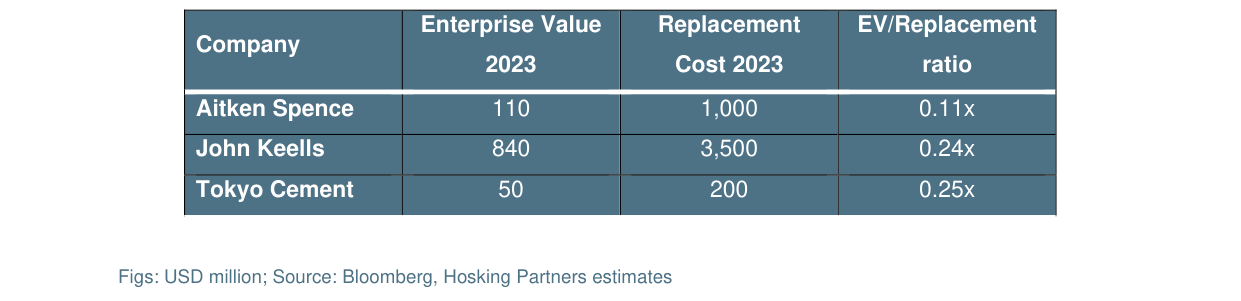
In 2023, the enterprise value of the three companies was at a significant discount to replacement cost, with EV/Replacement ratios of only 0.11–0.25x
Companies/Assets Involved
- Aitken Spence: Main business is hotels (approximately 3,000 rooms), also involved in ports, tourism, power, and plantations. The report considers it a representative of "extreme value", with EV at only 11% of replacement cost.
- John Keells: Owns a new container port and the country’s first integrated casino-hotel resort project (Cinnamon Life, with a cost of $300,000 per room). The report notes that massive capital expenditure had previously masked its earnings potential and expects these projects to significantly improve returns.
- Tokyo Cement: Sri Lanka’s largest cement supplier. The report considers it a low-utilization, low-valuation company, with EV at only 25% of replacement cost.
- Dialog Axiata: Mobile telecom operator. The report is optimistic about improved pricing power and shareholder returns following market consolidation.
- Holcim (for comparison): Global cement leader, P/E ratio over 12x, used to illustrate the undervaluation of Tokyo Cement.
- India market: Cited by the author as a cautionary example of a "high-valuation new era".
Investment Implications
- Directional opportunity: The report clearly states that holdings in Sri Lankan stocks have doubled in price since early 2023, but the author remains bullish. Current investors can still focus on Sri Lanka’s stock market, especially those companies with high replacement cost, low valuations, and businesses that have already recovered from the crisis.
- Specific strategy: Focus on companies where enterprise value is far below replacement cost (e.g., EV/replacement cost ratio below 0.3x) and whose profitability is about to benefit from the domestic economic recovery (GDP growth >5%, inflation at 0%, currency strengthening).
- Risk points: Political risk is a major variable (e.g., "politicians who always mess things up"), but the report believes the current economic recovery momentum is strong. Foreign investors are still largely absent, implying that future incremental capital inflows could drive further valuation recovery.