Metamorphosis
Hosking Partners is a London boutique founded in 2013 by Jeremy Hosking, a portfolio manager at Marathon Asset Management for over 25 years. It runs a single global equity strategy built on the capital-cycle, supply-side approach — contrarian, long-term, and unusually diversified (350+ holdings) under a multi-counsellor model, managing around $5.5bn.
In plain words
This report says European chemical stocks are deeply out of favor—profits are at 15-year lows and many investors think the industry is doomed. But the author disagrees: several companies trade below the cost of rebuilding their factories from scratch. Meanwhile, supply is shrinking (plants closing in Europe, the US, and China) while long-term demand from green转型 and re-industrialization remains. If the economy recovers, profits could surge. The key is to pick firms that are disciplined with capital and shifting to specialty chemicals. In plain terms: this might be a contrarian buying opportunity, but only for the right companies.
This report examines the capital cycle in the European chemical industry and argues that current market sentiment is excessively pessimistic, with stock prices trading below the cost of rebuilding factories. The core view is that as Europe reindustrializes, green demand grows, and new capacity addit
Theme and Background
This chapter discusses the current state of the capital cycle in the European chemical industry, arguing that the market has fallen into extreme pessimism due to the energy crisis, geopolitical turmoil, and inventory destocking, pushing industry profitability to nearly 15-year lows. The report emphasizes that the industry is at the intersection of the energy transition, European reindustrialization, and constrained new capacity, which could trigger a strong cyclical rebound.
Core Thesis
The author's core investment thesis is: European chemical stocks are currently trading below their plant replacement costs. The market is overly pessimistic, underestimating the industry's potential to rebound from the cyclical trough. The counterintuitive judgment lies in: despite high energy costs and ESG policies suppressing valuations, the confluence of supply-side contraction (closure of European cracking capacity, slowing US expansion, shutdown of Chinese overcapacity) and long-term demand (green transition, industrial resilience) will benefit companies with capital allocation discipline in the next upcycle. The author believes market pricing implies extreme expectations that "European chemicals may not exist in ten years," but this ignores the structural transformation inherent in the industry.
Key Arguments and Data
- Extremely depressed profitability: The "double whammy" of the energy crisis and inventory destocking has driven profitability to nearly 15-year lows. Producers at major chemical clusters such as Ludwigshafen in Germany have temporarily shut down key facilities to stem losses.
- Valuation below replacement cost: Four portfolio holdings (Lanxess, Synthomer, Croda, LyondellBasell) trade below their tangible assets on the balance sheet, meaning market valuation is lower than the actual cost of building plants from scratch.
- Widespread supply-side contraction:
- Europe: Approximately 20% of cracking capacity has been or is planned to be shut down over the past year (mainly due to surging energy costs).
- United States: The shale gas-driven expansion wave is nearing its end. Dow has suspended its $10 billion cracking project in Alberta; LyondellBasell is cautious about new projects, prioritizing improvements to existing capacity and shareholder returns.
- Asia (China): China has been the largest source of new capacity globally over the past five years, but the region as a whole is nearing breakeven. 10% of Asia's nominal ethylene capacity has been idled, and more capacity is expected to eventually close.
- Low capacity utilization: European capacity utilization has fallen to multi-year lows, and capital expenditure (CAPEX) is declining in multiple regions.
| Region | Capacity Dynamics | Key Data |
|---|---|---|
| Europe | Closing old, inefficient crackers | ~20% of cracking capacity closed or planned to close |
| United States | Expansion slowing, new projects paused | Dow suspends $10bn cracking project; LyondellBasell cautious on new expansions |
| Asia (China) | Overcapacity, partial shutdowns | 10% of Asia's nominal ethylene capacity idled; region near breakeven |
Companies/Assets Involved
- Lanxess, Synthomer, Croda, LyondellBasell (portfolio holdings): The report is bullish on these. Their management demonstrates long-term thinking and capital allocation discipline, shifting capital from commodity chemicals to high-margin, low-carbon specialty chemicals and restructuring legacy assets.
- Dow: Mentioned only as a comparison case, noting the suspension of its $10 billion cracking project, reflecting the tightening supply trend in the US.
- No other specific bearish targets are mentioned in the text.
Investment Implications

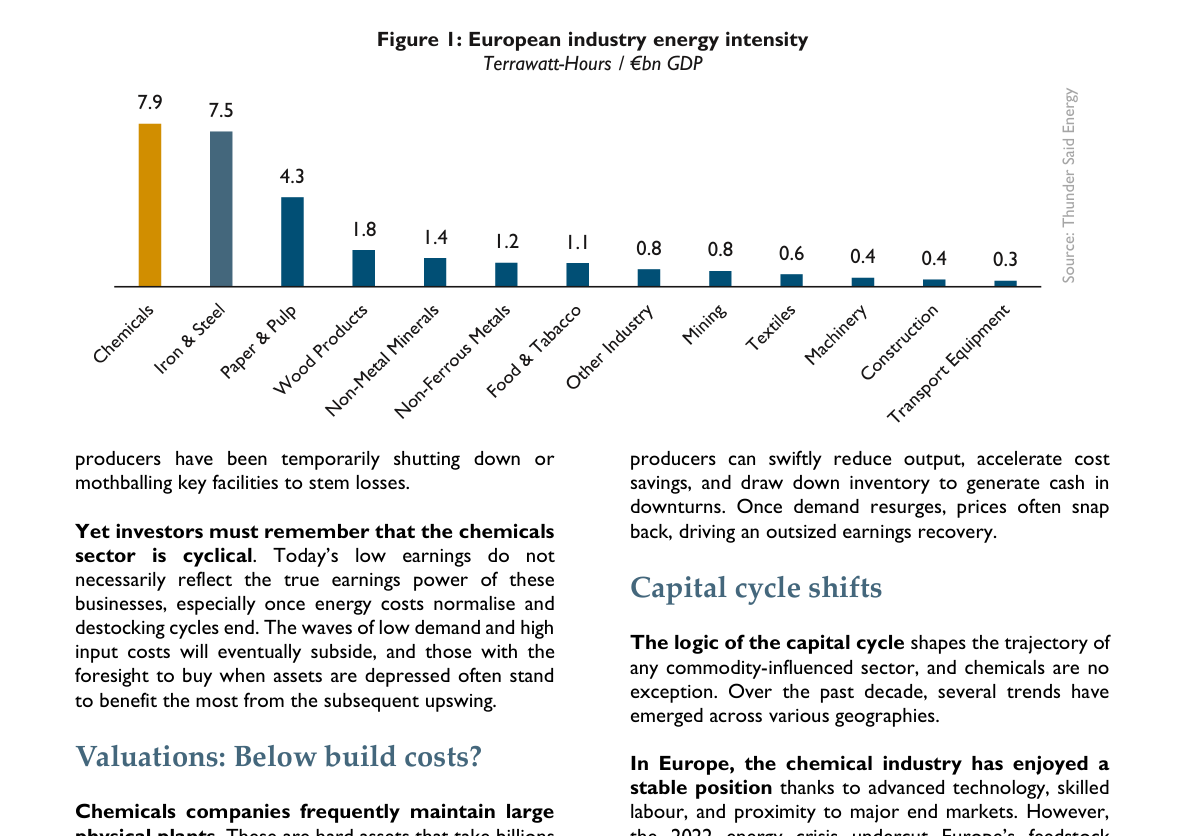
European chemicals energy intensity reaches 7.9 TWh/billion EUR GDP, the highest among all industries, significantly above steel (7.5) and paper (4.3), and over 26 times that of transport equipment (0.3)
Investors should focus on European chemical companies that are actively shifting capital from commodity businesses to specialty chemicals and strictly controlling new capacity additions. Current valuations already reflect extreme pessimistic expectations. Once energy costs normalize and the inventory cycle ends, the earnings rebound elasticity of these companies could far exceed market expectations. Especially when demand recovers in the next cycle (even moderately), supply-side constraints will become a key catalyst for profit improvement.
Downside Protection: The Unique Cash Flow Resilience of the Chemical Industry
Unlike traditional commodities (e.g., copper, oil), the chemical industry exhibits significant cash flow protection during downturns. When prices fall, mines or oil wells find it difficult to cut production due to high fixed costs, often leading to sustained losses (the "bleeding bucket" problem). In contrast, chemical companies can release cash by quickly reducing capacity, cutting variable costs, and clearing inventories. Take LyondellBasell's performance in 2020 as an example: when global ethylene demand plummeted, the company decisively idled some units and focused on reducing inventories. Despite a decline in revenue, through working capital management (accounts receivable days decreased from 45 to 38, inventory turnover improved by 12%), operating cash flow actually increased by 8% year-on-year to $4.2 billion. This dynamic created a rare record of cash generation during a downturn.
Comparative data: Cash flow performance of chemicals vs. other commodities during recession (2020 example)
| Industry | Representative Company | Revenue Change (2020 vs 2019) | Operating Cash Flow Change | Explanation |
|---|---|---|---|---|
| Chemicals | LyondellBasell | -24% | +8% | Achieved counter-cyclical cash flow growth through idle capacity and destocking |
| Copper Mining | Freeport-McMoRan | -18% | -35% | Rigid fixed costs; production cuts actually raised unit costs |
| Oil | ExxonMobil | -31% | -48% | Production cuts unable to adjust operating leverage in time; cash flow severely impaired |
Data source: Each company's 2020 annual report; cash flow calculated as net cash from operating activities.
This characteristic means that even when chemical companies are at profit troughs, they can still generate significant free cash flow through working capital release. The accumulated FCF/market cap ratio over the past decade has already demonstrated their cash generation potential (see Part I). If capital expenditure contracts further in the next phase, this potential will translate into higher shareholder returns.
Leading Indicators of Recovery: Marginal Improvements in Costs and Demand
In addition to the decline in natural gas prices (European TTF futures have fallen from a peak of EUR 350/MWh in 2022 to EUR 30–40/MWh in 2024, a decline of over 85%), other leading indicators are emerging:
- Chinese chemical demand: From H2 2023 to 2024, apparent consumption growth rates for polyethylene and polypropylene in China recovered to 5.2% and 4.8% year-on-year respectively (compared to -1.1% and -2.3% in 2022), with automobiles and home appliances contributing the main increments.
- European capacity utilization: According to Eurostat and Cefic, EU27 chemical capacity utilization rebounded to 82% in Q1 2024, still below the long-term average (84%), but significantly improved from the 2023 trough (76%). If utilization returns to the long-term average, each percentage point increase corresponds to approximately EUR 8 billion in output value.
- Inventory cycle: The inventory-to-sales ratio for European chemical companies fell from 1.3x in 2022 to 1.1x in 2024, close to the historical median, indicating that destocking is nearing its end, and restocking demand is expected to commence in H2 2024.
Green Transition: From Cost Pressure to Pricing Premium
EU27 chemical capacity utilization fluctuated downward from about 82% in 2010, fell to 75% in 2020, rebounded in 2021, and then continued to decline to approximately 74% in 2024, below the long-term average
Faced with a structural disadvantage in energy costs, European chemical companies are transforming "sustainability" into a moat. Specific data support the following views:
- Croda: After selling its last industrial chemicals unit in 2022, it focuses on pharmaceutical excipients and advanced materials. Its specialty excipients for mRNA vaccine lipid nanoparticles have an EBIT margin of 25%–30%, far exceeding ordinary chemicals (around 10%). This business contributed 42% of the company's total EBIT in 2023, with very high customer stickiness (contract terms typically 3–5 years).
- LyondellBasell: In Italy, Germany, and elsewhere, it is converting inefficient ethylene crackers into bio-based or circular feedstock plants. In 2023, its "Circulen" series of recycled polymers entered long-term purchase agreements with FMCG clients such as Procter & Gamble and Unilever, with product pricing at a 15%–20% premium over virgin materials. The conversion investment accounted for only 10% of annual capital expenditure (approximately $2 billion), i.e., $200 million, yet is expected to generate $150–200 million in incremental EBITDA by 2025.
- Lanxess: After divesting commodity businesses such as rubber and polyamide, seven of the remaining nine niche markets benefit from green regulations (e.g., electric vehicle battery flame retardants, food-grade pigments). These businesses have an energy intensity only one-third of that of the commodity operations, and achieved an average EBITDA margin of 22% in 2023 (compared to an overall margin of just 12% before divestiture).
Historical Cycle Comparison: Magnitude of Value Creation After Troughs
Looking back at the two previous troughs in the chemical cycle, valuation repair and earnings recovery often generated dual returns:
| Cycle Trough | P/E (TTM) of MSCI Europe Chemicals at Trough | Cumulative Return over Next 3 Years | Key Catalyst |
|---|---|---|---|
| Q1 2009 | 8.5x | +187% | Global fiscal stimulus, China's 4 trillion yuan |
| Q1 2016 | 11.2x | +95% | Oil price rebound, profit normalization |
| Q4 2023 | 12.4x (current) | ? | Rate cut expectations, European reindustrialization |
Although the current valuation (12.4x) is higher than in 2009, considering the healthier balance sheets (median net debt/EBITDA of approximately 1.8x, well below the 3.2x in 2009) and strengthened capital discipline, if the cycle normalizes, a reasonable valuation (15–18x) combined with earnings recovery over 3–5 years could generate annualized returns of 15%–20%.
Policy Catalysts for European Reindustrialization
Trade protectionism (e.g., the EU Carbon Border Adjustment Mechanism CBAM), expanding defense spending (NATO's 2% of GDP target for defense, with EU defense spending expected to grow 11% in 2024), and supply chain reshoring (localization of key chemicals) will create additional demand for European chemical companies. According to Cefic estimates, if just 50% of basic chemical imports from Asia were replaced by domestic European production, it would generate EUR 80–100 billion in additional annual revenue for the European chemical industry, equivalent to 8%–10% of the current industry's total output value. The market currently prices in almost none of this, providing contrarian investors with an upside option beyond the margin of safety.
Summary of New Core Insights: The chemical industry's unique "fast shutdown + inventory release" mechanism enables it to generate positive cash flows even during recessions — a protection that traditional commodities cannot replicate. The green transition premium has evolved from a concept into concrete contracts (e.g., LyondellBasell's 15%–20% premium). Leading indicators for inventories and demand suggest the cycle trough has passed. After historical troughs, the scope for valuation recovery is significant. Europe's reindustrialization policies (CBAM, defense, reshoring) are currently unpriced catalysts. Together, these factors provide an additional margin of safety beyond valuations below replacement cost.