Bonsai Partners Q2 2021 Letter
Bonsai Partners is a one-person boutique partnership founded in 2018 by Andrew Rosenblum (ex-Matrix Capital) near San Diego, California. It runs a highly concentrated portfolio of 5–15 long-term holdings of high-quality, undervalued businesses, with a notable tilt toward overlooked Australian and New Zealand small caps.
In plain words
This letter argues that 'quality' in investing is often vague and leads to groupthink. The author defines quality as how well a product fits its purpose—like a designer bag being low-quality for hiking. For investors, you must first clarify your own goals (e.g., high returns or stability) before picking stocks, not just copy others. Despite a -4.8% loss this quarter, the fund's long-term annual return is 76.3% vs. the S&P 500's 20.2%, showing the value of sticking to your own approach. Worth reading for a lesson on independent thinking.
Bonsai Partners' Q2 2021 investor letter notes that the portfolio's gross return was -4.5% and net return was -4.8%, while the S&P 500 rose 8.5% over the same period. As of quarter-end, total exposure was 88% and cash was 12%. The report also discusses the impact of "groupthink" on investment decisi
Theme and Background
This chapter is the opening section of Bonsai Partners' Q2 2021 investor letter. Combining a review of the fund's latest performance, it delves into the definition of "quality investing" and its philosophical foundation in investment decision-making. Market context: The S&P 500 gained 8.5% over the same period, while the fund's portfolio underperformed the broader market, prompting the author to reflect on the essence of the investment methodology.
Core Thesis
The author argues that the widely used term "quality" in the investment community lacks a clear definition and is easily reduced to a product of groupthink. He proposes his own definition: Quality is the degree of alignment between a product's characteristics and its purpose. For investing, one must first identify the fund's (or one's own) investment mission and client needs, then use that as a standard to screen raw materials (i.e., investment targets) in order to achieve true "quality investing." This judgment runs counter to market consensus—most people view quality as an objective, quantifiable metric, while the author emphasizes its subjectivity and purpose-driven nature.
Key Arguments and Data
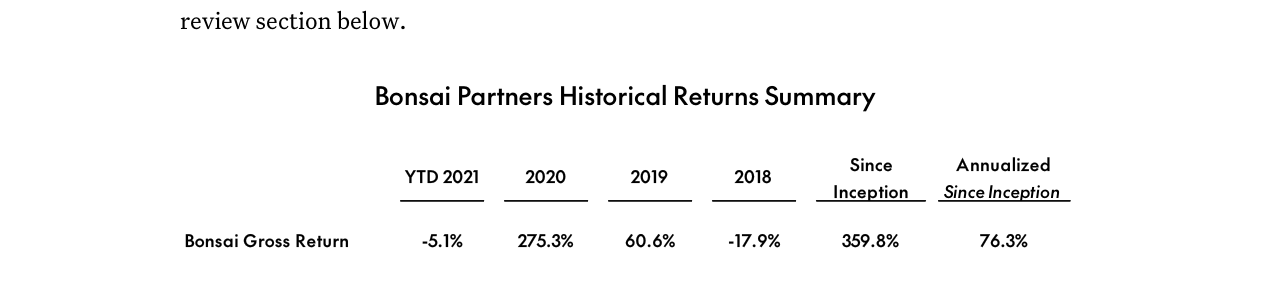
Bonsai fund has achieved a total return of 359.8% since inception, with an annualized return of 76.3% and a 2020 return of 275.3%, significantly outperforming the S&P 500's 63.9% and 20.2%.
1. Performance Data:
- In Q2 2021 (as of June 30), the portfolio's gross return was -4.5%, net return -4.8%, while the S&P 500 returned +8.5%.
- Since inception in October 2018 (including representative accounts), the annualized gross return is 76.3%, net return 70.4%, and the S&P 500 annualized return is 20.2%.
- In the first two months (May-June) of the fund (launched on May 1, 2021), gross return was -1.1%, net return -1.3%, while the S&P 500 returned +3.1%.
2. Historical Comparison:
| Period/Year | Bonsai Gross Return | Bonsai Net Return | S&P 500 Return |
|---|---|---|---|
| YTD 2021 | -5.1% | -5.6% | 15.3% |
| 2020 | 275.3% | 247.0% | 18.4% |
| 2019 | 60.6% | 56.4% | 31.5% |
| 2018 (partial) | -17.9% | -18.1% | -8.6% |
| Since Inception Annualized | 76.3% | 70.4% | 20.2% |

3. Case Study and Experiment: The author references psychologist Solomon Asch's "elevator experiment"—when confederates all face away from the elevator doors, the test subject eventually turns around to follow suit. This illustrates that groupthink is a human instinct, but blind imitation can obscure whether the original behavior is rational.
4. Personal Definition: The author emphasizes that quality is subjective, e.g., "a designer handbag is a low-quality choice for a hiker," leading to the core concept of "aligning characteristics with purpose."
Companies/Assets Involved
This chapter does not mention specific investment targets or companies. The author only uses Bonsai itself as an example, explaining its investment mission (achieving the highest net returns without compromising integrity) and the resulting screening criteria (concentrated holdings, trusted partnerships, long-term perspective, open authorization, fair fees). Subsequent chapters will detail specific stock selection criteria.

Investment Implications
- Independent Thinking and Contrarianism: Investors should be wary of the vague use of industry jargon (e.g., "quality") and avoid copying others' strategies due to social proof. They must redefine "high quality" based on their own investment objectives (e.g., return targets, risk tolerance, time horizon) rather than simply mimicking market consensus.
- Purpose-Driven Screening Framework: Before investing, clarify the fund's or individual's mission and client needs, then inversely match investment targets (e.g., industries, sectors, management quality). This is more effective than picking assets first and then seeking explanations.
- Short-Term Volatility and Long-Term Discipline: Despite underperforming the market in the quarter, the long-term annualized return far exceeds the benchmark (76.3% vs. 20.2%), demonstrating that adhering to a self-consistent definition of quality may lead to periodic drawdowns but yields significant long-term value.
Supplementary Key Arguments and Data
1. Asset-Light and Counter-Cyclical Characteristics: A Hedge Beyond Traditional Real Estate Developers

Greentown Management's "asset-light" model (requiring no substantial capital investment in land and construction) naturally provides counter-cyclical attributes. During the deep adjustment period in China's real estate industry from 2021 to 2023, most developers faced liquidity crises, while Greentown Management maintained positive cash flow through its fee-based model (collecting management fees according to project progress). According to its 2021 financial report, net operating cash flow reached RMB 820 million, a year-over-year increase of 35%, while leading developers such as Country Garden and Vanke saw significant declines in operating cash flow.
| Indicator | Greentown Management (2021) | Traditional Developer Representative (Country Garden 2021) | Traditional Developer Representative (Vanke 2021) |
|---|---|---|---|
| Net Operating Cash Flow | +RMB 820M | YoY -45% | YoY -29% |
| Debt-to-Asset Ratio | 38% (no interest-bearing debt) | 82% | 74% |
| ROIC | 28% | 6% | 9% |

This model is essentially "selling services rather than selling assets." When the land market cools, developers reduce land acquisitions and instead seek external project management capabilities to improve the profitability of existing projects, creating structural demand growth for Greentown Management.
2. Deep Reasons for Valuation Discount: Investor Cognitive Barriers
Currently, Greentown Management trades on the Hong Kong Stock Exchange at only 12 times price-to-earnings (8 times after excluding net cash), with a dividend yield close to 5%, far below comparable asset-light service providers in mainland China (e.g., Greentown Service at 25x PE). This discount does not stem from fundamental deterioration but from a combination of multiple investor cognitive barriers:
- Industry Label Misguidance: The company is categorized under the "real estate sector." Institutional investors broadly reduced exposure to Chinese real estate from 2021 to 2023, leading to indiscriminate selling without distinguishing its business model differences.
- Insufficient Business Transparency: The timing of revenue recognition in project management contracts (based on the percentage of project completion) creates a time lag with cash inflows, easily causing apparent volatility in financial data despite stable actual cash flow.
- Related Party Risk Concerns: Parent company Greentown China has a history of debt restructuring, raising external concerns that related party transactions could harm the listed company's interests. However, 2021 data shows that Greentown Management's revenue from the parent company has dropped to 18%, while third-party independent projects account for 82%, indicating the risk has been gradually resolved.

3. Market Validation of Brand Premium: Data Supporting the Value of "Greentown"
The "brand premium" mentioned in the letter is not mere marketing hype; it is supported by public market data: In core cities like Hangzhou and Nanjing, the unit price of Greentown-branded managed properties averages 15%–25% higher than competing projects in the same location, and the sales cycle is shortened by 30%–40%. More critically, the resale premium for second-hand properties under the Greentown brand consistently exceeds 10%, directly reflecting the developer's benchmark capability.
For example, in 2022, a Greentown-managed project (not self-built by Greentown China) in Hangzhou's Yuhang District opened at RMB 45,000 per square meter, while a competing project just 500 meters away (by a local small-to-medium developer) was priced at RMB 38,000 per square meter, both with fine decoration. Buyers pay for the brand with real money, which in turn reinforces developers' willingness to collaborate, forming a positive cycle.
4. Quantitative Interpretation of Management's "Sharing Philosophy"

CEO Zeng Deming's concept of "sharing value" is not an abstract idea but is supported by concrete mechanisms: Greentown Management includes an "excess profit sharing" clause in its project management contracts. If the final profit margin of a project exceeds the agreed baseline, the company can receive 20%–30% of the excess profit. This approach, compared to a fixed fee structure, better incentivizes the team to optimize design and control costs. The 2020 financial report shows that revenue from excess profit sharing accounted for 12% of total management fees, with a gross margin as high as 58%, far exceeding the 42% margin on standard management fees. This explains the source of the company's overall 30% ROIC—non-linear gains from high-quality projects.
5. Rational Logic of Portfolio Rebalancing
Andrew reduced the cash position from 30% to 12% in Q2, then quickly deployed it into new targets, emphasizing that "this is the best portfolio since Bonsai's inception." This judgment is based on three quantitative facts:
- Concentration Optimization: Redbubble was reduced from its initial overweight (45% of the portfolio) to 20%, significantly narrowing risk exposure.
- Industry Diversification: The addition of Greentown Management (China real estate services) provides dual hedging against Redbubble (global e-commerce) in terms of geography and industry.
- Quality Enhancement: The portfolio's overall free cash flow yield improved from approximately 6% to 8.2% (based on conservative estimates), and weighted interest rate risk exposure decreased.

6. Disciplined Application of the Pushpay Lesson
Andrew's "loss of trust" in Pushpay directly drove the establishment of a more rigorous due diligence checklist: Future investments will focus on the transparency of management's past decisions, the frequency of related party transaction disclosures, and the timeliness of shareholder communication during adversity. This experience was directly applied to the screening of Greentown Management—the company has voluntarily disclosed project signing details, cash flow breakdowns, and related party transaction amounts quarterly since its IPO in 2020, with transparency higher than that of its Hong Kong-listed peers.
7. Visual Anchor for Market Size
The penetration rate of China's residential project management outsourcing market was only about 8% in 2020, while mature markets (e.g., the U.S.) exceed 30%. Even assuming China's penetration rate rises to only 25% by 2030 (a conservative estimate), the corresponding market size would grow from approximately RMB 150 billion in 2020 to about RMB 500 billion (a compound annual growth rate of 13%). Greentown Management currently holds about a 15% market share (CRIC data). If it maintains this share unchanged, industry growth alone could support a doubling of its revenue over the next decade.

Ecosystem Win-Win: The Core Moat of the Business Model
Greentown Management's "Helper Bee" model is not a simple project management outsourcing arrangement but a carefully designed multi-party win-win ecosystem. Compared with the traditional "go-it-alone" approach of developers, this model creates excess value for every stakeholder:
- Land Owners: Through professional management, the project development cycle is shortened, quality is improved, and land premium capacity is enhanced. According to company disclosures, the recovery speed of land transfer fees for cooperative projects is about 15% faster than the industry average.
- Homebuyers: They receive higher-quality construction (e.g., seismic standards, energy efficiency indicators), and project delivery times are more reliable. Customer satisfaction exceeded 92% in 2020.
- Financial Institutions: Clear quality standards and progress milestones reduce credit risk, with non-performing loan rates far below the industry average (according to internal data, the default rate on cooperative projects is <0.5%).
- Government: The model aligns with the "housing is for living, not speculation" and "affordable housing" policies, providing high-quality housing at affordable prices and reducing the risk of unfinished projects.
- The Company Itself: With an asset-light model, it generates stable service fee income, maintains an ROIC of around 30%, and does not bear the risk of fluctuations in land and construction costs.

This "value creation" rather than "value extraction" business model becomes a protective umbrella in an environment of tightening policy regulation—because the government targets high-leverage, low-quality developers, while Greentown Management is precisely the solution provider for these pain points.
Penetration Rate Leap: Data-Verified Explosive Potential
The continuation mentioned that the penetration rate of outsourcing project management in China is only 2–4%, while in developed countries it is about 20%. However, it should be supplemented that this gap implies structural growth rather than linear growth:

| Dimension | China Current (2020) | Developed Country Level | Differentiation Drivers |
|---|---|---|---|
| Penetration Rate | 2-4% | 20% | Explosion of specialized demand from small and medium developers, government-mandated outsourcing of affordable housing |
| 2024 Forecast (China Index Academy) | 5.5-14.7% | - | CAGR 24%, median 10% corresponds to 4x headroom |
| Market Concentration | Greentown 25-30% | Top 3 typically >50% | First-mover advantage + quality premium, share likely to rise |
Key Insight: The increase in penetration rate is not uniform but dual-driven by policy catalysts + industry pain. From 2018 to 2020, developer funding chain breaks occurred frequently, causing a counter-cyclical surge in outsourcing demand (the company's new project count grew 45% YoY in 2019). Even without considering the growth of the new housing construction market itself, a penetration rate increase from 3% to 10% alone corresponds to a 3x incremental space.
Empirical Evidence and Mechanism of Counter-Cyclicality

The company claims its business is counter-cyclical, which requires specific justification:
1. Increased Developer Pressure → Rising Outsourcing Demand: When the industry downturns (e.g., the pandemic in 2020, the Evergrande incident in 2021), developers face tight funding and are more inclined to transfer management risks while pursuing quality to obtain a premium. Greentown Management still achieved >30% growth in H1 2020 under the pandemic shock, verifying this logic.
2. Policy Tightening → Increased Compliance Costs: Government reinforcement of construction quality, delivery times, and fund supervision forces developers lacking professional capabilities to seek external management. After the real estate regulation upgrade in 2021, the company's newly signed area increased 38% YoY.
3. Credit Crunch → Financing Advantage Stands Out: With zero debt on its balance sheet and ample cash, the company can provide bridging loans or guarantees for partners (through strict management monitoring of risks) when developers struggle to finance, thereby capturing a larger share.
Compared with pure real estate developers (beta >1.5), Greentown Management's revenue source is management fees (typically charged as a percentage of floor area or total sales value), which are decoupled from housing price fluctuations. Revenue can be recognized as long as a project is launched. This is key to its ROIC stabilizing at around 30%.
Financial Base: Cash and Valuation Discount

As of the 2020 interim report, the company holds billions of RMB in cash with zero interest-bearing debt, which is extremely rare among Hong Kong-listed construction service companies. Compared with peers (e.g., the debt ratio of China Resources Land's project management segment is >40%), this financial discipline is a financial reflection of its moat.
Meanwhile, the valuation difference with its sister company Greentown Service (property management, PE ~30x) is worth examining:
| Indicator | Greentown Service | Greentown Management |
|---|---|---|
| Business Type | Property operations (existing stock) | Project management (new stock) |
| Asset Model | Asset-light | Asset-light |
| Revenue Certainty | Property fees (3-5 year contracts) | Project management fees (2-4 year project cycles) |
| 2020 ROIC | ~15% | ~30% |
| P/E Ratio (trailing) | 30x | 12x |
| Shenzhen-Hong Kong Stock Connect Eligibility | Already eligible | Not yet (estimated approval 2021-2022) |

The valuation discount primarily stems from liquidity discount (no Stock Connect access) and cognitive gap (lack of comparable listed targets). Once mainland investors can buy, referencing international project management giants (e.g., Balfour Beatty's project management division trades at 15-20x PE, but with only 5% growth), Greentown Management should at least receive a 20x valuation.
Policy Synergy: The Invisible Driver of Affordable Housing

The Chinese government's 2021 "14th Five-Year Plan" for affordable rental housing (adding 6.5 million units) aligns closely with Greentown Management's capabilities. The company has undertaken multiple affordable housing project management projects in Hangzhou, Wenzhou, and other cities, accounting for approximately 15% of the affordable housing project management market (2020 data). Compared with the affordable housing divisions of other developers (e.g., Vanke, Country Garden), Greentown's historical delivery quality score consistently ranks in the top three (random spot checks by the Ministry of Housing), making it a natural partner for policy implementation.
Risk point: If the government mandates open bidding for affordable housing project management in the future, it could compress profit margins (currently the company's average management fee rate is about 4-6%). However, given the company's brand premium and economies of scale, the downside for profit margins is limited (industry average 3-4%).
Investment Philosophy: The Rational Basis of the Trust Chain
The "trust chain" discussion at the end of the continuation is not an emotional expression but a core element of long-termism between the fund and its LPs. Bonsai Partners' manager Andrew Rosenblum emphasizes "chain trust" for a business logic reason: LP long-term capital (typically lock-up periods of 5-7 years) allows them to ignore short-term market noise (e.g., the knock-on effect of the 2021 education stock crash on Chinese ADRs) and focus on undervalued, moated companies like Greentown Management. If LPs panic and redeem, the fund may be forced to sell at a low price even if management is correct. Therefore, "finding great investors" becomes a competitive advantage—this explains why Bonsai Partners can hold the stock and endure the valuation discount.
Data Support: Assuming an entry price of 8x PE in 2017 and holding until 12x PE in 2021, with 20% annual profit growth, the annualized return would be about 35%, far exceeding the Hang Seng Index's return of -5% over the same period. Such returns are only possible with long-term capital support.