Quarterly letter 3Q2018
azvalor Asset Management is a Madrid deep-value boutique founded in 2015 by Álvaro Guzmán de Lázaro and Fernando Bernad, formerly the core of Bestinver's investment team in the Graham tradition. It is known for contrarian concentration in unloved cyclical assets — gold and silver miners, oil services, uranium — buying into panic and exiting once value is realized. Its flagship international fund is about 70% of firm AUM and has more than tripled since inception a decade ago; letters were quarterly from 2016-2022 and semiannual since 2023.
In plain words
This letter from a fund manager explains two key ideas: stocks are the best long-term investment, but they're down 75% of the time (measured from past highs), so you need emotional stamina to profit. They also buy deeply undervalued companies others hate, like mining and oil stocks, waiting for a turnaround. For regular investors, the takeaway is to avoid panic-selling during downturns and stick with a good fund manager. Worth reading because it uses data and real examples to show why contrarian investing works and warns that your own emotions are the biggest risk.
Azvalor’s investment report for the third quarter of 2018 notes that despite a broad decline in global stock markets in October, its international portfolio fell by -3.1%, outperforming the benchmark index’s -4.5%. The Iberian portfolio declined by -12.3%, roughly in line with the benchmark’s -7.7%.
Theme and Background
This chapter is the first letter to investors from Azvalor's new fund manager, focusing on the fundamental contradiction between the long-term return advantages of stock investing and investor sentiment management. The report notes that despite a broad decline in global stock markets in October 2018, Azvalor's international portfolio fell by -3.1% cumulatively, outperforming the benchmark's -4.5%; the Iberian portfolio fell by -12.3%, roughly in line with the benchmark's -7.7%. From inception to the end of October 2018, the Iberian portfolio outperformed the benchmark by 17.7% cumulatively, with an annualized return of 6%; the international portfolio outperformed the benchmark by 8.8%, with an annualized return of 5%.
Core Thesis
The author's core investment argument is: Stocks are the best asset class for long-term compounding, but the real challenge of stock investing lies not in knowledge or skill, but in emotional management. Investors must endure the psychological test of markets being in decline or correction for most of the time to achieve long-term excess returns.
Counter-intuitive / consensus-defying judgments:
- Markets are in a loss-making state 75% of the time (measured from historical highs), yet this does not contradict positive long-term returns—these are two different perspectives on the same data.
- Value investing is not a "triumphant march" but a "painful obstacle course," requiring the purchase of hated and abandoned assets, which is precisely where the greatest opportunities lie.
- When everyone believes an asset is "high risk," its price has often already fallen to the lowest risk level (citing Howard Marks).
Key Arguments and Data
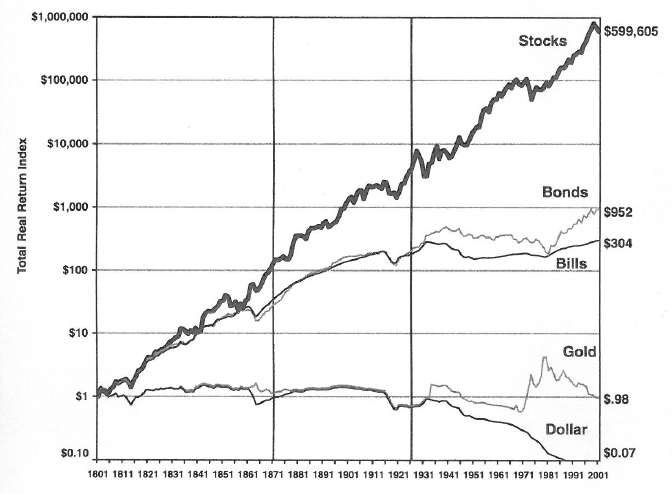
1. Historical evidence of long-term stock returns: Citing data from Jeremy Siegel's Stocks for the Long Run, over the past 200 years in the U.S., the real total return of stocks has far exceeded that of other asset classes (the report includes a chart).
2. Spanish household asset allocation severely underweights stocks:
- Stocks account for only 2.8% of total household net savings.
- Even considering only financial assets, stocks represent just 8%.
- Most funds are allocated to demand deposits or fixed-income securities—assets with significantly poorer long-term wealth creation capabilities.
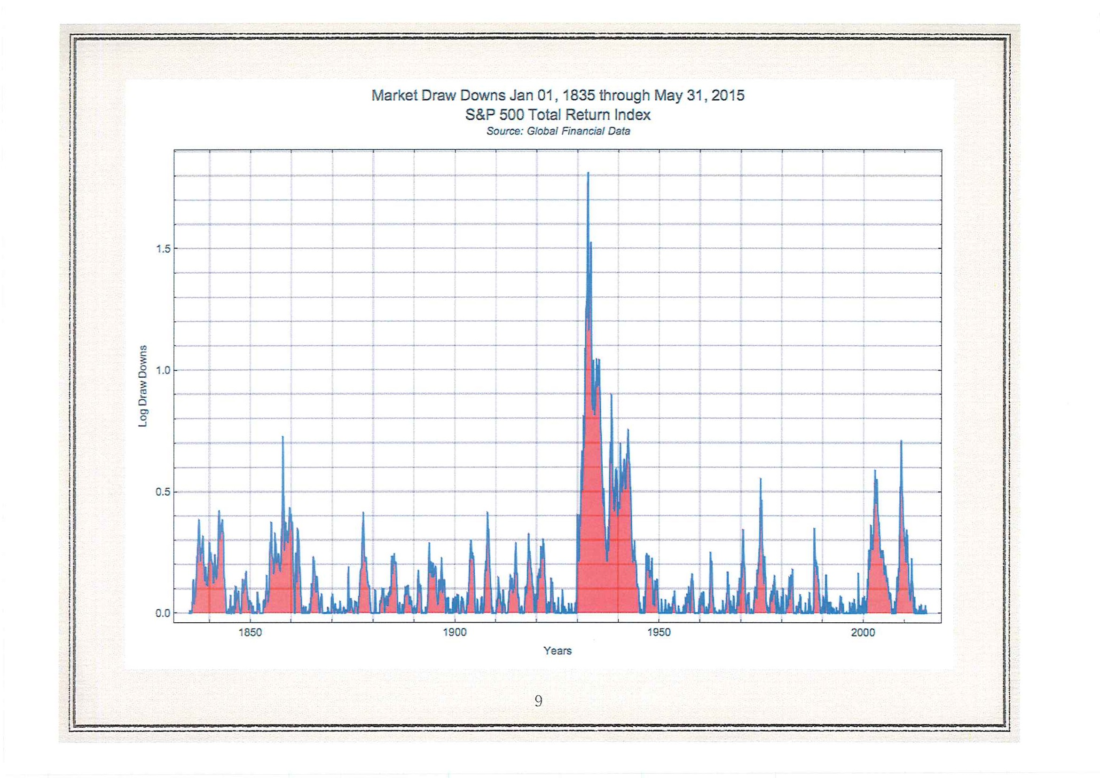
3. Statistics on market decline frequency (Robert Frey's research):
| Time Period | Percentage of Time Market Is in a Loss (Measured from Previous High) |
|---|---|
| Past 180 years (U.S. stock market) | 75% |
| Since 1950 | 66% |
| Time with declines of more than 5% from previous high | 50% |
| Time with declines of more than 20% from previous high | 40% |
4. Investor behavioral biases: The average investor achieves significantly lower long-term returns than the index, because investors tend to buy after rallies and sell after declines, forming a statistically significant behavioral pattern.
5. Azvalor's own case: In 2016, the international portfolio achieved a +20% return, but it had fallen nearly 20% in the first few months of that year, requiring investors to endure immense psychological pressure.
Companies/Assets Involved
This chapter does not cover specific companies or assets; it primarily discusses investment philosophy and macro market characteristics. Referenced figures include:
- Jeremy Siegel: Provides historical data on long-term stock returns.
- Robert Frey: Provides statistical analysis of market decline frequency.
- Howard Marks: Cited for his discussion on "risk perception and price."
- Michael Steinhardt: Cited for his discussion on "contrarian investing."
Investment Implications
1. Investors must accept that markets are in decline or correction most of the time: 75% of the time, markets are down from previous highs; this is the "price" of achieving long-term returns and cannot be avoided.
2. Value investing requires contrarian action: True opportunities arise when assets are hated and abandoned, but this also means investors must endure the pressure of being alone and questioned.
3. Choosing a value fund manager is a viable path: However, the author emphasizes that selecting the right value manager is not easy in itself, and investors must themselves exhibit the behavioral patterns of value investors (not panicking and redeeming during downturns).
4. Avoid behavioral traps: Do not linearly extrapolate recent trends, do not blindly follow the crowd. Only through deep analysis can one develop the conviction to seize opportunities, rather than becoming a "victim" of market volatility.
Theme and Background
This chapter focuses on the investment philosophy of the Azvalor International portfolio—investing in "uncomfortable" assets. The report notes that the average share price of companies in the portfolio has fallen 60% from their 2011–2014 highs, but the author believes these companies have far better future prospects than current stock prices reflect.
Core Thesis
The author's core investment argument is: Market pessimism toward cyclical industries is excessive, leading to severe undervaluation of quality assets. The counterintuitive judgment is that despite simultaneous sharp declines in both stock prices and earnings, the potential for future returns is substantial—if each company's stock price returns to its previous high, the portfolio would rise by 150%. The author emphasizes that the current portfolio valuation already implies a 125% upside (relative to estimated intrinsic value).
Key Arguments and Data
1. Antofagasta Case: From late 2015 to early 2016, copper miner Antofagasta's stock price fell 75% from its 2011 high to £3.5 per share, while copper prices dropped from $10,000/ton to $4,200/ton (a 60% decline). At that time:
- The stock traded at just 15 times earnings (based on depressed copper price earnings)
- Approximately 25% of global copper production generated negative cash flow at $4,200/ton
- Historical data showed copper consumption grew at an average annual rate of 3% over 150 years
- The author considered the market's implied assumption of long-term demand collapse unreasonable
- Outcome: Copper prices rebounded to $6,000/ton by year-end, and the author gradually liquidated the position at £8/share (the stock later rose above £10)
2. Current Portfolio Performance:
- The international portfolio's excess returns in 2016 contributed most of its best returns since inception
- From 2017 to September 2018, the portfolio's performance was close to or slightly worse than the index
- In October 2018, the portfolio declined less than the market (relative performance improved)
3. "Green Shoots" Signals: Several major holdings (Cameco, Tullow, Buenaventura, Serco, Ensco, Transocean, Consol, Petrofac) have shown signs of business improvement, but the market has yet to fully recognize this.
| Indicator | Data |
|---|---|
| Average stock price decline of portfolio companies (from highs) | 60% |
| Potential portfolio upside if returning to previous highs | 150% |
| Current portfolio upside (to estimated intrinsic value) | 125% |
| Antofagasta purchase price (2015–2016) | £3.5/share |
| Antofagasta sale price (2016) | £8/share |
| Copper price trough (early 2016) | $4,200/ton |
| Copper price rebound (end of 2016) | $6,000/ton |
| Copper price historical high (2011) | $10,000/ton |
Companies/Assets Involved
- Antofagasta (copper mining): Case study company, already liquidated. Purchase price £3.5, sale price £8, later rose above £10. Bullish rationale: efficient copper producer, strong balance sheet, history of proper capital allocation.
- Cameco (uranium mining): Current holding, business showing signs of improvement.
- Tullow Oil (oil): Current holding, business improving.
- Buenaventura (gold/silver): Current holding, business improving.
- Serco (government services outsourcing): Current holding, business improving.
- Ensco (offshore drilling): Current holding, business improving.
- Transocean (offshore drilling): Current holding, business improving.
- Consol Energy (coal/natural gas): Current holding, business improving.
- Petrofac (oil engineering services): Current holding, business improving.
Investment Implications
- Investors should focus on deep value opportunities in cyclical industries: When stock prices fall sharply due to industry downturns and the market's implied assumption of long-term demand collapse contradicts historical trends and fundamentals, it may be an opportune time for contrarian buying.
- Patience is key: The report emphasizes that value investing requires enduring up to two years of "underperformance" (as seen from 2017 to September 2018), but once the cycle reverses, returns can be significant.
- Deep research is essential: The author narrows the circle of competence through field visits (USA, Peru, Senegal, Canada, Sweden, etc.), industry conferences, and third-party expert interviews—this "pack your bags" research approach is worth emulating.
- The current portfolio's upside (125%) provides a clear margin of safety, but investors must be mentally prepared for short-term volatility.
Theme and Background
This chapter primarily discusses the Azvalor Iberian portfolio's perspective on the current political situation in Spain, as well as the fund's internal culture and incentive mechanisms. The author believes that the new Spanish government may adopt policies contrary to wealth creation, but emphasizes that the portfolio's actual exposure to the Spanish economy is limited, and current valuations provide a sufficient margin of safety.
Core Views
- The author holds a cautious stance on Spain's political outlook but argues that the portfolio's exposure to the Spanish economy is only 20%, far below market expectations, thus limiting the impact of political risk on the portfolio.
- Most companies in the portfolio are seeing improving performance, and valuations are at historical lows, offering attractive medium-term expected returns. The author explicitly states: the portfolio currently has 80% upside potential.
- Internally, the fund enforces a "skin in the game" culture by mandating employees (excluding compliance and risk control personnel) to invest a portion of their bonuses in the fund for the long term, ensuring alignment of interests.
Key Arguments and Data
- Spanish Economic Exposure: The Iberian portfolio's direct exposure to the Spanish economy is only 20%, significantly lower than investors generally expect.
- Valuation and Returns: Most companies in the portfolio are currently at trough earnings, but valuations become more attractive when measured against medium-term expected earnings. After the recent decline, the portfolio's overall upside potential reaches 80%.
- Historical Error Tolerance: The author acknowledges the possibility of mistakes but believes that as long as the error rate remains similar to the past, the overall outcome will not be significantly affected.
- Incentive Mechanism: All employees (excluding compliance and risk control) are required to invest a portion of their bonuses in the fund for the long term. Most employees have exceeded this obligation, making the workforce collectively the fund's largest investor.
Companies/Assets Involved
This chapter does not mention specific company names, only discussing the portfolio as a whole. The asset class involved is the Iberian equity portfolio, primarily investing in companies from Spain and the Iberian region.
Investment Insights
- Investors should not overly worry about this portfolio due to Spain's political uncertainty, as its actual economic exposure is limited and valuations provide a sufficient safety cushion.
- Current portfolio valuations are at historical lows, with clear medium-term upside potential (80%), making it suitable for long-term holders to accumulate on dips.
- The fund's strong internal alignment of interests (employees are the largest investors) reduces agency risk and enhances the credibility of investment discipline.