Quarterly letter 2Q2018
azvalor Asset Management is a Madrid deep-value boutique founded in 2015 by Álvaro Guzmán de Lázaro and Fernando Bernad, formerly the core of Bestinver's investment team in the Graham tradition. It is known for contrarian concentration in unloved cyclical assets — gold and silver miners, oil services, uranium — buying into panic and exiting once value is realized. Its flagship international fund is about 70% of firm AUM and has more than tripled since inception a decade ago; letters were quarterly from 2016-2022 and semiannual since 2023.
In plain words
This is a quarterly letter from Azvalor, an investment fund, to its investors. It covers two main points: first, their fund lost a bit in early 2018, but they stress you should judge performance over five years, not months. Second, they sold stocks like Telefónica (a phone company) and bought more of Mota Engil (a construction firm) when prices dropped. For regular investors, the key takeaway is that short-term underperformance is normal. They expect future annual returns to beat the market by 5-7%, down from 13%, but their portfolio still has 63% upside potential. Worth reading because it shows how pros buy when others panic and why patience matters.
Azvalor's letter to investors discusses the performance and investment strategy of its Iberian and International funds in the first half of 2018. The core argument is that while short-term performance may lag behind benchmarks, the long-term goal should be to achieve significant excess returns. The
Theme and Background
This section is the first part of Azvalor's letter to investors, primarily discussing the performance, portfolio adjustments, and future expectations of the Iberian Fund in the first half of 2018. The report emphasizes that the fund operates with a minimum five-year investment cycle, making short-term performance fluctuations normal, and investors should evaluate the fund based on long-term excess returns.
Core Views
- Underperformance relative to the benchmark in the short term is normal; investors should focus on long-term excess returns rather than quarterly or annual fluctuations.
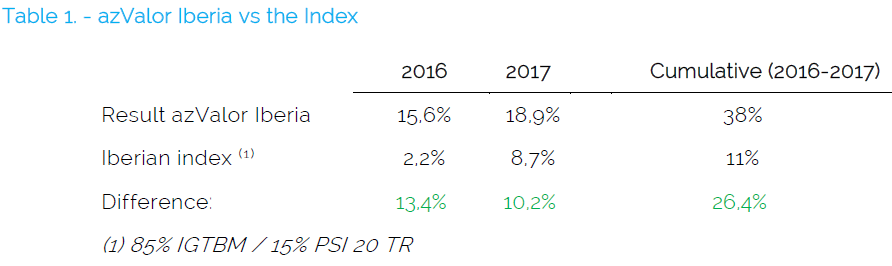
- The fund has outperformed the market by an average of approximately 13 percentage points annually over the past two years, but the probability of repeating this over the next decade is near zero. Expected excess returns are projected to decline to 5–7 percentage points per year.
- The current portfolio implies a 63% potential upside, based on the valuations and prospects of existing holdings.
Key Arguments and Data
- Performance Comparison: In the first half of 2018, the Iberian portfolio posted an absolute return of -0.9%, slightly below the index's -0.6%.
- Historical Excess Returns: The fund outperformed the market by an average of approximately 13 percentage points annually over the past two years, but the author believes excess returns will fall to 5–7 percentage points per year over the next decade.
- Portfolio Adjustments:
- Exited Telefónica (IRR of only 5%), citing uncertainty regarding its non-Brazilian market exposure.
- Exited Almirall (IRR +34%) and Catalana Occidente (IRR 9.8%), and partially reduced Técnicas Reunidas (due to share price appreciation).
- Used share price declines to increase positions in Mota Engil, Jerónimo Martins, NOS, OHL, and Tubacex.
- Portfolio Potential: The current portfolio consists of 24 companies, implying a 63% potential upside.
Companies/Assets Involved
| Company/Asset | Role | Key Data | Bullish/Bearish |
|---|---|---|---|
| Telefónica | Exited | IRR 5% | Bearish (uncertainty in non-Brazilian markets) |
| Almirall | Exited | IRR +34% | Bearish (profit-taking) |
| Catalana Occidente | Exited | IRR 9.8% | Bearish (profit-taking) |
| Técnicas Reunidas | Partially reduced | Share price appreciation | Neutral (partial profit-taking) |
| Mota Engil | Increased | Significant share price decline | Bullish |
| Jerónimo Martins | Increased | Significant share price decline | Bullish |
| NOS | Increased | Significant share price decline | Bullish |
| OHL | Increased | Significant share price decline | Bullish |
| Tubacex | Increased | Significant share price decline | Bullish |
Investment Implications
- No Overreaction to Short-Term Volatility: The fund's short-term underperformance relative to the benchmark is part of the strategy. Investors should remain patient and evaluate performance over a five-year cycle.
- Downward Revision of Expected Returns: Expected excess returns over the next decade have been reduced from 13 percentage points per year to 5–7 percentage points per year, requiring investors to adjust their return expectations.
- Contrarian Accumulation Opportunities: The report shows that the fund used significant share price declines to increase positions in Mota Engil, Jerónimo Martins, and others, suggesting these assets are currently attractively valued and may offer medium-term revaluation opportunities.
- Portfolio Upside Potential: The current 24-stock portfolio implies a 63% upside, indicating that the fund manager believes existing holdings are significantly undervalued.

Theme and Background
This chapter focuses on the performance of the Azvalor International fund in the first half of 2018 and its unique investment methodology. The report notes that despite a 5% loss in the first quarter, the fund achieved a positive return of 4% by the end of June, outperforming the benchmark index, which posted a slight decline. The author emphasizes that in volatile markets, client patience accounts for half the success, while the other half depends on the fund's rigorous analytical process.
Core Thesis
The author's core investment argument is: Long-term excess returns stem from deep fundamental analysis, not from predicting short-term market fluctuations. Counterintuitive judgments include:
- Market volatility represents opportunity rather than risk, especially in overlooked industries (e.g., uranium mining), where valuation dislocations offer significant upside potential.
- The 42 companies in the portfolio currently imply over 100% potential upside based on their valuations. Although the broader market has risen, these stocks were purchased at low prices after experiencing substantial declines.
- The fund's internal employees (including spouses and children) are the largest holders, with assets 1.65 times those of the second-largest holder family, which is seen as a strong testament to confidence in the fund's own strategy.
Key Arguments and Data
The author details a four-step analytical process, supported by specific data:
1. Data Collection and Organization: Gather historical sales, earnings, and other data for companies and compare them against all competitors.
2. Hypothesis and Validation: Formulate hypotheses based on historical data, verify them with industry experts, and assess management incentives, integrity, and stakeholder perceptions.
3. Valuation and Decision-Making: Estimate the range of future profits, conduct company valuations, and allocate weights based on attractiveness.
4. Continuous Monitoring: Review the performance of 70 companies (Iberia + International) each quarter, analyze 3–4 competitors per company, and process 850 to 1,100 quarterly reports annually.
Key Data Comparison:
| Metric | Data |
|---|---|
| First-half 2018 return | 4% |
| Benchmark index performance | Slightly negative |
| Number of portfolio companies | 42 |
| Potential upside | Over 100% |
| Employee assets vs. second-largest holder | 1.65 times |
Market Observation Example:
- On the day of Facebook's stock price crash, the total market capitalization of all publicly listed uranium mining companies (including integrated miners) was lower than Facebook's single-day market value loss.
- Uranium mining generates 10% of global electricity and is a clean energy source (without the intermittency issues of wind or solar), yet the industry is shunned by the market and valued at extremely low levels.
Companies/Assets Involved
- Uranium Mining Companies (Global Listed): Cited as representatives of an overlooked industry with cheap valuations, where the author is dedicating significant analytical effort.
- Facebook: Used as a comparative case, where its single-day market value loss exceeded the entire market cap of the uranium mining industry.
- 42 Companies in the Portfolio: Not named specifically, but emphasized as all purchased at low prices, with valuations far exceeding current prices.
Investment Insights
- Directional Advice: Investors should focus on industries overlooked by the market (e.g., uranium mining), where negative sentiment has caused valuation dislocations, but fundamentals (such as clean energy demand) may provide long-term growth drivers.
- Methodological Insight: Avoid chasing short-term market fluctuations; instead, seek a margin of safety through deep analysis (historical data, competitive comparisons, management evaluation). The high proportion of holdings by the fund's internal employees indicates strong confidence in the strategy by the management team.
- Risk Warning: Despite a rigorous process, the possibility of future errors cannot be eliminated; short-term performance (e.g., half-year results) is insufficient to judge long-term success, and patience is required for valuations to revert.
Theme and Background
This chapter is a letter from the CEO of the Azvalor Fund to investors, primarily reviewing the fund's progress in client growth, client service, compliance audits, investor events, and educational outreach during the first half of 2018. Through this, the author conveys the robustness of the fund's operations and the emphasis on client relationships, while hinting at the high potential of the current portfolio.
Core Thesis
The author's core investment thesis is: The fund's success depends not only on investment performance but also on client trust and operational discipline. The counterintuitive aspect is that the author does not directly discuss the market or holdings but instead indirectly demonstrates the fund's worthiness for long-term holding by emphasizing client service, compliance, and community building. The author believes the current portfolio has extremely high potential but requires patience and confidence from clients.
Key Arguments and Data
- Client Growth: Nearly 1,000 new clients were added in the first half, bringing the total number of clients to 17,600.
- Client Service: The call center handled 5,966 calls, with support provided by the team (Jorge Santamaría, Jenny, Pilar, Ana, etc.).
- Compliance and Audit: The management team (Sergio Fernández-Pacheco) completed the third external audit and hosted the first on-site inspection by Spanish regulators, which passed without incident.
- Investor Events: The "A Coffee at azValor" event saw nearly 1,000 registrations, far exceeding the author's expectation of one-third of that number. The summer course was held in El Escorial, with over 70 attendees in person and nearly 300 viewers online.
- Team Role Analogy: The author compares the compliance team to "defense in the World Cup," emphasizing that in an increasingly regulated industry, compliance failures can be fatal.
Companies/Assets Involved
This chapter does not involve specific investment targets or company analysis but focuses on the fund's operations. The internal team members and external speakers mentioned (such as Alex Estebaranz, Javier Ruiz, etc.) are only participants in events and do not constitute investment advice.
Investment Implications
For investors, the implication of this chapter is: The Azvalor Fund is currently in a high-potential phase but requires patience from clients. By showcasing client growth, compliance without incidents, and event participation, the author implies that the fund's operations are robust and worth holding for the long term. Investors should focus on the potential returns of the fund's portfolio rather than short-term fluctuations and utilize client service channels to address any concerns.