Job Lot on Sale (December 2025)
The Capital Cycle is the official podcast that Marathon Asset Management (the London firm founded in 1986) launched in 2024, hosted by financial historian Edward Chancellor, who interviews Marathon's investors about each Global Investment Review letter — applying the firm's long-term, contrarian "capital cycle" supply-side approach.
In plain words
This report looks at Kanzhun (Boss Zhipin), a Chinese job platform. It argues that while Boss Zhipin already dominates with 51% of daily users, it's barely started making money—only 30% of employers pay to post jobs, and the average fee is just 100 yuan a month. That's far below peers like Australia's Seek, which charges over 10 times more. The report uses historical examples like Japan's USS auction platform and Seek itself to show how dominant platforms can raise prices for years without losing users. For ordinary investors, this suggests Boss Zhipin could double profits over time, and at 20 times earnings with a 6% cash yield, the stock isn't expensive. It's worth a read because it uses real data to explain why a winner can keep winning.
The Capital Cycle report explores investment opportunities in platforms with network effects during their early monetization phase. The core thesis is that the gap between value creation and value capture is key to predicting a company’s long-term returns. The report uses Kanzhun (which operates Bos
Theme and Background
This chapter explores investment opportunities in the early monetization stage of online platforms with network effects. The report argues that the gap between value creation and value extraction is a key indicator for predicting a company's long-term returns; this gap is largest when the platform has just established initial market dominance but has not yet fully commenced monetization, providing a window for investors to achieve excess returns.
Core Thesis
The author's core judgment is: Kanzhun (operator of Boss Zhipin) is at an inflection point where network effects are strengthening and monetization is just starting, exhibiting a long-term expansion path similar to that historically seen by Japan's USS and Australia's Seek. The counterintuitive aspect is that although Boss Zhipin already commands over 50% of DAU market share, its monetization level is extremely low (only 30% of job postings are paid, with ARPU around RMB 100/month), far below Seek's 100% paid rate and more than 10 times higher ASP, indicating significant room for future margin and cash flow expansion.
Key Arguments and Data
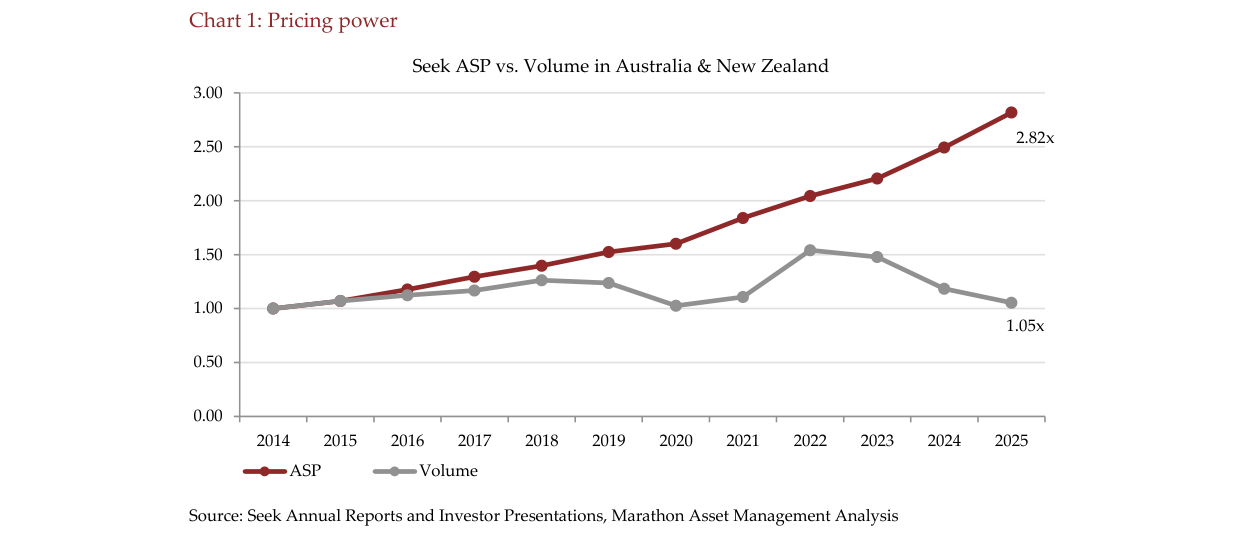
Seek's average selling price (ASP) in Australia and New Zealand grew from a baseline of 1.00 in 2014 to 2.82 times in 2025, while transaction volume over the same period increased only marginally to 1.05 times, demonstrating strong pricing power
1. Historical Cases Validate the Path: Japan's USS leveraged network effects to continuously raise prices after capturing over 40% market share, with operating margins expanding from 40% in FY2011 to 52% in FY2025, despite headwinds from an aging population. Seek Limited's ANZ division saw its ASP nearly triple (2.82 times) from FY2014 to FY2025, while job postings grew cumulatively only 5% (1.05 times), with EBITDA margins consistently above 50%. Boss Zhipin is in a similar early stage.
Seek ANZ Division Price vs. Volume Comparison (Base Year 2014 = 1.00):
| Metric | 2014 | 2025 | Cumulative Change |
|---|---|---|---|
| ASP | 1.00 | 2.82 | +182% |
| Job Postings | 1.00 | 1.05 | +5% |
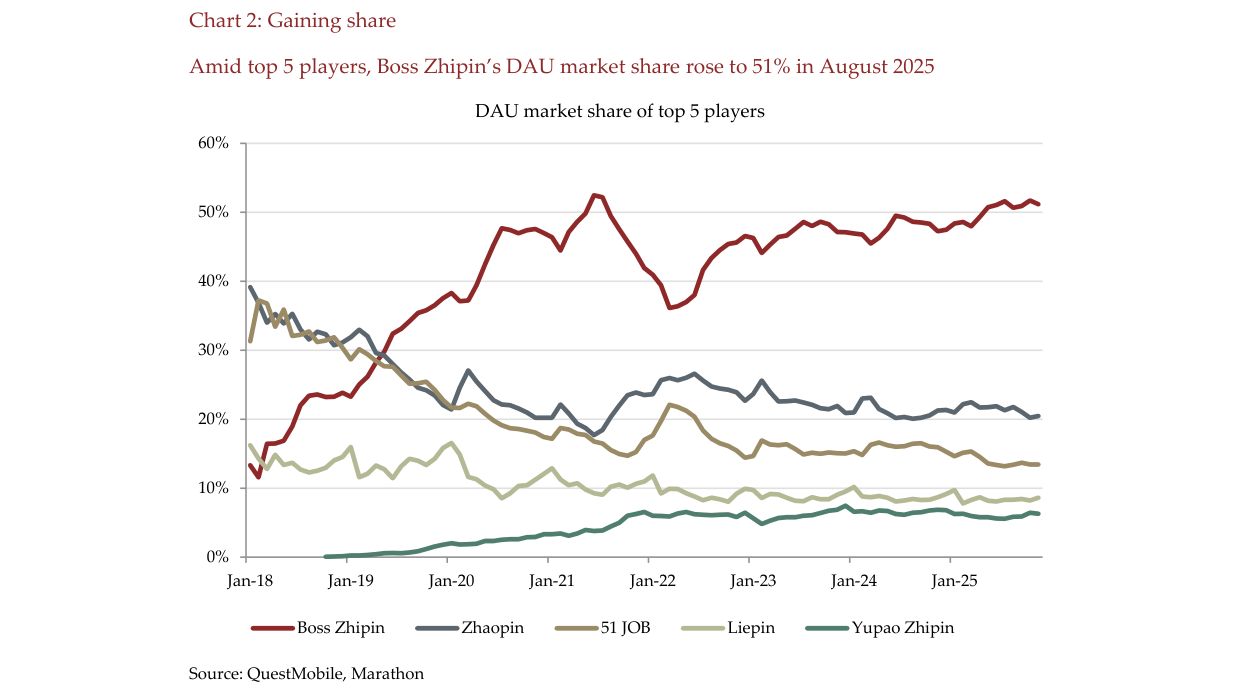
Among the top five online recruitment platforms in China, Boss Zhipin's DAU market share rose steadily from approximately 12% in early 2018 to 51% in August 2025, while competitors such as Zhaopin saw their shares decline
2. Boss Zhipin Market Share and Financial Performance: As of August 2025, Boss Zhipin held a 51% DAU share among the top five platforms, far ahead of traditional rivals such as Zhaopin and 51Job. Revenue grew from roughly RMB 1 billion (estimated) in 2019 to an estimated RMB 8 billion in 2025E (chart estimate); EBITDA margins improved from a loss in 2019 (-49% margin) to approximately 42% margin in 2025E.
3. Monetization Headroom: Currently, only 30% of employers pay for job postings, and paid user ARPU is only RMB 100/month. For reference, Seek's ASP in Australia/New Zealand is more than 10 times higher than Boss Zhipin's (before adjusting for salary differences), and even after adjustment, there remains significant upside.
4. Valuation and Cash Flow: Kanzhun currently trades at 20x P/E, with a 6% FCF yield and net cash representing 30% of market cap. FCF conversion is expected to exceed 100%, and the company plans to return USD 330 million to shareholders via dividends and buybacks in 2025 (close to 100% of net profit).
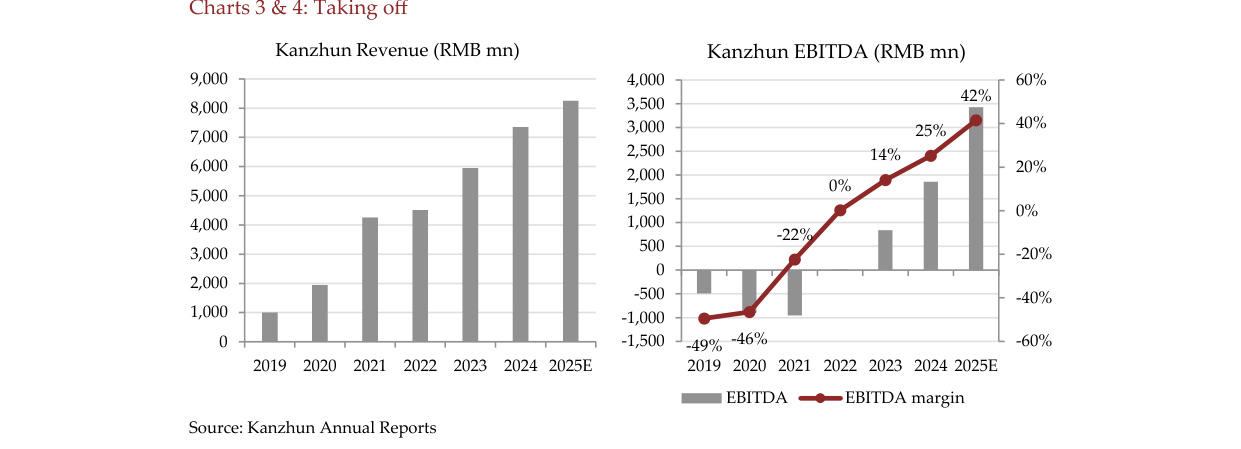
Kanzhun's revenue grew from approximately RMB 1 billion in 2019 to approximately RMB 7.5 billion in 2024, and is expected to reach approximately RMB 8.2 billion in 2025, demonstrating continued rapid growth
Companies/Assets Involved
| Company/Asset | Role | Key Data | View |
|---|---|---|---|
| Kanzhun (Boss Zhipin) | Core analysis target | DAU share 51%; revenue from ~RMB 1B (2019) to ~RMB 8B (2025E); EBITDA margin from -49% to ~42%; ARPU RMB 100/month | Bullish: Network effects strengthening, monetization beginning, valuation reasonable |
| USS (Japan used car auction) | Historical benchmark | Market share >40%; operating margin from 40% (FY2011) to 52% (FY2025) | Positive case: Price/profit expansion path of a mature network effect platform |
| Seek Limited (ANZ division) | Historical benchmark | ASP nearly tripled; EBITDA margin >50%; 100% paid job postings | Positive case: Long-term high profitability from pricing power |
| Zhaopin | Competitor comparison | Revenue declining consecutively, margins shrinking annually (after Boss Zhipin IPO) | Negative case: Traditional platform under pressure |
| 51Job, Liepin, Yupao | Other competitors | Market share eroded by Boss Zhipin | Not rated, background reference |
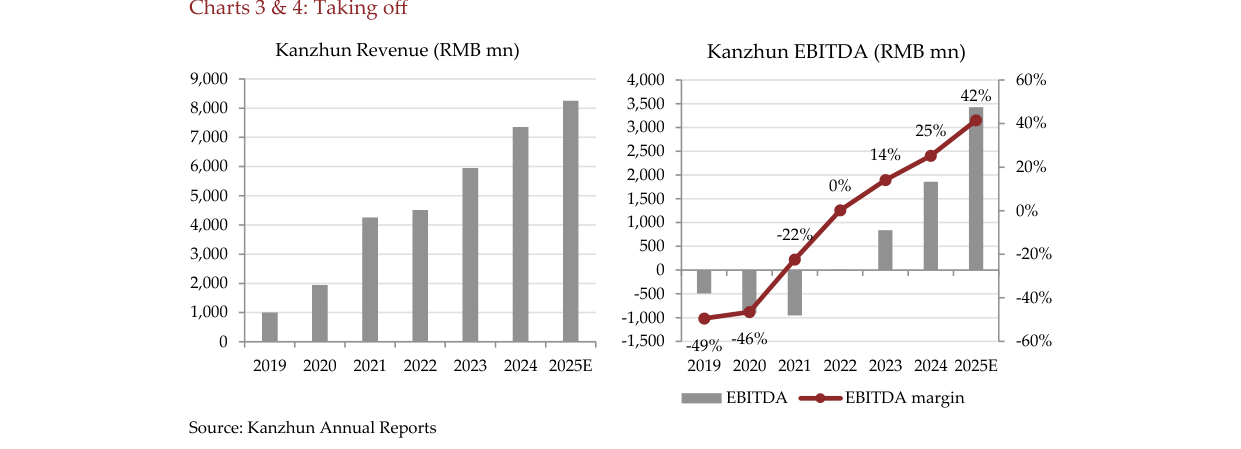
Kanzhun's EBITDA margin improved continuously from -49% in 2019, turned positive to 14% in 2022, and is expected to reach 42% in 2025, with absolute EBITDA also increasing substantially
Investment Implications
- Buy Kanzhun: The current valuation does not fully reflect the long-term growth from early-stage monetization (20x P/E corresponds to high growth, high FCF, ample net cash). As the paid rate rises and ARPU converges toward Seek's levels, revenue and margins will continue to expand over the next several years.
- Monitor VIE Structure Risk: Currently, profits and cash flows are all within the VIE, creating obstacles to repatriation to the holding company. However, management has committed to completing restructuring by year-end; founders and employees hold over 16% of shares, aligning interests to mitigate risk. Resolution of the structural issue would be an additional catalyst.
- Avoid Traditional Recruitment Platforms: Companies like Zhaopin cannot compete with Boss Zhipin in network effects and AI-driven matching efficiency, and will continue to lose revenue and users.