Boxing Day Gift (December 2025)
The Capital Cycle is the official podcast that Marathon Asset Management (the London firm founded in 1986) launched in 2024, hosted by financial historian Edward Chancellor, who interviews Marathon's investors about each Global Investment Review letter — applying the firm's long-term, contrarian "capital cycle" supply-side approach.
In plain words
This report looks at the North American cardboard box industry (the kind used for shipping) and makes a counterintuitive point: even though box sales have fallen back to 2016 levels, big producers are voluntarily shutting down factories. That supply cut could actually make the remaining companies more profitable. The report is especially bullish on Smurfit Westrock, arguing its recent merger and operational fixes could boost earnings and lift the stock by 60%. For regular investors, the key idea is 'capital cycle'—when an industry stops fighting over market share and starts cutting supply, the leaders become more valuable. Worth reading because it shows how to find opportunity in a seemingly weak sector.
This report begins with the British Boxing Day tradition and discusses the capital cycle investment opportunities in the North American containerboard industry. The core thesis is that industry consolidation and rational capacity cuts are driving supply contraction, while demand has weakened to 2016
Theme and Background
This chapter uses the British Boxing Day tradition as an entry point to discuss capital cycle investment opportunities in the North American containerboard industry. The market backdrop is characterized by significant consolidation, yet end-market demand has softened to levels last seen in 2016, severely disconnected from macroeconomic growth.
Core Thesis
The report's author argues that the North American containerboard industry is at an inflection point of structural supply-side improvement. Despite weak demand, capacity rationalization is reshaping the industry landscape. The counterintuitive observation is that box shipments have declined for three consecutive years, reverting to 2016 levels, while the real economy is now significantly larger than in 2016. This suggests that the demand decline is not due to an economic recession but rather a combination of structural factors, leaving room for supply-side discipline to restore balance.
Key Arguments and Data
1. Market concentration has risen sharply: the top five producers' market share has increased from 34% in 1984 to 75%, with International Paper and Smurfit Westrock together accounting for nearly half.
2. Approximately 3.9 million tons of capacity have been closed this year, representing 10% of total industry capacity — the largest absolute and percentage reduction in recent years.
3. Box shipments have fallen for three consecutive years, returning to 2016 levels (Chart 1 shows approximately 30,500 thousand tons), while the real economy has grown by 25% over the same period.
4. End markets appear stable — 45% food and beverage, 30% other non-durables — but demand has been suppressed by a confluence of factors: the e-commerce surge during the pandemic, weakness in the U.S. industrial economy, historically low housing turnover, and substitution of boxes by paper mailers.
5. Capacity utilization is expected to rise above 95%, a historical tipping point for pricing recovery.
6. The European market is more fragmented (top four hold ~55% share) with utilization at only 86%, yet Smurfit still maintains mid-to-high double-digit margins.
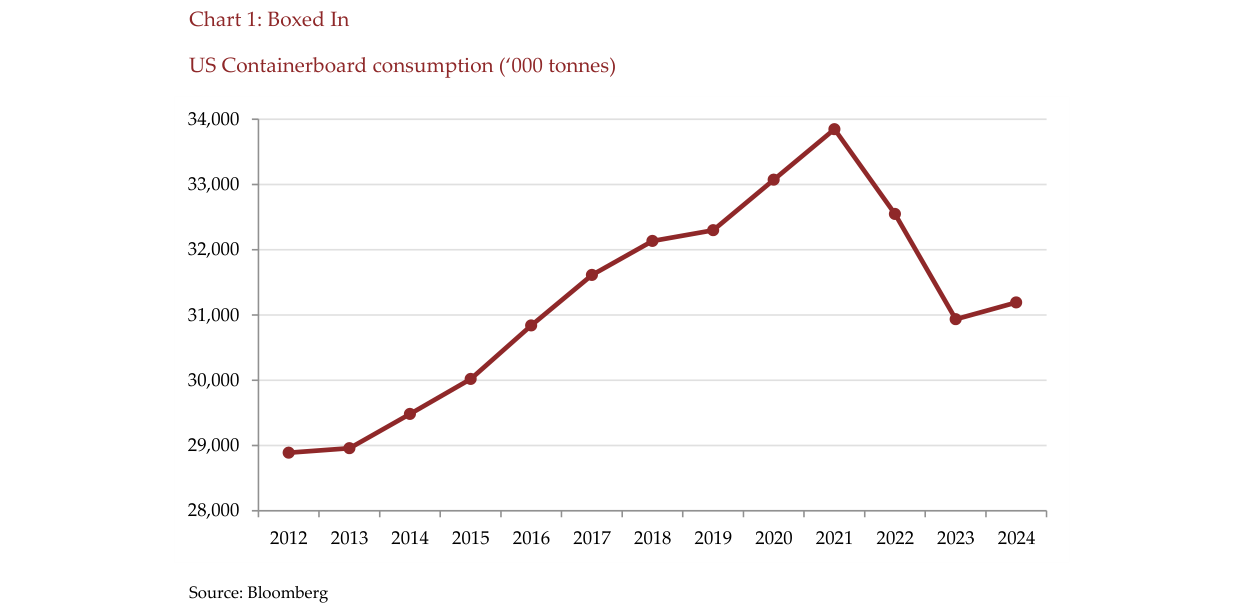
U.S. containerboard consumption grew from approximately 29 million tons in 2012 to a peak of about 34 million tons in 2021, then fell back to around 31 million tons in 2023, with a modest rebound in 2024
| Metric | Data |
|---|---|
| Top 5 Market Share (1984) | 34% |
| Top 5 Market Share (Current) | 75% |
| IP + Smurfit Westrock Combined Share | ~50% |
| 2025 Capacity Closures | 3.9 million tons (10% of industry) |
| Current Box Shipment Level | 2016 Level |
| Real Economic Growth (vs. 2016) | 25% |
| Capacity Utilization Threshold for Pricing | 95% |
| European Top 4 Share | ~55% |
Companies/Assets Involved
- Smurfit Westrock (formerly Smurfit Kappa): The report is explicitly bullish. Revenue mix: 60% U.S., 34% EMEA, 6% Latin America. Management is known for an efficient decentralized model, with only 98 headquarters staff supporting $3.1 billion in global revenue. Westrock's poor integration and volume-oriented approach left a $10 billion box plant network unprofitable. Marathon expects that by introducing local profit incentives and automation, this network could generate $0.8–$1.2 billion in incremental profit. Synergies of $400 million have been announced, but the author believes this is far from full potential. At current levels, the stock trades at ~11x P/E with a ~5% dividend yield. EPS is expected to approach $5 within three years, which could imply a ~60% upside from the current share price.
- International Paper: The new CEO follows a "value over volume" strategy and has also closed capacity. The report does not explicitly take a bullish or bearish stance but cites it as a positive example of rational industry behavior.
Investment Implications
- Favor Smurfit Westrock: Tightening supply, significant self-help integration potential, and a pronounced valuation discount make it a classic capital cycle turnaround opportunity.
- Industry-wide: Capacity closures are permanent. If demand recovers (even to trend), the supply gap will drive pricing recovery, structurally benefiting incumbent leaders.
- Avoid high-cost, non-consolidated smaller producers: Europe still has substantial loss-making capacity (about a quarter "underwater"). New capacity construction is expensive and time-consuming (a greenfield mill costs approximately €2 billion and takes several years), creating high barriers to supply-side entry.