Barbarous Relics (November 2025)
The Capital Cycle is the official podcast that Marathon Asset Management (the London firm founded in 1986) launched in 2024, hosted by financial historian Edward Chancellor, who interviews Marathon's investors about each Global Investment Review letter — applying the firm's long-term, contrarian "capital cycle" supply-side approach.
In plain words
This report divides companies into two types: big spenders (like tech giants pouring money into data centers) and disciplined operators (like firms consolidating telecom or real estate). It argues the best opportunities are in the latter—they've been unloved, with low valuations, but are now cutting capital spending and improving cash flow, setting up for a turnaround. In contrast, the big spenders look risky because their high investment and lofty growth expectations are hard to justify. Bottom line: avoid the hype, look for cheap stocks that are quietly fixing their businesses.
The report compares "Joneses" (high spenders pursuing status) with "Barbers" (low capital intensity, disciplined focus) to discuss capital cycles and investment opportunities. Core view: In emerging markets, Tencent, Alibaba, and Meituan generated CNY 91 in market value growth per CNY 1 in capital e
Theme & Background
This chapter introduces two opposing economic behavior models: "Keeping Up with the Joneses" (high-spending status seekers) and the "Wealthy Barber" (low capital intensity, disciplined commoners), drawing an analogy to two types of companies in the current market. By comparing "Joneses"-type giants in emerging markets with "Barbers"-type consolidators, the report explores how changes in capital intensity within the capital cycle affect investment returns, and points out that the market's valuation of the two asset classes implies vastly different growth expectations.
Core Thesis
The report argues that the best investment opportunities today are not in high-capital-intensity, high-valuation "Joneses" (e.g., hyperscalers), but in "Barbers" where capital intensity is declining and industries are healing (e.g., emerging market additions). Contrarian view: Although hyperscalers boast the highest historical returns (5-year average RoIC of 19%) and prominent status, their rising capital intensity (set to breach the 20% ceiling) and negative CRoIIC (since 2022) mean that the growth expectations implied by valuations are unlikely to be realized. Conversely, historically poor-performing "Barbers" (5-year average RoIC of only 4%) are reducing capital intensity by consolidating asset-intensive industries; their current low valuations and improving free cash flow yields provide a margin of safety and a free growth option.
Key Arguments & Data
1. Historical Comparison — Rewards and Pitfalls of the "Joneses":
- In 2020, Chinese internet giants Tencent, Alibaba, and Meituan generated CNY 91 in incremental market cap for every CNY 1 in capex, but competition intensified later and CNY 60 billion in value evaporated by 2023.
- At the 2020 peak, these three companies had a market cap of CNY 6 per CNY 1 of sales, but incremental free cash flow was negative, growth relied on sales expansion, and valuations eventually collapsed.
- Currently, hyperscalers see a CNY 7 stock price increase per CNY 1 of sales, with average CRoIIC negative since 2022. Sparkline estimates that AI revenue would need to grow roughly 100x in less than 5 years to justify current data center construction; AI capex's contribution to GDP already exceeds that of telecom fiber during the 2000 internet bubble.
2. "Barbers" Consolidation & Healing:
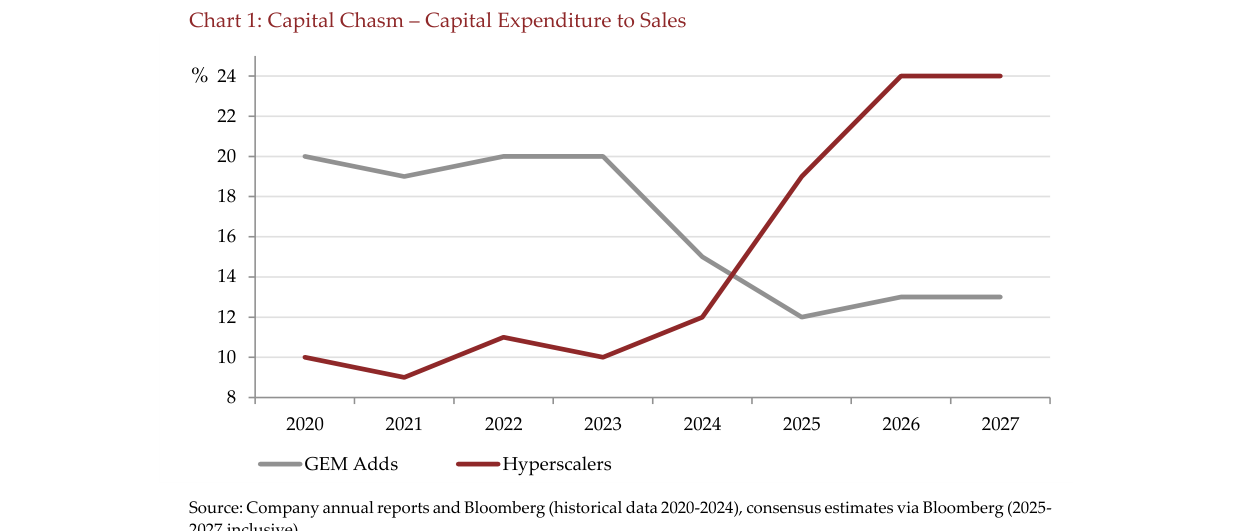
- New additions (China Resources Land, Millicom International, Entel Chile) historically had average capital intensity of 20%, twice that of hyperscalers (currently around 10%), but this is expected to fall to low double digits in the future.
- In 2024, these companies' free cash flow (FCF) margins and yields both rose to double digits (previously single digits or negative), signaling "green shoots" of industry healing.
- The new additions' CRoIIC (2025-2027E) averages 13%, equal to their estimated cost of capital (13%); current FCF yield is 13%, implying a perpetual growth rate of 0%. In contrast, hyperscalers have a CRoIIC of only 1%, cost of capital of 8%, FCF yield of 2%, and an implied perpetual growth rate of 6%.

Hyperscalers' capex-to-sales ratio is expected to rise from ~10% in 2020 to 24% in 2027, while GEM Adds decline from 20% to ~13% over the same period
3. Comparison Table:
| Metric | GEM Adds | Hyperscalers |
|---|---|---|
| 2025-2027E CRoIIC | 13% | 1% |
| Estimated Cost of Capital | 13% | 8% |
| Current FCF Yield | 13% | 2% |
| Implied Perpetual Growth Rate | 0% | 6% |
| 5-Year Average RoIC (Historical) | 4% | 19% |
| Market Cap per Sales (Recent) | <2x | ~7x |
GEM Adds are expected to deliver average CRoIC of 13% and free cash flow yield of 13% over the next three years, versus 1% and 2% for Hyperscalers, implying a perpetual growth rate of 6%
4. Specific Case — Entel Chile:
- Chile is one of the most fragmented and least profitable mobile markets globally. The second-largest player Telefonica (market share >25%) exited with losses; the third-largest WOM also lost money and is held by private equity, unlikely to be a permanent participant. Entel, controlled by three family-owned businesses, is more stable.
- A 15-year real price decline has driven industry revenue to extremely low levels; a 4x recovery would be needed to return to the starting point. The report estimates capital intensity can drop from 18% to 15%, boosting FCF margin from 4% to >10%. Telecom industry healing in Brazil, Guatemala, etc. already provides precedent.
- Entel's current 13% yield implies the market is pricing in perpetual contraction, but the report sees a high likelihood of industry healing.
Companies/Assets Involved
- Tencent, Alibaba, Meituan: Former "Joneses" with extremely high capex returns in 2020, but subsequently saw significant value erosion. Used as a cautionary tale for growth traps at high valuations.
- Hyperscalers (Alibaba, Alphabet, Amazon, IBM, Meta, Microsoft, Oracle, Tencent): Current "Joneses" with capital intensity set to breach 20%, CRoIIC as low as 1%, FCF yield of only 2%, implying high growth expectations. The report is bearish on their relative appeal.
- China Resources Land, Millicom International, Entel Chile: New additions — "Barbers" with declining capital intensity, CRoIIC improving to 13%, FCF yield of 13%, implying zero growth expectations. The report is bullish, especially on Entel Chile's industry healing thesis.
- Telefonica, WOM: Competitors in Chile's telecom market, both exiting or likely to exit with losses, providing consolidation tailwinds for Entel.
Investment Implications
- Long "Barbers", Short/Avoid "Joneses": The report explicitly states that the best opportunities lie in buying emerging market consolidators (e.g., Entel) with declining capital intensity, improving CRoIIC, and extremely low valuations, rather than continuing to chase hyperscalers with expensive valuations and excessive implied growth expectations. Investors should focus on "industry healing" signals in the capital cycle — FCF margins and yields rising from low levels to double digits, which are leading indicators of capex slowdown and improving competitive dynamics.
- Specific Direction: Telecom industry consolidation (especially Latin America); continue to hold or add to emerging market "Barbers" such as China Resources Land, Millicom International, and Entel Chile. Their low valuations and declining capital intensity provide a margin of safety and potential for a Davis double play. For hyperscalers, despite the secular technology trend, current valuations and capital intensity make the risk-reward unattractive; positions should be reduced or hedged.