AI: Mad Maths? (September 2025)
The Capital Cycle is the official podcast that Marathon Asset Management (the London firm founded in 1986) launched in 2024, hosted by financial historian Edward Chancellor, who interviews Marathon's investors about each Global Investment Review letter — applying the firm's long-term, contrarian "capital cycle" supply-side approach.
In plain words
This report uses a 'capital cycle' lens to question the AI investment frenzy. It argues that nearly $3 trillion planned for data centers by 2028 is far too high for reasonable returns. For example, just the hardware portion would need to generate over $500 billion in annual cash flow by 2028 to cover costs. The real threat isn't weak demand, but rising competition—more firms are making AI chips and models, which could squeeze profits. For everyday investors, this is a warning: don't chase AI hype blindly. Companies selling AI hardware and infrastructure may face shrinking margins, not endless growth.
This report examines the AI investment boom from a capital cycle perspective, noting that current spending is enormous while the outlook for returns remains uncertain. Morgan Stanley estimates that cumulative investment in data centers from 2025 to 2028 will reach nearly $3 trillion (excluding energ
Theme and Background
This chapter examines the AI investment frenzy from a capital-cycle perspective, questioning the market’s optimistic expectations for massive spending. The author argues that understanding AI investment prospects should not get bogged down in technical details (such as trillions of tokens or reinforcement learning) but should return to fundamentals: capital flows, industry structure, and potential investment returns. The backdrop is that since the launch of ChatGPT, the market capitalization of ten U.S. technology companies has increased by $12 trillion, yet a huge gap has emerged between the scale of actual investment and the outlook for returns.
Core Thesis
The author’s core judgment is that the current scale of AI investment (nearly $3 trillion from 2025 to 2028) far exceeds what is needed for reasonable returns, and the market may be overly optimistic. The counterintuitive point is that although surging market caps appear to validate the investment, when calculated from a return-on-capital perspective, hardware investment alone would need to generate net cash flow exceeding $500 billion by 2028 to cover capital costs, while current stock prices already imply much higher future profits, suggesting bubble risk. The author also believes that intensifying competition, rather than insufficient demand, is the main threat to long-term returns.
Key Arguments and Data
1. Investment Scale Estimates:
- Morgan Stanley estimates cumulative data center investment from 2025 to 2028 at nearly $3 trillion (excluding energy costs).
- McKinsey forecasts $5.2 trillion by 2030.
- Citi estimates $2.3 trillion in hardware spending and $1.4 trillion in R&D spending from 2025 to 2029.
2. Return Rate Calculation:
- Hardware accounts for 60% of data center investment (approximately $1.7 trillion), with current depreciation periods around 5.5 years (Amazon has already shortened its period).
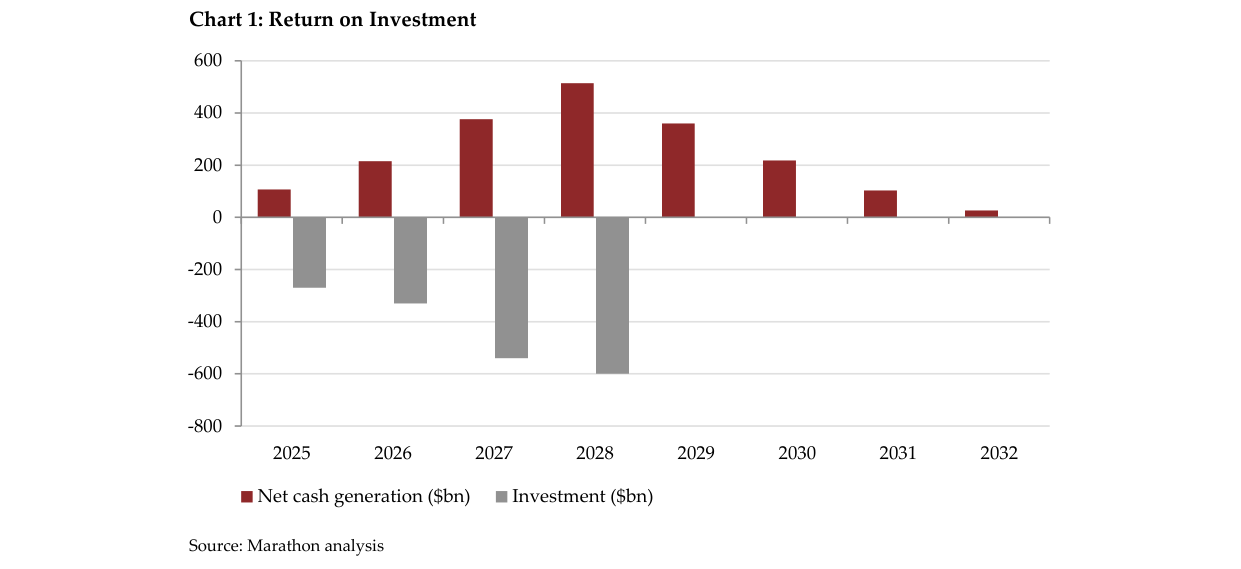
- Based on this assumption, hardware investment alone would need to generate net cash flow exceeding $500 billion by 2028 to meet capital costs (see table below).
- If operators require a 20% free cash flow margin, they would need $2.5 trillion in revenue; if customers then require a similar margin, end consumers and businesses would need to pay nearly $3.1 trillion in AI service fees, equivalent to 10% of current U.S. GDP or 5% of global labor costs.
| Metric | Value | Description |
|---|---|---|
| Data center investment 2025-28 | ~$3 trillion | Morgan Stanley estimate, excluding energy |
| Hardware investment share | 60% ($1.7 trillion) | McKinsey estimate |
| Required net cash flow from hardware (2028) | >$500 billion | Minimum to cover capital costs |
| Implied terminal AI services revenue | ~$3.1 trillion | After two levels of profit margins |
| Comparison: U.S. GDP (2024) | 10% | $3.1 trillion / ~$31 trillion |
| Comparison: Global labor costs | 5% | Based on OECD data |
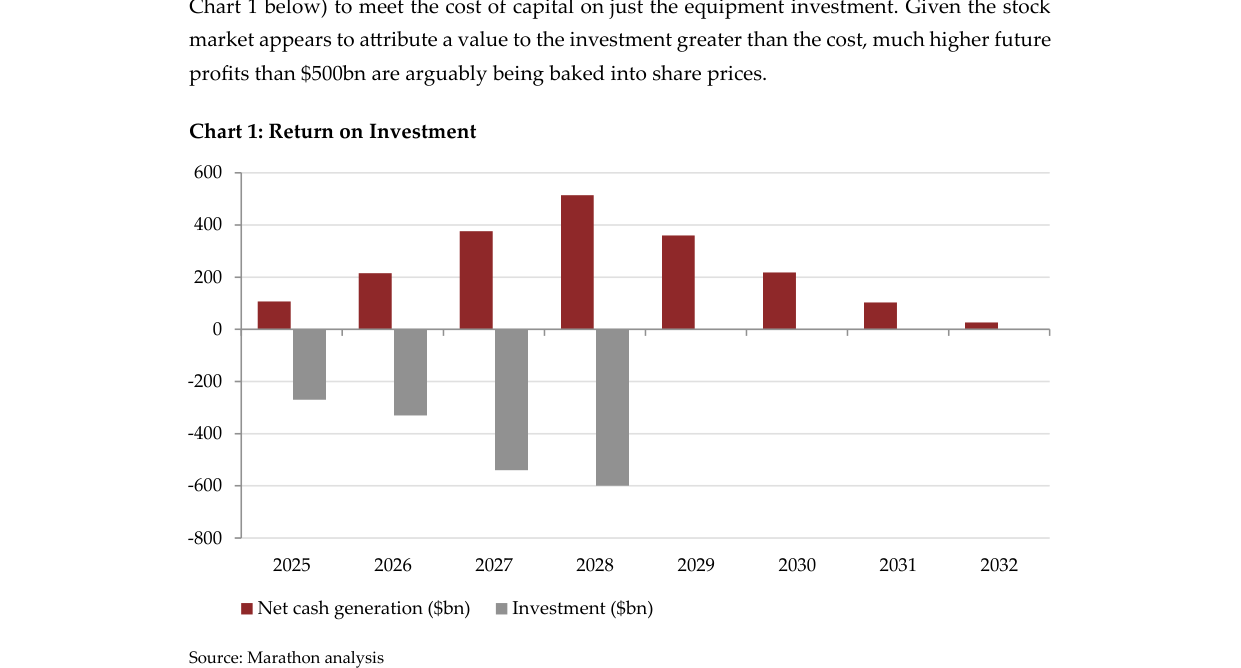
Bar chart showing AI investment and net cash generation projections for 2025-2032, with investment spending peaking at around $600 billion in 2028 and net cash inflows peaking at around $500 billion in 2028
3. Current AI Revenue Comparison:
- OpenAI currently has annual revenue of about $13 billion; The Information predicts this will grow to $200 billion by 2029.
- Citi estimates AI application revenue of $43 billion in 2025, reaching $780 billion by 2030 (80% annual growth).
- However, UBTC notes that third-party AI product revenue for publicly listed software companies is only about $2.5 billion, of which Microsoft accounts for 84%.
4. Poor Enterprise Adoption Results:
- An MIT study tracking 300 public AI projects found that 95% did not lead to profit improvement (reported by The Atlantic).
- A McKinsey survey from March 2024 showed that 71% of companies use generative AI, but over 80% reported no "material impact" on profitability.

5. Competition and Industry Structure:
- Nvidia holds a 75% share of the global accelerator market, but competitors in the data center space are increasing (e.g., Oracle, CoreWeave).
- The large language model market is trending toward fragmentation, with new entrants including Grok and DeepSeek.
- The author believes data centers are a high-fixed-cost, low-marginal-cost industry; once competition erupts, prices will approach marginal cost, leading to a "dumb pipe" predicament similar to that of airlines and telecoms after the internet bubble.
6. Behavioral Motivations:
- Citing Alphabet CEO Pichai’s remark that "the risk of under-investing is dramatically greater than the risk of over-investing," this reflects the innovator’s dilemma: industry leaders continue spending due to fear of missing out (FOMO).
- Bill Gates points out that agentic AI could disrupt existing tech markets such as search, shopping, and productivity, pushing giants to invest for self-preservation.
Companies/Assets Involved

- Nvidia (held by Marathon Capital): Dominates the global accelerator market (75% share), benefiting from AI hardware investment but facing rising competition. The author does not explicitly take a bearish stance, but notes risks from accelerated depreciation periods and technological iteration.
- Microsoft (held by Marathon Capital): Accounts for 84% of third-party AI product revenue, a major beneficiary of the AI ecosystem, but faces the risk of agentic AI disrupting its productivity tools.
- Amazon (held by Marathon Capital): Recently shortened its depreciation period to cope with technological acceleration, reflecting concerns about shortened hardware asset lifespans.
- Oracle (held by Marathon Capital): Growing as a challenger in the data center space, intensifying competition.
- OpenAI: Leader in AI applications, with annual revenue of about $13 billion, but its high valuation depends on explosive future growth ($200 billion by 2029).
- CoreWeave: Emerging competitor in data centers, adding to fragmentation.
- Grok and DeepSeek: New entrants in large language models, driving industry fragmentation rather than concentration.
Investment Implications
- Remain cautious on AI infrastructure and hardware companies (e.g., Nvidia): Although they currently benefit, shortening depreciation periods, intensifying competition, and high fixed-cost structures weigh on long-term profits. From a capital-cycle perspective, the current massive spending resembles the "dumb pipe" trap of airlines/telecoms rather than a sustainable winner-takes-all scenario.
- Focus on competition rather than demand: The author implies that the market is overly focused on AI demand growth, but the real risk is excessive capital inflows leading to fragmentation; even if demand exceeds expectations, profits could be eroded by competition.
- Cautiously optimistic but prudent on AI application layers: Low enterprise adoption rates (MIT's 95% failure rate) indicate a high current level of froth. If Citi’s forecast of $780 billion in application revenue fails to materialize, the ecosystem could suffer massive losses. Investors should prioritize companies with moats rather than concept hype.
- Macro risk: If AI service fees reach 10% of GDP, this would constitute a systemic macroeconomic strain, potentially dampening consumption and business investment.