Robotti & Company Advisors Q3 2025 Letter
Robotti & Company is a New York deep-value boutique founded by Bob Robotti in 1983, specializing in left-for-dead cyclical industries — energy services, building products, shipping — with multi-year holding periods and occasional activist letters. It manages about $650m; Bob is regarded as one of the most steadfast Graham-tradition cyclical value hunters.
In plain words
This article asks whether AI makes old-school stock picking obsolete. The author says AI is just a tool, not a replacement for human judgment and patience. Today's market is dangerously narrow—a handful of AI stocks drive most gains, similar to the late-1990s dot-com bubble. For regular investors, this means avoid chasing overpriced AI stocks and look at ignored companies with strong cash flow and low expectations (priced for indifference), like energy or materials. History shows that after bubbles burst, value stocks tend to win. Worth reading because it explains the risks with clear data and logic.
Robotti & Company Advisors noted in its Q3 2025 report that AI has not rendered fundamental investing obsolete; rather, it has highlighted the value of human judgment. The core argument is that while AI excels at pattern recognition and data processing, value investing retains an edge in gray areas
Theme and Background
This chapter discusses whether AI renders fundamental investing obsolete. The author argues that the market widely believes AI eliminates information advantages, but this view confuses "information" with "insight." The current market is highly concentrated, with gains in the S&P 500 Index driven primarily by a few AI-related technology companies, reminiscent of the late-1990s internet bubble.
Core Views
- AI is a tool, not a replacement: AI excels at pattern recognition and predictions within stable frameworks, but value investing retains an edge in "gray areas" such as human behavior, structural changes, and incentive structures. Independent judgment, patience, and embracing discomfort are enduring advantages that algorithms struggle to replicate.
- Current market concentration is unsustainable: The S&P 500 market-cap-weighted index has outperformed its equal-weight counterpart by nearly 30 percentage points over the past 24 months, a gap unseen since the internet bubble. History suggests that after such divergence, the equal-weight index tends to perform better over the long term, and value investors often shine when the bubble bursts.
- Counterintuitive judgment: The author does not view AI-related companies as "bad investments" but believes they are priced for "perfect expectations," while the companies in the author's portfolio are "priced for indifference"—valuations embed low expectations yet generate strong cash flows. This provides a margin of safety for future returns.
Key Arguments and Data
- Market concentration data: Over the past 24 months, the S&P 500 market-cap-weighted index has outperformed its equal-weight counterpart by nearly 30 percentage points, the largest gap since the internet bubble.
- Historical comparison: From January 2000 to January 2005, both the S&P 500 and the Nasdaq posted negative returns, while disciplined value investors achieved strong absolute performance.
- AI ecosystem case: NVIDIA, through substantial cash investments in its customers (effectively discounting chips), creates a self-reinforcing capital flow, suggesting that ecosystem growth relies on internal circulation rather than external demand.
- Portfolio divergence: The author's portfolio is highly uncorrelated with major indices, as it avoids AI-driven high-valuation stocks and adheres to valuation discipline.
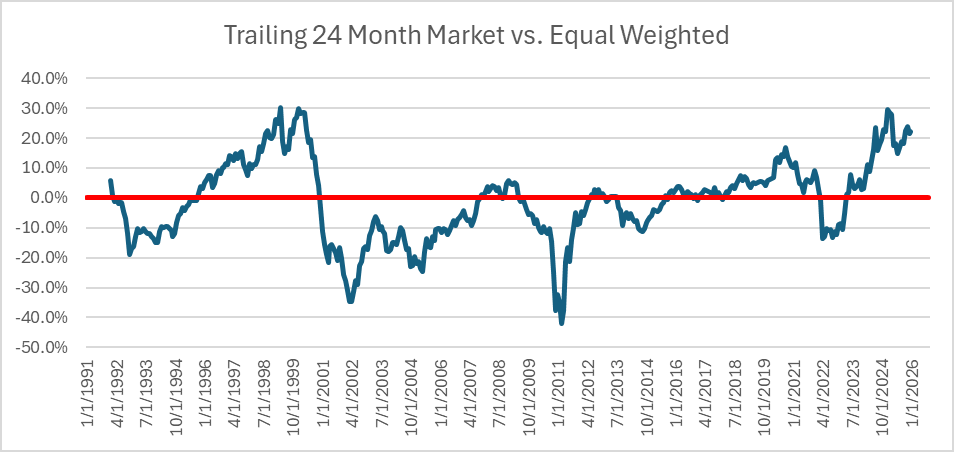
| Metric | Current Market | Internet Bubble Era |
|---|---|---|
| Market-cap-weighted vs. equal-weight index gap | Outperformed by nearly 30 percentage points over past 24 months | Similar magnitude, followed by bubble burst |
| Market drivers | A few AI-related tech companies | A few internet companies |
| Subsequent performance | Author expects value stocks to outperform | Value stocks outperformed from 2000-2005 |
Companies/Assets Involved
- NVIDIA: Case role—by investing in customers to effectively discount chips, it shows the AI ecosystem relies on self-reinforcing capital flows. The author does not directly short it but hints at valuation risk.
- Interfor Corporation: Exited position. Reasons: announced a ~15% share issuance (raising ~CAD 125 million), diluting existing shareholders; weak lumber prices led to production cuts of ~145 million board feet (12% of normal output); rising U.S. softwood lumber tariffs. The author believes management was forced to prioritize survival, unable to create shareholder value during the downturn.
- West Fraser Timber (WFG): Still held. The author believes its strong balance sheet enables counter-cyclical expansion, and its scale and geographic diversification allow it to withstand or even benefit from industry pressures. Bullish.
Investment Implications
- Avoid chasing the AI bubble: Current AI-related stock valuations already embed perfect expectations; investors should be wary of concentration risk. History shows that after a bubble bursts, value stocks often outperform.
- Focus on overlooked real assets: Capital is flowing from the physical world (energy, materials) to the digital frontier, but the digital world still depends on these foundational resources. The author believes these areas offer scarcity, cash flows, and significant mispricing.
- Adhere to valuation discipline: In a momentum-driven market, patience and price discipline are competitive advantages. Investors should seek companies "priced for indifference"—low expectations, strong cash flows, and fundamental support.