Robotti & Company Advisors Q2 2013 Letter
Robotti & Company is a New York deep-value boutique founded by Bob Robotti in 1983, specializing in left-for-dead cyclical industries — energy services, building products, shipping — with multi-year holding periods and occasional activist letters. It manages about $650m; Bob is regarded as one of the most steadfast Graham-tradition cyclical value hunters.
In plain words
This letter explains why Robotti's fund lagged the market in mid-2013. The Fed kept interest rates very low (from 4% down to about 2%), which pushed stock prices above what companies were actually worth. But the manager sticks to old-school value investing—buying stocks that could double in 3-5 years and are currently cheap. He gives an example: his biggest holding, Subsea 7 (an underwater pipeline company), dropped 11% in one day after a project write-down. But its orders and profits were actually improving, so he thinks the market overreacted. For regular investors, the takeaway is: don't panic over short-term losses. If a company's business is getting better while its stock falls, that might be a buying opportunity.
Robotti’s Q2 2013 investment report shows that its Value Equity Composite posted a return of -2.73% in the second quarter, underperforming the benchmark (Russell 2500 Value Index) which returned 1.54%; year-to-date return stands at 1.62%, significantly lagging the benchmark’s 15.10%. The report’s co
Theme and Background
This chapter serves as the introduction to Robotti's Q2 2013 investment report, primarily addressing the fund's short-term underperformance in a low-interest-rate macro environment and elaborating on its 30-year commitment to a deep value investment philosophy. The report notes that since the market low in 2009 (S&P 500 at 677), the overall market has risen over 138%, yet Robotti's value portfolio significantly underperformed its benchmark in both Q2 2013 and year-to-date.
Core Thesis
The author's core investment argument is: Short-term underperformance results from the Fed's sustained low-interest-rate policy (dropping from 4.00% in June 2008 to 1.98%), causing market valuations to detach from fundamentals. However, historically, such environments self-correct quickly, creating opportunities for fundamental investors. The author insists on seeking securities with the potential to double over the next 3-5 years and possessing a margin of safety, viewing volatility as an acceptable cost—citing Buffett's quote, "I would rather have a lumpy 15% return than a smooth 12%."
Counterintuitive judgments:
- The market treated Subsea 7's Brazilian project impairment as systemic risk, but the author views it as a one-time event, with the market overreacting (stock down 11.66% in a single day).
- While the stock fell 27.93%, the company's fundamentals (orders, EBITDA, margins) were actually improving.
Key Arguments and Data
1. Performance Comparison:
- Q2: Portfolio -2.73% vs. Benchmark +1.54%
- Year-to-Date: Portfolio +1.62% vs. Benchmark +15.10%
- Long-term (20 years): Portfolio annualized 13.04% vs. Benchmark 8.59%
2. Macro Environment:
- The Fed lowered rates from 4.00% in June 2008 to 1.98%.
- The S&P 500 rose over 138% from its March 2009 low of 677.
3. Subsea 7 Case Study:
- Stock price fell from $24.60 at the start of the year to $17.73, a decline of 27.93%.
- Single-day drop of 11.66% following the impairment announcement.
- Order book grew from $9B to over $10B during the same period.
- TTM EBITDA grew nearly 20% compared to 2011.
- EBITDA margin improved from 15.9% to 16.5%.
Companies/Assets Involved
| Company | Role | Key Data | View |
|---|---|---|---|
| Subsea 7 (OB:SUBC) | Largest portfolio holding | Stock price $17.73 (start of year $24.60); Orders $10B+; EBITDA margin 16.5% | Bullish: Market overreaction, fundamentals improving, favorable deepwater market growth trends |
| Technip, Saipem | Competitors | Form the three major competitors with SUBC | No explicit rating, but SUBC seen as best positioned |
| Amazon (AMZN) | Cites CEO Bezos | 1997 shareholder letter | Used as an analogy for consistency in investment philosophy |
Investment Implications
- Short-term volatility should not alter long-term strategy: The author believes the valuation divergence caused by the current low-rate environment is temporary. Investors should remain patient and wait for the market to revert to fundamental pricing.
- Distinguish between one-time events and systemic risk: The impairment on Subsea 7's Brazilian project is viewed by the author as a one-off issue, not a worsening industry trend. Investors should differentiate company-specific events from industry-wide systemic risks.
- Opportunities for contrarian positioning: Divergence where stock prices fall while fundamentals improve may contain opportunities for excess returns. The author emphasizes "behavioral advantage"—the ability to endure short-term losses while waiting for value realization.
- Long-term bullish on deepwater oil & gas services: Technological advancements (e.g., subsea compression, separation) and emerging production zones (Gulf of Mexico, West Africa, Southeast Asia) expand the market space, with large contractors benefiting from increasing project complexity.
New Analysis: Portfolio Adjustments and Value Discovery Logic
1. New Position Pico Holdings: Alternative Assets and Tax Arbitrage Strategy
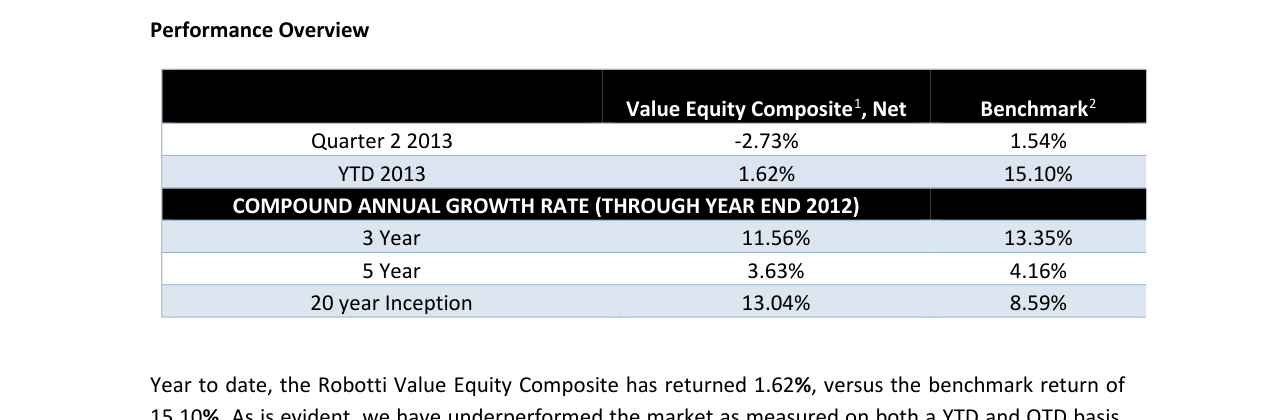
Robotti Value Equity Composite returned -2.73% in Q2 2013 (benchmark 1.54%), and 1.62% year-to-date, significantly underperforming the benchmark's 15.10%, but achieved a 20-year compound annual growth rate of 13.04%, outperforming the benchmark's 8.59%
Robotti added Pico Holdings (NASDAQ:PICO) in Q2 2013, with an investment logic typical of deep value and catalyst-driven approaches:
- Valuation Margin of Safety: Pico traded at 1.19 times book value (source: Q1 2013 10-Q). For a holding company with substantial hard assets (water rights, land), this valuation did not fully reflect the assets' appreciation potential.
- Long-term Value of Water Rights: The company has acquired water rights in the Southwest since the 1990s, initially for agricultural sales. Management foresaw higher margins from growing housing demand in the Southwest, a prescient judgment in the early stages of the 2013 US housing market recovery.
- Innovative Tax Arbitrage: Pico built a Canola oil crushing plant on its own land in Minnesota, becoming the only domestic Canola crushing plant in the US. In 2012, the US imported 1.37 billion pounds of Canola oil from Canada (USDA data). Pico avoids import taxes through domestic production, creating a structural cost advantage. This decision reflects management's "contrarian asset thinking"—acquiring real estate cheaply during the 2008 housing crisis, closely aligning with Robotti's investment philosophy.
2. UMH Properties: A REIT Directly Benefiting from the Housing Recovery
Robotti continued to add to UMH Properties (NYSE:UMH), with logic complementing Pico:
- Economic Substitution Effect: UMH operates, leases, and sells manufactured home communities. In a slow economic recovery, manufactured homes, being cheaper due to factory production, offer consumers a lower-cost home buying/renting option compared to the market, acting as an "economic substitute" in the housing market.
- Expansion and Leverage Potential: UMH expands its footprint by acquiring manufactured home communities, and most communities have substantial developable land. This "land bank plus unit expansion" model provides significant upside leverage—new units directly translate into rental or sales revenue, while fixed costs (land, infrastructure) are partially amortized.
3. Partial Sale of Builders FirstSource: Profit-Taking and Sustained Conviction
Robotti reduced its position in Builders FirstSource (NASDAQ:BLDR) but retained a "very substantial position":
- Price Appreciation and Valuation Change: BLDR rose 200% in a year and a half, no longer fitting the "value stock" definition. However, Robotti emphasizes that knowledge accumulated through industry tracking gives it strong conviction in the company's potential.
- Industry Cycle Judgment: The reduction is not a bearish call but based on the macro judgment that "the housing market will continue to rebound." As a building materials supplier, BLDR's business volume is highly correlated with new home starts and renovation demand. Robotti chose to partially take profits to manage risk while retaining a core position to capture subsequent gains.
4. Comparative Analysis: Differences in Investment Logic Across Three Holdings
| Holding | Investment Theme | Catalyst | Risk |
|---|---|---|---|
| Pico Holdings | Contrarian Assets + Tax Arbitrage | Realization of water rights value, Canola plant commissioning | Long asset realization cycle, water rights policy risk |
| UMH Properties | Housing Recovery + Economic Substitute | Community expansion, rising unit occupancy rates | Interest rate impact on REIT valuations, fluctuating manufactured home demand |
| Builders FirstSource | Industry Cycle + Value Reversion | Rising new home starts, increasing market share | Building material price volatility, intensifying competition |
5. Consistency of Investment Philosophy
Robotti reaffirms its "long-term buy-and-hold" strategy in the letter, with extremely low quarterly turnover (typically adding only 2-5 new positions annually). Its actions reflect three core principles:
- Contrarian Thinking: Buying assets during the 2008 housing crisis (Pico's real estate, UMH's communities) and adding positions in the early 2013 recovery.
- Management Quality: Preferring management aligned with public shareholder interests (Pico's management ownership, UMH's expansion decisions).
- Margin of Safety: Even with strong conviction in BLDR, partially selling after a 200% gain to avoid over-concentration.
6. Macro Background and Industry Data Support
- Housing Market Recovery: US new home starts recovered from a 2009 low of 554,000 to 928,000 in 2013 (Census Bureau), but still below the historical average of 1.5 million. Robotti judges "the rebound will continue."
- Canola Oil Demand: US Canola oil consumption grew from 500 million pounds in 2000 to 1.37 billion pounds in 2012 (USDA), a CAGR of approximately 8%, driven mainly by healthy eating trends. Pico's crushing plant is precisely positioned.
7. Summary: Patience and Discipline in Value Investing
Robotti's Q2 2013 letter demonstrates the flexibility of value investing in practice: buying contrarian during market panic (Pico's real estate), partially taking profits after significant gains (BLDR), while continuously adding to positions directly benefiting from macro trends (UMH). This strategy of "long-term core holdings plus flexible peripheral adjustments" allows it to balance risk and return during the housing recovery cycle.