Paul’s Notes #16 — 18th September, 2026
Rick Rule is a veteran natural-resource investor who began in 1974, built Global Resource Investments (sold to Sprott in 2011), and led Sprott U.S. Holdings until retiring in 2021 to found Rule Investment Media. His free Substack covers contrarian speculation in mining, energy and critical minerals — gold, silver, copper, nickel, royalty and streaming companies — framed by geopolitical risk.
In plain words
This article says Canada is giving mining companies a permanent tax break, and mining stocks are at their cheapest in 50 years. Rick Rule is bullish, especially on copper and gold. Three key holdings: Generation Mining got $340 million to build its copper project; Goldgroup Mining expanded its fundraising to $125 million, with big investors like Trafigura and Eric Sprott joining; Wheaton Precious Metals, with only 47 employees, shows how profitable the 'streaming/royalty' model (paying upfront for future metal at low prices) can be.
At a Glance
One-sentence summary: Rick Rule believes that Canada's tax incentives and historically low valuations in mining stocks have created a highly attractive investment window, with a stance of [Bullish].
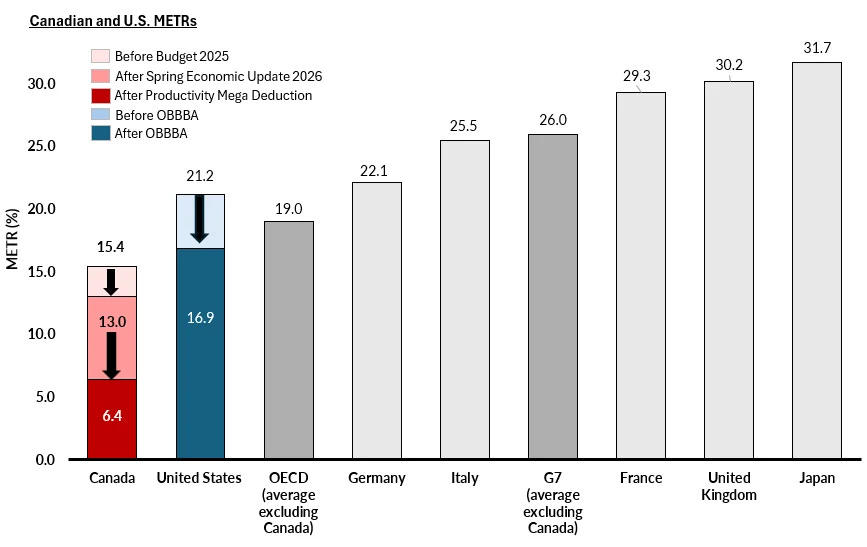
- Canada has introduced a permanent "Productivity Super Deduction" (PMD), allowing mining companies to fully deduct exploration and development costs, which is expected to accelerate up to CAD 1 trillion in new investment.
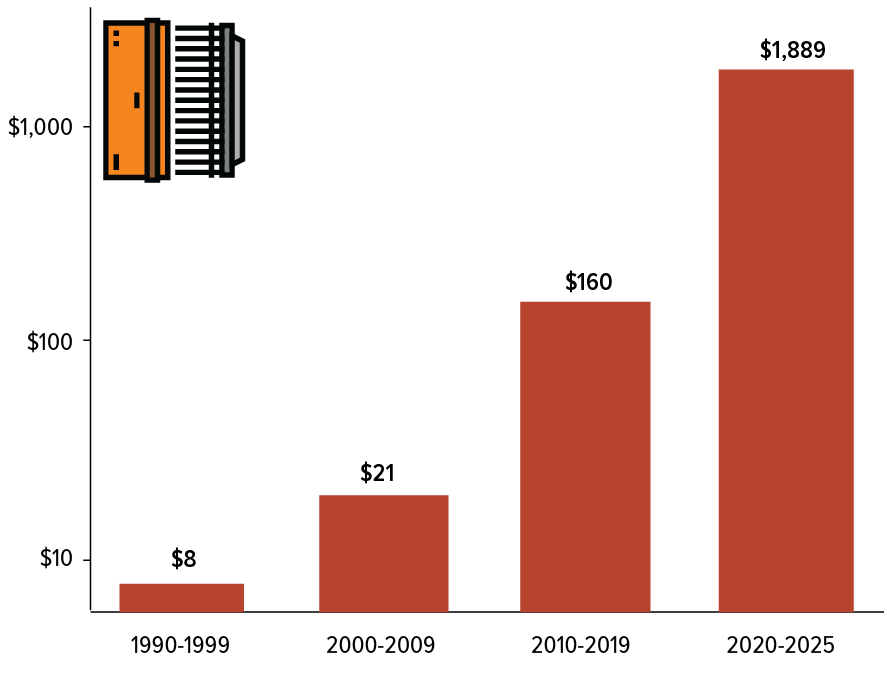
- Copper discovery costs have exceeded $1,500 per tonne, with new discoveries continuing to decline, widening the long-term supply gap.
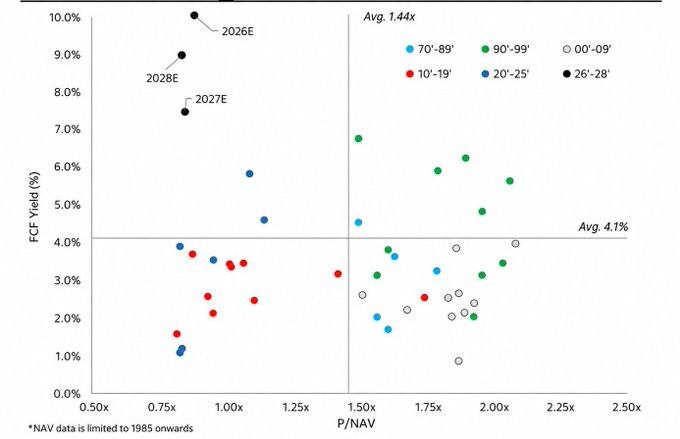
- Gold mining stocks currently have free cash flow yields and P/NAV ratios at their cheapest levels in 50 years, with producers engaging in large-scale share buybacks signaling a value revaluation.
- Several junior mining companies have secured significant financing or advanced key projects, including Generation Mining receiving $340 million in construction funding and Goldgroup Mining expanding its private placement to $125 million.
- The author is an investor in Goldgroup Mining, and the perspective reflects a position-holder's viewpoint.
Canadian Government Drives Mining Investment with Permanent Tax Incentives
The article notes that the Canadian government's proposed "Productivity Super Deduction" (PMD) will permanently allow companies to fully deduct investment costs, aiming to accelerate up to CAD 1 trillion in new investments. This policy is particularly favorable for junior mining companies, enabling immediate deductions for exploration and development expenses, shortening project payback periods, and reducing shareholder dilution. The author states, "PMD gives juniors an immediate deduction of exploration and development expenses, which means development projects will have a shorter payback period, which will make them more attractive to finance, and result in lower dilution for shareholders." This policy also applies to the oil and gas sector, allowing 100% immediate write-offs for major capital assets and development costs (e.g., well development, pipelines, and LNG liquefaction equipment), replacing the previous 30% declining balance method.
Multiple Companies Secure Financing or Advance Projects, Involving Specific Targets
The article lists mining companies that have recently received government support or advanced key projects, each with clear actions and data.
- Generation Mining (TSXV:GENM): Secured the final USD 340 million of its CAD 1.3 billion construction package for the Marathon copper-palladium project in Ontario, with funding from the Canada Growth Fund (USD 140 million) and the Canada Infrastructure Bank (USD 50 million). Glencore has agreed to offtake the project's multi-metal concentrate. A construction decision is expected soon, with pre-engineering work set to begin in Q4 2026.
- Osisko Gold (NYSE/TSXV:OGG): Formally decided to build its Cariboo gold project in British Columbia, targeting annual production of 190,000 ounces of gold starting in 2029, with remaining capital expenditures of CAD 990 million.
- Osisko Metals (TSX:OM): Plans to spin out its non-core exploration assets in New Brunswick into Osisko Critical Minerals, with John Burzynski as CEO. The primary assets are copper-silver-gold porphyry-skarn targets.
- NGEx Minerals (TSX:NGEX): Detailed plans to spin out its Valle Ancho project in Argentina into a new company named Valiente Resources, expected to be completed by late 2026 or early 2027. Preliminary metallurgical testing at its Lunahuasi project shows that over 95% of arsenic can be removed via flotation and the GlassLock process, achieving high recoveries of copper, gold, and silver.
- Fireweed Metals (TSXV:FWZ): At the Tom South zone of its Macpass zinc-lead-silver project in Yukon, drilling intersected a 180-meter extension, including 64 meters grading 8.35% zinc equivalent.
Large-Scale Financing and Business Model Highlights
The article emphasizes the large equity financing capabilities of junior mining companies and showcases the profitability of the precious metals stream/royalty model.
- Goldgroup Mining (NYSE-A/TSXV:GORO): Expanded a non-brokered private placement from USD 75 million to USD 125 million, with investors including Trafigura, Eric Sprott, and Rick Rule himself. Proceeds will fund assets in Mexico and Michigan, USA.
- Wheaton Precious Metals (TSX:WPM): The article cites a chart showing that the company generates remarkable market capitalization and net profit with a team of just 47 people, illustrating the "bulletproof" nature of the stream/royalty model.
Investment Implications
The article presents a clear signal of strong Canadian government support for mining investment through tax incentives, supported by evidence of specific companies' financing and project progress. Readers should note that Rick Rule is an investor in Goldgroup Mining, mentioned in the article, and his views may reflect a position-holder's perspective.
Copper Discovery Costs Surge, Supply Gap Widens
The article notes that copper discovery costs have exceeded $1,500 per tonne, and new discoveries continue to decline, exacerbating the long-term supply gap. The author cites two new charts to support this assessment. The first chart (Exhibit 5) shows that the implied discovery cost for copper has surpassed $1,500/tonne, represented by blue bars. The author states, "Less copper is being found and it is getting more expensive to find."
The second chart (Exhibit 6) illustrates this trend over a longer historical span (broken down by decade), with data sourced from S&P Global Market Intelligence and US Global Investors. The author argues that rising discovery costs, combined with a scarcity of new finds, form a core component of the long-term copper investment narrative ("a growing supply gap").
Gold Mining Stocks at 50-Year Valuation Lows, Buybacks Signal Value Reassessment
The author argues that gold mining stocks are currently at their cheapest valuations in 50 years, explaining why producers are aggressively buying back shares and suggesting that the low prices for developers may not persist. The article references Exhibit 4, comparing free cash flow yield (FCF yield %) with the price-to-net asset value ratio (P/NAV), concluding that gold mining stocks are in their cheapest range in 50 years ("the cheapest they've been in 50 years"). The author states, "It also seems on the cards that at some point producers will recycle that cash flow into other projects, which means the bargain P/NAV of the developers may not be a bargain for long."
Investment Implications
Through the dual lenses of surging copper discovery costs and historically low valuations for gold mining stocks, the article suggests that the mining sector—particularly developers—may currently represent a value opportunity. However, it should be noted that author Rick Rule is a well-known long-term bull on resource stocks, and his views inherently carry a position-holder's perspective. He cites producer buybacks and potential future shifts toward project investment to argue that "low prices won't last," and readers should treat this as an optimistic narrative rather than a definitive prediction.
Position Moves
| Ticker | Direction | Author's One-Sentence View | Key Data |
|---|---|---|---|
| Generation Mining (TSXV:GENM) | Add | Secured the final $340 million in financing, project construction imminent | Final $340 million of the C$1.3 billion construction package in place, with Glencore as offtaker |
| Osisko Gold (NYSE/TSXV:OGG) | Add | Formal decision to build the Cariboo gold mine, clear target | 190,000 oz gold per year, remaining capex of C$990 million |
| Osisko Metals (TSX:OM) | Add | Spinning off non-core assets to focus on critical minerals | Spin-off into Osisko Critical Minerals, John Burzynski as CEO |
| NGEx Minerals (TSX:NGEX) | Add | Spinning off Argentine project, positive metallurgical test results | Spin-off into Valiente Resources, arsenic removal rate exceeding 95% |
| Fireweed Metals (TSXV:FWZ) | Add | Drilling intersected high-grade extension, resource upgrade | 64 meters at 8.35% zinc equivalent within a 180-meter extension |
| Goldgroup Mining (NYSE-A/TSXV:GORO) | Add | Large private placement upsized, participation from notable investors | Private placement upsized from $75 million to $125 million |
| Wheaton Precious Metals (TSX:WPM) | Hold & Watch | Streaming/royalty model profitability "unbreakable" | Generates remarkable market cap and net profit with a team of only 47 people |