Cash and catalysts — Rule Investment Newsletter #20
Rick Rule is a veteran natural-resource investor who began in 1974, built Global Resource Investments (sold to Sprott in 2011), and led Sprott U.S. Holdings until retiring in 2021 to found Rule Investment Media. His free Substack covers contrarian speculation in mining, energy and critical minerals — gold, silver, copper, nickel, royalty and streaming companies — framed by geopolitical risk.
In plain words
This article says mining investing is all about 'catalysts'—events like big financings, discoveries, or takeovers. The author sees a good but possibly tightening funding window. Three key names: Kingfisher Metals got a C$20.9M investment from Barrick Gold (a major miner), boosting its stock; Allied Mining's US$5.5B takeover by Zijin fell through, hurting its stock; Snowline Gold hit a big discovery, pushing its market value to C$3B.
At a Glance
One-sentence summary: The core of mining investment lies in identifying "catalysts" (financing, M&A, drilling results). While the current financing window remains wide, signs of narrowing have emerged. Ample capital can accelerate exploration, but capital allocation efficiency warrants caution. 【Cautiously Optimistic】
- As of early 2026, cumulative financing by junior mining companies exceeded US$13.9B (up 54% YoY), but July's monthly financing plunged 42% MoM, suggesting a potential shift in market sentiment.
- Positive catalyst example: Kingfisher Metals received a C$20.9M strategic investment from Barrick Mining; negative example: Allied Mining's US$5.5B acquisition agreement with Zijin Mining was terminated.
- Excess financing fuels large-scale drilling: Collective Mining has raised C$215M since 2021 and is executing a 110,000-meter drilling program; Talisker Resources raised C$52.1M to expand drilling from 30,000 meters to 105,000 meters.
- A single drill hole can change a company's fate: Kingfisher Metals secured a C$20M bought-deal financing after a blind discovery of 425m @ 0.4% CuEq; Snowline Gold laid the foundation for a C$3B market cap with a drill hole of 282.9m @ 2.3g/t Au.
- Cautionary tale: Osisko Mining was acquired after drilling over 1.7 million meters at the Windfall gold project. The author believes excessive drilling may lead to dilution and diminishing marginal returns.
At a Glance
The article opens by stating that the key to mining investment lies in identifying "catalysts"—specific events or milestones that can trigger significant share price movements. Author Rick Rule argues that investors must actively seek out and anticipate these catalysts, as they can lead to "significant value appreciation"; conversely, if catalysts fail to materialize or fall short of expectations, they may result in "value contraction." He cites two nearly simultaneous positive and negative examples: the positive case is Kingfisher Metals (TSXV:KFR) , which announced in late July that Barrick Mining (NYSE:B) would invest C$20.9M to acquire a 9.9% stake in the company; the negative case is Allied Mining (NYSE:AAUC) announcing the termination of its US$5.5B takeover agreement with Zijin Gold. Rule's original words: "Catalysts can come out of the blue, such as when British Columbia explorer Kingfisher Metals… announced… that Barrick Mining was investing C$20.9M to take a 9.9% stake in the company. An opposite example… was the announcement by Allied Mining that the US$5.5B takeover agreement by Zijin Gold had been terminated."
At a Glance
The article cites data from S&P Global Market Intelligence, showing that the financing environment for junior mining companies was extremely accommodative from mid-2025 to early 2026, but a significant cooling trend emerged in July. As of July 2026, cumulative financing for junior mining companies exceeded US$13.9B, up 54% year-over-year, but the number of transactions fell by 30%. However, July's monthly financing amount was only US$1.3B, a sharp 42% decline month-over-month, reflecting the impact of the substantial pullback in precious metals prices since March. The author emphasizes that this data indicates the financing window "can shut for junior and intermediate companies." The table below summarizes the key data:
| Indicator | Data | YoY/MoM Change |
|---|---|---|
| Total financing through July 2026 | US$13.9B | +54% (vs. same period in 2025) |
| Number of transactions | Down 30% | — |
| July 2026 monthly financing | US$1.3B | -42% (vs. June) |
At a Glance
The article highlights a large-scale private placement by Goldgroup Mining (NYSE-A/TSXV:GORO) and a specialized mining bootcamp on Mexico to be hosted by Rick Rule himself. Goldgroup Mining expanded a non-brokered private placement originally sized at US$75M (@ $3.65/unit) to US$125M, with US$60M already committed by investors including Trafigura, Eric Sprott, Rick Rule, Fiscal Wisdom, and several institutional natural resource funds. Proceeds will be used to advance its Don David, Cerro Prieto, and San Francisco assets in Mexico, the Back Forty project in Michigan, USA, as well as for exploration, resource growth, and potential M&A. The author considers this move "timely," as Rick Rule will host an online "Mining in Mexico Bootcamp" on September 26, 2026, designed to provide intermediate and advanced investors with deep, actionable information on mining investment in Mexico. The bootcamp will cover regional geology, corporate strategy, local politics, infrastructure, and socio-economic dynamics, with instructors including Karen Flores (CEO of the Mexican Mining Chamber), Dr. Stephen Enders (retired professor at the Colorado School of Mines), and Dr. John-Mark Staude (Founder and CEO of Riverside Resources (TSXV:RRI)).
Investment Implications
The core investment implication of the article is that current mining investment should place a high priority on "catalyst events," particularly financing announcements, M&A transactions, and exploration progress. At the same time, financing data suggests that market sentiment and capital availability may be turning, and investors need to be wary of the impact of precious metals price corrections on the financing capacity of junior mining companies. As a position holder and bootcamp organizer, Rick Rule's views are naturally inclined to promote his own activities and invested projects; readers should be mindful of this perspective bias when referencing his judgment.
Abundant Capital Accelerates Exploration, Catalysts Arrive Sooner
The core argument of the article is that in mining exploration, the level of capital abundance directly determines the pace of exploration and the frequency of catalyst events. The author uses a simplified model to illustrate: if drilling 10,000 meters of a single hole costs $5 million, and the company estimates that 50,000 meters are needed to calculate an initial inferred resource, then a one-time financing of $25 million could complete the work in one quarter, whereas raising $5 million in installments would take five quarters. The author reminds investors to be aware of their own patience threshold for validating exploration assumptions.
Collective Mining (NASDAQ:CNL) Executive Chairman Ari Sussman emphasizes the critical role of capital abundance in exploration freedom. The author quotes him directly: "The real bottleneck created by lack of capital is new mineral discoveries. Large financings give explorers the freedom to drill beyond the safe, incremental targets. You can test bigger, higher-risk concepts at the scale required to actually find the next generation of deposits." He further notes that without sufficient drilling meters, the industry will fall into a cycle of recycling old resources.
Corvus Gold former CEO Jeff Pontius (the company was sold to AngloGold Ashanti (NYSE:AU) for $370 million in 2022) provides empirical evidence. He states: "As you have more capital, you’re able to get to the resource confirmation point quicker, more efficiently, and get it to market quicker. At Corvus, we financed the company through eight years of the doldrums, where we were still able to raise about C$10M a year. If we had C$30-40M a year, we could have brought the project along much quicker." He concludes that abundant capital allows a CEO to aggressively test projects that would otherwise be deferred due to funding constraints, some of which may turn into stunning discoveries.
Speed Is Not the Only Variable; Time Itself Is Also Critical
The article points out that simply pursuing drilling speed does not create value; companies need sufficient time and team capacity to digest drilling results. Commodity Discovery Fund consulting geologist Neil Adshead offers a warning: "Aggressively spending C$50M in a field season is likely to have a lower probability of success than spending C$50M diligently over several years."
A report from S&P Global Market Intelligence (August 2026) shows that based on a study of 232 mining projects from discovery to production between 1990 and 2025, the average lead time is 16 years. Exploration teams need time to reveal a deposit's potential and deliver catalysts. The author notes that industry attention often focuses on permitting timelines, but the exploration task itself is also lengthening—companies must search for larger deposits in more complex geology, with an increasing number of deposits lacking surface expressions, and must conduct more rigorous economic studies to prove project viability.
Rick Rule himself highlights a common investor pitfall: "Investors often have a mismatch between strategy and tactics. If your investment thesis requires a three- to five-year horizon to play out, but you experience severe anxiety or trauma holding stocks over a holiday weekend, that is not going to work."
Investment Implications
This edition focuses on exploration companies that have raised unusually large amounts of capital, enabling them to execute extensive drilling programs, implying that catalysts should arrive sooner. Readers should note that the companies listed here are for informational reference only and do not constitute investment advice. Institutional perspective bias: As a mining investment expert, the author naturally leans toward emphasizing the positive logic of "abundant capital → accelerated exploration → faster catalysts," but does not fully discuss the potential capital efficiency issues or risks of impulsive management decisions that over-financing may bring.
At a Glance
The report argues that ample capital is a double-edged sword: it can accelerate exploration but may also breed inefficiency. The author uses several Canadian mining companies as examples to illustrate how capital can translate into exploration success and market cap growth, while also warning of the risks of over-financing.
Positive Cases: Capital-Driven Exploration Success and Market Cap Surge
- Snowline Gold (TSXV:SGD): Leveraging exploration success at the Rogue project, the company completed a C$150M bought-deal financing in August 2026 (following a C$102M raise in September 2025), pushing its market cap to C$3B.
- Collective Mining: Multiple drilling successes at the Apollo discovery zone within the Guayabales project in Caldas, Colombia, propelled its market cap to US$2B before any resource estimate was released. The company has raised over C$215M since 2021 and is currently executing a 110,000-meter drilling program to rapidly advance Apollo, particularly the Apollo Deeps discovery zone, which may host 10Moz.
- Banyan Gold (TSXV:BYN): Benefiting from regional momentum, the company raised C$46.5M in May 2026 and is conducting a 70,000-meter diamond drilling program to expand mineralization at its AurMac project. The author emphasizes that Banyan is at an exploration inflection point, with drill grades consistently exceeding its average grade of below 1g/t. AurMac currently hosts 3.6Moz @ 0.68g/t in indicated resources and 5Moz @ 0.58g/t in inferred resources, totaling 8.6Moz, with potential above 10Moz.
- ATEX Resources (TSXV:ATX): Completed a C$110M bought-deal private placement (upsized twice) in November 2025 to advance the Valeriano copper project in Chile, subsequently receiving an additional C$52.5M from warrant exercises.
Paradigm Shift from Survival to Expansion
The author quotes Banyan Gold President and CEO Tara Christie to illustrate how ample capital changes a company’s mindset. The author states: “Having money in the bank gives you a change of mindset and paradigm from being more conservative, focused and thinking about running out of money at the end of the year, to getting to drill the holes we always wanted to drill but couldn’t justify paying for.” This shift is concretely reflected in Banyan’s ability to now drill below the conceptual open pit (previously limited to 200m depth at US$1,500/oz gold) and test all 11 regional targets.
Cautionary Tale: Pitfalls of Poor Capital Allocation
- Efficiency vs. Waste: The author stresses that capital is not a panacea. He quotes Joe Mazumdar, editor of Exploration Insights: “You need to understand how money is being efficiently spent, as efficiency is very important. Having more money is not necessarily a good thing, as companies tend to spend on stupid things when they have a large treasury.”
- Over-Drilling and Dilution: The author cites Osisko Mining, which completed over 1.7 million meters of drilling at the Windfall gold project before being acquired by Gold Fields (NYSE:GFI) . The author argues that the marginal value of data from each additional meter may diminish, and every meter drilled resulted in equity dilution. In contrast, Great Bear Resources, another high-grade project, drilled only 340,000 meters before being acquired by Kinross Gold (NYSE:KGC) .
| Company | Project/Region | Financing/Market Cap Data | Author’s Stance |
|---|---|---|---|
| Snowline Gold (TSXV:SGD) | Yukon Rogue Project | Market cap C$3B; C$150M financing in Aug 2026 | Positive case: capital + exploration success drives market cap |
| Collective Mining | Colombia Guayabales Project | Market cap US$2B; C$215M raised since 2021 | Positive case: drilling success, market cap surged pre-resource |
| Banyan Gold (TSXV:BYN) | Yukon AurMac Project | C$46.5M financing in May 2026; 8.6Moz resource | Positive case: capital enables exploration paradigm shift, grade improvement |
| ATEX Resources (TSXV:ATX) | Chile Valeriano Copper Project | C$110M financing in Nov 2025 | Positive case: large financing advances project |
| Sitka Gold (TSXV:SIG) | Yukon RC Project | 60,000m drilling plan; resource includes 1.29Moz indicated + 3.83Moz inferred | Neutral observation: regional beneficiary with clear drilling plan |
| Osisko Mining | Quebec Windfall Gold Project | Over 1.7M meters drilled before Gold Fields acquisition | Negative case: over-drilling may lead to dilution and diminishing returns |
| Great Bear Resources | Ontario Dixie Project | 340,000 meters drilled before Kinross Gold acquisition | Comparative case: relatively efficient drilling led to successful exit |
Investment Implications
The core investment implication of this report is that investors should focus on a mining company’s capital allocation efficiency, not merely the size of its financing. The author clearly distinguishes between “ample capital” and “successful capital allocation.” An ideal investment target should deploy most of its capital into high-return exploration activities (rather than bloated administrative costs) and convert capital into market cap growth through successful drilling results. Readers should note that author Rick Rule is a seasoned mining bull, and his views are inherently bullish on the sector. The positive descriptions of companies like Banyan reflect a position-holder’s perspective; investors should independently verify the quality of exploration data and cost control capabilities.
现金应配置黄金而非持有法币
The report argues that mining companies should allocate a portion of their cash reserves to physical gold and silver, aligning with investors' expectations of rising precious metal prices. The author notes that although company marketing materials routinely criticize the declining purchasing power of fiat currency, the mining industry seldom holds gold or silver. Rick Rule's original statement: "Company marketing materials routinely talk of the deteriorating purchasing power of fiat currency, yet the mining industry seldom holds gold and silver. Investors need to examine what might constitute a failure by management to reflect their preferences." This means: "Company marketing materials frequently discuss the deteriorating purchasing power of fiat currency, but the mining industry rarely holds gold and silver. Investors need to assess what might constitute a failure by management to reflect their preferences." Management often argues this is not their responsibility, but the author believes this is precisely what investors pay them to do. Mineros (TSX:MSA) serves as a positive example: in the first half of 2026, it spent US$110M purchasing gold bars, holding 19,912 ounces in Switzerland in Q2 2026, while its Nicaraguan subsidiary acquired 8,995 ounces, executing a strategic reserve policy of allocating 15% of cash to gold. CEO Daniel Henao explained: "We have a clear use of proceeds, which includes investment, dividends, and share buybacks. After that, we are left with a significant amount of gold we produce, so why are we rushing to exchange that hard work for fiat paper?" This means: "We have a clear use of funds, including investment, dividends, and share buybacks. After that, we are left with a substantial amount of self-produced gold, so why rush to exchange that hard work for fiat paper?" The company aims to build a 40,000-ounce gold position.
早期勘探投资需关注地质与管理层能力
The report emphasizes that early-stage exploration is an extremely high-risk investment, with success hinging on geological models, mineralization types, alteration footprints, and management skills. Expert Brent Cook notes that non-technical investors struggle to assess the first point but can evaluate management's understanding through communication. Cook's original statement: "Although some very large financings have been done recently into early stage exploration, it’s clear to me that the financiers didn’t consider the first point." This means: "Although some very large financings have been completed recently in early-stage exploration, it is clear to me that the financiers did not consider the first point." Adshead adds factors influencing exploration success rates: land package size, accessibility, terrain ruggedness, and seasonality of fieldwork. His original statement: "Some deposit types have relatively simple exploration models, whereas others are far more enigmatic." This means: "Some deposit types have relatively simple exploration models, while others are far more enigmatic." The maturity of the target area is also critical—historical data should provide a foundation but not be excessive, as that would indicate the potential has already been proven. Collective Mining's success at Apollo and Guayabales stems precisely from its different interpretation of the mineralization model.
超额融资推动勘探升级与催化事件
The report points out that excess financing enables junior companies to expand drilling scale, creating a virtuous cycle: good results attract capital, and capital accelerates discoveries. Key examples:
- Talisker Resources (TSX:TSK): Completed a C$52.1M bought-deal financing in March 2026, expanding drilling at the Bralorne project from 30,000 meters to 105,000 meters (including 83,000 meters of resource conversion drilling and 22,000 meters of exploration drilling).
- Panoro Minerals (TSXV:PML): After completing a C$21M financing, expanded drilling at the Cotabambas copper-gold project in Peru from 15,000 meters to 45,000 meters. The first hole from its South Pit Phase 1 expansion drilling returned 759m @ 0.80% CuEq (including 6m @ 1.04% CuEq), with mineralization 50 meters shallower than expected and extending over 350 meters down-dip.
| Company | Financing Size | Drilling Expansion | Key Results |
|---|---|---|---|
| Talisker Resources | C$52.1M | 30,000m→105,000m | Resource conversion + exploration drilling |
| Panoro Minerals | C$21M | 15,000m→45,000m | 759m @ 0.80% CuEq |
单个钻孔可改变公司命运
The report uses multiple cases to illustrate that a single good drill hole can completely transform a company's prospects, attracting strategic investment and talent. Key cases:
- Collective Mining: In June 2022, the Apollo discovery returned high-grade mineralization (87.8m @ 2.49g/t AuEq), later driving the company's listing on Nasdaq.
- Kingfisher Metals: In January 2026, a blind Cu-Au porphyry system discovery at the HWY 37 project in BC (425m @ 0.15% Cu, 0.21g/t Au, 2.2g/t Ag, i.e., 0.4% CuEq) immediately secured a C$20M bought-deal financing, followed by a C$20.9M strategic investment from Barrick Mining (NYSE:B) .
- Hercules Metals (TSXV:BIG): Barrick previously invested C$23.4M for a 12.3% stake following a drill result of 185m @ 0.84% Cu. The discovery also attracted the former Arizona Sonoran Copper management team (CEO George Ogilvie), who recently sold Arizona Sonoran to Hudbay Minerals (TSX:HBM) for US$1.5B at a 30% premium.
- Mogotes Metals (TSXV:MOG): In May 2026, announced high-grade shallow Cu-Au-Ag-Mo results at Filo Sur (86m @ 0.7% Cu, 0.55g/t Au, 2.7g/t Ag, 169ppm Mo), prompting Rio Tinto (LSE:RIO) to invest US$15M for approximately 5% equity.
- Snowline Gold (TSXV:SGD): In August 2022, a Valley Zone drill hole (282.9m @ 2.3g/t Au) established the company's position, following an earlier report in the same year of 136.75m @ 1.01g/t.
Adshead reminds investors to define their objectives: "You need to define whether you are investing to assist a company in making a discovery, or whether you are investing because you want to make money from the share price. It’s not the same thing." This means: "You need to define whether you are investing to help a company make a discovery, or investing because you want to profit from the share price. These are not the same thing."
Investment Implications
The report suggests investors focus on two types of opportunities: first, companies that hold physical gold as cash reserves (e.g., Mineros), which directly reflects alignment between management and investor interests; second, junior companies that secure excess financing and accelerate exploration due to strong drill results (e.g., Talisker, Panoro, Kingfisher, etc.), as these are more likely to generate the next catalyst. Institutional bias note: As a mining investment expert, the author naturally favors encouraging high-risk exploration investments; readers should be aware of the extremely high failure rate in early-stage exploration.
1. Large-Scale Drilling After Old Mine Ownership Change Is the Core Catalyst
The report points out that non-core assets divested by major mining companies, once acquired by junior miners and injected with capital and renewed exploration, often become "company makers." The author cites Northern Star (ASX:NST) as an example, whose acquired Kalgoorlie Super Pit currently holds 15 million ounces in reserves and 42 million ounces in resources. The author quotes Neil Adshead, geological advisor at Commodities Discovery Fund: "If the majors had believed in the gold price, kept these assets and invested in them wisely, these majors would now be in a much healthier position."
Hemlo Mining (TSX:HMMC) is a typical example. After acquiring assets from Barrick, it is conducting a 130,000-meter exploration drilling program. The breakdown is as follows: 70,000 meters to upgrade inferred resources to indicated resources (supporting a technical study update in the second half of 2027), 30,000 meters of high-precision drilling to de-risk short-term mining plans over the next two years, and 30,000 meters of growth drilling outside the current resource boundary. CEO Jason Kosec stated: "This 130,000m program represents a step-change in ambition for HMMC."
Other junior miners that have become producers by acquiring existing mines include: Integra Resources (NYSE:ITRG), Discovery Metals (TSX:DSV), Americas Gold & Silver (NYSE-A:USAS), and Greatland Resources (ASX:GGP).
2. Drilling Programs Exceeding 100,000 Meters: Ample Funding Drives Rapid Project Advancement
The author believes that a few companies are undertaking extremely large-scale drilling, enabling them to significantly advance projects in a relatively short time. Specific cases include:
| Company | Drilling Scale | Funding Source and Key Details |
|---|---|---|
| Gold X2 Mining (TSXV:AUXX) | 160,000 meters (8 rigs) | Completed a C$115.9 million non-brokered strategic investment in January 2026; AngloGold Ashanti acquired a 9.9% stake. Targets: 63,000 meters for resource expansion (step-out), 72,000 meters for resource conversion (infill), 25,000 meters for near-mine exploration |
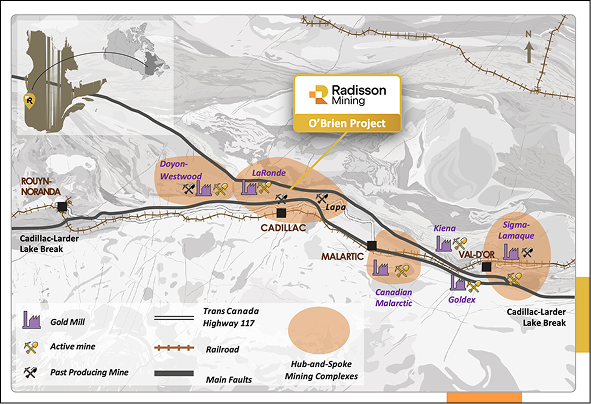
| Radisson Mining Resources (TSXV:RDS) | 140,000 meters (O'Brien project) | In August 2026, Agnico Eagle Mining (NYSE:AEM) invested C$57.2 million at a 19% premium for a 10.45% stake, funding an underground exploration program (including a ramp and related infrastructure) |
| Onyx Gold (TSXV:ONYX) | 110,000 meters (Munro-Croesus project) | Near Timmins, Ontario, has outlined a strike length exceeding 1.4 kilometers and a vertical extent exceeding 500 meters |
| Cartier Resources (TSXV:ECR) | 100,000 meters (Cadillac project) | Launched in August 2025, following years of prudent budget management. Raised C$11.4 million, including a C$3 million investment from strategic partner Agnico Eagle. The author identifies Agnico as a potential acquirer |
The author particularly emphasizes the turning point for Cartier. CEO Philippe Cloutier stated: "This is the most extensive drilling program ever undertaken on Cadillac and a turning point for Cartier. Our objective is clear: to prove Cadillac's scale as a major gold camp."
Investment Implications
Through these large-scale drilling cases, the author implies that these junior miners are entering a "catalyst-rich period"—drilling results will directly drive share price revaluations. However, note that this article is a viewpoint piece by Rick Rule as a mining investor, with an inherently bullish bias. The end of the article explicitly states it is "for reference only and does not constitute investment advice." Readers should focus on the actual release timing of drilling results (e.g., Hemlo's technical study in the second half of 2027) and be wary of the risk that high valuation expectations may already be partially priced into the stock.
Position Moves
| Ticker | Direction | Author's One-Sentence View | Key Data |
|---|---|---|---|
| Kingfisher Metals (TSXV:KFR) | Hold & Watch | Positive case: Barrick strategic investment, catalyst-driven value growth | Barrick invested C$20.9M for 9.9% stake; blind discovery of 425m @ 0.4% CuEq in January 2026 |
| Allied Mining (NYSE:AAUC) | Not Stated | Negative case: acquisition termination led to value contraction | Zijin Mining's US$5.5B acquisition agreement terminated |
| Goldgroup Mining (NYSE-A/TSXV:GORO) | Add | Large financing well-timed, advancing multiple assets | Private placement expanded from US$75M to US$125M; Trafigura, Eric Sprott, Rick Rule committed US$60M |
| Collective Mining (NASDAQ:CNL) | Hold & Watch | Positive case: ample cash + successful drilling, market cap surged ahead of resource estimate | Market cap US$2B; raised C$215M since 2021; ongoing 110,000m drilling; Apollo Deeps may host 10Moz |
| Snowline Gold (TSXV:SGD) | Hold & Watch | Positive case: cash + exploration success driving market cap | Market cap C$3B; raised C$150M in August 2026; August 2022 drill hole 282.9m @ 2.3g/t Au |
| Banyan Gold (TSXV:BYN) | Hold & Watch | Positive case: cash enabled exploration paradigm shift, grade improvement | Raised C$46.5M in May 2026; ongoing 70,000m drilling; resource 8.6Moz (potential >10Moz) |
| ATEX Resources (TSXV:ATX) | Hold & Watch | Positive case: large financing advancing Chilean copper project | Raised C$110M in November 2025; additional C$52.5M from warrant exercise |
| Osisko Mining | Not Stated | Negative case: over-drilling may lead to dilution and diminishing returns | Drilled over 1.7 million meters before acquisition by Gold Fields |
| Great Bear Resources | Not Stated | Comparative case: relatively efficient drilling led to successful exit | Drilled 340,000 meters before acquisition by Kinross Gold |
| Mineros (TSX:MSA) | Hold & Watch | Positive case: executing strategic gold reserve allocation of 15% cash | Spent US$110M on gold bars in H1 2026; targeting 40,000 oz gold position |
| Talisker Resources (TSX:TSK) | Hold & Watch | Positive case: oversubscribed financing significantly expanded drilling scale | Raised C$52.1M in March 2026; drilling expanded from 30,000m to 105,000m |
| Panoro Minerals (TSXV:PML) | Hold & Watch | Positive case: drilling results exceeded expectations post-financing | Raised C$21M; drilling expanded from 15,000m to 45,000m; first hole returned 759m @ 0.80% CuEq |
| Hercules Metals (TSXV:BIG) | Hold & Watch | Positive case: strong drill holes attracted strategic investment and talent | Barrick invested C$23.4M for 12.3% stake after 185m @ 0.84% Cu; former Arizona Sonoran management team joined |
| Mogotes Metals (TSXV:MOG) | Hold & Watch | Positive case: high-grade results prompted Rio Tinto strategic investment | Rio Tinto invested US$15M for ~5% stake; 86m @ 0.7% Cu, 0.55g/t Au |
| Hemlo Mining (TSX:HMMC) | Hold & Watch | Positive case: large-scale exploration after acquiring assets from Barrick | Ongoing 130,000m exploration drilling program |
| Gold X2 Mining (TSXV:AUXX) | Hold & Watch | Positive case: large financing driving 160,000m drilling program | Completed C$115.9M strategic investment in January 2026; AngloGold Ashanti bought 9.9% stake |
| Radisson Mining Resources (TSXV:RDS) | Hold & Watch | Positive case: Agnico Eagle strategic investment supporting 140,000m drilling | Agnico Eagle invested C$57.2M for 10.45% stake |
| Onyx Gold (TSXV:ONYX) | Hold & Watch | Positive case: 110,000m drilling program advancing Munro-Croesus project | Project located in Ontario |