Paul's Notes #11 — Gold continues to shine for producers
Rick Rule is a veteran natural-resource investor who began in 1974, built Global Resource Investments (sold to Sprott in 2011), and led Sprott U.S. Holdings until retiring in 2021 to found Rule Investment Media. His free Substack covers contrarian speculation in mining, energy and critical minerals — gold, silver, copper, nickel, royalty and streaming companies — framed by geopolitical risk.
In plain words
This report covers the gold mining industry. The author is cautiously optimistic: despite falling gold prices and rising costs squeezing margins, miners still have strong cash flow and generous shareholder returns. Key holdings include Newmont, which returned $4 billion to shareholders via buybacks and dividends; Agnico Eagle Mines, the only major miner with lower costs; and Alamos Gold, a mid-tier miner with excellent cost control and no long-term debt.
At a Glance
One-sentence summary: The author holds a cautiously optimistic view on the gold mining industry, arguing that despite gold price volatility and rising costs compressing profit margins, the industry boasts strong cash flows, generous shareholder returns, and some mid- and small-cap miners have demonstrated excellent cost control.
- This quarter, gold prices fell from approximately $5,000/oz to below $4,000/oz, recently recovering to $4,500/oz, with large miners' average realized gold prices declining by 7%.
- Industry all-in sustaining costs (AISC) surged due to soaring energy and shipping costs, with large miners' AISC rising 9.5% quarter-over-quarter, yet per-ounce profits still exceeded $2,500.
- Total industry production was flat, with mid-cap miners improving 16% quarter-over-quarter, but extended project development timelines and rising costs weighed on growth prospects.
- In the first half of 2026, the industry returned over $14.8 billion to shareholders (84% of free cash flow), led by Newmont with $4 billion.
- The author warns that buybacks may mask the lack of actual performance improvement, and miners may eventually have to rely on mergers and acquisitions to sustain growth.
Gold Prices First Fell Then Stabilized; Miners Saw Price-Cost Divergence
This quarter, gold prices fell from approximately US$5,000/oz to below US$4,000/oz due to the Iran conflict, rising interest rates, and a stronger US dollar, before recently recovering to US$4,500/oz. The average realized gold price for large gold producers declined 7% to US$4,441/oz, while junior miners saw a 9.5% drop to US$4,336/oz. All-in sustaining costs (AISC) surged due to soaring energy and shipping costs. For large miners, AISC rose 9.5% quarter-over-quarter to US$1,876/oz, up 22.5% year-over-year; mid-tier miners saw only a 2% sequential increase to US$1,934/oz. Among them, Alamos Gold (NYSE:AGI), Allied Gold (NYSE:AAUC), Artemis Gold (TSX:ARTG), Centerra Gold (NYSE:CGAU), DPM Metals (TSX:DPM), and Eldorado Gold (NYSE:EGO) saw costs decline. Among large miners, only Agnico Eagle Mines (NYSE:AEM) reduced costs.
Profit Margins Declined, but Per-Ounce Earnings Still Exceeded US$2,500
The AISC margin for large miners fell from 64% in Q1 2026 to 58%, while mid-tier miners saw margins rise from 59% to 60%. Despite the margin decline, large miners still earned over US$2,500/oz, and mid-tier miners earned over US$2,400/oz. The author stated, "Despite the falls, gold producers still enjoyed very attractive AISC margins of more than US$2,500/oz for the majors and more than US$2,400/oz for the mid-tiers," meaning that despite falling margins, gold miners still enjoyed very substantial AISC margins—over US$2,500/oz for large miners and over US$2,400/oz for mid-tier miners.
Production Flat; Mid-Tier Miners Showed More Significant Sequential Improvement
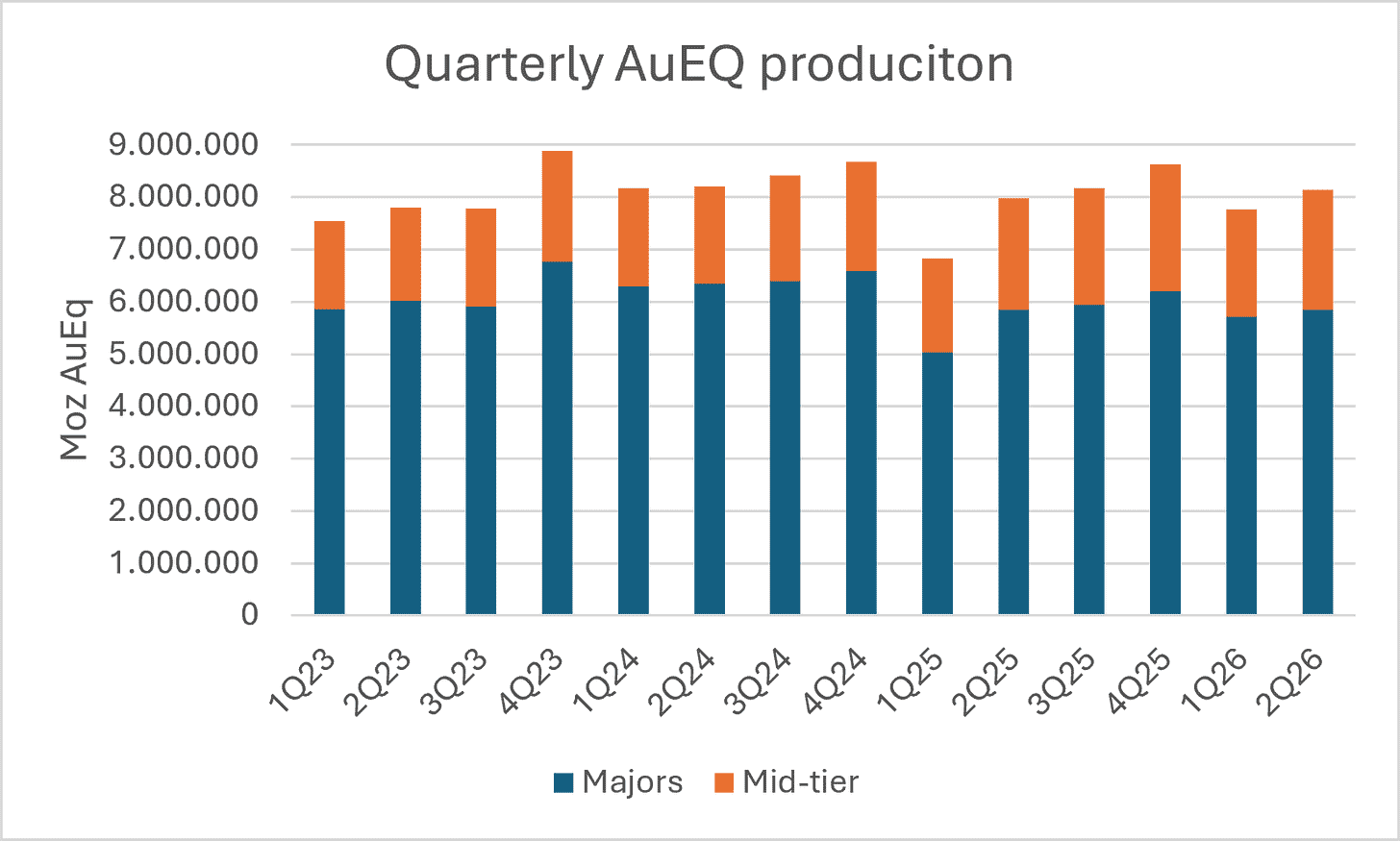
Total production was flat, with large miners producing 5.8 million ounces and mid-tier miners producing 2.3 million ounces, but sequential improvements were 2% and 16%, respectively. The author noted that flat production is a concern for the industry, and that extended project development timelines and rising costs may sustain this trend.
Strong Balance Sheets; Shareholder Returns Exceeded US$148 Billion
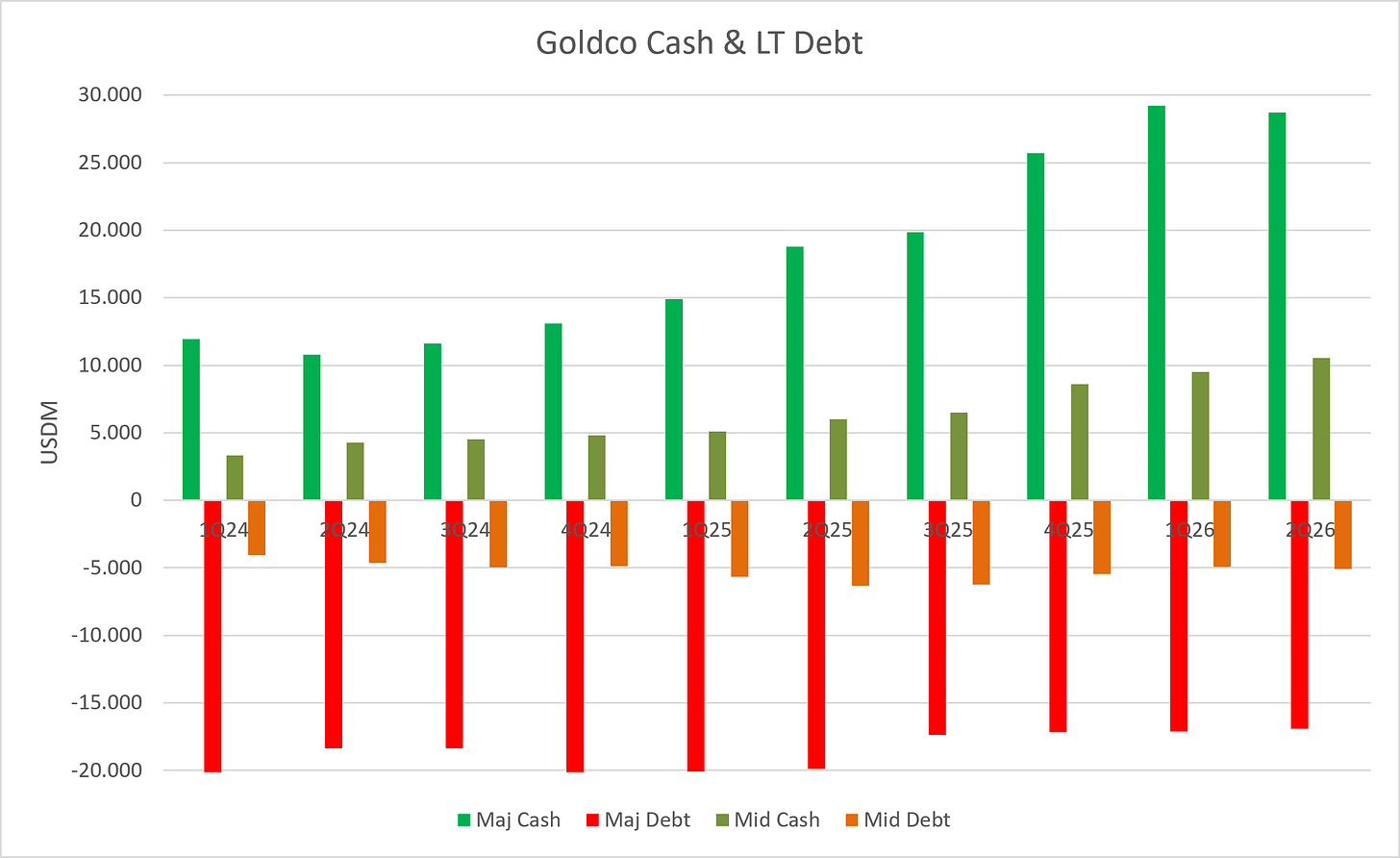
The industry is cash-rich, with large miners holding US$29 billion in cash and mid-tier miners holding US$10.5 billion, while long-term debt continued to decline to US$16.9 billion and US$5 billion, respectively. Several mid-tier miners have no long-term debt: Allied Gold, Centerra Gold, DPM Metals, Discovery Mining (TSX:DSV), Lundin Gold (TSX:LUG), Oceanagold (NYSE:OGC), SSR Mining (NASDAQ:SSRM), and Torex Gold (TSX:TXG). Among large miners, only B2Gold (NYSE-A:BTG) had positive net debt (cash minus long-term debt). In the first half of 2026, the industry returned over US$14.8 billion to shareholders (84% of free cash flow), including US$7.8 billion in buybacks and US$6.9 billion in dividends. Newmont led with US$4 billion, followed by Barrick Mining (NYSE:B), AngloGold Ashanti (NYSE:AU), Gold Fields (NYSE:GFI), and Agnico.
The Double-Edged Sword of Buybacks: Boosting Per-Share Metrics, but Not Necessarily Improving Actual Performance
The author noted that buybacks both reward exiting shareholders and boost per-share metrics by reducing the share count, but may mask the fact that actual performance has not improved. The author stated, "having fewer shares outstanding also means management can post improving per-share metrics even though their actions may not have improved de facto performance," meaning that a reduced share count also allows management to report improving per-share metrics, even if their actions have not improved actual performance. The author cautioned that with flat production and extended project development timelines, miners may be forced to rely on M&A to maintain the status quo or even grow in the future.
Position Moves
| Position | Action | Key Data/Rationale |
|---|---|---|
| Alamos Gold (NYSE:AGI) | Hold & Watch | AISC declined this quarter; excellent cost control among mid-tier miners |
| Allied Gold (NYSE:AAUC) | Hold & Watch | AISC declined this quarter; no long-term debt |
| Artemis Gold (TSX:ARTG) | Hold & Watch | AISC declined this quarter |
| Centerra Gold (NYSE:CGAU) | Hold & Watch | AISC declined this quarter; no long-term debt |
| DPM Metals (TSX:DPM) | Hold & Watch | AISC declined this quarter; no long-term debt |
| Eldorado Gold (NYSE:EGO) | Hold & Watch | AISC declined this quarter |
| Agnico Eagle Mines (NYSE:AEM) | Hold & Watch | Only large miner with AISC decline this quarter; US$1 billion in shareholder returns |
| Newmont | Hold & Watch | US$4 billion in shareholder returns, industry leader; executing aggressive buybacks |
| Barrick Mining (NYSE:B) | Hold & Watch | US$2.2 billion in shareholder returns |
| AngloGold Ashanti (NYSE:AU) | Hold & Watch | US$1.9 billion in shareholder returns |
| Gold Fields (NYSE:GFI) | Hold & Watch | US$1.2 billion in shareholder returns |
| Discovery Mining (TSX:DSV) | Hold & Watch | No long-term debt |
| Lundin Gold (TSX:LUG) | Hold & Watch | No long-term debt |
| Oceanagold (NYSE:OGC) | Hold & Watch | No long-term debt |
| SSR Mining (NASDAQ:SSRM) | Hold & Watch | No long-term debt |
| Torex Gold (TSX:TXG) | Hold & Watch | No long-term debt |
| B2Gold (NYSE-A:BTG) | Hold & Watch | Only large miner with positive net debt (cash minus long-term debt is negative) |
Position Moves
| Ticker | Direction | Author's One-Sentence View | Key Data |
|---|---|---|---|
| Alamos Gold (NYSE:AGI) | Hold & Watch | A mid-tier miner with excellent cost control | AISC declined this quarter |
| Allied Gold (NYSE:AAUC) | Hold & Watch | Costs declining with no long-term debt | AISC declined this quarter; no long-term debt |
| Artemis Gold (TSX:ARTG) | Hold & Watch | A mid-tier miner with declining costs | AISC declined this quarter |
| Centerra Gold (NYSE:CGAU) | Hold & Watch | Costs declining with no long-term debt | AISC declined this quarter; no long-term debt |
| DPM Metals (TSX:DPM) | Hold & Watch | Costs declining with no long-term debt | AISC declined this quarter; no long-term debt |
| Eldorado Gold (NYSE:EGO) | Hold & Watch | A mid-tier miner with declining costs | AISC declined this quarter |
| Agnico Eagle Mines (NYSE:AEM) | Hold & Watch | The only major miner with declining costs and strong shareholder returns | AISC declined this quarter; shareholder returns of $1 billion |
| Newmont | Hold & Watch | Industry-leading shareholder returns with aggressive buybacks | Shareholder returns of $4 billion |
| Barrick Mining (NYSE:B) | Hold & Watch | Significant scale of shareholder returns | Shareholder returns of $2.2 billion |
| AngloGold Ashanti (NYSE:AU) | Hold & Watch | Significant scale of shareholder returns | Shareholder returns of $1.9 billion |
| Gold Fields (NYSE:GFI) | Hold & Watch | Significant scale of shareholder returns | Shareholder returns of $1.2 billion |
| Discovery Mining (TSX:DSV) | Hold & Watch | A mid-tier miner with no long-term debt | No long-term debt |
| Lundin Gold (TSX:LUG) | Hold & Watch | A mid-tier miner with no long-term debt | No long-term debt |
| Oceanagold (NYSE:OGC) | Hold & Watch | A mid-tier miner with no long-term debt | No long-term debt |
| SSR Mining (NASDAQ:SSRM) | Hold & Watch | A mid-tier miner with no long-term debt | No long-term debt |
| Torex Gold (TSX:TXG) | Hold & Watch | A mid-tier miner with no long-term debt | No long-term debt |
| B2Gold (NYSE-A:BTG) | Hold & Watch | The only major miner with negative net debt | Net debt positive (cash minus long-term debt is negative) |