British Columbia's mining revival — Rule Investment Newsletter #19
Rick Rule is a veteran natural-resource investor who began in 1974, built Global Resource Investments (sold to Sprott in 2011), and led Sprott U.S. Holdings until retiring in 2021 to found Rule Investment Media. His free Substack covers contrarian speculation in mining, energy and critical minerals — gold, silver, copper, nickel, royalty and streaming companies — framed by geopolitical risk.
In plain words
The article says British Columbia's mining sector is enjoying a revival, helped by faster permitting, big mergers and fresh capital. The author is cautiously optimistic for the medium term but warns that marginal projects could become money traps when metal prices fall. Key names: Teck's merger with Anglo American is progressing; Seabridge benefits from a new power line near its KSM project; Newmont is expanding its Red Chris copper-gold mine.
At a Glance
The author holds an [optimistic] stance on the medium-term outlook for BC mining: policy, capital, and major-player consolidation form a triple tailwind, but the opportunity window is measured in years, and marginal projects may long remain "capital traps."
- Tariff shock forces a sharp policy pivot in BC: the fast-track process covers four mines totaling ~C$20B, and the North Coast transmission line is budgeted at C$10B (initial phase C$3B).
- Giants place bets via M&A: Teck and AngloAmerican's US$53B merger is expected to close in 2027; Newmont achieves "critical mass" in northern BC.
- Indigenous consent rights are the biggest variable in permitting acceleration: BC exploration spending fell from C$740M to C$552M (-25%), drilling meters -45%; the "substantial start" designation for KSM was ruled to have insufficient consultation.
- Dense project catalysts: Eskay Creek first production in 2027 (450koz/y AuEq in the first five years); Seabridge's KSM reserves of 47.3Moz gold, with NPV exceeding US$30B at current metal prices; a US$100M loan suggests a JV partner has been secured.
- Capital is rushing in across the board: Barrick took a 9.9% stake in Kingfisher for C$20.9M, Wheaton prepaid US$55M to Spanish Mountain, and Coeur acquired New Gold to form a US$20B precious metals company.
Tariff Shock Forces BC Mining Policy Shift
Bottom line: U.S. tariffs have triggered a sharp reversal in Canadian mining policy, with the federal government and BC simultaneously shifting toward supporting mining and significantly accelerating project permitting. The article cites recently approved projects: Hudbay Minerals (TSX:HBM)'s New Ingerbelle expansion at the Copper Mountain mine, Skeena Gold & Silver (NYSE/TSX:SKE)'s Eskay Creek, Centerra Gold (NYSE:CGAU)'s Mount Milligan expansion, and Imperial Metals (TSX:III)'s Mount Polley life extension. The author notes that the industry previously viewed BC as one of the hardest places in the world to build a mine, yet approval momentum has now clearly picked up. After the Trump administration imposed tariffs on Canadian steel, aluminum, copper, and other goods, Prime Minister Mark Carney quickly shifted toward supporting mining; Premier David Eby is also promoting a "mining renaissance" to turn BC into a leading mining jurisdiction. But the author suggests this is a "political expedient": Eby's NDP historically suppressed mining through permitting delays and regulatory uncertainty, and with the Conservatives gaining ground in non-metropolitan ridings, his reversal is wrapped in critical-minerals/clean-energy narratives and faces friction from Indigenous land rights disputes and regulatory freezes — in June, the NDP government extended the freeze on mineral claim staking in parts of northwestern and north-central BC for another seven months.
Fast-Track Permitting and Grid Investment Back a C$20B Project Pipeline
Bottom line: The February 2025 fast-track list, combined with BC Hydro transmission expansion, constitutes the article's most concrete policy positives. The four mines covered by the fast-track process represent roughly C$20B in combined investment: Skeena's Eskay Creek, the 70:30 Newmont (NYSE:NEMM)-Imperial Metals joint venture Red Chris expansion, Teck Resources (TSX:TECK)'s Highland Valley Copper extension, and Centerra's Mount Milligan. The same list also includes Northisle Copper & Gold (TSXV:NCX)'s North Island project, Surge Copper (TSXV:SURG)'s Berg project, and Defense Metals (TSXV:DEFN)'s Wicheeda rare earth project. On the power side, federal and provincial governments are providing more than C$100M combined for BC Hydro regional clean transmission upgrades; the North Coast transmission line is 750km long with a C$10B budget, built in three phases, with construction starting August 2026 and an initial phase costing C$3B, doubling high-voltage transmission capacity to serve development in the Golden Triangle mining district in the province's north. The author only mentions Northisle, Surge, and Defense Metals as list inclusions without providing further detail.
Federal Funding Flows to Teck, Red Chris, and Seabridge
Bottom line: Federal funding is landing on specific projects in the form of grants, offtake arrangements, and transmission support, with clear amounts and timelines. In July 2026, Teck signed a strategic agreement with the Canada Growth Fund (CGF) and Natural Resources Canada under the new Canada Critical Minerals Accelerator; the CGF can invest up to C$400M, roughly doubling Teck's germanium and antimony production capacity at its Trail smelter and refinery, with potential new gallium capacity, and the agreement includes a federal offtake structure. The Red Chris block cave expansion received up to C$500M in support from Ottawa, plus C$195M for surrounding road improvements; Newmont received a revised environmental assessment certificate and Mines Act permit in June 2026, extending the mine life into the mid-2040s, with expected Canadian copper output rising by about 15%. The mine produced 42kt of copper and 92koz of gold in 2025, with reserves of 3.6Moz gold and 900kt copper. Seabridge Gold (NYSE:SA) is cited as a policy beneficiary, particularly from the Northwest transmission line project. CEO Rudi Fronk's exact words: "This was a game-changer for us, as it brought hydro power past our project." (Meaning: "This was a game-changing opportunity for us, because the hydro power line passes near our project.") Fronk says Seabridge has been connected to the grid, the switchyard is nearly complete, buying power from the grid is economically very helpful, and the KSM project could later make an electric truck fleet part of feasibility optimization, rather than hauling diesel to the site.
Old Permitting Problems Persist; Policy Window Measured in Years
Bottom line: The article also acknowledges that BC mining still carries the historical burden of decades of slow permitting, and the opportunity window may last only a few years. A 2024 S&P study shows that Canadian mines take an average of 27 years from discovery to production, among the longest in the world. In response, Carney established the federal Major Projects Office, using a "one project, one review" approach to coordinate federal and provincial approvals and spare developers from navigating two separate processes. But PwC describes the overall environment as a narrow opportunity window, "likely measured in years, not decades" (i.e., "likely counted in years, not decades"), and BC must establish itself as a reliable critical minerals supplier before competitors catch up. The author also cautions that, outside the fast-track list, the NDP government continues to extend the northern mining claim freeze for seven more months — a sign that old habits are hard to break.
Investment Implications
Bottom line: Policy positives and institutional risks coexist, and the article also serves as a marketing gateway for Rick Rule's paid subscription — readers should distinguish facts from bias. The actionable implications: BC mining is improving simultaneously on three fronts — permitting, grid access, and federal funding — and the direct beneficiaries are the developers and producers named one by one in the article; however, the 27-year development cycle, mining claim freezes, and Indigenous land disputes mean execution still carries uncertainties. At the end of the article, the author promotes the paid subscription "The Rule Portfolio," claiming it will share real trades and the reasoning behind them; therefore, this article reflects the perspective of a position-holder/marketer and should not be treated as neutral third-party analysis, especially with respect to optimistic claims.
Giants Use M&A to Cast a Vote of Confidence in BC
The report notes that the mining sector has responded to the improved investment environment, with the highlight being Newmont and Teck using M&A and core assets to turn BC into a strategic stronghold. Newmont acquired GT Gold in 2021 and Newcrest Mining in 2023, thereby building "critical mass" around its two mines in the province, Red Chris and Brucejack; it also holds the Galore Creek development project, a joint venture with Teck. However, the author refrains from drawing conclusions about Newmont's next move, writing verbatim: "will its northern BC consolidation play continue?" — meaning, "Will its consolidation game plan in northern BC continue?"
Teck has been BC's "local hero" for decades, operating the Highland Valley copper mine and the Trail smelter; however, this status has been somewhat diluted since it sold its Elk Valley steelmaking coal business to Glencore (LSE:GLEN) for US$7.3B in 2024. Highland Valley and Trail are key components of the US$53B merger between Teck and AngloAmerican, which is expected to close in 2027; the author specifically notes that Trail is a strategic asset expected to play an increasingly important role in Canada's critical minerals agenda — especially in the production of niche elements such as germanium and gallium.
Mid-cap M&A Puts BC Assets into Larger Platforms
The three mid-cap transactions the author reviews show that BC projects are being folded into larger, more geographically diversified platforms. Coeur Mining (NYSE:CDE) acquired New Gold, creating a US$20B precious metals company that includes the New Afton copper-gold mine; Contango ORE (NYSE-A:CTGO) merged with Dolly Varden Silver to form Contango Silver & Gold, folding BC's Kitsault Valley silver project into its Alaskan gold assets.
Centerra is likewise pursuing expansion: in addition to expanding its Mount Milligan gold-copper operation, in April 2025 it took a 9.9% stake in Thesis Gold & Silver (TSXV:TAU), citing potential synergies with its nearby Kemess project. The author's treatment of this minority investment is neutral and factual — citing Centerra's own synergy rationale.
From Exploration to Financing, Capital Moves In Across the Board
It is not just miners entering the scene — the report says some of the industry's "smartest money" is flowing into BC through project stakes and financing agreements. Freeport McMoran (NYSE:FCX) already holds a 60% interest in the AuRORA project in the Toodoggone district (a joint venture with Amarc Resources (TSXV:AHR)); most recently, in July 2026, Barrick Mining (NYSE:B) invested C$20.9M at a 31% premium to take a 9.9% stake in copper-gold explorer Kingfisher Metals (TSXV:KFR), after high-grade porphyry drilling at the Highway 37 project.
| Investor | Target/Project | Amount/Stake | Timing |
|---|---|---|---|
| Freeport McMoran (NYSE:FCX) | AuRORA project (JV with Amarc Resources (TSXV:AHR)) | 60% interest | Not specified |
| Barrick Mining (NYSE:B) | Kingfisher Metals (TSXV:KFR) | 9.9% stake, C$20.9M, 31% premium | July 2026 |
| Wheaton Precious Metals (TSX:WPM) | Spanish Mountain Gold (TSXV:SPA) | US$55M prepayment (royalty agreement) | Not specified |
| Osisko Development (NYSE:ODV) | Cariboo gold project | US$650M+ financing (including US$450M loan facility) | August 2025 |
Wheaton Precious Metals (TSX:WPM) advanced US$55M to Spanish Mountain Gold (TSXV:SPA) under a royalty agreement to advance the Spanish Mountain gold project; Osisko Development (NYSE:ODV), meanwhile, secured over US$650M in financing in August 2025 to build the Cariboo gold project, including a US$450M loan facility from Appian Capital Advisory.
The Boom Has a Dark Side: Potential Money Traps After the Cycle Turns
At the end of the optimistic narrative, the author adds a note of caution: such projects may perform reasonably well in the near term, but they could become long-term "money traps." The article points out that, thanks to Vancouver's local financial infrastructure and the tendency of the local community to favor "insiders" (the original text uses "ethnocentric nature," literally meaning a bias toward one's own kind), BC projects often enjoy a lower cost of capital; even so, until recently many projects on the development list were still economically marginal. Higher metal prices have made them decent market performers in the near term — but the author writes verbatim: "they are potential money traps in the long term, as they may be unable to thrive when the metals price cycle inevitably swings downwards," meaning "over the long run, they are potential money traps, because when the metals price cycle inevitably turns down, they may struggle to thrive."
Investment Implications
The author's implicit conclusion is bullish in the short term and cautious in the long term. For investors, marginal projects can perform well within the high-metal-price window, but what is truly worth tracking are the core assets consolidated by the giants (such as Teck's Trail smelter's position in the critical minerals landscape) and projects with clear synergies, rather than marginal assets that can only survive on high prices. Institutional perspective bias: this chapter's narrative is built around a rundown of deal flows and positives, with the risk warning appearing only in the final sentence. The author is a long-term bull on the resource sector; readers should recognize this as an industry-promoter-perspective account — deal heat is not the same as investment returns.
Indigenous Consent Rights Become the Biggest Variable in Approval Acceleration
BC's 2019 DRIPA legislation established Indigenous "free, prior, and informed consent" rights, and in 2025 the Court of Appeal further ruled that the province's mineral tenure registration system was non-compliant—putting faster approvals and Indigenous rights protection on a head-on collision course. The article points out that the excitement and tailwinds of mining development also create turbulence: some Indigenous groups worry that the urgency of approvals will turn environmental and social assessments into a rubber stamp and allow their rights to be overridden. The backdrop to this potential conflict is the strengthening of Indigenous status through BC's 2019 Declaration on the Rights of Indigenous Peoples Act (DRIPA)—which aligns with the United Nations Declaration on the Rights of Indigenous Peoples (UNDRIP) and requires free, prior, and informed consent before projects can proceed on traditional territories. In 2025, the BC Court of Appeal ruled that the province's mineral tenure registration system was not compliant with DRIPA: the Gitxaała and Ehattesaht First Nations sued, arguing that the automatic mineral claim registration process neither consulted nor obtained consent from affected communities; previously, a 2023 BC Supreme Court judicial review had already found the registration system under the Mineral Tenure Act unconstitutional. The provincial government has promised to consult before allowing companies to register exploration rights on Indigenous territories, but the resulting Mineral Tenure Consultation Framework drew a severe warning from the Association for Mineral Exploration (AME).
Exploration Spending Down 25%; Industry Calls It an Existential Crisis
AME warns that the Mineral Tenure Consultation Framework could prolong the exodus of exploration capital: BC exploration spending fell from C$740M (2022) to C$552M (2024), down 25%, while drilling meters fell 45% over the same period. AME president Trish Jacques called the framework "an existential crisis for the exploration industry"—meaning "this is an existential crisis for the exploration industry"—because the consultation process would mean claim stakers lose their first-mover advantage, expose their intentions to competitors, and could give Indigenous nations a veto over who can acquire mineral rights on their territories. AME says this could extend the declining trend described above. The data are as follows:
| Metric | Value |
|---|---|
| 2022 BC exploration spending | C$740M |
| 2024 BC exploration spending | C$552M |
| Exploration spending decline (2022-2024) | -25% |
| Drilling meters decline over same period | -45% |
It should be noted: AME and Trish Jacques represent the exploration industry's interests, so the "existential crisis" wording carries a lobbying tint; but the dual decline in spending and drilling is hard data.
Provincial Approvals Continue to Be Challenged in Court
Provincial permitting decisions keep being challenged in court: Seabridge Gold's KSM "substantial start" designation was ruled to have inadequate consultation, and the Mount Polley extension approval was challenged—consultation procedures have become the weak link in project advancement. In June 2026, the BC Supreme Court ruled that the provincial government had failed to adequately consult the Tsetsaut Skii km Lax Ha Nation before designating Seabridge Gold's KSM project as making a "substantial start." Justice Emily Burke found that the province's underlying determination was itself reasonable, but the consultation process was insufficient—even though the larger Tahltan and Niska First Nations both agreed with the "substantial start" designation for KSM. Indigenous groups also challenged the approval extending Mount Polley operations to 2033, with particular concern over plans to expand the tailings dam from the catastrophic 2014 breach (which released more than 24 million cubic metres of mine waste). That mine is an asset of Imperial Metals, mentioned in the background overview.
Nations Royalty Sets a Precedent for Indigenous-Owned Listings
Some Indigenous groups are moving from "being consulted" to "taking equity": Tahltan has invested in Skeena and Imperial, and Nisga'a, through its 77% stake in Nations Royalty, has set a precedent for an Indigenous-controlled publicly listed mineral royalty company—though the author concedes it faces internal dissent, dilution, and takeover risks. The article notes that some Indigenous groups want a greater share of benefits from projects on their territories beyond impact and benefit agreements: in addition to supplying more and more services to projects, some nations have begun investing. The Tahltan Nation has invested in Skeena (i.e., Skeena Gold & Silver) and Imperial (i.e., Imperial Metals). Nisga'a Nation, meanwhile, contributed its royalty interests in the three Golden Triangle projects—Brucejack, KSM, and Premier—into the listed company Nations Royalty (TSXV:NRC). This is the first publicly listed mineral royalty company with majority Indigenous ownership (Nisga'a holds 77%). The author says: "This could be a durable, sustainable competitive advantage"—meaning "this could become a durable, sustainable competitive advantage." Nisga'a thereby gains additional exposure to project development upside, is deeply tied to project success, and this helps projects on its territory receive the Nation's blessing; Indigenous nations are important players in the political sphere, and if an Indigenous nation wants to advance a project, the provincial government in Victoria is unlikely to strongly oppose it. The author asks in response: will other Indigenous nations follow Nisga'a's example?
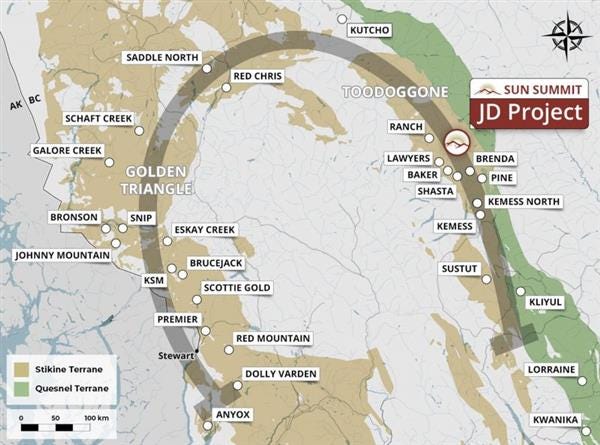
The author then proactively lists risks: ① unanimity is rare within any polity; divisions within and between nations are not uncommon, and views change over time; ② Nations Royalty's chief development officer, Kody Penner, is a Tahltan member, but Tahltan has not contributed any royalties to the company—so if some Nisga'a members do not agree with the current arrangement in the future, they may see it as another example of their rights being taken away; ③ company expansion will require issuing new shares, diluting Nisga'a's 77% stake; ④ the portfolio has "some real peaches" (high-quality assets)—what happens if a larger royalty company launches a takeover? This section closes with "Below, a look at BC's major mining camps," accompanied by Exhibit 1 (Golden Horseshoe, covering the Golden Triangle and Toodoggone), sourced from Sun Summit.
Investment Implications
- Project level: Inadequate execution of consultation duties can directly slow already-approved projects—KSM's "substantial start" designation was flagged by the court for procedural deficiencies, and Mount Polley's extension is under litigation; consensus between the provincial government and most nations is still insufficient to make projects immune to legal challenges.
- Exploration level: If the Mineral Tenure Consultation Framework takes effect, rising uncertainty and costs around claim registration could extend the 2022-2024 contraction of -25% in spending and -45% in drilling, hitting junior exploration companies (juniors) that depend on low-cost, rapid staking the hardest.
- Structural level: Nations Royalty is worth tracking—77% owned by Nisga'a, packaging royalty interests in the three Golden Triangle projects; if other nations follow suit, royalty securitization plus Indigenous equity participation could become the new normal in BC mining, but watch for internal governance divisions, dilution from issuance, and the possibility of acquisition.
- Perspective note: The author, Rick Rule, is a veteran natural resources investor, and the article as a whole is an industry-optimistic narrative; AME's "existential crisis" wording serves the exploration industry's lobbying goals, so readers should treat it as an industry-side/position-holder view, not a neutral assessment.
Golden Triangle M&A Reaches US$4.8B; Eskay to Start Production in 2027
The Golden Triangle is British Columbia's most high-profile mining district: glacial retreat is opening new exploration ground, while road and power investments are lowering development barriers. Skeena's Eskay Creek is more than half built, with first production due in 2027, and is expected to become a leading silver producer.
The article notes that the Golden Triangle is in northern BC, and M&A transactions in the region have totaled US$4.8B since 2018. The main producing mines today are Newmont's Brucejack and Red Chris, but more projects will follow. Skeena's Eskay Creek received its environmental approval in early 2026—jointly signed by the Tahltan Central Government in February 2026—and the project is now more than half built, with first production targeted for 2027. Key data from the 2023 feasibility study are as follows:
| Project | Reserves/Resources | Grade | Capacity/Status |
|---|---|---|---|
| Eskay Creek | 4.6Moz AuEq (including 88Moz silver reserves) | 3.6g/t AuEq | Average 450koz/y AuEq over first five years; first production in 2027 |
| Snip (nearby) | indicated 823koz | 9.35g/t gold | Potential satellite development opportunity for Eskay Creek |
The author argues that Eskay Creek will therefore become a leading silver producer; Snip's indicated resource of 823koz @ 9.35g/t gold can be developed as a satellite to Eskay.
KSM Joint Venture Partner to Come; Capex Seen Rising
Seabridge's KSM is the largest project in the development pipeline: reserves of 47.3Moz gold, 7.3Blb copper, and 160Moz silver, with an initial mine life of 33 years. A US$100M short-term loan suggests a joint venture partner has been selected, and management acknowledges capex will exceed US$6.4B, but at current metal prices the NPV is over US$30B.
The author calls KSM "the elephant in the development pipeline." The project's capex is estimated at US$6.4B, and the industry is waiting for Seabridge to announce its joint venture partner. The author notes that CEO Fronk had been evasive about a potential partner for some time, but on July 20, 2026, Seabridge obtained a US$100M unsecured short-term loan, suggesting a partner has already been selected. The company received a "substantially started" designation in July 2024, and some construction has already advanced ahead of schedule; the feasibility study is expected to be completed by end-2027.
The author quotes Fronk as saying: "The capex will be higher than that, but it will be more than offset by higher metal prices." (i.e., "Capex will be higher than that number, but it will be more than offset by higher metal prices.") Fronk also said: "At today's metal prices, it is north of US$30, which can capture a lot of capital cost escalation." (i.e., "At today's metal prices, its [NPV] exceeds US$30 billion, enough to absorb a large amount of capex escalation.") It should be noted that Fronk is the CEO of the project developer, and his emphasis on higher prices offsetting costs reflects a long-side perspective.
| Metric | Value |
|---|---|
| Reserves | 47.3Moz gold, 7.3Blb copper, 160Moz silver |
| Initial mine life | 33 years |
| Capex | US$6.4B (expected to rise) |
| PFS base-case NPV | US$8B |
| NPV at current metal prices | Over US$30B |
| Feasibility study | End-2027 |
Junior Miners Pursue Three Paths: Restart, Direct Shipping, and a Blind Discovery
A group of small-cap companies in the Golden Triangle is pursuing opportunities through three distinct paths: reviving old mines, direct-shipping ore, and capitalizing on a newly discovered porphyry copper-gold deposit—but their maturity and risk profiles vary widely.
The article highlights Cambria Gold Mines (TSXV:CAMB, formerly Ascot Mining), Scottie Resources (TSXV:SCOT), and Kingfisher Metals, comparing them as follows:
| Company | Path | Key Data |
|---|---|---|
| Cambria Gold Mines | Reviving the Premier mine | Red Mountain M&I resource 783koz @ 7.63g/t Au; 2,500tpd mill |
| Scottie Resources | Direct-shipping ore | Feasibility study to be completed in 2027 |
| Kingfisher Metals | Highway 37 blind porphyry copper-gold discovery | Drill intersection 425m @ 0.4% CuEq; Barrick has taken an equity stake |
- Cambria is backed by Fiore Group, and CEO Robert McLeod has spent most of his career in the Golden Triangle. The author notes that predecessor Ascot failed to produce enough ore to feed its 2,500tpd mill, and Cambria is now attempting a turnaround at Premier, planning to develop a feed source from the nearby Red Mountain deposit.
- Scottie is advancing a direct-shipping-ore concept for its Scottie project, eliminating the milling step, with a feasibility study expected to be completed in 2027.
- Kingfisher's Highway 37 porphyry copper-gold discovery has "leapt into focus," driven by a blind porphyry discovery with a drill intersection of 425m @ 0.4% CuEq, as well as Barrick's investment.
Toodoggone: Centerra Dominates, New Discoveries Emerge
Toodoggone is less developed than the Golden Triangle, and Centerra dominates through Mount Milligan and the Kemess redevelopment plan; neighboring projects from Thesis, Amarc-Freeport, and TDG form a second tier. The Golden Triangle and Toodoggone together are known as the Golden Horseshoe.
Centerra is the dominant player in Toodoggone: Mount Milligan will produce up to 155koz gold and 60Mlb copper this year, with mine life extended to 2045. The company may also expand its regional footprint by redeveloping the old Kemess mine—a PEA outlines an initial 15-year mine life, 171koz gold and 61Mlb copper per year, and initial capex of $771M, with a PFS expected in mid-2027.
| Project/Company | Key Data | Status/Timeline |
|---|---|---|
| Lawyers-Ranch (Thesis) | 13,700tpd; 187koz AuEq per year; 15 years | PFS released December 2025 |
| AuRORA / Joy (Amarc-Freeport JV) | Drillhole 57: 70m @ 2.6g/t Au, 0.42% Cu, 5g/t Ag | Freeport holds 60%; cumulative spending C$110M |
| Shasta (TDG Gold, TSXV:TDG) | Indicated 516koz @ 1.35g/t AuEq + inferred 506koz | PEA initiated June 2026 |
- Thesis completed a PFS for Lawyers-Ranch in December 2025; Centerra acquired a 9.9% stake in April 2025, citing synergies with the neighboring Kemess project; AngloGold Ashanti (NYSE:AU) also holds a 5% stake.
- Amarc and Freeport's AuRORA is located in the emerging Joy gold-copper project; the author says it is unusual in combining grade, continuity, and ore-body geometry. Drillhole 57 intersected 70m @ 2.6g/t Au, 0.42% Cu, and 5g/t Ag, prompting Freeport to continue fulfilling its earn-in obligations: it has spent C$35M to earn a 60% interest in the AuRORA Minerals JV, and has exercised its right to spend an additional C$75M to increase its stake by 10%, for a total of C$110M; this year's C$20M drilling budget is focused on expanding AuRORA and the TWINS Discovery.
- TDG Gold initiated a PEA for the Shasta gold-silver project in June 2026; the project is adjacent to AuRORA, and the AuRORA ore body crosses the TDG–Amarc claim boundary. Skeena holds an 11% stake in TDG.
Investment Implications
This article is a scoping review of regional project progress and does not give specific buy or sell instructions, but it lays out a clear catalyst timeline: Eskay Creek first production in 2027, the Scottie feasibility study, the Kemess PFS (mid-year), and the KSM feasibility study (year-end). Nearer-term milestones include the formal announcement of Seabridge's JV partner (signaled by the US$100M loan), Freeport's exercise of its C$75M follow-on investment in AuRORA, and the advancement of TDG's Shasta PEA. Cross-holdings by strategic investors (Centerra taking a 9.9% stake in Thesis, Barrick investing in Kingfisher, and Skeena holding 11% of TDG) are also signals worth tracking.
Readers should be reminded that the author, Rick Rule, is a well-known natural-resources investor and industry promoter; his writing tends to be optimistic in describing exploration results ("exciting," "leapt into focus"), and this is a scan from a bullish industry perspective rather than independent due diligence. The article also preserves uncertainty—KSM's capex is clearly expected to rise, and Cambria's predecessor Ascot once failed to feed its own mill due to insufficient ore supply.
Central BC Copper-Gold Projects Enter an Intensive Advancement Phase
The author uses a string of project data to show that central BC (especially around Merritt) is becoming a copper-gold development hotspot, with multiple expansion/new-build projects either approved or advancing. He lists them one by one:
- Westhaven Gold (TSXV:WHN) brought in Dundee Corp (TSX:DC) as a strategic partner for the Shovelnose gold-silver project: Dundee invests C$30M upfront as part of a C$85M earn-in, in exchange for a 60% interest; Shovelnose holds a 1Moz resource, and the March 2025 PEA plans an 11-year underground operation with annual gold production of 56koz.
- Kodiak Copper (TSXV:KDK) is drilling the MPD project between the two operating mines, Highland Valley and Copper Mountain; the initial resource in December 2025 was 82.9Mt indicated + 356.3Mt inferred, with grades comparable to its neighbors; after an oversubscribed C$15M financing in June 2026, it expanded its 2026 drilling program.
- Hudbay's Copper Mountain is expected to produce approximately 144kt of copper per year on average over the next three years; its New Ingerbelle expansion was approved in 2026, extending mine life by 12 years and delivering total production of 750kt copper, 900koz gold, and 5.5Moz silver over the remaining life.
- Teck's Highland Valley is expected to produce up to 137kt of copper per year through 2046.
- Artemis Gold (TSXV:ARTG) approved a C$1.44B Phase 2 expansion, raising Blackwater's throughput to 21Mtpa and production to over 500koz/y, making it one of Canada's three largest gold mines; the Phase 1 8Mtpa expansion was 57% complete as of the end of Q2 2026, with commissioning planned for 4Q26 and capital expenditure of C$120M; the company hedged downside risk with put options covering 173koz Au at a strike price of C$5,300/oz, covering more than 80% of expected spot sales during the construction period.
- Osisko Development has raised more than C$600M to build the Cariboo gold mine; the optimized feasibility study shows 4,900tpd capacity and annual gold production of 190koz over a 10-year life, with initial capital expenditure of C$881M.
- Surge Copper's Berg project PFS shows a 28-year mine life with annual production of 308Mlb CuEq; Northisle Copper & Gold holds 1.2Bt of reserves containing 5.8Blb copper, 687Mlb molybdenum, 160Moz silver, and 800koz gold; at current copper prices and after by-product credits, its mine would produce approximately 80kt of copper per year, and C1 cash costs could be negative.
High Development Costs Mismatched with Small Market Caps; the Majors Will Take Over
The author sounds a key cautionary note: the project economics look appealing on paper, but the disparity between development costs and developer market capitalizations means small companies will struggle to advance projects independently, and the eventual leaders will be the copper majors. He uses Berg as an example: development costs run as high as C$4.7B, while Surge Copper's market cap is only C$183M — the implication being that it will not be Surge itself that develops Berg. The author's exact words are "it behoves the investor not to get carried away by splashy numbers" — meaning: "investors should exercise restraint and not be swept away by flashy numbers." He also cautions that Berg has not yet received its permits, and the saying "many a slip betwixt cup and lip" is an apt description (many things can go wrong before success is achieved). That said, the large miners will act quickly: Freeport invested quickly in Amarc Resources after it produced eye-catching drill holes, and Barrick invested quickly in Kingfisher Metals after it produced eye-catching drill holes. The author judges that, given copper shortages and a thin project pipeline, the copper majors tend to be "very quick to obtain a toehold in companies with projects they think are interesting" — meaning: "they are often quick to establish a foothold in companies whose projects they find interesting."
Overviews of Five Additional BC Companies; Direction Not Stated
In the "Companies" section, the author adds overviews of Skeena, Kingfisher, Amarc, Centerra, and Westhaven, together with market capitalizations and 52-week ranges; apart from Kingfisher and Amarc, which have already appeared above due to the major-company investments, the rest are new observational introductions. One by one:
- Skeena Gold & Silver: The Eskay Creek project is fully permitted and under construction, with first production expected in 2Q27; it is positioned as one of the world's highest-grade open-pit precious metals mines; market cap approximately US$3.56B, 52-week range US$13.81–38.77.
- Kingfisher Metals (TSXV:KFR): A junior copper-gold explorer in the Golden Triangle; in early 2026, the HWY 37 project confirmed a new blind copper-gold porphyry system beneath the Hank epithermal gold-silver system. Barrick's C$20.9M investment raised cash to C$47M, with at least 80% to be deployed into HWY 37; market cap C$174–176M (July 2026), 52-week range C$0.215–1.45.
- Amarc Resources (TSXV:AHR): A copper-gold porphyry explorer affiliated with Hunter Dickinson; core assets include the IKE copper-molybdenum-silver discovery, the JOY copper-gold porphyry zone adjacent to Centerra Gold's Kemess mine, and the DUKE and AURORA claim blocks; market cap C$207M, 52-week range C$0.49–1.52.
- Centerra Gold (NYSE:CGAU): A Canadian mid-tier gold-copper producer operating two mines — Mount Milligan in BC and Öksüt in Turkey — along with a US-Canada molybdenum business unit; pays a quarterly dividend of 7 Canadian cents; market cap US$3.4B, NYSE 52-week range US$6.71–21.17.
- Westhaven Gold: An exploration company focused on high-grade epithermal mineralization in the Spences Bridge gold belt of southern BC; it controls four gold assets: Shovelnose, Prospect Valley, Skoonka, and Skoonka North; market cap C$78M, 52-week range C$0.125–0.35.
Nations Royalty: A Unique Indigenous Royalty Company Model
The author lists Nations Royalty as one of the BC-related companies, describing its business model as Canada's first majority-Indigenous-owned public royalty company, and emphasizing that progress on the Red Mountain and KSM projects is its value driver; no direction is stated.
Nations Royalty (TSXV:NRC) works with First Nations to convert future Benefit Agreement payments into equity. Its royalty portfolio includes Brucejack (in production), Premier, Red Mountain, KSM (Seabridge Gold), and Kitsault. In June 2026, Cambria Gold began early works on the Red Mountain access road, which the author views as a key development milestone; continued progress on Seabridge's KSM project serves as the option-value driver for the long-term portfolio. Market cap C$186M, 52-week range C$0.43–1.98.
Investment Implications
The actionable takeaway of this article is that BC mining has entered a period of heightened activity on both the policy and project fronts; investors should focus on companies holding projects that could be acquired by the majors, as well as vehicles such as Nations Royalty that provide exposure to royalties from a diversified set of projects. It should be noted, however, that the author, as a resource-equity research institution, has produced a report with an industry-promotional character, and the text explicitly cautions against being swept away by headline numbers; investors should therefore verify project permits, development capital, and ownership structures themselves.
Position Moves
| Company | Direction | Author's one-sentence stance | Key data |
|---|---|---|---|
| Skeena Gold & Silver (NYSE/TSX:SKE) | Not stated | Bullish on Eskay Creek, saying it could become a leading silver producer. | Eskay Creek 4.6Moz AuEq (incl. 88Moz silver), 450koz/y AuEq first five years, first production 2027; holds 11% of TDG |
| Seabridge Gold (NYSE:SA) | Not stated | KSM is the "elephant" in the development pipeline and a policy beneficiary, but the JV partner has not been announced and the court has ruled consultation insufficient. | Reserves 47.3Moz gold, 7.3Blb copper, 160Moz silver; capex US$6.4B (expected to increase); current NPV over US$30B; received US$100M loan |
| Teck Resources (TSX:TECK) | Not stated | BC "local hero"; the Trail smelter is a strategic critical minerals asset. | CGF can invest up to C$400M, germanium/antimony capacity roughly doubles; US$53B merger with AngloAmerican closes 2027; US$7.3B sale of Elk Valley to Glencore |
| Newmont (NYSE:NEMM) | Not stated | Through acquisitions it has created "critical mass" in northern BC; whether the consolidation play continues remains undecided. | Red Chris life extended to mid-2040s, copper output +~15%; 2025 production 42kt copper, 92koz gold |
| Centerra Gold (NYSE:CGAU) | Not stated | Neutrally records its expansion: Mount Milligan expansion, Kemess redevelopment, and an equity stake in Thesis. | Mount Milligan up to 155koz gold/60Mlb copper, life to 2045; Kemess PEA initial 15 years, 171koz gold/61Mlb copper per year, initial capex $771M |
| Imperial Metals (TSX:III) | Not stated | Mount Polley extension approved, but the delayed permit is challenged by First Nations. | Mount Polley operations extended to 2033; holds 30% of Red Chris JV |
| Kingfisher Metals (TSXV:KFR) | New position (Barrick stake) | Highway 37 blind discovery "jumps into focus," with Barrick endorsement. | Barrick holds 9.9% for C$20.9M, a 31% premium; drill hole 425m @ 0.4% CuEq |
| Thesis Gold & Silver (TSXV:TAU) | New position (Centerra stake) | Neutrally records the synergy logic Centerra sees; Lawyers-Ranch PFS completed. | Centerra took a 9.9% stake in April 2025; Lawyers-Ranch 13,700tpd, 187koz AuEq per year, 15 years; AngloGold holds 5% |
| Amarc Resources (TSXV:AHR) | Added (Freeport increased JV interest) | AuRORA project has rare grade, continuity, and geometry; Freeport continues to fulfill the earn-in. | Freeport cumulative investment C$110M (C$35M for 60% + C$75M for additional 10%); drill hole 57: 70m @ 2.6g/t Au, 0.42% Cu, 5g/t Ag |
| Freeport-McMoRan (NYSE:FCX) | Not stated | Betting on BC through the AuRORA JV and continuing to add. | Holds 60%, total investment C$110M; this year's C$20M drilling budget is focused on AuRORA/TWINS |
| Nations Royalty (TSXV:NRC) | Not stated | The first Indigenous-controlled listed royalty company; could be a "durable competitive advantage," but faces internal discord, dilution, and takeover risk. | Nisga'a holds 77%; packages royalties on three Golden Triangle projects: Brucejack, KSM, and Premier |
| Coeur Mining (NYSE:CDE) | Not stated | Acquiring New Gold to form a large precious metals company; a mid-cap consolidation. | Combined forms a US$20B precious metals company (incl. New Afton copper-gold mine) |
| New Gold | Not stated | Acquired by Coeur; BC assets placed into a larger platform. | Includes New Afton copper-gold mine; merged into US$20B company |
| Contango ORE (NYSE-A:CTGO) | Not stated | Merging with Dolly Varden; BC silver projects combined with Alaska gold assets. | Combined becomes Contango Silver & Gold |
| Dolly Varden Silver | Not stated | Rolled into a larger platform; Kitsault Valley silver project enters new company. | Merges with Contango ORE to form Contango Silver & Gold |
| Wheaton Precious Metals (TSX:WPM) | Not stated | Provides funding for Spanish Mountain through a royalty agreement. | US$55M prepayment to Spanish Mountain |
| Spanish Mountain Gold (TSXV:SPA) | New position (Wheaton prepayment) | Received royalty financing from Wheaton to advance the gold project. | Wheaton prepayment US$55M |
| Osisko Development (NYSE:ODV) | Not stated | Secures large-scale financing to build the Cariboo gold mine. | US$650M+ financing, incl. US$450M loan facility from Appian Capital |
| Cambria Gold Mines (TSXV:CAMB) | Not stated | Seeking a turnaround at the old Premier mine, developing Red Mountain as an ore source. | Red Mountain M&I 783koz @ 7.63g/t Au; mill 2,500tpd |
| Scottie Resources (TSXV:SCOT) | Not stated | Advancing the direct-ship ore concept, eliminating the milling stage. | Direct-ship ore (DSO); feasibility study to be completed in 2027 |
| TDG Gold (TSXV:TDG) | Not stated | Shasta PEA initiated; adjacent to AuRORA and the orebody crosses the boundary; Skeena holds a stake. | Shasta indicated 516koz @ 1.35g/t AuEq + inferred 506koz; PEA initiated June 2026; Skeena holds 11% |
| Barrick Mining (NYSE:B) | Not stated | Using the Kingfisher stake and drilling as a signal, betting on Highway 37. | C$20.9M for 9.9% of Kingfisher (31% premium) |