The Art of Imagining: Conviction without Prediction
Patient Capital Management is a Baltimore asset manager founded in 2020 by Samantha McLemore, CFA — Bill Miller's long-time co-manager (working together since 2002, running the flagship Opportunity Equity strategy since 2014). Continuing the Miller-school contrarian tradition, it practices "time arbitrage": exploiting behavioral mispricing to concentrate in controversial growth names (tech, healthcare, Bitcoin-related) at deep discounts to intrinsic value. Its site preserves Bill Miller's complete 1995-2022 market letters, alongside ongoing quarterly letters and webinars.
In plain words
This letter says the market is in the late stage of a long bull run, but the AI revolution and interest-rate swings are creating rare opportunities. The fund beat the S&P 500 this quarter, thanks to bets on AI and crypto like Meta, Nvidia, and a Bitcoin ETF. Higher rates hurt some stocks like Citigroup and Delta Air Lines, but the manager sees long-term value there. He aggressively added to his top holding QXO, which fell 61% from its high, believing it has big upside. He also stays bullish on Precigen, up 10x but still undervalued, and Nvidia, which he says is cheap at under 15 times earnings unless profits peak soon.
At a Glance
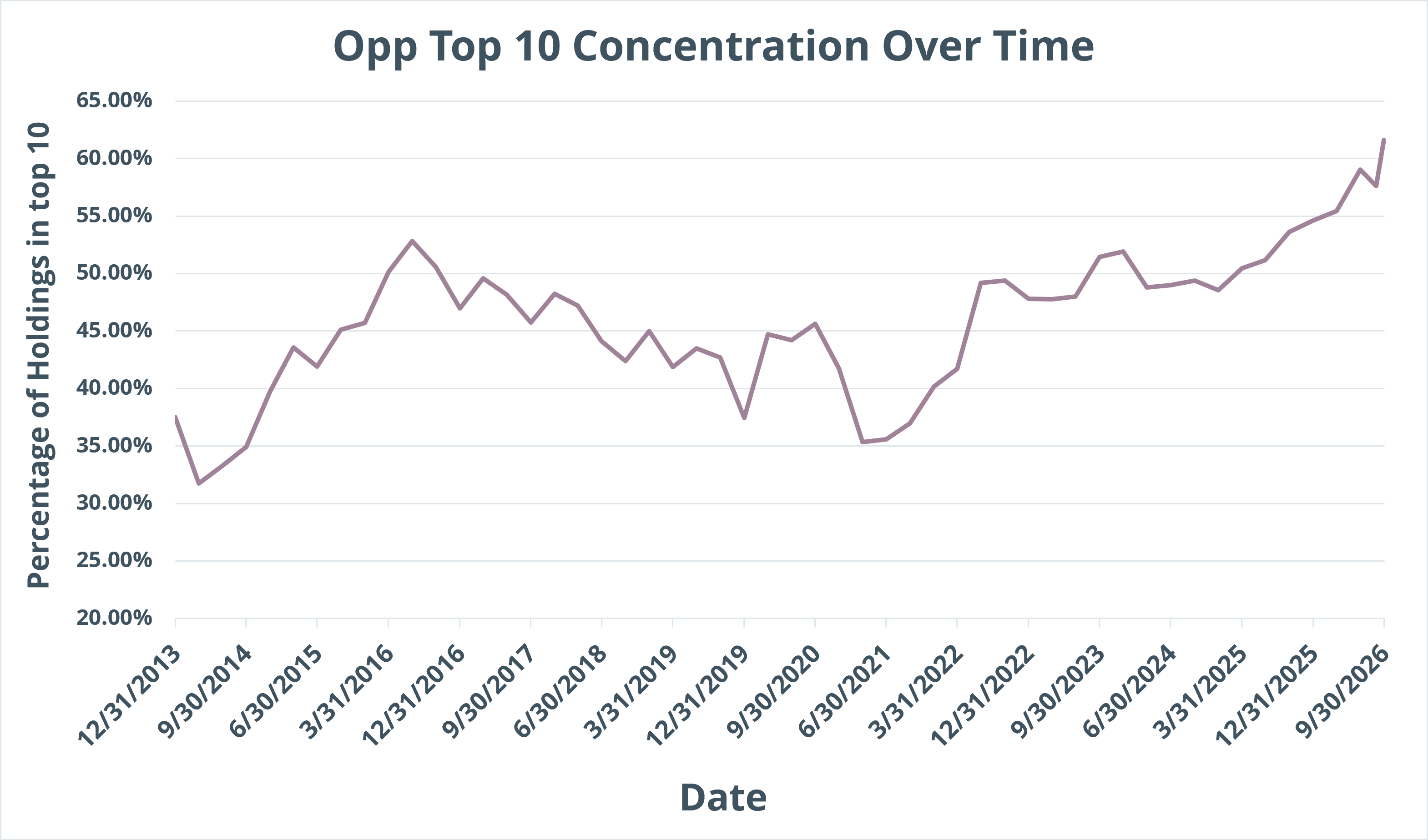
One-sentence summary: The author believes the market is in the late stage of a long-term bull market, but the AI revolution and interest rate volatility are creating the best opportunities in years, with portfolio concentration reaching its highest level in over a decade. [Optimistic with caution]
- This quarter's net return was 4.32%, outperforming the S&P 500's 2.30%, with major contributions from Precigen, Meta, and crypto assets (FBTC/Coinbase), collectively adding 693 basis points.
- Interest rates and oil prices dragged down three major sectors (interest rate-sensitive stocks, oil-sensitive stocks, and managed care companies), totaling a drag of 572 basis points, but the author believes this is creating very attractive long-term opportunities.
- The top holding, QXO, has fallen 61% from its year-to-date high, prompting the author to increase the position by over 70% against the trend, estimating a potential 2030 EPS of $2.20, corresponding to a forward P/E of just 5x at current levels.
- Precigen has already risen 10x, but the author believes the stock price of $7.60 has not yet fully reflected the value of its core product, Papzimeous, let alone other pipeline assets.
- The author remains optimistic about Nvidia, arguing that unless earnings peak, a forward earnings multiple of less than 15x next year is highly attractive.
This Quarter Outperformed the Market, Driven by AI and Crypto Assets
Performance Comparison: Net return for the quarter was 4.32%, outperforming the S&P 500's 2.30%; year-to-date net return stands at 14.93%, beating the index's 12.75%. Since inception in 2000, a $10,000 investment has grown to over $91,500, compared to the index's $85,080. Since the author took over at the end of 2022, the annualized return has reached 29.0%, significantly outpacing the S&P 500's 21.8%. The main contributors were Precigen (PGEN $7.60, Papzimeous launch exceeded expectations), Meta (META $720.89, Muse agents boosted AI investment expectations), and crypto assets (FBTC $71.08 and Coinbase $172.00), collectively contributing 693 basis points. The author stated, "We added to all these holdings on weakness earlier this year, including initiating a Meta option position in the third quarter before the stock rebounded." The author remains optimistic about all three.
Interest Rates and Oil Prices Weighed on Three Sectors
Performance Comparison: The drag factors fall into three categories: interest rate-sensitive stocks (QXO $11.12, Citigroup $128.08, UBS $47.06, SoFi $15.61, OneMain $56.42), oil-sensitive stocks (Delta Air Lines $82.14, United Airlines $107.44, Norwegian Cruise Line $15.49), and managed care companies (UnitedHealth $370.95, CVS $87.80), collectively dragging performance by 572 basis points. Long-term interest rates rose sharply, with the U.S. 10-year Treasury yield hitting 5.3%, up over 80 basis points (18%) from the previous quarter's low, while developed market yields rose an average of 25%. The correlation between oil prices and interest rates exceeded 60%, suggesting oil prices are the primary driver. The author believes that while rising interest rates are a risk factor, "it's creating some very attractive long-term opportunities."
Market in Late Stages of a Secular Bull Market, AI Adds Uncertainty
Market Judgment [Cautiously Optimistic]: The author believes the market is in the late stages of the longest bull market since the March 2009 low (S&P 500 annualized 16.9%, strategy 18.7%), but "final years of a secular bull market are often some of the strongest." The S&P 500 has annualized nearly 22% over the past 3.75 years. The author is uncertain whether "final" means six months or seven years but focuses on optimizing risk-reward across all future scenarios. The AI revolution adds uncertainty, but the author emphasizes that "successful investing doesn't require knowing which path the future will take." What matters is understanding the expectations priced into securities and assessing the expected returns across various possible outcomes.
AI Valuations Far Below the 2000 Tech Bubble, but Earnings Durability in Question
Key Stock: The author uses Nvidia (NVDA $237.47) as an example, bullish but flagging risks.
- Argument (Bullish): Current valuations are far below the 2000 bubble levels. The S&P 500 forward P/E has fallen from 23x last year to 19x. Nvidia's forward P/E is 19.6x, Micron is 6.3x, while at the 2000 peak, Cisco traded at 127x. The author believes "The widespread fear of another Tech Bubble is likely one reason today's valuations look so different from 2000."
- Evidence: Nvidia's fiscal 2027 revenue is estimated at $410B, operating profit at $269B, and free cash flow at $186B, 7-8 times higher than when earnings durability was first questioned. Operating margins have expanded from the mid-50% range to the mid-60% range. The author closely monitors the supply-demand balance for AI computing power, believing the shortage will persist and is the most important driver of earnings.
- Risk (Self-Identified by Author): Earnings durability is a real risk. If this judgment is wrong, the secular bull market could face risks. However, the author believes this should not prevent "letting winners run." Cisco experienced an earnings downcycle after the bubble but surpassed its previous peak in just three years. At Nvidia's current valuation, that scenario would be bullish.
Interest Rate Volatility Creates Best Opportunity in Years, Portfolio Concentration Increases
Position Moves:
- QXO (Added): The author believes the market's knee-jerk reaction to interest rates overlooks long-term fundamentals and has actively added to the position.
- Chime (Added): Similarly misjudged by the market due to interest rate volatility, the author believes long-term fundamentals remain unchanged.
- Overall Portfolio: The concentration of the top ten holdings is at its highest in over a decade. The author states, "we've aggressively added to weak names where the market's knee-jerk reaction to rates misses the longer-term fundamental pictures."
Appendix: Position Moves at a Glance
| Ticker | Action | Logic/Data |
|---|---|---|
| Precigen (PGEN) | Hold & Observe | Papzimeous launch exceeded expectations; FDA granted Adenoverse technology platform status |
| Meta (META) | Added (incl. options) | Muse agents boosted AI investment expectations; option position established this quarter |
| FBTC / Coinbase (COIN) | Hold & Observe | Bitcoin price bottomed in July; crypto assets contributed positively |
| Nvidia (NVDA) | Hold & Observe | Forward P/E 19.6x; earnings durability is a key risk; author believes shortage will persist |
| Micron | Hold & Observe | Forward P/E 6.3x; up tenfold since Dalio's January 2025 AI bubble warning |
| QXO | Added | Interest rate-sensitive stock dragged, but author believes market misjudges long-term fundamentals |
| Citigroup (C) | Not Specified | Interest rate-sensitive stock dragged |
| UBS (UBS) | Not Specified | Interest rate-sensitive stock dragged |
| SoFi (SOFI) | Not Specified | Interest rate-sensitive stock dragged |
| OneMain (OMF) | Not Specified | Interest rate-sensitive stock dragged |
| Delta Air Lines (DAL) | Not Specified | Oil-sensitive stock dragged |
| United Airlines (UAL) | Not Specified | Oil-sensitive stock dragged |
| Norwegian Cruise Line (NCLH) | Not Specified | Oil-sensitive stock dragged |
| UnitedHealth (UNH) | Not Specified | Managed care stock dragged |
| CVS (CVS) | Not Specified | Managed care stock dragged |
| Chime | Added | Interest rate volatility led to market misjudgment; author believes long-term fundamentals unchanged |
At a Glance
The top ten holdings are highly concentrated, with QXO representing the largest contrarian bet.
As of September 30, 2026, the concentration of the top ten holdings is at a historical high. The author focuses on the largest position, QXO ($11.12), which has fallen 61% from its year-to-date high, yet the author has increased the position by over 70% against the trend. The author believes CEO Brad Jacobs is a "serial entrepreneur with an outstanding track record," noting that his previous companies delivered an average annualized return of approximately 40% from trough to the end of his tenure. The author estimates 2030 earnings per share potential at $2.20, implying a forward P/E of just 5x at current levels; at a 25x P/E valuation, the stock could reach $50+, implying a 37% annualized gain; even if the P/E compresses to 15x, the annualized gain still exceeds 20%. Performance reference: QXO recently completed the acquisition of TopBuild, which Jacobs called his "best acquisition." The author's original quote: "We’ve analyzed a range of scenarios and believe QXO offers one of the most attractive risk-rewards we’ve encountered."
Precigen Has Become a 10-Bagger, but the Author Sees Further Upside
Precigen ($7.60) has risen 10x since its 2024 year-end financing, but the author believes the current stock price does not yet fully reflect the value of its core product. The driver is the successful launch of its first drug, Papzimeous (for treating HPV-induced recurrent respiratory papillomatosis). Its underlying technology, Adenoverse, recently received FDA platform designation, which can streamline the approval process for other related therapies. The author expects trial results for head and neck cancer and cervical cancer to be "solid" and is optimistic about the potential of its CAR-T program. The author's original quote: "Precigen’s stock price is $7.60, which doesn’t yet fully reflect the value of Papzimeous, let alone the other pipeline assets."
Royalty Pharma and United Healthcare Provide Portfolio Stability
Royalty Pharma ($56.21) and United Healthcare ($370.95) have contributed significantly this year, and the author continues to favor their risk-reward profiles. Royalty Pharma is a key capital provider in the biopharma industry, dominating the large-ticket transaction market, with a return on capital in the "high teens" (15-19%) and earnings growth in the "low-to-mid-teens" (11-15%). Its 2027 owner earnings P/E is 16.7x. United Healthcare is in the early stages of an earnings recovery, with excellent management and expected earnings growth in the "mid-teens" (13-17%) over the next few years.
Citigroup Turns Around, Valuation Still Not Expensive
Citigroup ($128.08) is another major winner, with CEO Jane Fraser successfully executing a turnaround. The author believes the work is not yet complete: the 2026 return on tangible common equity (ROTCE) should be 11.5% (up from a trough of 4.8% in 2023), and is expected to rise to the "mid-teens" (13-17%) by the end of the decade, which should support a "mid-teens" annualized stock price gain. The current valuation is 10x 2027 earnings, which the author considers "not demanding."
Three of the Magnificent Seven Held: Google, Meta, Amazon
The author believes these three Mag 7 stocks represent some of the most attractive opportunities in the market. Their 2027 P/E ratios range between 21-24x, with revenue growth exceeding 20%. All three have underperformed the market this year (having previously been leaders). The author believes their advantages in data, capital, technological strength, and culture position them to win in an AI-dominated future. Google and Amazon's AI investments have already "clearly demonstrated" strong capital returns, while Meta's Muse launch is a "good start."
Nvidia: Unless Earnings Are Believed to Have Peaked, <15x P/E Is Extraordinarily Attractive
The author remains optimistic on Nvidia ($230.48). CEO Jensen Huang is seen as "the primary spokesperson and visionary of this boom era," helping to cultivate new customers and seed additional revenue streams. The author's original quote: "Unless one believes an earnings peak is imminent – and we don’t – next year’s < 15x earnings multiple is extraordinarily attractive."
Chime: The Author's "Economies of Scale Shared" Long-Term Compounder
Chime ($28.96) is the last of the top ten holdings, and the author continues to add to the position. The author draws a parallel to renowned investor Nick Sleep's "economies of scale shared" paradigm (Amazon, Costco), viewing Chime as a low-cost basic banking service provider that has built a beloved brand. It has added more new checking account relationships than any bank, including JPMorgan Chase and Bank of America, and its unaided brand awareness recently surpassed that of Bank of America. The author estimates its fair value at $47, representing 68% upside from the current price.
Appendix: Notable AI Achievements
The author lists three major breakthroughs of AI in science and medicine: 1) AlphaFold predicted over 200 million protein structures, contributing to the 2024 Nobel Prize in Chemistry; 2) AI designed a new drug, rentosertib, for idiopathic pulmonary fibrosis (IPF), which has entered randomized Phase 2 human clinical trials; 3) DeepMind's GNoME predicted 2.2 million unknown crystal structures, of which 380,000 have the potential to improve technologies such as batteries, semiconductors, and solar cells.
Position Moves
| Position | Action | Summary Rationale |
|---|---|---|
| QXO | Added | After a 61% decline, increased position by 70%+; CEO has strong historical performance, forward P/E of only 5x, excellent risk-reward |
| Precigen | Hold & Monitor | Already up 10x, but stock price does not fully reflect Papzimeous value or pipeline potential |
| Royalty Pharma | Hold & Monitor | Return on capital in high teens, 2027 P/E of 16.7x, provides portfolio stability |
| United Healthcare | Hold & Monitor | Early stage of earnings recovery, mid-teens earnings growth expected over next few years |
| Citigroup | Hold & Monitor | Turnaround in progress, ROTCE rising from 4.8% to 11.5%, 2027 P/E of 10x |
| Hold & Monitor | 2027 P/E 21-24x, revenue growth >20%, strong returns on AI investment | |
| Meta | Hold & Monitor | Same as above, Muse launch is a good AI start |
| Amazon | Hold & Monitor | Same as above, clear AI investment returns |
| Nvidia | Hold & Monitor | Unless earnings have peaked, <15x P/E is extraordinarily attractive |
| Chime | Added | Low-cost banking service, brand awareness surpasses Bank of America, fair value $47 |
Multiple AI Breakthroughs Are Moving from Theory to Real-World Application
AI has solved a million-dollar math problem and significantly improved algorithm efficiency, weather forecasting, medical diagnostics, and programming productivity. In September 2026, an OpenAI model proposed a solution to the Navier–Stokes equations, demonstrating that fluid equations could exhibit "blow-up." This is one of the seven million-dollar Millennium Prize Problems and could become the first major unsolved math problem solved by AI, currently under expert review (Nature). On October 6, OpenAI announced that its frontier AI model generated solutions to hundreds of previously unsolved math problems, producing 722 research manuscripts covering 372 sets of results.
- Algorithm Innovation: The algorithm discovered by AlphaEvolve restored 0.7% of Google's global computing capacity, accelerated a key Gemini computation by 23%, boosted FlashAttention by up to 32.5%, and improved matrix multiplication results that had remained unchanged since 1969 (Google DeepMind).
- Weather Forecasting: DeepMind's GenCast outperformed the European Centre's leading ensemble forecast system on 97.2% of 1,320 metrics—achieving 99.8% accuracy for forecasts beyond 36 hours and generating 15-day global forecasts in about 8 minutes (Nature).
- Medical Diagnostics: In a randomized mammography trial involving over 100,000 women, AI-assisted screening detected approximately 29% more cancers while reducing radiologists' reading workload by about 44%, with no significant increase in false-positive rates (Lancet Digital Health).
- Programming and Productivity: Airbnb CEO Brian Chesky predicted that "next year, almost no one at Airbnb will write a single line of code," highlighting the rapid shift from manual software writing to directing AI systems. A study of 5,179 customer service agents showed that AI boosted overall productivity by 14%, with novice/low-skilled workers improving by about 34%, making less experienced employees perform like veterans (NBER).
Massive Investment and Power Demand Spark a Historic Industrial Wave
Meeting AI computing demand is expected to require nearly $7 trillion in data center investment, with global data center electricity consumption set to double by 2030. McKinsey estimates that global data center investment needs will reach approximately $7 trillion by 2030, driving massive spending on chips, servers, power generation, electrical equipment, networks, construction, and real estate. The International Energy Agency (IEA) predicts that global data center electricity consumption will double to about 950 TWh by 2030—exceeding Japan's current total electricity use—with data centers accounting for nearly half of U.S. electricity demand growth.
AI Adoption Sets Historic Records, Model Companies See Unprecedented Revenue Growth
Generative AI has moved from research breakthroughs to daily use in just a few years, with adoption rates surpassing those of mobile phones and the internet; OpenAI and Anthropic have seen revenues skyrocket from zero to hundreds of billions of dollars. The Stanford AI Index Report notes that generative AI has one of the fastest adoption curves among all major general-purpose technologies. ChatGPT reached 1 billion monthly active users in about 3.5 years, compared to TikTok's 5 years, Instagram's 8 years, Facebook's 8.5 years, mobile phones' 21 years, and the internet's 36 years. OpenAI and Anthropic have scaled commercial revenue from near zero to annualized hundreds of billions of dollars in just a few years; Anthropic alone surged from about $1 billion to $65 billion in 19 months. In contrast, previous tech giants like Salesforce and Google took roughly a decade or more (Axios).
Position Moves
| Ticker | Direction | Author’s One-Sentence View | Key Data |
|---|---|---|---|
| QXO | Add | The market’s knee-jerk reaction to interest rates ignores long-term fundamentals, offering one of the most attractive risk-reward setups we have ever seen | Share price $11.12, up 70%+ after a 61% decline YTD; 2030 EPS potential $2.20, forward P/E of just 5x |
| Meta | Add (incl. options) | Muse agents raise AI investment expectations; this quarter, we established an options position before the stock rebounded | Share price $720.89 |
| Chime | Add | Interest rate volatility has led to market mispricing, while long-term fundamentals remain unchanged; brand recognition for low-cost banking services has already surpassed Bank of America | Share price $28.96, fair value $47 (upside 68%) |
| Precigen | Hold & Watch | Already up 10x, but the stock has yet to fully reflect the value of Papzimeous, let alone other pipeline assets | Share price $7.60; FDA grants Adenoverse technology platform status |
| Nvidia | Hold & Watch | Unless earnings are believed to have peaked, a sub-15x earnings multiple next year is highly attractive | Share price $237.47; forward P/E 19.6x; fiscal 2027 revenue estimated at $410B |
| Royalty Pharma | Hold & Watch | Provides portfolio stability, with high-teens return on capital and reasonable valuation | Share price $56.21; 2027 owner earnings P/E 16.7x |
| United Healthcare | Hold & Watch | Early stage of earnings recovery, excellent management, mid-teens earnings growth over the next few years | Share price $370.95 |
| Citigroup | Hold & Watch | Turnaround in progress, ROTCE rising from 4.8% to 11.5%, valuation not expensive | Share price $128.08; 2027 P/E 10x |
| Hold & Watch | AI investments have clearly demonstrated strong capital returns; 2027 P/E 21-24x, revenue growth >20% | Share price not provided | |
| Amazon | Hold & Watch | AI investment returns are clear; 2027 P/E 21-24x, revenue growth >20% | Share price not provided |
| Micron | Hold & Watch | Forward P/E of just 6.3x; has risen tenfold since the AI bubble warning | Share price not provided |
| FBTC | Hold & Watch | Crypto assets contribute positively; Bitcoin price bottomed in July | Share price $71.08 |
| Coinbase | Hold & Watch | Crypto assets contribute positively | Share price $172.00 |