Looking Where the Light Is: Volatility Is Not Risk
Patient Capital Management is a Baltimore asset manager founded in 2020 by Samantha McLemore, CFA — Bill Miller's long-time co-manager (working together since 2002, running the flagship Opportunity Equity strategy since 2014). Continuing the Miller-school contrarian tradition, it practices "time arbitrage": exploiting behavioral mispricing to concentrate in controversial growth names (tech, healthcare, Bitcoin-related) at deep discounts to intrinsic value. Its site preserves Bill Miller's complete 1995-2022 market letters, alongside ongoing quarterly letters and webinars.
In plain words
This article argues that real investment risk is permanent loss of capital or lost purchasing power, not short-term price swings—so long-term investors should ignore daily noise, pick fund managers with solid processes, and buy when those managers temporarily underperform. Key names: Mag 8 (a basket of big tech stocks) returned 31.5% a year on average, more than double the S&P 500's 14%, showing high volatility often accompanies big long-term winners; the S&P 500 is used as a benchmark; university endowments managed with complex risk models returned only 6.8% over ten years, trailing the S&P.
At a Glance
The author believes investment risk is permanent capital loss and purchasing power loss, not price volatility; long-term investors should ignore short-term volatility, select managers with robust processes, and buy when those managers are temporarily underperforming. [Neutral]
- The industry replaces hard-to-measure true risk with quantifiable volatility—a pragmatic choice in the spirit of the "streetlight effect," not a rational definition.
- University endowments delivered an average annual return of only 6.8% over the past decade, underperforming the S&P 500 (12.8%), MSCI ACWI (9.0%), and a 60/40 equity/bond portfolio (7.7%); the volatility framework has not proven effective.
- Mag 8 (FAANG/Mag 7) has historically delivered an average annual return of 31.5%, more than double the S&P 500's 14% over the same period; a $10,000 investment would now be worth $796,000, roughly 10 times the S&P 500's $83,000.
- Academic evidence (Black-Jensen-Scholes, Fama-French, Frazzini-Pedersen) does not support high beta generating reliable excess returns; the only reliably valid approach is a leveraged market index.
- The author's test for a risk framework is "make more when right than lose when wrong": earn more when correct than you lose when incorrect, rather than reducing volatility.
Volatility Is a Proxy for Risk Under the Streetlight Effect
The author argues that the industry has replaced hard-to-measure true risk with quantifiable volatility — a pragmatic choice in the spirit of the streetlight effect, not a rational definition. The article first cites Buffett's famous maxim — the riskiness of an investment is measured not by beta, but by the probability that the investment causes its owner a loss of purchasing power — and then opens with the parable of the lost keys: people look for their keys under the streetlight not because the keys were dropped there, but because that is where the light is. Modern portfolio theory and the capital asset pricing model (CAPM) introduced a rigorous mathematical framework to investing, and volatility gradually evolved from a proxy for risk into the definition of risk itself. The mathematician Benoit Mandelbrot later showed that extreme market price moves occur far more frequently than traditional models predict (fat tails), but this flaw did not curb the spread of the quantitative framework; on the contrary, its quantifiability made it more attractive. The author's original words: "Investment risk is inherently difficult to measure and quantify. Volatility isn't." That is: investment risk itself is difficult to measure and quantify; volatility is not. The author also draws a boundary: for short-term investors, volatility may be an appropriate risk framework, but temporary price fluctuations mean little to long-term investors.
Neither Ratings Nor Endowments Validate Volatility
If volatility were an effective measure of risk, using it should improve investment returns — but neither fund ratings nor university endowments support this. Morningstar's fund ratings give significant weight to volatility, yet several studies find that Morningstar ratings have only a weak relationship with funds' future performance; one Vanguard study even found that one-star funds outperformed five-star funds. The author notes that the industry's preferred quantitative metrics tend to be backward-looking and non-stationary: they look best after strong performance and worst after sustained underperformance, and in practice often reinforce the cardinal investing sin of buying high and selling low. The institutional level shows the same disconnect: after the financial crisis, many university endowments adopted complex risk models and volatility-based portfolio construction, yet their ten-year average annualized return through June 2024 was only 6.8%, trailing several benchmarks:
| Portfolio | 10-Year Annualized Return |
|---|---|
| University endowments | 6.8% |
| S&P 500 | 12.8% |
| MSCI ACWI | 9.0% |
| 60/40 equity/bond portfolio | 7.7% |
The author concedes that the underperformance cannot be attributed entirely to the "risk equals volatility" paradigm, but there is also no convincing evidence that increasingly complex volatility metrics consistently translate into better investment outcomes. Some institutions have moved to metrics such as "downside capture" that measure only downside volatility, or have adopted up/down capture, at least acknowledging that upside volatility has positive value. The better fund-selection process the article offers: identify strong managers with robust processes, and buy them when they are temporarily underperforming.
High Volatility Is a Hallmark of Long-Term Winners
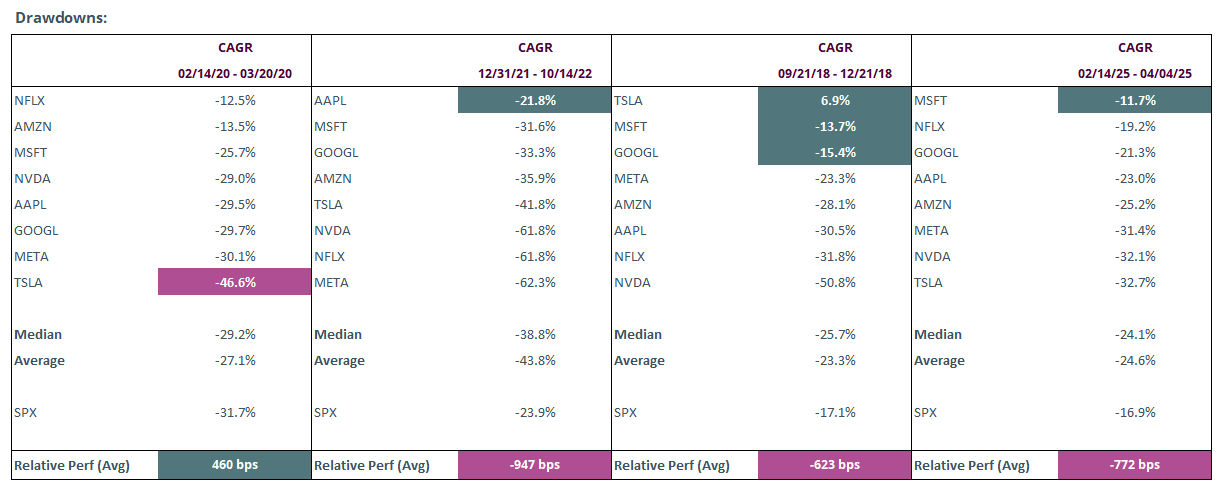
The author usesFAANG/Mag 7 or Mag 8(hereafterMag 8)'s historical performance to show that high volatility — including downside volatility — is often a hallmark of the market's long-term winners, not a flaw. The article notes that, in hindsight, the FAANG/Mag 7 or Mag 8 became among the greatest wealth creators in modern market history; if investors had known this outcome in advance, temporary drawdowns would have been a very small price. From the end of 2009 (or each stock's IPO date) through the end of last year, the basket generated an average annualized return of 31.5% — more than double the S&P 500's 14% over the same period; $10,000 invested in the Mag 8 would be worth $796,000 today, roughly ten times the $83,000 final value of the same amount invested in the S&P 500. These returns had a cost: the basket almost always drew down more deeply than the broad market, underperforming the market in three of the four major selloffs of the past decade, the sole exception being the pandemic (when the sudden shift toward digital services disproportionately benefited many of these business models); excluding the pandemic period, its average drawdown was roughly 1.6 times the market's. Research by Hendrik Bessembinder of Arizona State University finds that many of the market's long-term wealth creators also suffered large drawdowns along the way. The article does not expand on the basket's current membership in the main text. The author thereby proposes: if the market's greatest long-term wealth creators consistently exhibit the traits commonly defined as risk, the problem may lie not in volatility itself but in the definition of risk.
Beta Is Not a Reliable Source of Excess Returns
CAPM holds that high beta should command high expected returns, but the academic evidence does not support this; the author believes that raising beta cannot reliably construct an outperforming portfolio. Beta attempts to separate company-specific volatility from overall market volatility; in theory, bearing more systematic risk should be compensated. But early work by Black, Jensen, and Scholes found that the relationship between beta and returns deviates from CAPM's predictions; research by Fama-French and Frazzini-Pedersen further challenges the view that buying the highest-beta stocks reliably earns long-term excess returns. The only thing that reliably holds up is a leveraged market index — its upside and downside correspond one-for-one to beta's predictions. The author says beta remains a useful measure of market sensitivity, and they use it themselves; but like volatility, it describes only one dimension of investment risk, and one cannot reliably construct an outperforming portfolio by increasing beta, so its validity in evaluating fund performance is also questionable.
The Real Risk Is Permanent Capital Loss, Not Price Volatility
The author offers his own definition of risk: permanent capital loss and loss of purchasing power, not day-to-day price fluctuations. The author defines risk as "investment risk is the possibility of a permanent loss of capital and the loss of purchasing power, not the day-to-day fluctuations of market prices" — that is: investment risk is the possibility of permanent capital loss and loss of purchasing power, not the day-to-day fluctuations of market prices. Drawing on a diagram from Howard Marks, the article explains that future risk should be understood as the distribution of potential future returns — the wider the distribution, the greater the risk. This framework is reflected in Patient Capital's investment process: through broad scenario analysis, it assesses the range of potential outcomes for each investment, the key drivers behind those outcomes, and whether the current price is sufficient compensation for the associated risks.
Investment Implications
The article's actionable implications: long-term investors should ignore short-term volatility, select managers with robust processes, and buy when those managers are temporarily underperforming; when evaluating funds, they should not treat volatility or beta as the entirety of risk, but instead focus on the possibility of permanent loss and loss of purchasing power. Note, however, the institutional perspective bias: the author's use of the Mag 8's ex-post performance to argue that high volatility is acceptable is a rearview-mirror narrative that does not discuss survivorship bias; and the article closes by promoting its own scenario-analysis process — readers should recognize that this is the perspective of a position holder.
Uncertainty and Risk Both Require Compensation
The author believes that long-term returns come from better investment decisions, and therefore the uncertainty and risk assumed must each receive adequate compensation.
The article states its thesis at the outset: in the author's original words, "Our objective is to achieve better long-term returns by making better investment decisions, which means we must be adequately compensated for both uncertainty and risk." In other words: "Our goal is to achieve better long-term returns by making better investment decisions, which means we must be adequately compensated for both uncertainty and risk." In the author's view, risk is not a single metric: business quality, valuation, competitive position, management decisions, and numerous other factors together shape the risk of an investment.
The Test of a Risk Framework: Earn More, Lose Less
The author proposes a practical standard: whether a risk framework is useful depends not on how refined the model is, but on whether it can improve long-term investment returns.
The author believes that the "practical test" of whether a risk framework is effective is whether it can improve long-term returns. What investors ultimately seek is this: when their judgments are correct, they earn more than they lose when their judgments are wrong — which the author defines as effective risk management. In other words, the value of risk management lies not in reducing volatility, but in improving the payoff ratio of judgments.
Volatility Is Measurable, but the Answer Isn't Where the Light Is Brightest
The author acknowledges that volatility, because it is measurable, has become an indispensable investment tool, but cautions that long-term investment success is precisely a matter of seeing through the market's most conspicuous surface.
The author uses everyday experience to expose the methodological trap: in the author's original words, "In investing, as in life, the easiest place to look isn't always where you'll find the answer." In other words: "In investing, as in life, the easiest place to look is not always where you will find the answer." Volatility became an indispensable tool because it is measurable; but long-term investment success has always depended on seeing what lies beyond the market's most conspicuous places. The footnote at the end of the article provides an academic evidence chain: Vanguard's research on fund ratings and future performance (Philips & Kinniry, 2010); Bessembinder's (2018) Do Stocks Outperform Treasury Bills?; Black, Jensen, and Scholes's (1972) empirical test of the CAPM; Fama and French's (1992) The Cross-Section of Expected Stock Returns; and Frazzini and Pedersen's (2014) Betting Against Beta — all classic references used to support the position that "risk does not equal volatility." The future potential return distribution chart (Exhibit C) at the end of the article, meanwhile, is adapted from Howard Marks's The Most Important Thing (2011).
Position Moves
| 标的 | 方向 | 作者态度一句话 | 关键数据 |
|---|---|---|---|
| Mag 8 (FAANG/Mag 7) | Not specified | High volatility is a characteristic of long-term winners, not a flaw | Average annual return 31.5%, more than double the S&P 500's 14% over the same period; a $10,000 investment is now worth $796,000, roughly 10 times the S&P 500's $83,000 |
| University endowments | Not specified | They employ complex volatility models but have underperformed, failing to prove their effectiveness | 10-year average annual return 6.8%, trailing the S&P 500 (12.8%), MSCI ACWI (9.0%), and 60/40 stock/bond portfolio (7.7%) |
| S&P 500 | Not specified | Serves as a benchmark, used to highlight the failure of the volatility framework and Mag 8's excess returns | 14% annual return over the same period when compared with Mag 8; 12.8% 10-year annual average in the endowment comparison |
| MSCI ACWI | Not specified | Serves as a benchmark, outperforming university endowments | 10-year annual average return 9.0% |
| 60/40 stock/bond portfolio | Not specified | Serves as a benchmark, outperforming university endowments | 10-year annual average return 7.7% |
| Leveraged market index | Not specified | The only reliably established high-beta strategy, with upside/downside corresponding one-to-one to beta predictions | No specific figures |