2Q26 Quarterly Market Review
Patient Capital Management is a Baltimore asset manager founded in 2020 by Samantha McLemore, CFA — Bill Miller's long-time co-manager (working together since 2002, running the flagship Opportunity Equity strategy since 2014). Continuing the Miller-school contrarian tradition, it practices "time arbitrage": exploiting behavioral mispricing to concentrate in controversial growth names (tech, healthcare, Bitcoin-related) at deep discounts to intrinsic value. Its site preserves Bill Miller's complete 1995-2022 market letters, alongside ongoing quarterly letters and webinars.
In plain words
This report covers the stock market's big rally in the second quarter of 2026. The S&P 500 returned 15.2%, one of the best quarters in decades. But the economy looks messy: inflation is up to 4.2%, consumer confidence hit a record low, yet retail sales are still strong. The rally was mostly driven by AI-related tech stocks—semiconductors soared 88%. For regular investors, don't get fooled: the market is disconnected from weak fundamentals. The Fed is stuck, and gold and Bitcoin both fell. Worth reading because it shows why chasing the hype could be risky.
U.S. Stock Market Rebounded Sharply in Q2 2026 The S&P 500 surged 15.2% in the second quarter of 2026, marking its strongest quarterly performance since Q2 2020. The Nasdaq rose 21.6%, and the semiconductor sector posted a quarterly return of 88.0%, with AI and tech stocks leading the rally. Althoug
Theme and Background
This chapter reviews the performance of the U.S. stock market in the second quarter of 2026, focusing on how the market achieved a significant rebound against a backdrop of persistently conflicting macro data (rising inflation, low consumer confidence, but strong retail data). The report argues that the AI and technology sectors were the core drivers of the rebound, while the macro environment remains complex, leaving the Federal Reserve in a dilemma.
Core Thesis
The author's core judgment is: The second-quarter rebound was primarily driven by the AI theme and geopolitical easing, but the macro fundamentals have not improved, resulting in a clear disconnect between the market and the real economy. The counterintuitive aspects are: consumer confidence fell to an all-time low (44.8), yet retail sales continued to grow; inflation rose to 4.2%, but the stock market hit record highs.
Key Arguments and Data
- Market Performance: The S&P 500 posted a quarterly return of 15.2%, the 12th best quarter since 1950 and the strongest since Q2 2020; the Nasdaq rose 21.6%; the semiconductor sector achieved a record quarterly return of 88.0%.
- Macro Data: May CPI rose to 4.2% (highest since 2023), core PCE rose to 3.4%; the unemployment rate remained near 4.3%; consumer confidence fell to an all-time low of 44.8 in May, rebounding to 49.5 in June but still at extremely low levels; retail sales grew 0.9% month-over-month in May.
- Federal Reserve: Kevin Warsh chaired the FOMC meeting for the first time, maintaining the interest rate at 3.50%-3.75%, but the dot plot indicated the possibility of further tightening before year-end.
- Sectors and Styles: The information technology sector led gains (+31.8%), while the energy sector fell 13.4%; small-cap stocks (Russell 2000 +21.6%) outperformed large-caps; growth stocks (+16.7%) outperformed value stocks (+13.9%).
- Other Assets: The U.S. dollar rose 1.2%; gold fell 14.3%, breaking below its 200-day moving average; WTI crude oil corrected 31.4% (still up 21.0% year-to-date); Bitcoin fell for a third consecutive quarter, closing at $58.6k.
Comparative Data Table:
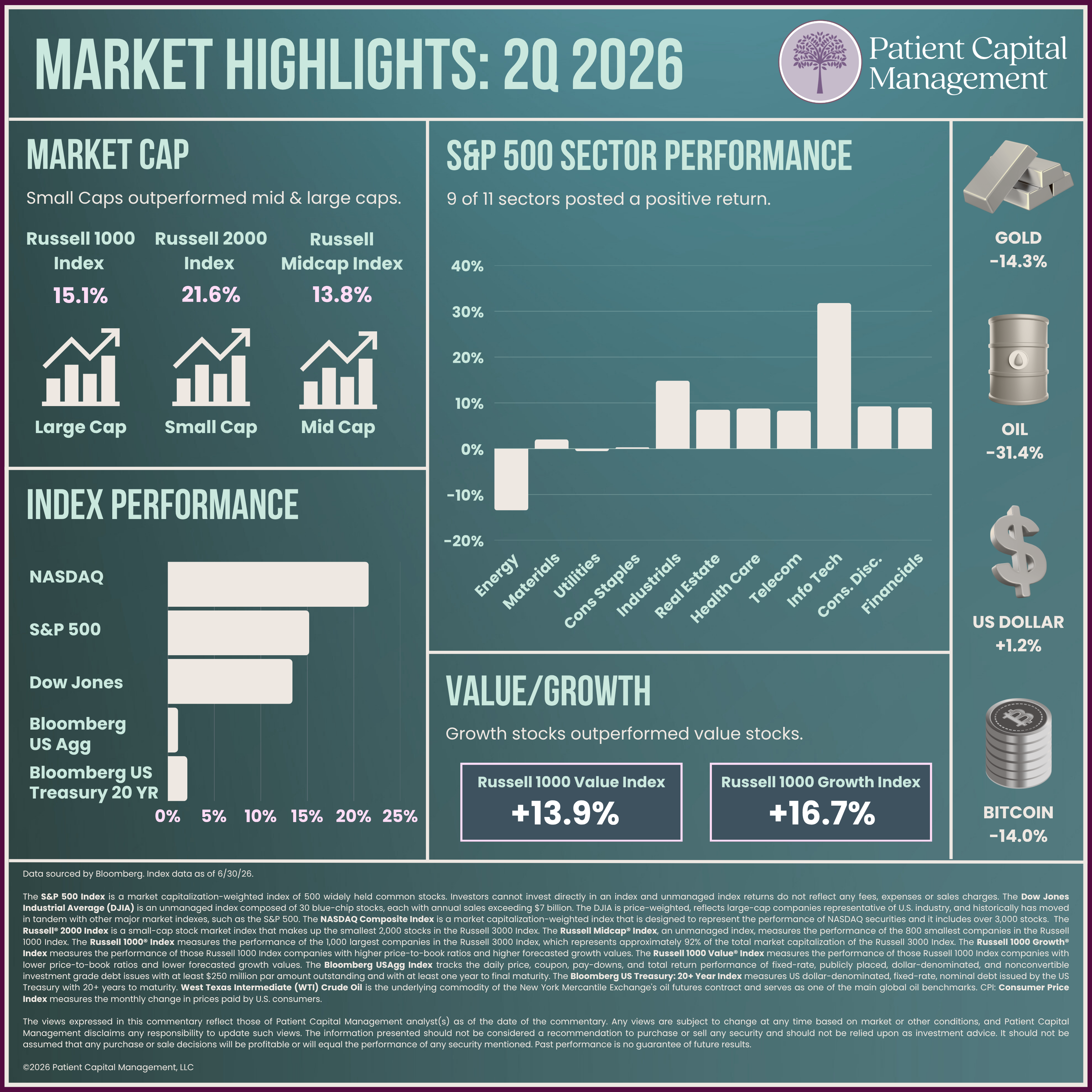
| Asset Class | Q2 2026 Return | Notes |
|---|---|---|
| S&P 500 | +15.2% | 12th best quarter since 1950 |
| Nasdaq | +21.6% | Led major benchmarks |
| Semiconductor Sector | +88.0% | Record quarterly return |
| Russell 2000 | +21.6% | 8th best quarter since inception |
| Information Technology Sector | +31.8% | Led the S&P 500 |
| Energy Sector | -13.4% | Dragged down by falling crude oil prices |
| Long-Term U.S. Treasuries | +2.1% | Underperformed all stock indices |
| Gold | -14.3% | Broke below 200-day moving average |
| WTI Crude Oil | -31.4% | Still +21.0% year-to-date |
| Bitcoin | -14.0% | Fell for three consecutive quarters |
Companies/Assets Involved
This chapter does not mention specific companies, primarily analyzing index and sector performance. Core assets of focus include:
- Semiconductor Sector (unnamed companies): Bullish, quarterly return of 88.0%, core of the AI theme.
- Information Technology Sector: Bullish, quarterly return of 31.8%.
- Energy Sector: Bearish, quarterly decline of 13.4%.
- Bitcoin: Bearish, fell for three consecutive quarters, closing at $58.6k.
Investment Implications
- The AI theme remains the core market driver, but investors should be wary of valuation bubble risks, as macro fundamentals (inflation, consumer confidence) do not support such a strong rebound.
- Small-cap stocks (Russell 2000) outperformed large-caps, suggesting capital is rotating from large-cap tech stocks into the broader market, but the sustainability of this trend needs confirmation.
- Growth stocks have regained leadership over value stocks, indicating a recovery in market risk appetite, but if the Fed tightens further, style rotation could occur again.
- The decline in gold and Bitcoin shows that safe-haven assets and digital assets are under pressure in a rising interest rate environment, and investors should reduce allocations to these categories.