3Q25 Quarterly Market Review
Patient Capital Management is a Baltimore asset manager founded in 2020 by Samantha McLemore, CFA — Bill Miller's long-time co-manager (working together since 2002, running the flagship Opportunity Equity strategy since 2014). Continuing the Miller-school contrarian tradition, it practices "time arbitrage": exploiting behavioral mispricing to concentrate in controversial growth names (tech, healthcare, Bitcoin-related) at deep discounts to intrinsic value. Its site preserves Bill Miller's complete 1995-2022 market letters, alongside ongoing quarterly letters and webinars.
In plain words
This review covers Q3 2025 US markets, which hit 23 new highs driven by strong retail sales, Fed rate cuts, and AI spending. But consumer confidence plunged to near-record lows—a red flag. For ordinary investors: growth and small-cap stocks may keep rising short-term, but watch for a slowdown in spending. Gold is up 42% this year and remains a safe haven. Bonds offer modest returns. Understanding this gap between strong data and weak sentiment can help you avoid overpaying for risky assets.
In the third quarter of 2025, major U.S. stock indices all hit record highs, recording 23 new highs during the period, far exceeding the five seen in the first half of the year. The Federal Reserve cut interest rates by 25 bps in September, the unemployment rate rose to 4.3%, and both CPI and PCE in
Theme and Background
This chapter reviews the overall performance of the U.S. financial market in the third quarter of 2025, focusing on major stock indices hitting new highs, the Federal Reserve's policy shift, and the divergence in returns across various asset classes (stocks, bonds, commodities, and cryptocurrencies). The report notes that the market staged a strong rebound from the volatility seen in the first half of the year, recording 23 new all-time highs during the quarter, far exceeding the five recorded in the first half.
Core Thesis
The author's core judgment is: The market's strong rebound was driven by three factors—robust retail sales, expectations of Fed rate cuts, and AI capital expenditure—but extremely low consumer confidence (below 99% of historical readings since 1952) constitutes a significant divergence signal. Counterintuitively, despite solid economic data (GDP revision of 3.8%, retail sales growth of 4.8%), consumer confidence has fallen to an extremely low level of 55, suggesting that future consumption momentum may be unsustainable.
Key Arguments and Data
- Federal Reserve Policy: A 25bps rate cut in September, prioritizing a response to labor market weakness (unemployment rate rising to 4.3%) over recent inflation upticks (CPI and PCE both up 2.9% year-over-year). The market prices in another 25bps cut in October and an 89% probability of a 50bps cut in December.
- Economic Data: Q2 GDP revision of 3.8%, retail sales up 4.8% year-over-year, but the consumer confidence index fell to 55 (below 99% of historical readings). The government shutdown delayed the release of nonfarm payroll data.
- Asset Performance Comparison:
| Asset Class | Quarterly Return | Year-to-Date Return |
|---|---|---|
| Nasdaq Composite Index | +11.4% | — |
| S&P 500 | +8.1% | — |
| Dow Jones Industrial Average | +5.7% | — |
| Russell 2000 (Small-Cap) | +12.4% | — |
| Russell 1000 Growth | +10.5% | — |
| Russell 1000 Value | +5.3% | — |
| Bloomberg Aggregate Bond Index | +2.0% | — |
| Long-Term U.S. Treasuries | +2.4% | — |
| Gold | +15.2% | +42.6% |
| WTI Crude Oil | -4.2% | -13.0% |
| Bitcoin | +6.5% | — (August high of 123.0k, quarter-end 114.6k) |
| U.S. Dollar | Flat | -9.9% |
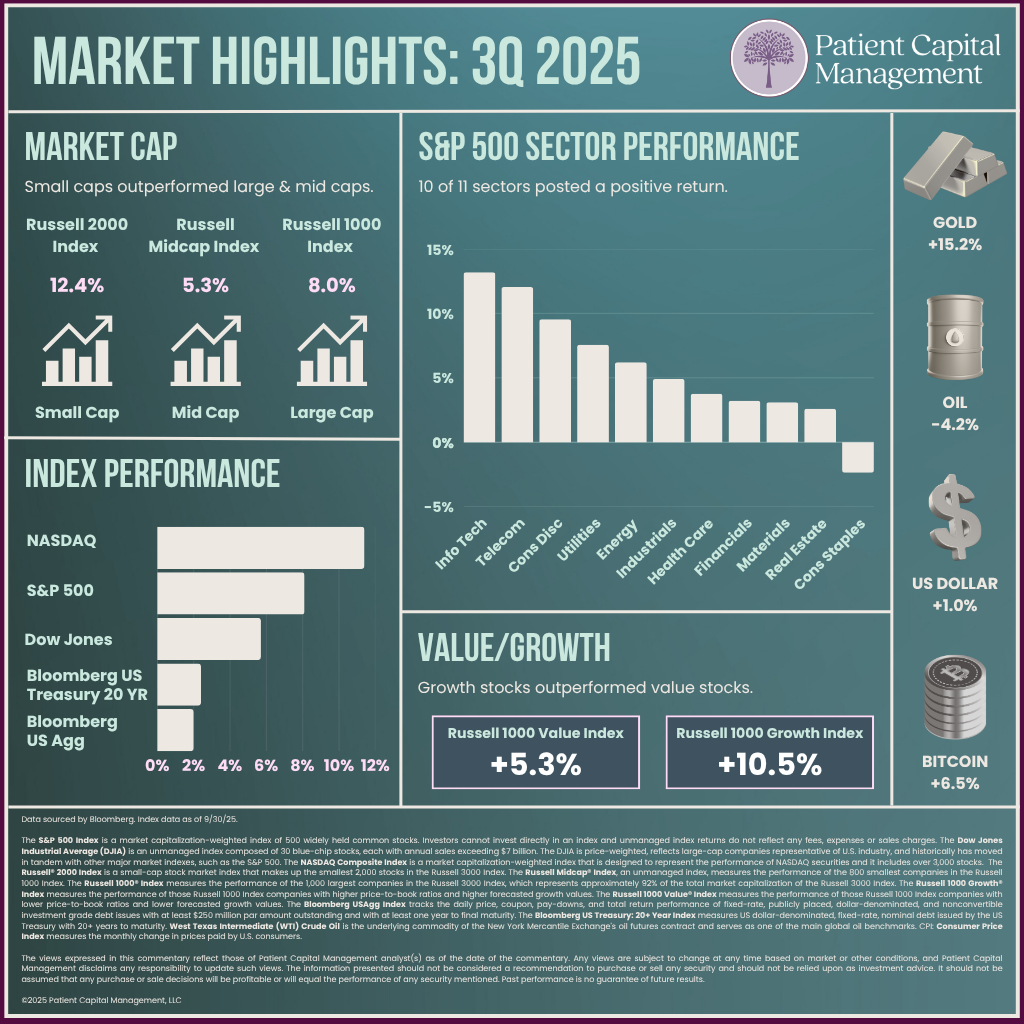
- Sector Rotation: 10 sectors in the S&P 500 posted gains, with Information Technology (+13.2%) and Telecommunications (+12.0%) leading for two consecutive quarters; Consumer Staples (-2.4%) was the worst performer. Small-cap stocks (Russell 2000 +12.4%) continued to outperform large- and mid-caps, while growth stocks significantly outperformed value stocks.
Companies/Assets Involved
- Indices/Assets: Nasdaq Composite Index (bullish, quarterly leader +11.4%), S&P 500 (bullish, +8.1%), Dow Jones (bullish, +5.7%), Russell 2000 (bullish, small-cap leader +12.4%), Russell 1000 Growth (bullish, +10.5%), Russell 1000 Value (neutral, +5.3%), Bloomberg Aggregate Bond Index (neutral, +2.0%), Long-Term U.S. Treasuries (neutral, +2.4%), Gold (strongly bullish, +42.6% YTD), WTI Crude Oil (bearish, -13.0% YTD), Bitcoin (bullish, August high of 123.0k).
- No specific companies mentioned, only sectors: Information Technology, Telecommunications (bullish), Consumer Staples (bearish).
Investment Implications
- Continue favoring growth and small-cap stocks in the near term: Expectations of rate cuts and sustained AI capital expenditure continue to support the Information Technology and Telecommunications sectors, while small-cap stocks show greater resilience in a declining rate environment.
- Watch for the divergence between consumer confidence and spending data: Consumer confidence is at historically extreme lows. If retail sales slow in the future, it could trigger a market correction. Consider defensive opportunities in the Consumer Staples sector (currently the worst performer, potentially already overreacted).
- Gold remains the preferred safe haven: With a YTD gain of 42.6%, a weakening U.S. dollar and the rate-cutting cycle continue to support gold prices. Crude oil and Bitcoin exhibit high volatility and require cautious allocation.
- Bonds offer limited appeal: Despite the tailwind from rate cuts, bond returns (2.0%-2.4%) significantly lag stocks. Long-term U.S. Treasuries only slightly outperformed the aggregate bond index; a yield curve steepening trade may be more attractive.