1Q24 Portfolio Activity and Attribution
Patient Capital Management is a Baltimore asset manager founded in 2020 by Samantha McLemore, CFA — Bill Miller's long-time co-manager (working together since 2002, running the flagship Opportunity Equity strategy since 2014). Continuing the Miller-school contrarian tradition, it practices "time arbitrage": exploiting behavioral mispricing to concentrate in controversial growth names (tech, healthcare, Bitcoin-related) at deep discounts to intrinsic value. Its site preserves Bill Miller's complete 1995-2022 market letters, alongside ongoing quarterly letters and webinars.
In plain words
This report says the ‘Magnificent 7’ tech giants (like Google, Amazon, Meta, Nvidia) are not a bubble. For example, Google’s stock price implies only 4% annual revenue growth for 20 years, far below its past 20%—so it’s cheap, not overpriced. Nvidia’s profit grew faster than its stock price, making it cheaper despite a 230% market value jump. The takeaway: don’t panic about a bubble; patient investors might find opportunities. Also, Biogen (a biotech firm) has a good risk-reward if its new Alzheimer’s drug takes off. Worth reading because it’s data-driven, not hype.
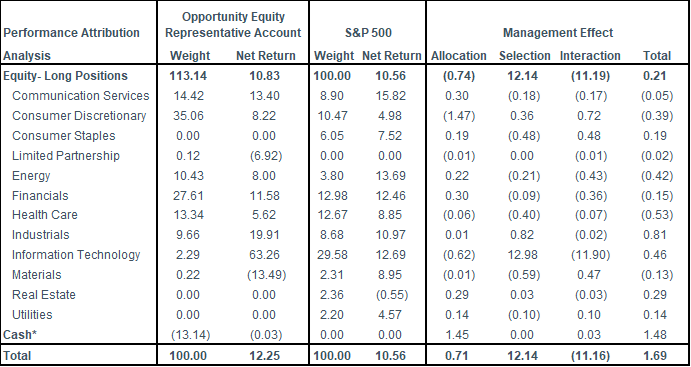
Patient Capital’s Patient Opportunity Equity Strategy delivered a net return of 11.8% in the first quarter of 2024, outperforming the S&P 500 Index’s 10.6%. The core view is that despite market buzz about a bubble in the “Magnificent 7,” the report argues that these companies have strong fundamental
Theme and Background
This chapter reviews the performance and portfolio adjustments of the Patient Opportunity Equity Strategy in the first quarter of 2024. The report focuses on the debate over whether the "Magnificent 7" is experiencing a bubble and analyzes the performance of the portfolio's main contributors and detractors.
Core Viewpoint
The report explicitly refutes the prevailing market view that the "Magnificent 7" is in a bubble. The author argues that these companies have extremely strong fundamentals, and the growth expectations implied by their current valuations are not high, far from bubble levels. For example, Alphabet's valuation implies a 20-year revenue compound annual growth rate (CAGR) of only 4%, barely above inflation.
Key Arguments and Data
- Performance: The strategy delivered a net return of 11.8%, outperforming the S&P 500 index's 10.6%. Excess returns were primarily driven by stock selection and allocation effects, partially offset by interaction effects.
- "Magnificent 7" Fundamentals: Over the past decade, this group of companies has averaged revenue, EPS, and free cash flow CAGRs of 24%, 33%, and 41%, respectively, with return on invested capital (ROIC) more than doubling.
- Valuation-Implied Growth:
- Alphabet: Current valuation implies a 20-year revenue CAGR of 4% (assuming current margins), only slightly above inflation.
- Amazon: Valuation implies 20-year revenue growth of 7% (assuming a long-term margin of 12%), which the author considers low, as e-commerce and cloud migration are still in early stages.
- Meta: Valuation implies 20-year growth of 7% (at current margins), consistent with short-term expectations for digital advertising growth.
- Nvidia: Valuation implies 20-year growth of 15% (dropping to 12% if using FY25 as the base year). The author believes Nvidia is more akin to Microsoft than Cisco.
- Nvidia Valuation Change: As of March 31, 2023, the market consensus valuation was 61x forward EPS; it is now 37x. Despite a 230% surge in market capitalization to $2.3 trillion over the past year, the valuation has actually declined because earnings have grown faster (revenue, EPS, and FCF grew by 126%, 392%, and 610%, respectively).
- Bitcoin ETF Impact: 11 new spot Bitcoin ETFs were approved, with AUM growing to $55 billion in a single quarter. Coinbase, as a beneficiary, is seen as building the infrastructure for the crypto ecosystem.
- Portfolio Concentration: The top ten holdings account for 49% of assets (compared to 32.2% for the index), with an active share of approximately 98%.
Companies/Assets Involved
| Company/Asset | Role | Key Data | Viewpoint |
|---|---|---|---|
| Meta Platforms (META) | Largest contributor | Net contribution of 151 bps, up 37.5% in Q1; increased buybacks by $50 billion (6.4% of float), initiated a dividend of $0.50/share (yield 0.39%); trades at 25x this year's earnings | Bullish: Strong advertising leadership, under-monetized Reels, high-quality AI assets, robust capital returns |
| Nvidia (NVDA) | New position, second-largest contributor | Net contribution of 133 bps; 92% market share in data center GPUs; revenue/profit/FCF growth of 126%/392%/610%; valuation fell from 61x to 37x forward EPS | Bullish: CUDA software moat, AI-driven demand, earnings growth outpacing valuation expansion |
| Citigroup (C) | Third-largest contributor | Net contribution of 131 bps | Bullish (not elaborated in detail) |
| Crocs (CROX) | Fourth-largest contributor | Net contribution of 123 bps | Bullish (not elaborated in detail) |
| Amazon (AMZN) | Fifth-largest contributor | Net contribution of 118 bps; valuation implies 20-year revenue CAGR of 7% (assuming 12% long-term margin) | Bullish: E-commerce and cloud migration still in early stages, growth expectations are low |
| Alphabet (GOOGL) | Beneficiary in holdings | Valuation implies 20-year revenue CAGR of 4% | Bullish: Growth expectations only slightly above inflation, not a bubble |
| Coinbase (COIN) | Beneficiary of Bitcoin ETFs | AUM grew to $55 billion | Bullish: Platform for the crypto ecosystem, widening moat |
| Biogen (BIIB) | New position, one of the largest detractors | Net contribution of -31 bps; new CEO appointed, Leqembi approved but rollout slow | Bullish: Asymmetric risk-reward; current valuation reflects only existing asset value; Leqembi and pipeline serve as call options |
| Expedia (EXPE) | Largest detractor | Net contribution of -72 bps | No clear viewpoint |
| Peloton (PTON) | Second-largest detractor | Net contribution of -66 bps | No clear viewpoint |
| Sofi Technologies (SOFI) | Third-largest detractor | Net contribution of -62 bps | No clear viewpoint |
| Kosmos Energy (KOS) | Fifth-largest detractor | Net contribution of -29 bps | No clear viewpoint |
| Cleveland-Cliffs (CLF) | Liquidated | Used as a source of funds | Sold |
| Coinbase 3.375% Notes 2028 | Liquidated | Used as a source of funds | Sold |
| 2U Inc. Convertible Notes 2025 | Liquidated | Exited | Sold |
Investment Implications
- Continue overweighting high-quality names in the "Magnificent 7": The report believes market concerns about a bubble are overblown. The growth expectations implied by the valuations of Alphabet, Meta, Amazon, and Nvidia are reasonable or even low, and their fundamentals are strong. The report recommends continuing to hold or add to these positions.
- Focus on Nvidia's valuation-earnings mismatch: Despite a surge in market cap, the valuation has declined due to faster earnings growth. The current 37x forward EPS provides a margin of safety, with the CUDA moat and AI demand supporting long-term growth.
- Leverage Biogen's asymmetric risk-reward: The current stock price reflects only the value of existing assets. The rollout of Leqembi and pipeline progress offer upside optionality, making it suitable for patient investors.
- Be cautious of detractors: Expedia, Peloton, Sofi, and others have underperformed. The report advises monitoring changes in their fundamentals but does not explicitly recommend selling.
Theme and Background
This chapter focuses on the specific portfolio performance of the Patient Capital Opportunity Equity strategy in the first quarter of 2024, providing a detailed analysis of the top five contributors and the top five detractors. The report explains why these companies became key drivers of quarterly performance through dimensions such as individual stock fundamentals, valuations, and strategic transformations.
Core Views
The author believes that despite market skepticism about certain holdings, the core positions in the portfolio (such as Nvidia and Citigroup) have strong fundamentals, with their stock price increases supported by solid earnings performance. For the underperforming positions (such as Peloton and Expedia), the author argues that their value lies in high-retention subscription businesses or shareholder return programs already underway, with current valuations reflecting risks and presenting opportunities for a turnaround or acquisition. The overall assessment is that both the "winners" and "losers" in the portfolio are based on deep fundamental analysis rather than short-term market sentiment.
Key Arguments and Data
- Nvidia (NVDA): Quarterly gain of 82.5%, with a 242% increase over the past year. Key data supporting the valuation: revenue growth of 126% over the past year, EPS growth of 392%, and free cash flow growth of 610%. The report emphasizes that its GPU market position is reinforced by the proprietary software CUDA, and despite intensifying competition, it is expected to maintain a leading market share.
- Citigroup (C): Quarterly gain of 24.1%, extending the rally from the fourth quarter. Key target: achieving a return on tangible common equity (ROTCE) of 11-12% by 2026. As of early March, 70% of business exits had been completed, and management layers had been reduced by a quarter. The report expresses high confidence in achieving this target and notes that if the Basel III capital proposal is revised, shareholder returns could increase significantly.
- Expedia (EXPE): Quarterly decline of 9.3%, giving back some of the gains from the fourth quarter. Key actions: completing a technology transformation, launching a unified loyalty program, and restarting advertising investments. In November 2023, a $5 billion share buyback program was initiated (representing 26% of outstanding shares), with 11% of shares already repurchased over the past year.
- Peloton (PTON): Quarterly decline, hitting its lowest valuation since going public by the end of March. Key actions: cutting cost structures and expanding sales channels (Amazon, Dick's Sporting Goods). The report believes the business value lies in its high-margin, high-retention subscription segment, and at current valuations, it either successfully transforms or becomes an acquisition target.
- Sofi Technologies (SOFI): Quarterly decline, despite strong fourth-quarter results and 2024 guidance. Key data: deposit growth of $2 billion per quarter, with an average customer FICO score of 749 (prime/super-prime customers). The report views the company as being in the early stages of its lifecycle, still a small player in a massive total addressable market (TAM).
Companies/Assets Involved
| Company/Asset | Role | Key Data | Bullish/Bearish |
|---|---|---|---|
| Nvidia (NVDA) | Top Contributor | Quarterly +82.5%, Annual Revenue +126%, EPS +392%, FCF +610% | Bullish |
| Citigroup (C) | Contributor | Quarterly +24.1%, Target ROTCE 11-12% by 2026, Business Exits 70% Complete | Bullish |
| Expedia (EXPE) | Detractor | Quarterly -9.3%, $5B Buyback Program (26% of Outstanding Shares), 11% Repurchased | Bullish (Awaiting Market Recognition) |
| Peloton (PTON) | Detractor | Quarterly Decline, Hit Lowest Valuation Since IPO | Bullish (Subscription Value + M&A Potential) |
| Sofi Technologies (SOFI) | Detractor | Quarterly Decline, Deposit Growth of $2B per Quarter, Average FICO 749 | Bullish (Early-Stage High Growth) |
Investment Insights
- Nvidia: Despite significant stock price appreciation, earnings growth (revenue +126%, FCF +610%) far outpaces the stock price increase, and the valuation remains supported. Investors should focus on its CUDA ecosystem moat and sustained AI demand, rather than short-term competitive intensification.
- Citigroup: Restructuring progress is clear (70% business exits completed, management layers reduced by a quarter). If the ROTCE target is achieved, the valuation has room for re-rating. Monitor changes to the Basel III capital proposal, which could trigger additional shareholder returns.
- Expedia: Technology transformation completed plus a massive buyback (26% of outstanding shares). The current decline is a digestion period, with fundamental improvements not yet priced in by the market. Investors can wait for valuation recovery after execution is validated.
- Peloton: Valuation has fallen to its lowest since IPO, but the high-margin subscription business provides a safety net. If the turnaround fails, an acquisition premium may offer downside protection. Investors with higher risk tolerance can watch for distressed reversal opportunities.
- Sofi: Deposit growth is strong ($2B per quarter), focusing on prime customers (FICO 749), with market share increasing in the digital banking space. The current decline reflects volatility typical of early-stage growth stocks, while the long-term TAM remains enormous.
Theme and Background
This chapter focuses on the valuation debate surrounding the "Magnificent 7" components (Alphabet, Amazon, Meta, Nvidia) within the Patient Capital portfolio. The report refutes the widespread market concern that these stocks are in a bubble, arguing that their current valuations do not excessively reflect future growth potential.
Core Thesis
The report's central judgment is: The "Magnificent 7" is not a bubble. The author believes that the market's growth expectations for these tech giants are underestimated, with their implied long-term growth rates far below historical performance, making current valuations reasonable or even low. This is a contrarian view against market consensus—many investors worry that the AI boom has led to overvaluation, but the report points out that fundamental data does not support the bubble theory.
Key Arguments and Data
- Alphabet: The report notes that the market implies Alphabet's revenue compound annual growth rate (CAGR) over the next 20 years is only 4%. Compared to its actual revenue CAGR of approximately 20% over the past five years, this implied growth rate is extremely low, meaning the market has not fully priced in the potential growth of its AI-driven search, cloud computing, and other businesses.
- Meta: Similarly, Meta's implied long-term growth rate is also far below its historical performance. The report does not provide specific figures but emphasizes that its advertising business and AI investments (e.g., Reels, Llama models) have not been fully reflected in its valuation.
- Amazon: The market's implied growth rate for Amazon is also conservative, particularly as the high-margin growth of AWS cloud computing and advertising businesses has not been fully accounted for.
- Nvidia: Despite Nvidia's significant stock price increase, the report argues that the explosive growth in demand for its AI chips (e.g., H100, B100) has not yet been fully priced in. Nvidia's implied growth rate remains below its actual order growth rate.
Comparative Data (Based on the Report's Implied Logic):
| Company | Market Implied 20-Year Revenue CAGR | Actual 5-Year Revenue CAGR | Valuation Reasonableness Judgment |
|---|---|---|---|
| Alphabet | Approximately 4% | Approximately 20% | Undervalued |
| Meta | Below historical levels | Approximately 25% (2020-2023) | Undervalued |
| Amazon | Below historical levels | Approximately 22% (2019-2023) | Undervalued |
| Nvidia | Below actual order growth rate | Approximately 50%+ (2023-2024) | Undervalued |
Companies/Assets Involved
- Alphabet: Bullish. The report argues its implied growth rate is only 4%, far below historical levels, with AI search and cloud businesses undervalued.
- Meta: Bullish. Its advertising business and AI investments (Reels, Llama) are not fully priced in.
- Amazon: Bullish. The high-margin growth of AWS and advertising businesses is undervalued by the market.
- Nvidia: Bullish. AI chip demand is exploding, and the implied growth rate is below actual order growth.
Investment Implications
- Direction: Continue to hold or increase positions in Alphabet, Meta, Amazon, and Nvidia among the "Magnificent 7." The report believes the market's growth expectations for them are overly conservative, especially the long-term potential of AI-related businesses (search, cloud, advertising, chips) has not been priced in.
- Risk Warning: If market sentiment shifts (e.g., an AI bubble burst or regulatory tightening), these stocks could face a pullback. However, the report argues that fundamental data does not support the current situation being a bubble, so a pullback would instead be an opportunity to add positions.
- Actionable Advice: Investors should ignore short-term market noise (e.g., "bubble" discussions) and take contrarian positions based on the gap between implied growth rates and historical data.