Fertilizers
In plain words
This piece breaks down the fertilizer industry into three very different businesses: nitrogen, phosphate, and potash. Kopernik thinks the market often mistakes temporary weakness for permanent trouble, creating opportunities. Key holdings: Nutrien (world's largest potash producer), K+S (Europe's top potash producer, sold its salt business to fund a mine), Mosaic (largest US phosphate producer), and BHP (building the only major new potash mine, but with high costs and low expected returns).
Kopernik's research report focuses on the fertilizer industry, interpreted by analyst Taylor McKenna, CFA. The report's core argument is that nitrogen, phosphate, and potash fertilizers are three distinct businesses, each with different supply chains, cost structures, and price drivers. Nitrogen fer
Introduction: Fertilizer Industry Overview
Kopernik analyst Taylor McKenna, CFA opens the report by noting that fertilizers are often discussed as a single category, but nitrogen, phosphate, and potash are three distinct businesses, each with different supply chains, cost structures, and price drivers.
Fundamental Differences Among the Three Fertilizers
Nitrogen fertilizer is an essential nutrient for promoting crop growth and increasing yields. The atmosphere is 78% nitrogen, but it must be combined with hydrogen (primarily sourced from methane/natural gas) to be converted into fertilizer. Therefore, the nitrogen fertilizer industry is essentially a chemical conversion business highly correlated with natural gas prices. Major producers include China, the United States, Russia, and the Middle East (Saudi Arabia, Qatar). Although natural gas and atmospheric nitrogen are widely available, conversion requires capital-intensive processing plants, reliable gas sources, and distribution infrastructure.
Phosphate fertilizer promotes root growth, disease resistance, and flowering/seed production. Synthetic phosphate fertilizer requires mining phosphate rock, which is then treated with sulfuric acid to produce diammonium phosphate (DAP) or monoammonium phosphate (MAP). China is the largest producer; Morocco holds the world's largest reserves and is the second-largest producer. The United States, Russia, and Jordan also have significant reserves and production.
Potash fertilizer (typically muriate of potash/MOP) is extracted by mining potassium-bearing ore. Potassium helps plants manage water and stress, supporting root development and overall vigor. Unlike nitrogen and phosphorus, potash is a commodity mining business that does not require extensive chemical processing. Many potash deposits are buried deep underground, requiring enormous capital and years of development, but existing mines can operate for decades, with some reserves and resources measured in centuries.
The Critical Importance of Fertilizers and Demand Logic
A lack of nitrogen, phosphorus, and potassium significantly reduces crop yields — one study shows that completely eliminating fertilizer use can reduce wheat and corn yields by 81% and 84%, respectively. Organic alternatives (manure, compost, bone meal, etc.) exist, but their nutrient concentrations vary, they are bulky, difficult to transport, and challenging to apply at scale.
The three fertilizers are not interchangeable (crops require all three), but they compete within farmers' budgets. Farmers make decisions based on soil needs, working capital, and crop selling prices. A 2026 American Farm Bureau Federation survey found that 70% of U.S. farmers cannot afford to purchase all the fertilizer they need for the current season.
Long-term demand tracks planted acreage, crop mix, and yields, influenced by population growth, dietary changes, and arable land area — trends that are slow and steady.
Differences in Demand Timing Elasticity
- Nitrogen fertilizer: Essential each season; can be applied in stages or precisely. When prices spike sharply, application can be delayed or slightly reduced, but it remains a necessity.
- Phosphate and potash fertilizers: Can be stored in the soil to some extent, giving farmers more flexibility in timing — they can skip a season when prices surge. However, skipping merely borrows from the soil; it is not true demand destruction, and going multiple consecutive growing seasons without applying phosphate or potash is unsustainable.
At cycle troughs, the market often mistakes short-term demand weakness as permanent, but this demand is merely deferred.
Regional Demand Growth Potential
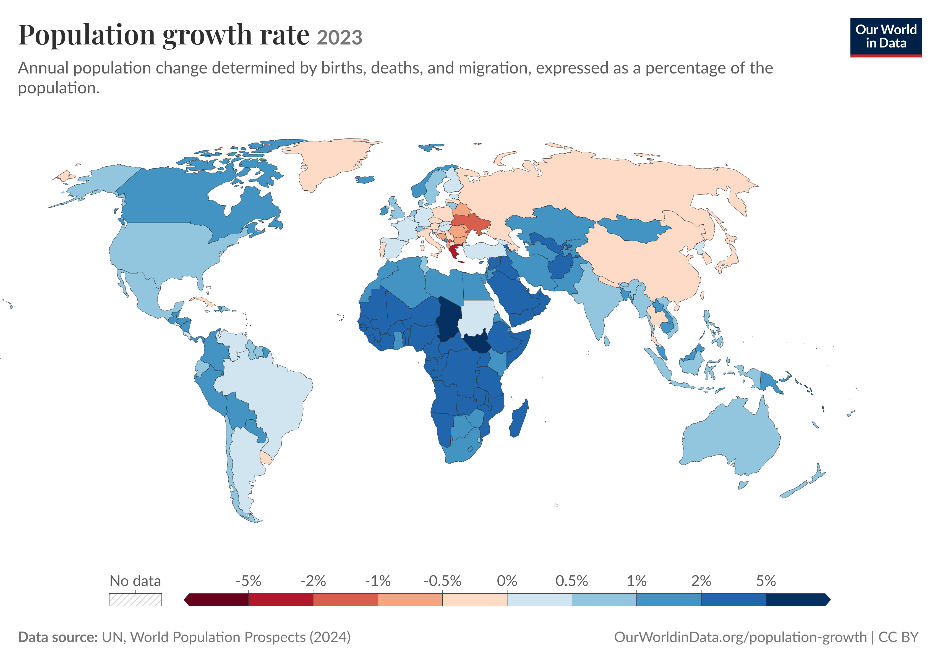
The strongest demand growth regions are likely areas with historically low fertilizer application, where farmers are shifting toward balanced nutrition. Large emerging markets such as China, Brazil, and India already apply more fertilizer than developed markets, but nuances exist:
- India: Excessive nitrogen but insufficient potash (nitrogen is heavily subsidized, making urea cheap and readily available, leading to soil nutrient imbalance and degradation)
- Brazil: Two growing seasons increase fertilizer usage
- China: Geographic diversity leads to significant crop and regional variation
Global arable land per capita continues to decline, with population growing while arable land area does not increase. The regions with the lowest fertilizer application are precisely those with the strongest population growth: Sub-Saharan Africa and northwestern South America. As these regions experience population growth and rising food demand, fertilizer usage is likely to increase.
Supply Dynamics and Bottlenecks
Nitrogen fertilizer: Closely tied to natural gas prices (when the March 2026 U.S.-Iran war closed the Strait of Hormuz and damaged Qatari gas fields, nitrogen-based product prices surged 30%-40%). Natural gas is not scarce, and atmospheric nitrogen is virtually unlimited, so nitrogen fertilizer supply is essentially unconstrained.
Phosphate fertilizer: Supply is exceptionally concentrated. Morocco controls approximately 68% of global reserves. China is a major producer but consumes nearly all of its output domestically. Concentration risk exists — Morocco could theoretically increase supply but has historically maintained discipline to avoid flooding the market. Phosphate supply also depends on chemical inputs like sulfuric acid, whose price is linked to oil refining, creating an additional connection between fertilizer economics and energy markets.
Potash fertilizer: Constrained by project economics and engineering. New greenfield potash capacity takes nearly a decade to come online, with capital requirements often exceeding $3 billion per million tons of annual capacity. BHP's Jansen project is the only potash mine under construction, with Phase 1 and Phase 2 expected to provide approximately 8.5 million tons of annual capacity (roughly 10% of the global market), but combined capital expenditure has already risen to approximately $15.5 billion. At BHP's assumed prices, Phase 1's expected return is only 7.9%-9.1%, below Kopernik's preferred 15% threshold. At consensus prices of $350-$400/ton, project economics do not hold. BHP may still proceed, as it views potash alongside copper as a commodity with rising long-term demand.
Common to all fertilizers: Meaningful new supply cannot be brought online overnight. Potash and phosphate require high prices to justify building large mines; nitrogen expansion depends on natural gas costs, capital-intensive plants, and distribution infrastructure. The supply cycle is typical: high prices encourage investment → new supply comes online → prices fall → investment slows.
Stock Selection Criteria and Holdings
Kopernik seeks opportunities that often emerge near cycle troughs: when supply is anticipated, demand disappoints, and investors extrapolate current conditions as permanent. As of September 2026, holdings include:
| Position | Key Assets/Positioning |
|---|---|
| Nutrien Ltd. | World's largest integrated potash producer; six Saskatchewan potash mines; large nitrogen network; marketing and logistics platform |
| K+S AG | German company, Europe's largest potash producer; operates large mines in Germany and Canada |
| Mosaic Co. | Headquartered in Florida, the largest U.S. phosphate producer and a major potash producer |
| BHP Group Ltd. | One of the world's largest diversified mining companies; Jansen project is the only major potash project under construction globally |
K+S is a case study in sound capital allocation: during the last cycle trough, its Canadian potash mine project faced cost overruns, and the market widely believed the project should be sold. The company chose to sell its profitable salt business, using the proceeds to complete the potash mine investment and repay debt. When potash prices recovered, the company had an operational potash mine and a strong balance sheet.
Risks and Valuation Perspective
Fertilizer companies are affected by multiple factors: crop prices, weather, trade policy, geopolitics, environmental regulations, shipping routes, and input costs. Company-specific risks include tight balance sheets, persistently high costs, or poor management responses to the cycle.
Kopernik does not attempt to avoid these risks but requires excess compensation for potential downside risks. The market tends to treat temporary conditions as permanent: at cycle troughs, weak crop prices, delayed farmer purchases, excess inventories, or new capacity depress current earnings, making quality assets appear unattractive; the opposite occurs at cycle peaks.
Potash and phosphate producers own long-life reserves and resources, with mine lives sometimes approaching a century, giving them value far beyond what traditional DCF models can capture, along with option value from significant price increases. Nitrogen producers lack the same reserve optionality, but advantaged gas sources, efficient conversion plants, and well-positioned distribution networks can support cross-cycle economics.
Fertilizer prices do not move in a straight line, and not all producers benefit equally. But nitrogen, phosphorus, and potassium are indispensable for maintaining crop yields, and the assets and infrastructure required to produce these essential products are costly, slow to develop, and difficult to replicate. Periods of weak demand or compressed margins obscure these realities, especially for investors who do not think long-term. Kopernik seeks to identify companies whose long-term value the market fails to recognize during uncomfortable phases of the cycle.