Seinfeld
Worldly Partners is a research-intensive, ultra-concentrated investment partnership founded by Arvind Navaratnam in 2020 near Boston, applying a Munger-style multi-decade approach. It is known for deep business-history studies of long-term compounders like IKEA, Mars, and TSMC.
In plain words
This article uses the unlikely success of Seinfeld—from a poorly received pilot to one of TV's most lucrative assets—to make an investment point: unconventional ideas can create enormous long-term value when they get key support and the right scheduling. The piece is optimistic. The show itself has generated more than $4 billion from reruns and licensing; Netflix paid over $500 million in 2019 for global streaming rights; and NBC profited from Thursday-night ads—the 1998 finale sold 30-second spots for $2 million, 54% more than that year's Super Bowl ads.
At a Glance
One-sentence summary: This report uses the trajectory of Seinfeld—from a disastrous pilot to becoming the most profitable television asset in history—to argue that "niche creativity + key support + strategic scheduling" can generate enormous long-term value, with a [Bullish] stance.
- The total production cost of Seinfeld was approximately $135 million, but it subsequently generated an estimated $4–5 billion in revenue from reruns, syndication, and licensing, demonstrating a remarkable leverage effect.
- The 1998 series finale attracted approximately 76.3 million viewers, with a 30-second ad selling for $2 million—54% more expensive than a Super Bowl ad in the same year.
- In 2019, Netflix acquired global streaming rights for over $500 million (roughly $3 million per episode), far exceeding Hulu's previous $130 million deal for U.S. rights.
- Jerry Seinfeld, with a 15% profit stake in the show and ongoing monetization, had a net worth of approximately $1.1 billion as of 2026, while Larry David, holding an equal stake, had a net worth of less than $400 million due to divorce and differences in income structure.
- A comparative case, Curb Your Enthusiasm, failed in traditional television syndication, highlighting the enormous uncertainty in the commercial value of content assets.
Position Moves
| Ticker | Direction | Entry Price | Current Price | Position Size | Rationale |
|---|---|---|---|---|---|
| N/A | N/A | N/A | N/A | N/A | N/A |
Investment Implications
- The report believes that the Seinfeld case validates the long-term value of "non-mainstream" content assets. The show's initial pilot was rated "worst of the season" by NBC executives, yet it ultimately became the highest-grossing comedy in television history. This suggests that investors should pay attention to content assets with unique creative visions, especially those that receive early support from key decision-makers (e.g., NBC executive Rick Ludwin, who allocated $13 million in budget for the pilot).
- The report argues that the "syndication + streaming" dual model is the core driver of content asset value. Seinfeld generated over $3 billion from traditional syndication and an additional $500 million+ from streaming rights. This implies that content assets with strong repeat-viewing value and cultural penetration may have significantly higher long-term cash flow potential than the market currently prices in.
- The report warns that the commercial value of content assets is highly uncertain. The failure of Curb Your Enthusiasm in syndication shows that even works by the same creative team can have vastly different outcomes. Therefore, investors should avoid over-relying on "star effect" and instead focus on the content's structural repeatability and cross-generational appeal.
- The report notes that the personal wealth disparity between Jerry Seinfeld and Larry David highlights the importance of income structure and asset protection. Despite holding equal profit shares, the two have a net worth gap of over $700 million, mainly due to differences in divorce settlements and income diversification. This suggests that when evaluating content asset investments, attention should be paid to the stability of the revenue distribution mechanism and the impact of personal financial management on asset value.
1. Failed Pilot, Saved by Internal Support
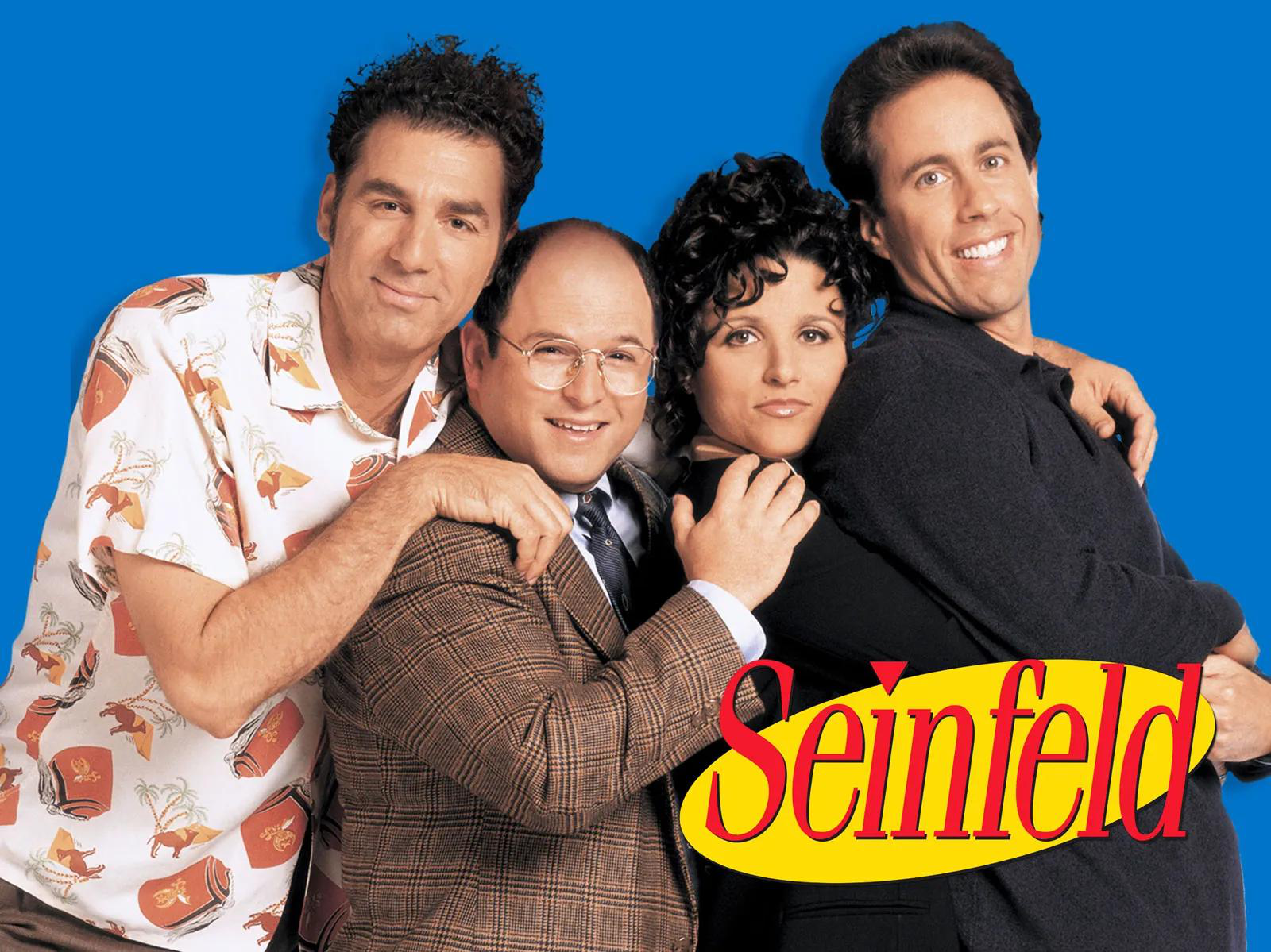
The 1989 pilot of Seinfeld scored extremely poorly in audience testing, leading NBC to initially abandon it, but executive Rick Ludwin funded four episodes from his own budget, giving the show a second chance. The pilot, The Seinfeld Chronicles, aired in July 1989 and received terrible audience test results. One research report complained that "it’s hard to get excited about two guys going to the Laundromat." Jerry Seinfeld himself recalled that "the report was really bad." NBC ultimately decided not to move forward with the series. The key turning point came from NBC executive Rick Ludwin, who heard objections that the show was "too New York…too Jewish," but disagreed: "I’m not from New York, I’m not Jewish, and I thought it was funny, so I thought it could work." Ludwin diverted funds from his own programming budget to finance the production of four additional episodes.
2. Schedule Adjustment Was the Ratings Breakthrough
In 1993, moving from Wednesdays at 9 p.m. to Thursdays at 9:30 p.m. (following Cheers), Seinfeld leaped from a cult show to a top-10 national hit. Early on, the show's ratings languished for a long time. In 2001, the Los Angeles Times described its ratings as having "languished." Producer Howard West was more direct: "We were nothing until [we got] the Thursday slot." After the move, the show entered the Nielsen top 10, beginning its transformation from a cult show into a television juggernaut. The author's original text states: "A major turning point came in 1993, when NBC moved Seinfeld from Wednesdays at 9 p.m., where it competed against ABC’s popular Home Improvement...to Thursdays at 9:30 p.m. following Cheers."
3. Creative Persistence and "Anti-Formula" Storytelling
The creators rejected NBC's pressure to become more "mainstream," insisting on a narrative style centered on mundane trivialities and unresolved conflicts, which ultimately became the show's hallmark. Initially described as "a show about nothing," Jerry Seinfeld clarified that their pitch to NBC was "a show about conversation." He explained: "in our show, we don’t resolve the problem. Sometimes things just get worse and then it is over. Sometimes it gets better. It’s more stimulating. We try to avoid familiar patterns." When NBC objected to the episode The Chinese Restaurant (which revolves almost entirely around waiting for a table), co-creator Larry David refused to change: "I’m going to do the same show. Nothing’s going to change." This creative stubbornness eventually became part of the show's identity.
4. From Ratings Success to Long-Term IP Asset
Seinfeld's commercial value far exceeded its initial NBC run, creating a decades-long economic life through syndication, cable television, home video, and streaming. In its later seasons, the show attracted over 30 million viewers per episode, with the finale estimated to have drawn 76 million viewers. It became the highest-rated show in the U.S. for the 1994-95 season and remained either 1st or 2nd thereafter. The 1997-98 season averaged 34.1 million viewers, ahead of ER (30.2 million), Veronica’s Closet (24.4 million), and Friends (24 million). The author quotes Viacom Chairman Sumner Redstone in 1998: "All the networks are nothing but distribution vehicles…Take away the hits and they lose money. People don’t watch distribution." The article concludes that the show evolved from a poorly tested NBC pilot into a lasting entertainment asset, capable of reaching new generations of viewers decades after its final episode aired.
Investment Implications
This article uses the Seinfeld case to argue the investment theme that "unconventional creative works can achieve a comeback through critical support and timely scheduling adjustments." The core takeaway: content that is initially overlooked (e.g., "too New York, too Jewish") requires patient nurturing and strategic scheduling, rather than reliance on immediate data-driven judgments. Institutional Perspective Bias: As investment research, this article may overemphasize the replicability of the "comeback" narrative, while neglecting that most failed projects do not receive similar critical internal support or scheduling opportunities.
1. The Seinfeld Finale Reached a Ratings Peak
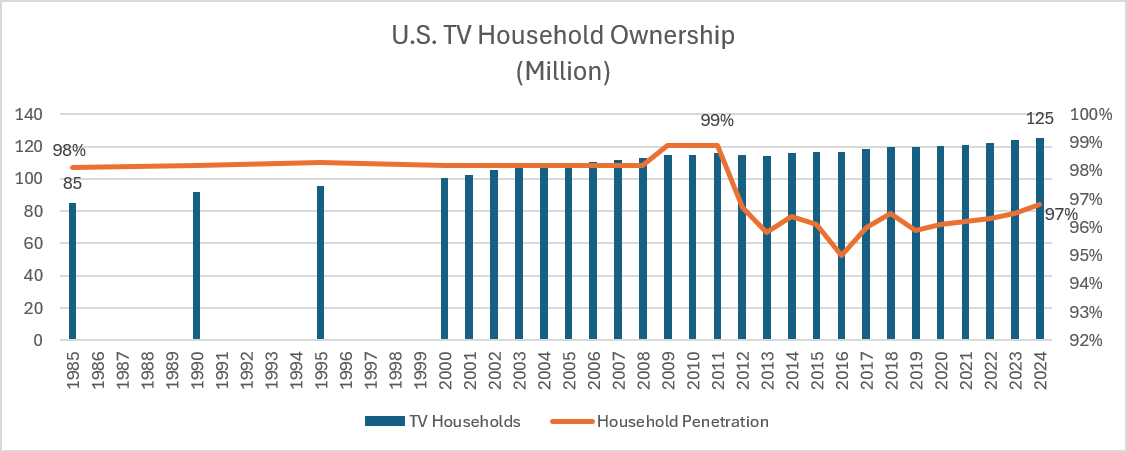
On May 14, 1998, the 75-minute Seinfeld finale attracted approximately 76.3 million viewers, achieving a Nielsen rating of 41.3 and a share of 58, making it the sixth-highest-rated entertainment program in U.S. television history (excluding the Super Bowl). If broader viewing beyond traditional Nielsen household measurement was included, NBC estimated that 133.9 million people watched at least six minutes of the finale. The author emphasizes that this scale must be understood within the context of the television market at the time: NBC was a free over-the-air broadcast network, and by 1990, U.S. household television penetration had already exceeded 98%. The number of TV households grew from approximately 92.1 million in 1990 to 95.4 million in 1995, surpassing 100 million by 2000—in other words, Seinfeld operated within a nearly ubiquitous medium.
2. Cable Television Expansion Intensified Audience Fragmentation
During Seinfeld's run, cable television penetration increased significantly, offering viewers an ever-growing number of competing channels and programs. Since TV ownership was already near saturation, the expansion of viewing options primarily fragmented the audience rather than expanding the total potential TV audience. Against this backdrop, the show's ability in its later seasons to attract over 30 million viewers on average became particularly valuable to broadcast networks such as NBC, whose economics depended heavily on advertising and therefore on their ability to aggregate large audiences for advertisers.
3. Advertising Prices Soared with Ratings, Finale Set a Record Price
NBC primarily monetized this audience concentration through advertising. As Seinfeld's ratings rose, so did the prices advertisers were willing to pay. Key data points are as follows:
| Year | 30-Second Ad Price | Notes |
|---|---|---|
| 1995 | ~$490,000 | Highest price for a regular series at the time |
| 1996 | ~$550,000 | Seinfeld and ER became the first regular primetime programs to generate ~$1 million in ad revenue per minute |
| 1997 | Over $1 million per minute | The Los Angeles Times called the show "NBC's gold mine," attracting over 30 million viewers weekly |
| 1998 Finale | Up to $2 million for a 30-second ad | ~54% higher than the $1.3 million for a 30-second Super Bowl ad in 1998 |
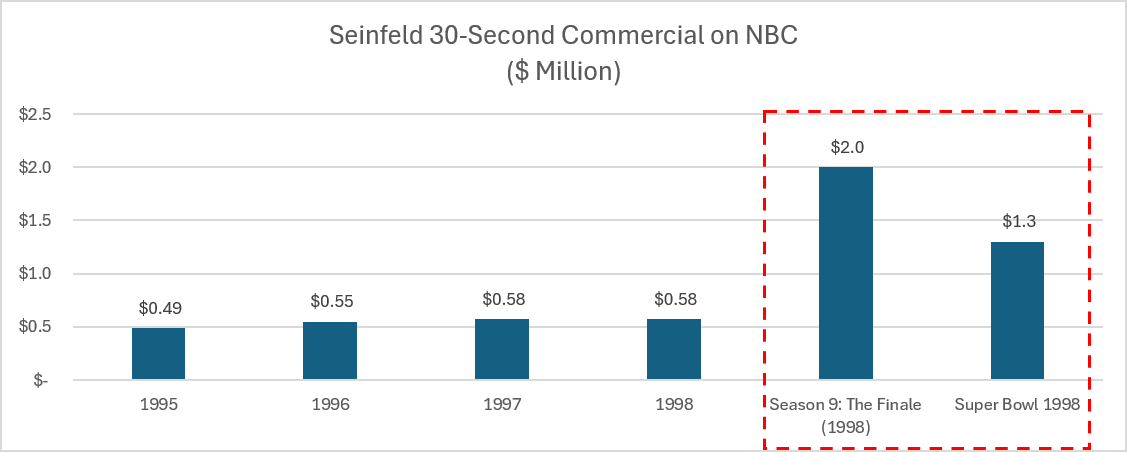
The author notes that the scarcity and audience anticipation for the finale pushed the economic effect to another level—a 30-second ad slot sold for $2 million, 54% more expensive than a Super Bowl ad.
Seinfeld's Strategic Value to NBC Extended Far Beyond Single-Episode Ad Revenue
The article points out that Seinfeld's value came not only from its own advertising revenue but also from its role as the cornerstone of NBC's "must-see TV" Thursday night lineup, providing a powerful audience base and program promotion platform for the entire time slot. The author's original text states: "Seinfeld anchored NBC’s Thursday-night lineup, historically one of television’s most valuable advertising nights." Advertisers were willing to pay a premium for Thursday programming because viewers were believed to be making consumption and entertainment decisions before the weekend. By 1997, The Washington Post called it "perhaps the most important show on television," and NBC built its Thursday lineup around it. Then-NBC President Warren Littlefield referred to Thursday as NBC's "Comedy Cape Canaveral," with Seinfeld as the launchpad.
The show's favorable audience demographics directly translated into advertising pricing power. In 1997, the Los Angeles Times noted that Seinfeld's total audience was only slightly more than double that of its competitor CBS's Diagnosis Murder, yet Seinfeld's ad prices were nearly ten times higher. The difference was partly due to audience composition: Seinfeld attracted younger viewers particularly valued by advertisers, while Diagnosis Murder's audience skewed heavily towards those over 65. That year, NBC's upfront advertising revenue was approximately $21.5 billion, about $900 million more than CBS's.
Production Costs Skyrocketed, but NBC Was Willing to Pay a Premium
Although Seinfeld's production costs set records, NBC deemed its strategic value far outweighed the budget. By the final season, Jerry Seinfeld became the first TV actor to earn over $1 million per episode, and the salaries of the other three main cast members were negotiated from ~$160,000 to $600,000 per episode. Production costs consequently rose to over $3 million per episode, which The Washington Post in 1997 called a record for a sitcom. For approximately 22 minutes of finished television programming, this was a substantial sum. However, the economics still worked in NBC's favor: it could charge premium ad rates around the show, use it to strengthen the entire Thursday night time slot's economics, and solidify its position as the leading broadcast network.
Jerry Seinfeld's own salary growth reflected the shift in bargaining power. His salary soared from approximately $20,000 per episode in the first season (1989) to $1 million per episode in the final season (1998), a compound annual growth rate of 54%. More strikingly, when Seinfeld decided to end the show, NBC offered him approximately $5 million per episode—over $100 million—to stay for another season. Then-NBC Entertainment President Warren Littlefield explained in a 2012 interview with Fox News: "We gave him a number that was unheard of… We went in with a staggering amount of money, confident no one could turn it down. He came to me and said, 'I have no life, I'm not married, I have no kids.' We gave it our all, he was tempted, but ultimately it was a decision about quality of life."
The Economics of Seinfeld: NBC Was Just One Layer of Value
The article emphasizes that NBC's original broadcast rights were just one layer in the show's value system, with the producer and distributor capturing greater value from long-term rerun rights. NBC paid for broadcast rights and collected ad revenue, but the show was produced by Castle Rock Entertainment (a Warner Bros. subsidiary), while Columbia TriStar (later part of Sony Pictures) handled syndication distribution. Once a show accumulated enough episodes and built a national audience, rerun rights became a valuable asset that could be licensed repeatedly without needing to be re-produced.
By 1998, Forbes estimated that Seinfeld had generated nearly $1.7 billion in profit over its nine-year run, calling it "the single most profitable entertainment property in history." The specific breakdown was as follows:
| Beneficiary | Estimated Profit |
|---|---|
| Castle Rock & Columbia TriStar | Nearly $1 billion |
| Jerry Seinfeld & Larry David | ~$500 million (plus over $100 million in production-related fees during the original run) |
| NBC | ~20%-40% of annual profit contribution (NBC's annual profit was ~$450 million) |
The article notes that the show's importance to NBC stemmed not only from the program's own profitability but also from the audience and pricing power it created for the entire Thursday night lineup. The author's original text states: "The economics of Seinfeld therefore extended far beyond its weekly television ratings." NBC benefited from advertising and the strategic value of the Thursday slot, while the producer, creators, and distributor captured enormous value from the show's long-term rerun rights.
1. Rerun Revenue Continued to Climb, Far Exceeding Contemporary Shows
Seinfeld's rerun revenue continued to grow for decades after its initial broadcast, accumulating over $4 billion. When it first entered the syndication market in 1995, the show was licensed to 224 local TV stations for over $3 million per episode; the second contract in 1998 (effective 2001) rose to approximately $6 million per episode, totaling about $1.1 billion over five years—nearly double the previous record of ~$600 million set by The Cosby Show. By 2010, rerun revenue was approximately $2.7 billion; by 2017, total revenue from reruns and related licensing was estimated to exceed $4 billion. The author's original text states: "Unlike most television properties, whose syndication value typically declines as they lose cultural relevance, Seinfeld remained highly valuable decades after its debut." In 2019, Viacom was reportedly willing to pay approximately $200,000 to $250,000 per episode for cable rights.
2. The Streaming Era: Netflix Acquired Global Rights for Over $500 Million
In 2019, Netflix agreed to pay over $500 million for the five-year global streaming rights to Seinfeld (starting in 2021), equating to approximately $3 million per episode. This price far exceeded Hulu's previous six-year U.S. streaming rights deal of ~$130 million (approximately $700,000 per episode). In announcing the deal, Netflix stated: "Seinfeld is the television comedy that all television comedy is measured against… It is as fresh and funny as ever, and will be available to the world in 4K for the first time." In 2026, Netflix renewed the deal for five years, with financial terms undisclosed. The article notes that classic sitcoms like Seinfeld, Friends, and The Office, due to their short episode formats, high rewatchability, and humor centered on everyday social behavior rather than specific historical events, possess cross-generational appeal. In 2018, The Office and Friends were watched for a combined 85 billion minutes on Netflix, equivalent to approximately 25 hours per subscriber.
3. Cross-Generational Audience and Enduring Reputation Support Commercial Value
Seinfeld's audience spans multiple generations from its original run to the present day, and its reputation remains strong. In the first half of 2026, Nielsen data showed the show reached approximately 60 million Americans through streaming and linear television, roughly 20% of the U.S. population. Data from 2021 indicated that 41% of viewers at that time were either toddlers or not yet born when the show ended in 1998. As of Q3 2026, the show ranked 47th on IMDb's Top 250 TV programs, having accumulated 81 awards and nearly 200 nominations, including recognition from the Emmys, Golden Globes, and the American Cinema Editors. The article concludes: This "show about nothing," more than 35 years after its debut, continues to exist simultaneously as a cultural landmark and a highly monetizable television asset.
$170 Million Production Cost Leveraged into $4-5 Billion in Revenue
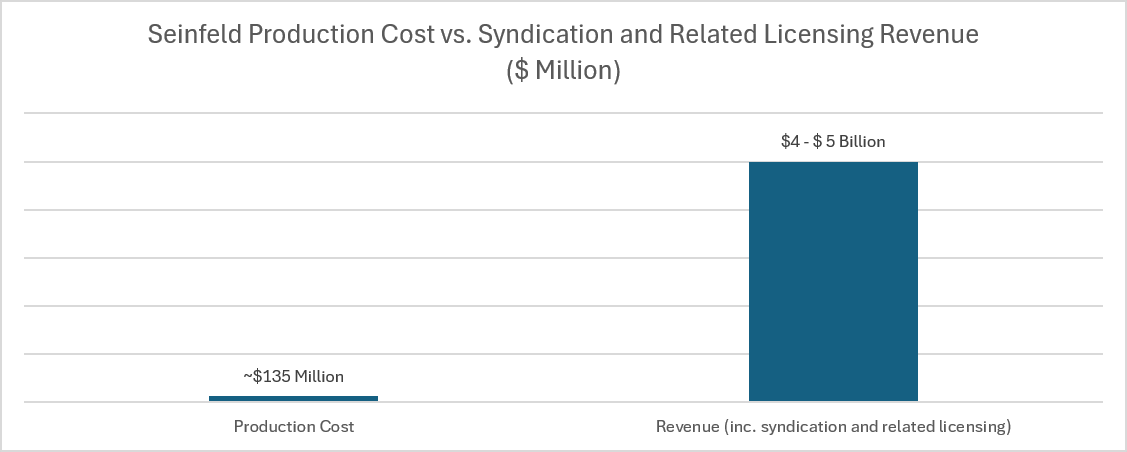
There is a significant leverage effect between Seinfeld's production costs and its subsequent revenue. The article notes that the show's per-episode production cost rose from approximately $750,000 in 1994 (per a 1994 Washington Post estimate) to about $3 million in its final season (a 1997 estimate). Using $750,000 as a rough median and multiplying by approximately 180 episodes yields a total production cost of at least $135 million. In contrast, the show subsequently generated an estimated $4-5 billion in cumulative revenue from reruns, syndication, and related licensing. The author's original text states: "Even on this rough basis, the production investment was small relative to the roughly $4-5 billion that Seinfeld has subsequently generated from reruns, syndication, and related licensing."
Jerry Seinfeld's Wealth: 15% Stake + Continuous Monetization
Jerry Seinfeld's billionaire status primarily derives from the show's syndication revenue. As of September 2026, Forbes estimated his net worth at approximately $1.1 billion. He and co-creator Larry David each hold a 15% stake in the show's profits. The initial cable and international distribution deals in 1998 were valued at approximately $1.7 billion, and subsequent television and streaming licenses have continued to generate revenue (cumulatively estimated at $4-5 billion by 2026, including the ~$500 million Netflix deal). Between 2016 and 2020, Seinfeld's annual income ranged from approximately $40 million to nearly $70 million.
Same Stake, Different Outcomes: Seinfeld vs. David
Despite holding the same 15% profit share, Larry David's net worth is significantly lower than Jerry Seinfeld's. Forbes estimated in 2024 that David's net worth was under $400 million, while Seinfeld's exceeded $1 billion. Two reasons account for the difference: first, David's 2007 divorce significantly reduced his wealth, which he summarized as "My wife got half of it," and his ex-wife is entitled to a share of ongoing income accumulated before the divorce; second, Seinfeld has continuously generated income through stand-up tours, Comedians in Cars Getting Coffee, and streaming deals, while David's production pace for Curb Your Enthusiasm has been slower, often with multi-year gaps.
Broadcast Model Determines Audience Size and Monetization Path
The economic differences between Seinfeld and Curb Your Enthusiasm are rooted in their different broadcast models. Seinfeld aired on NBC's free broadcast network, relying on advertising revenue. After moving to Thursdays in 1993, it regularly attracted approximately 30 million viewers, with the 1998 finale exceeding 70 million. In contrast, Curb Your Enthusiasm aired on HBO, a premium subscription network with no traditional advertising. In 2002, it averaged approximately 4-5 million viewers per episode; by 2009, this had fallen to about 1 million; the 2024 finale attracted only about 1.1 million on its premiere night (including replays). The article also reveals a historical detail: in 1995, when NBC only ordered 4 episodes for Seinfeld's first season, Seinfeld had the opportunity to move to a cable network willing to order 24 episodes, but he chose to stay with NBC, believing the show could succeed on broadcast television. Due to its smaller audience, Curb Your Enthusiasm's syndication performance was also far inferior—in 2009, Tribune acquired the show's three-year broadcast rights in an "all-barter deal," rather than a traditional cash licensing agreement.
Curb Your Enthusiasm's Syndication Failure Contrasts Sharply with Seinfeld
Curb Your Enthusiasm's television syndication attempt ended in failure, starkly contrasting with Seinfeld's enormous commercial success, though its subsequent streaming licenses continue to generate value.
- In 2010, Tribune Company acquired the syndication rights for Curb Your Enthusiasm and Entourage at a licensing fee of approximately $500,000 per episode. In exchange, Tribune provided HBO with 3 minutes of national advertising inventory per episode while retaining 4 minutes of local ad time.
- The arrangement performed poorly. By May 2011, roughly a year after syndication began, HBO asked its distribution partner Warner Bros. to pull both shows from syndication. The author notes: "Ratings had been weak, and stations increasingly moved the programs into later time slots, which further reduced their audiences." The resulting advertising revenue was evidently insufficient to justify distribution costs.
- This experience contrasts sharply with Seinfeld, whose reruns became one of the most commercially valuable syndicated television programs in history.
- However, Curb Your Enthusiasm continues to generate value through streaming and broader licensing arrangements. The show has since been available via Amazon Prime, HBO Max, and, in some markets, Netflix. However, these rights are typically included in broader HBO content licensing agreements, and publicly disclosed data does not assign a specific dollar value to Curb Your Enthusiasm itself. Therefore, unlike Seinfeld, no readily available public estimates exist for the cumulative syndication and licensing revenue generated by Curb Your Enthusiasm.
Investment Implications
This article, through the case of Curb Your Enthusiasm, demonstrates the enormous uncertainty in the commercial value of content assets. Works by the same creator (Larry David) performed vastly differently under the traditional television syndication model, while streaming-era licensing revenue is difficult to quantify individually due to bundled agreements. This reminds investors to be wary of the misleading nature of historical success stories when evaluating the long-term value of a single content IP and to recognize the decisive impact of business models (syndication vs. streaming) and distribution channels on monetization potential. Institutional Perspective Bias: As a research firm, Worldly Partners tends to emphasize the lack of data transparency and the complexity of business models, which is consistent with its own investment methodology focused on precise valuation.
Position Moves
| Instrument | Direction | Author's One-Sentence View | Key Data |
|---|---|---|---|
| Seinfeld | Hold & Observe | As a core case of "non-mainstream creative turnaround," its long-term IP value is highly affirmed. | Total production cost approx. $135 million, cumulative revenue approx. $4–5 billion; Netflix acquired global streaming rights for over $500 million in 2019. |
| Jerry Seinfeld | Hold & Observe | Became a billionaire through a 15% profit stake and ongoing monetization (tours, streaming deals). | Net worth approx. $1.1 billion as of 2026; annual income between approx. $40 million and nearly $70 million from 2016–2020. |
| Larry David | Hold & Observe | Holds the same 15% stake, but due to divorce and income structure differences, his wealth is far below Seinfeld's. | Net worth less than $400 million as of 2024; divorce caused significant wealth erosion. |
| Curb Your Enthusiasm | Hold & Observe | As a comparative case, its traditional syndication failed, but streaming licensing continues to generate value. | In 2010, Tribune acquired syndication rights at a license fee of approx. $500,000 per episode, but was pulled in 2011 due to weak ratings; subsequently distributed via Amazon Prime, HBO Max, and other streaming platforms. |