Cryptocurrency by the Numbers
Horizon Kinetics is a New York asset manager founded in 1994 by Murray Stahl and Steven Bregman, running a contrarian, anti-indexation, long-horizon value strategy concentrated in hard and real assets such as royalty companies and exchanges (notably Texas Pacific Land).
In plain words
This report uses hard data to make a simple point: the dollar keeps losing value, while Bitcoin keeps gaining. Since 1913, the dollar has lost over 96% of its purchasing power. Meanwhile, Bitcoin's total market value jumped from $12.2 billion in 2016 to nearly $4 trillion in 2025—a 32,000% gain. Seven hundred million people now own crypto, about 8% of the world's population. Even governments like the U.S. and China are quietly holding Bitcoin. The report argues that buying Bitcoin is essentially betting against all fiat currencies (government-issued money like dollars or euros). But it warns that companies borrowing money to buy Bitcoin is unsustainable. For regular investors, the takeaway is to focus on major assets like Bitcoin, not random new coins.
The report uses historical data to compare and analyze the value of cryptocurrencies. The core argument is: since the Federal Reserve was established in 1913, the purchasing power of the US dollar has lost 96.2%, while Bitcoin has a predetermined, unalterable inflation rate. Buying Bitcoin is essent
Theme and Background
This chapter examines the macro-historical backdrop of the long-term decline in U.S. dollar purchasing power, arguing for bitcoin as an investment alternative to fiat currency. Beginning with the establishment of the Federal Reserve in 1913, the report compares changes in the purchasing power of the U.S. dollar and bitcoin, and illustrates the exponential growth of the cryptocurrency market from 2016 to 2025, ultimately concluding that buying bitcoin is essentially a bet against the global fiat currency system.
Core Thesis
The report's central judgment is:
- Bitcoin is a tool for "shorting world currencies": With the U.S. dollar having lost 96.2% of its purchasing power since 1913, bitcoin features a predetermined and immutable inflation rate. Holding bitcoin essentially hedges against the ongoing dilution of fiat currencies.
- A "de-fiatization" trend is emerging at the sovereign level: Some countries have already added bitcoin to their balance sheets, increasingly surpassing traditional gold as a reserve asset. Although the scale remains small, the trend is clear.
- Counterintuitive insight: The total number of cryptocurrencies peaked in 2022 and has since declined (by approximately 400), marking a shift from unchecked expansion to a phase of survival of the fittest. Concentration among leading assets (e.g., bitcoin) may increase further.
Key Arguments and Data
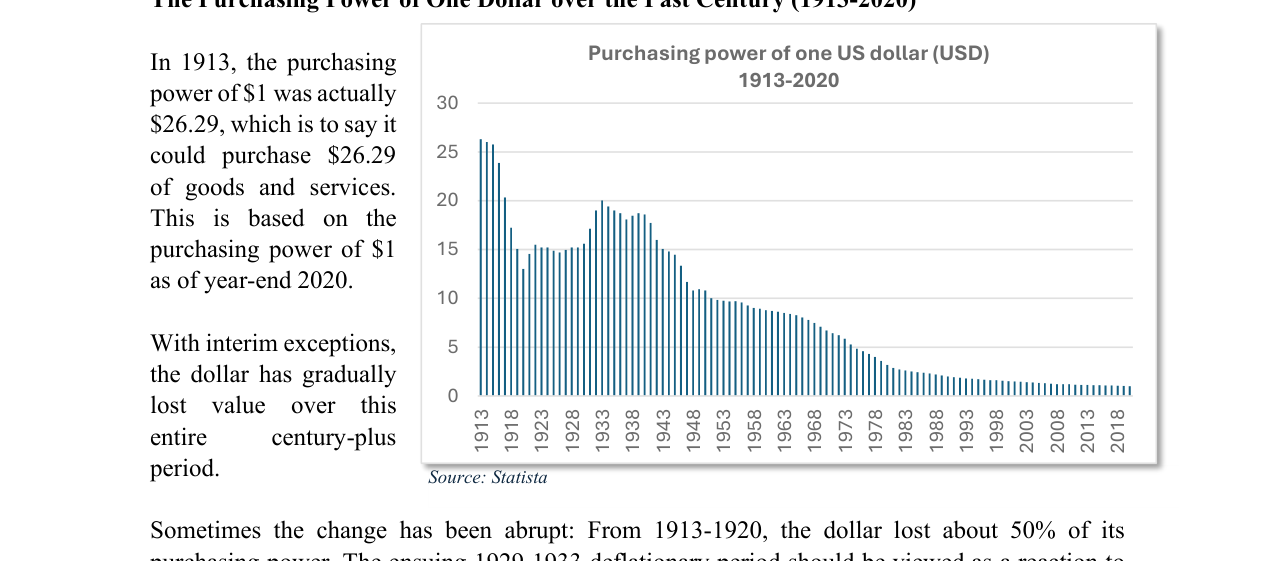
The purchasing power of one U.S. dollar fell from approximately $26 in 1913 to $1 in 2020, a cumulative decline of about 96.2% over a century.
1. Long-term Trend of U.S. Dollar Purchasing Power
- In 1913, one dollar had the purchasing power equivalent to $26.29 in 2020, meaning the dollar has lost 96.2% of its purchasing power since 1913.
- The decline included several sharp episodes: a roughly 50% loss between 1913 and 1920; and accelerated inflation from WWII starting in 1938.
2. Growth in Bitcoin's Purchasing Power
- The report does not provide specific bitcoin price data but shows via charts that bitcoin has exhibited a long-term upward trend against the U.S. dollar, euro, yen, Australian dollar, Canadian dollar, and others, contrasting sharply with fiat depreciation.
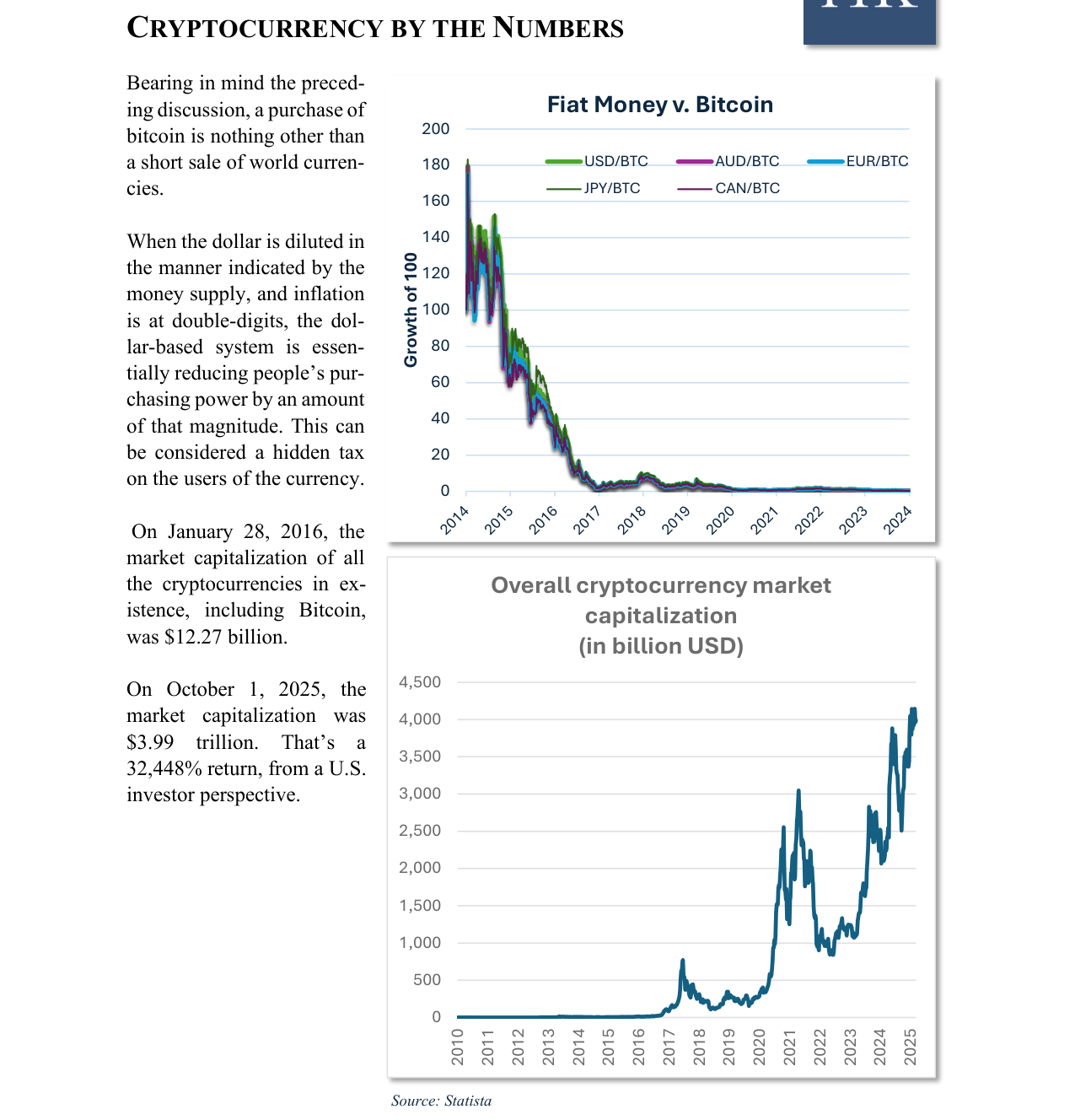
From 2014 to 2024, the purchasing power of major fiat currencies (USD, EUR, JPY, AUD, CAD, etc.) relative to bitcoin fell from around 100 to near zero.
3. Cryptocurrency Market Size
| Metric | Data |
|---|---|
| Market cap on Jan 28, 2016 | $12.27 billion |
| Market cap on Oct 1, 2025 | $3.99 trillion |
| Cumulative increase (USD) | 32,448% |
4. User Growth
- Global cryptocurrency users in 2018: 35.3 million
- Global cryptocurrency users in April 2025: 700 million (approx. 8% of world population)
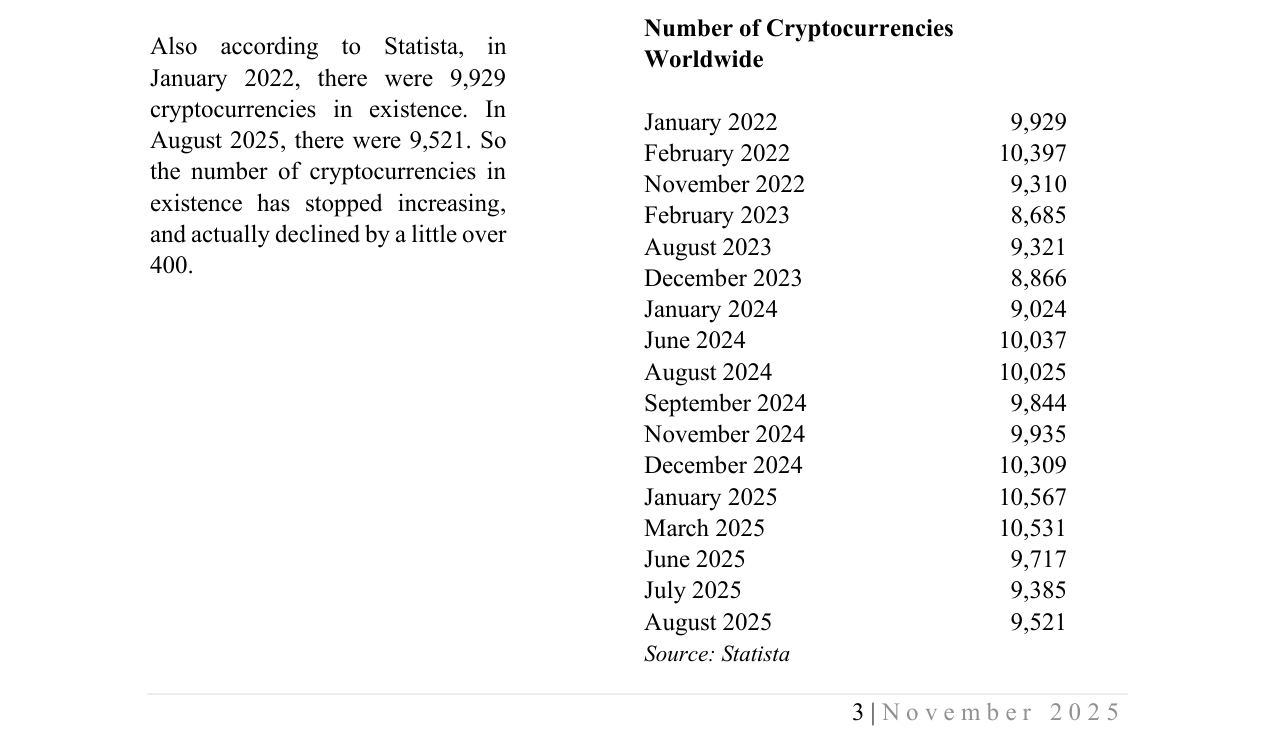
Total cryptocurrency market cap grew from near zero in 2010 to $3.99 trillion in October 2025, a return of 32,448% over the decade.
5. Changes in Number of Cryptocurrencies
| Date | Number of Cryptocurrencies |
|---|---|
| Jan 2022 | 9,929 |
| Dec 2023 | 8,866 |
| Sep 2024 | 9,844 |
| Dec 2024 | 10,309 |
| Aug 2025 | 9,521 |
- From January 2022 to August 2025, the total decreased by approximately 400, indicating market consolidation.
Global cryptocurrency users rose from about 1 million in 2016 to 700 million in April 2025, roughly 8% of the world population.
6. National Bitcoin Holdings
| Country | Bitcoin Holdings | Approx. USD Value |
|---|---|---|
| United States | 326,588 BTC | $35.33 billion |
| China (estimated) | 190,000 BTC | $20.61 billion |
| United Kingdom | 61,245 BTC | $6.64 billion |
| Ukraine (estimated) | 46,351 BTC | $5.02 billion |
| United Arab Emirates | 6,420 BTC | $692.4 million |
| El Salvador | 6,365 BTC | $690.3 million |
| Bhutan | 6,227 BTC | $678 million |
| North Korea (Lazarus Group estimated) | 803 BTC | $87.22 million |
| Venezuela (estimated) | 240 BTC | $26 million |
| Finland (estimated) | 90 BTC | $10 million |
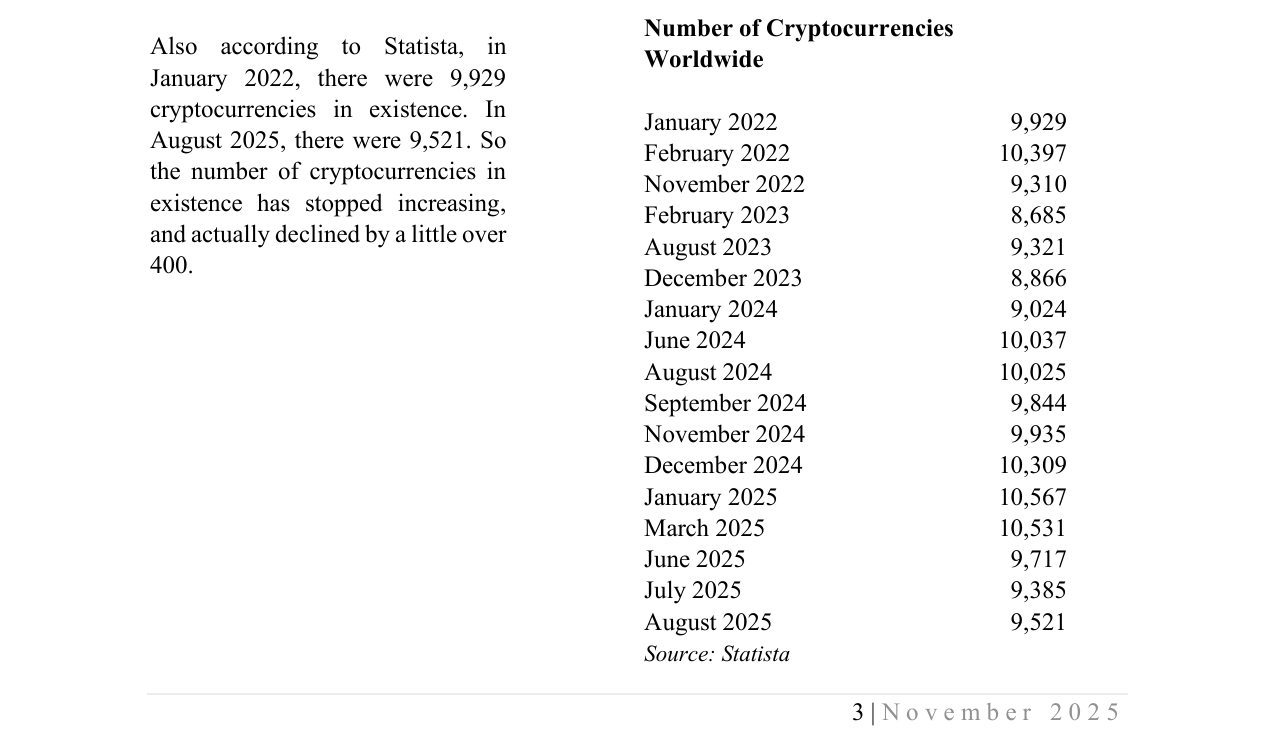
The global number of cryptocurrencies fluctuated between January 2022 and August 2025, changing from 9,929 to 9,521, with a peak of 10,567 in January 2025.
- U.S. publicly listed companies collectively hold 1,064,688 BTC.
- El Salvador holds 6,365 BTC (approx. $690 million), while its PPP-adjusted GDP is about $740 billion. Although the bitcoin position is small, it has already outperformed any traditional sovereign wealth fund portfolio.
Companies/Assets Involved
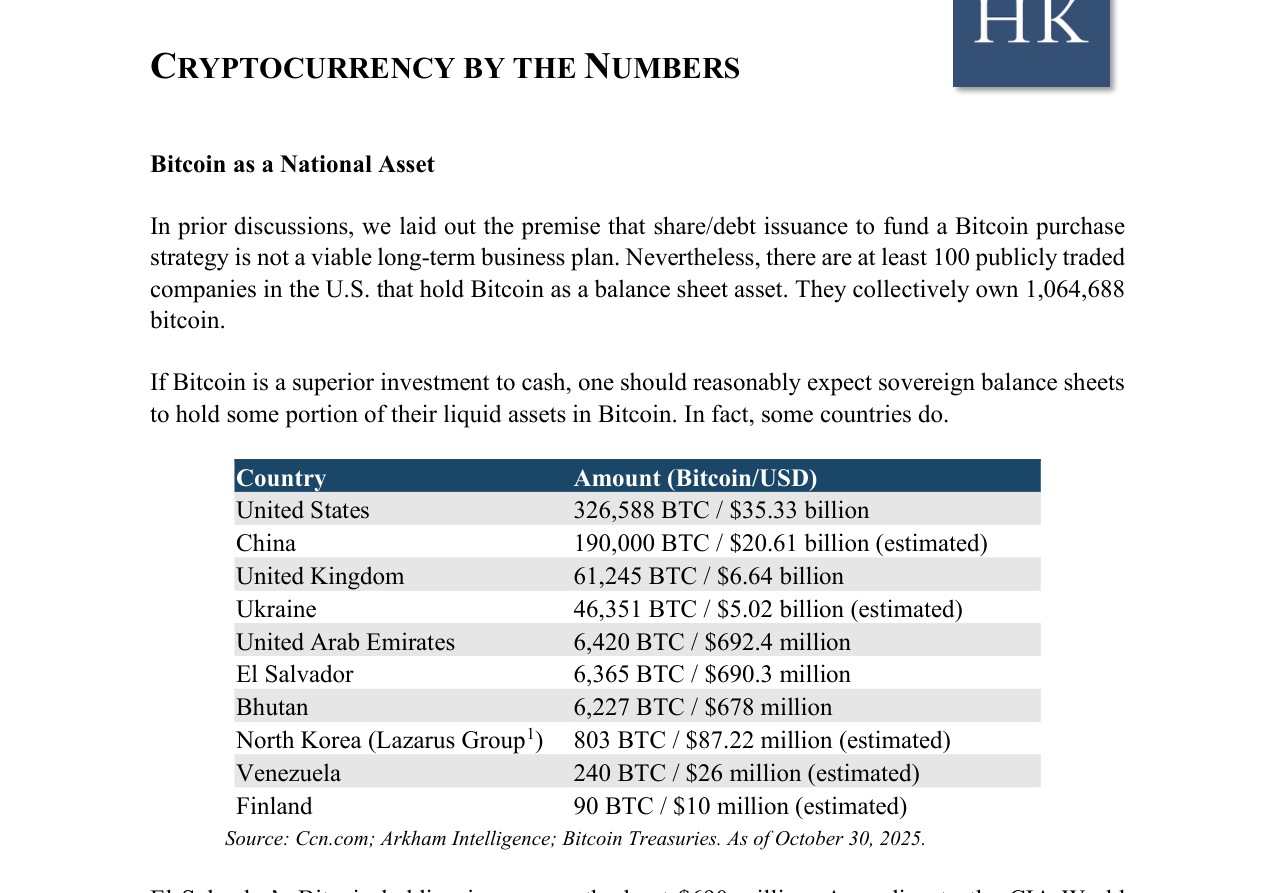
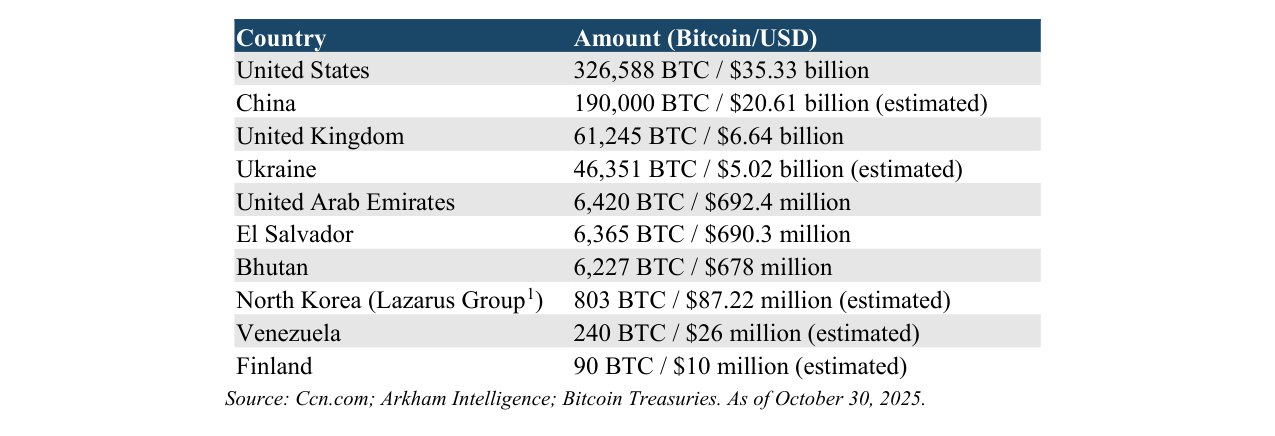
As of October 30, 2025, governments worldwide collectively hold approximately 1.06 million bitcoins, with the U.S. holding 326,588 BTC ($35.33 billion) and China holding 190,000 BTC ($20.61 billion).
- Bitcoin: Core subject of analysis, defined as an asset with a "predetermined, unchangeable inflation rate."
- U.S. Publicly Listed Companies: At least 100 U.S. public companies have added bitcoin to their balance sheets, collectively holding 1,064,688 BTC. The report does not name specific companies but emphasizes that while the "debt/equity issuance to buy bitcoin" strategy is unsustainable as a long-term business model, the trend of using it as a national or corporate reserve asset persists.
- El Salvador: A case study of a small economy pioneering bitcoin as a legal reserve, holding 6,365 BTC (approx. $690 million). Though the size is insufficient to alter the country's destiny, its performance exceeds any diversified sovereign wealth fund.
Investment Implications
- A beta tool for long-term shorting fiat currency: The report implies that against the macro backdrop of declining fiat purchasing power (annual depreciation of roughly 1.5%–2%), bitcoin holders effectively gain inverse exposure to fiat depreciation. Therefore, allocating to bitcoin should be viewed as a macro hedge against sovereign currency system risk, not mere speculative risk asset trading.
- Track sovereign holdings dynamics: Small countries like El Salvador and Bhutan have taken the lead, but major powers such as the U.S. and China are already the largest actual holders (U.S. 326,588 BTC; China 190,000 BTC). If more countries follow suit in adding bitcoin to foreign reserves, it could trigger a new positive feedback loop of "sovereign buying."
- Supply-side inflection point for cryptocurrencies: The number of cryptocurrencies decreased from 9,929 in January 2022 to 9,521 in August 2025, signaling a shift from a "wave of issuance" to "natural selection." Investors should focus on high-liquidity, high-market-share top assets like bitcoin, rather than blindly chasing new coins.
- Beware of the unsustainable "debt-to-buy-coins" model: The report explicitly denies the long-term viability of corporate debt/equity financing to buy bitcoin. Thus, investors should distinguish between "balance sheet allocation" and "speculative financing," and avoid over-leveraged crypto enterprises.