Under the Hood Revived: What’s In Your Index? The Metamorphosis of the Mega-cap IT Company Business Model
Horizon Kinetics is a New York asset manager founded in 1994 by Murray Stahl and Steven Bregman, running a contrarian, anti-indexation, long-horizon value strategy concentrated in hard and real assets such as royalty companies and exchanges (notably Texas Pacific Land).
In plain words
This report says big US tech firms are spending so much on AI data centers that their cash flow is drying up. The author is cautious, warning these companies may not generate real free cash flow for the next two years. Key names: Amazon's latest quarterly free cash flow turned negative because of heavy spending; Alphabet, for the first time in over 20 years, raised $85 billion in new equity; and even cash-rich NVIDIA issued $25 billion in bonds, which the author finds odd. In short, AI is so expensive that even the giants need to borrow or sell shares.
At a Glance
The report argues that the capital-expenditure spree by five mega-cap tech companies on AI is devouring free cash flow, transforming their “asset-light” business models into “heavy-asset capex machines.” They are unlikely to achieve positive free cash flow over the next two years, and systemic risk has risen markedly. [Cautious]
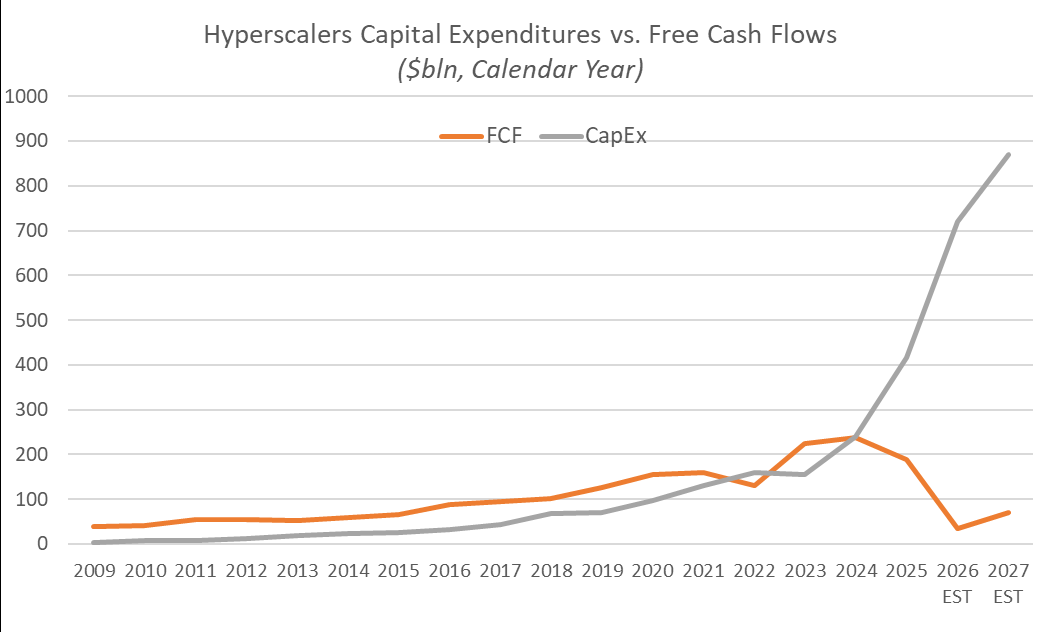
- Combined 2026 capex forecasts for the five hyperscalers (Amazon, Microsoft, Alphabet, Meta, Oracle) have risen to $720 billion, up roughly 200% from 2024. Their combined free cash flow in the most recent quarter was just $9.5 billion ($37.8 billion annualized), supporting a market cap of nearly $13 trillion—equivalent to 332x quarterly free cash flow, with a yield of only 0.30%.
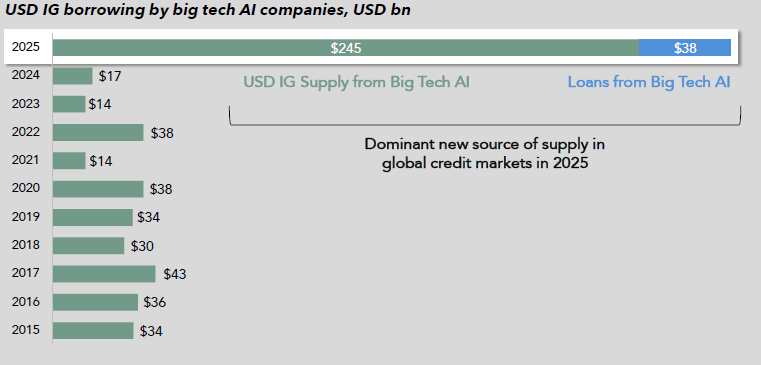
- The five companies have combined debt of $597 billion and net debt of $196 billion. To fill the gap, Alphabet conducted its first equity raise in over two decades, raising $85 billion; Oracle raised $20 billion in equity; Meta is considering an equity raise; and even cash-rich NVIDIA issued $25 billion in bonds.
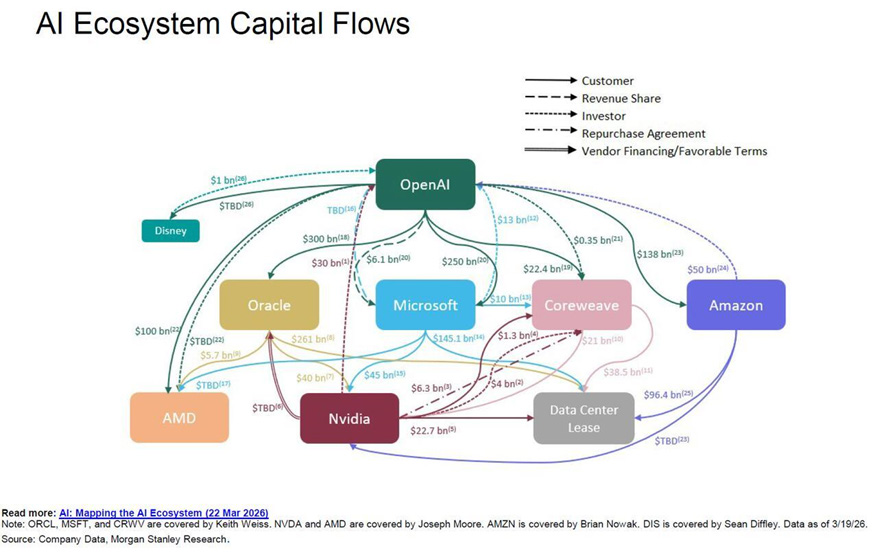
- The AI buildout also supports roughly $1.8 trillion in off-balance-sheet liabilities (long-term purchase and lease commitments). Stress at a single counterparty can propagate through multiple balance sheets simultaneously, posing systemic contagion risk.
- The author believes the tech giants’ “asset-light, high-margin” model over the past two decades was a free-rider dividend under net-neutrality rules; the cost has been borne by infrastructure companies such as Level 3, CenturyLink/Lumen, AT&T, and Verizon, whose share prices are all significantly below their 1999 levels.
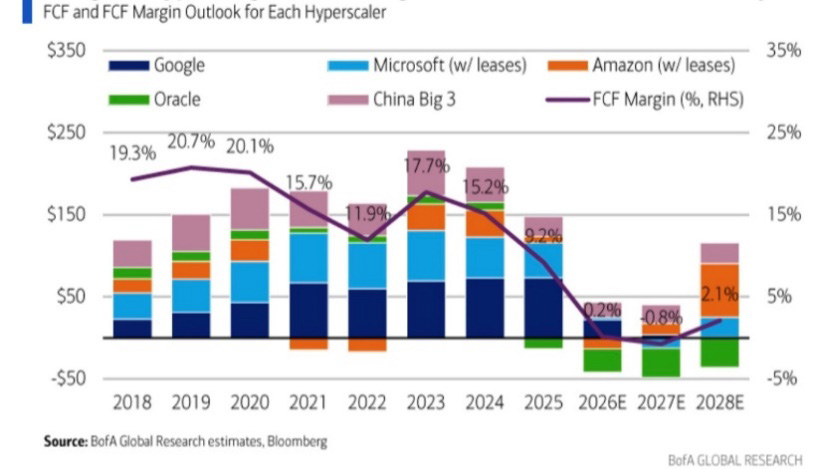
- BofA expects the five companies’ combined free cash flow margin to fall from over 20% in 2019-20 to -0.8% by 2027. The author warns that AI’s creative destruction “threatens the publicly traded Mag 7.”
Capital Expenditure Surge Devours Free Cash Flow
The five mega-cap tech companies' combined 2026 capital expenditure has climbed to $720 billion, up roughly 200% from 2024, while free cash flow is being squeezed to the point of near exhaustion. The article notes that the 2026 capex forecasts announced by Amazon, Microsoft, Alphabet, Meta, and Oracle — which the author calls "hyperscalers" — were revised upward by more than 25% in just five months. The specific figures: Amazon $198 billion, Microsoft $146 billion, Alphabet $186 billion, Meta $132 billion, and Oracle $56 billion.
Morgan Stanley further argues that these figures still need to be revised up, projecting a combined $805 billion for the five companies in 2026 and $1.1 trillion in 2027, with each company's spending at that point as follows: Amazon $268 billion, Alphabet $299 billion, Microsoft $276 billion, Meta $165 billion, and Oracle $107 billion.
The five companies together account for roughly 18% of the S&P 500's weight and 20% of the Nasdaq-100 (excluding Oracle, which trades on the NYSE). The cost is already reflected in cash flows — in the most recent quarter, the five companies generated combined free cash flow of just $9.5 billion ($37.8 billion annualized), a sharp deterioration from $158 billion over the trailing 12 months:

| Metric | Trailing 12 Months (US$ bn) | Latest Quarter (US$ bn) |
|---|---|---|
| Combined operating cash flow | 640.54 | 157.88 |
| Combined capex | -482.15 | -148.39 |
| Combined free cash flow | 158.39 | 9.49 |
| Amazon free cash flow | -2.47 | -18.17 |
| Microsoft free cash flow | 72.92 | 15.80 |
| Alphabet free cash flow | 64.43 | 10.12 |
| Meta free cash flow | 48.25 | 13.23 |
| Oracle free cash flow | -24.74 | -11.48 |
On this basis, supporting a combined market capitalization of nearly $13 trillion implies 332× quarterly-annualized free cash flow, a yield of just 0.30%. The author judges that the five companies combined will most likely fail to achieve positive free cash flow in 2026–27; BofA expects the combined free cash flow margin to decline from above 20% in 2019–20 to -0.8% by 2027.
Financing Pressures Mount: Debt, Equity Issuance, and Abandoning Carbon Neutrality
To fill the funding gap for AI data-center investment, the tech giants are being forced into large-scale debt and equity financing — and are even abandoning their carbon-neutrality commitments. The five companies held combined debt of $597 billion at the end of the latest reporting period, with net debt (debt minus cash) of $196 billion. The article highlights several specific cases:
- Alphabet, the parent company, has issued equity for the first time in more than two decades, raising $85 billion this month;
- Oracle has raised or is in the process of raising $20 billion in equity;
- Meta has announced it is considering an equity offering;
- NVIDIA — the world's most valuable company, with nearly $120 billion in free cash flow over the past four quarters — has nonetheless just issued $25 billion in bonds. The author questions this: "Why the company needs this is a question, and perhaps also a concern." — that is, "why this company needs this money is a question, and perhaps a worrying one."
The author also notes that data centers require enormous, continuous, and reliable electricity, and that wind and solar cannot compete with baseload energy sources such as natural gas and nuclear power. The cost of purchasing carbon credits can reach tens of billions of dollars (a single data center's annual electricity consumption equals that of New York City, 50–55 TWh, or Chicago, 30–35 TWh), making it economically unviable. Microsoft has recently shown signs of delaying or abandoning its 2030 carbon-neutrality plan.
In the Net Neutrality Era, "Asset-Light" Was a Free Ride
The author offers a deeper judgment: over the past two decades, the tech giants' "asset-light, high-margin" model was in fact a free-rider dividend conferred by net neutrality regulation, not a genuine business-model advantage. The net neutrality rules adopted by the FCC in 2010 constrained broadband providers from charging content companies for preferential treatment, allowing large platforms to avoid paying extra costs for traffic. The article notes that Netflix, at its peak, accounted for 35% of downstream internet traffic yet paid almost nothing to broadband carriers such as Verizon; Google, Amazon, Meta, and Microsoft likewise paid no significant fees to owners of the internet backbone.
The cost was shifted onto infrastructure companies — shares of Level 3, CenturyLink (now Lumen), AT&T, and Verizon all remain significantly below their 1999 levels, meaning these companies effectively fronted the capital expenditure that the tech companies needed for growth. The author's implicit conclusion: in the AI data-center era, this free ride has ended, and tech companies must now bear the enormous infrastructure investment themselves.
Interdependence Risk in the AI Arms Race

The complex cross-shareholdings and financing arrangements among the big tech companies, together with trillions of dollars in concentrated performance obligations, constitute a new systemic contagion risk. The article estimates that the AI buildout supports $1.8 trillion in off-balance-sheet liabilities (long-term purchase commitments and lease commitments), structurally characterized by "vendor financing" and repurchase-style arrangements. The author's exact words: "a single counterparty's stress can propagate through several balance sheets at once. The vast concentration compounds that stress." — that is, "the stress of a single counterparty can propagate through multiple balance sheets simultaneously; the vast concentration amplifies that stress."
The article further points out that the order backlog underpinning this spending rests on a small number of large, long-term contracts; concentrated counterparty exposure means there is a chain of dependence between the entire AI spending logic and actual cash flows. Using NVIDIA's financing as an example, the author implies that even a highly profitable company with abundant cash flow needs to take on debt — which in itself suggests some opacity or structural mismatch within the system.
Investment Implications

The core implication of the article is that the tech giants are transforming from "asset-light platforms" into "asset-heavy capex machines," a shift that will compress free cash flow margins, weaken financial flexibility, and introduce cyclicality into their business models. The author's wording is distinctly cautionary — "AI's creative destruction does not just threaten jobs, it threatens the publicly traded Magnificent Seven." — that is, "AI's creative destruction threatens not just jobs; it threatens the publicly traded Mag 7." The article also notes that alternative versions have already emerged in the private markets: OpenAI, Anthropic, xAI (now acquired by SpaceX), Stripe, Databricks, and Anduril.
Readers should note: this article is written from the perspective of an asset-management firm. The author is both a potential holder of mega-cap tech equities and a potential competitor to them, and has an incentive to reinforce the risk warnings in the "runaway capex" narrative. Although the article's explanation of net neutrality and the "asset-light illusion" is data-supported, it remains the author's own view.
Position Moves
| Target | Direction | Author's stance in one sentence | Key data |
|---|---|---|---|
| Amazon | Hold/watch | Enormous capex and negative free cash flow; named as one of the hyperscalers | 2026 capex $198B; latest-quarter FCF -$18.17B |
| Microsoft | Hold/watch | Capex remains elevated; FCF positive but down markedly | 2026 capex $146B; latest-quarter FCF $15.80B |
| Alphabet | Hold/watch | First equity raise in over two decades at $85B; pronounced capex pressure | 2026 capex $186B; latest-quarter FCF $10.12B |
| Meta | Hold/watch | Weighing an equity raise; enormous capex | 2026 capex $132B; latest-quarter FCF $13.23B |
| Oracle | Hold/watch | FCF negative; raising $20B in equity | 2026 capex $56B; latest-quarter FCF -$11.48B |
| NVIDIA | Hold/watch | Author questions the need for its bond issuance, calling it "a problem, and perhaps a troubling one" | Nearly $120B FCF over the past four quarters; just issued $25B in bonds |
| Netflix | Not stated | Cited as a beneficiary of free-riding in the net-neutrality era | Peaked at 35% of downstream internet traffic while paying almost nothing to broadband carriers |
| Level 3 | Not stated | Infrastructure companies front capex for tech companies; share price under pressure | Share price significantly below 1999 levels |
| CenturyLink (now Lumen) | Not stated | Same as above; bears the cost of free-riding | Share price significantly below 1999 levels |
| AT&T | Not stated | Same as above | Share price significantly below 1999 levels |
| Verizon | Not stated | Subject to free-riding by Netflix and others; share price below 1999 levels | Share price significantly below 1999 levels |
| OpenAI | Not stated | Mentioned as one of the private-market alternatives | — |
| Anthropic | Not stated | Same as above | — |
| xAI (acquired by SpaceX) | Not stated | Same as above | — |
| Stripe | Not stated | Same as above | — |
| Databricks | Not stated | Same as above | — |
| Anduril | Not stated | Same as above | — |