Greenhaven Road Capital Q2 2026 Investor Letter
Greenhaven Road Capital is a boutique hedge fund founded by Scott Miller, focused on overlooked small-cap value stocks with a concentrated, low-turnover book, plus a Partners Fund that seeds emerging managers. Its candid quarterly letters are known for surfacing obscure ideas; AUM is roughly $600m.
In plain words
This letter reviews Greenhaven Road's second-quarter investing and outlook. The manager is cautiously optimistic: he skipped this year's hottest AI hardware stocks and instead holds a few overlooked names, expecting their bets to be tested within a year. Key picks: Burford, a litigation-finance firm that funded a chicken price-fixing case, could win a settlement worth more than its own market cap. Hagerty, which insures classic cars, is more profitable than the market thinks—the author sees earnings nearly 30% above market expectations. Cellebrite, a phone-forensics software maker, is treated as an AI loser, but its new AI product got its first sale within a month, so the zero-AI-revenue guidance may be too conservative.
At a Glance
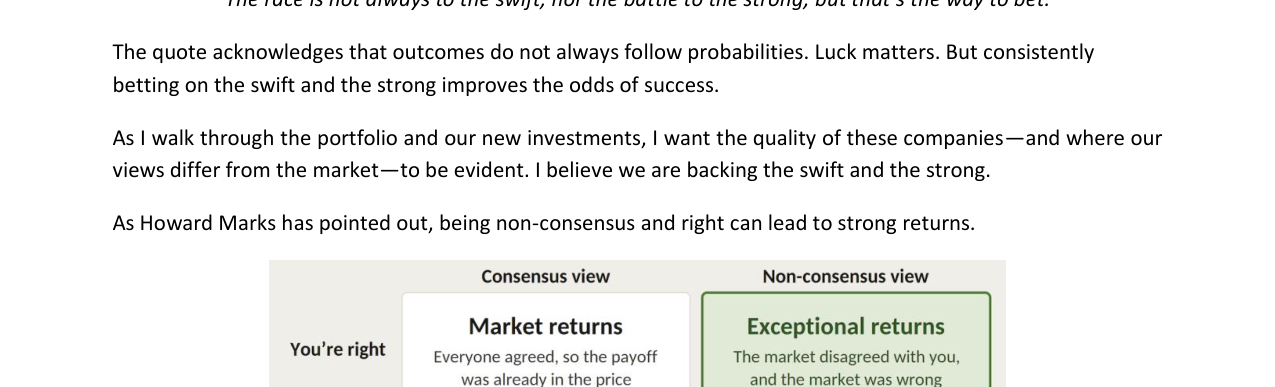
The author is overall cautiously optimistic in this edition: he has not participated in the AI hardware that drove this year's rally, instead concentrating on mispriced non-consensus opportunities in software, insurance, and alternative assets, and expects several of these calls to be tested over the next year.
- Portfolio level: Q2 net return was approximately 11%, with first-quarter losses not fully offset; the author will moderately reduce concentration, add positions with near-term catalysts, and be more willing to take profits in a timely manner.
- Burford: the protein case is a hidden catalyst—over $150 million has been invested, and a potential settlement could exceed the company's market cap, with the market "apparently largely unaware."
- Hagerty: operating leverage is underestimated by consensus—EBITDA has grown roughly 8x in six years to $237 million, and the author's 2027 earnings forecast is nearly 30% above consensus.
- Cellebrite: FY2026 guidance of $565M–$571M explicitly assumes zero AI/Genesis revenue, but within a month of Genesis's launch, the company has already completed its first sale and surpassed 800 registered users; AI benefits may be systematically underestimated.
- Portfolio changes: new positions in CODI (asset value of $30+/share vs. a share price of about $10), ANAB (a bet on a GSK settlement), and APP (a 1% small position); LQDA was realized and exited after rising over 30% ahead of the patent ruling.
Q2's 11% Gain Did Not Fully Offset the Decline; Portfolio to Trim Concentration and Add Catalysts
The fund returned approximately 11% net in Q2, not fully recouping the Q1 decline; the author plans to moderately reduce portfolio concentration, increase investment in near-term catalysts, and be more willing to take profits in a timely manner, while maintaining focus on advantaged companies and differentiated research.
Performance Comparison: The fund returned approximately 11% net this period (net basis); the original text did not provide a benchmark. The Q1 decline was not fully offset, and the author only said "this is progress," without attribution, while conceding that performance did not reach the level it should have. This leads to the adjustment direction: portfolio construction will "moderately change" — reduce concentration, allocate more to names with identifiable near-term catalysts, and be more willing to take profits when share prices run ahead of events. What remains unchanged is the focus on advantaged companies and differentiated research that reaches conclusions different from consensus.
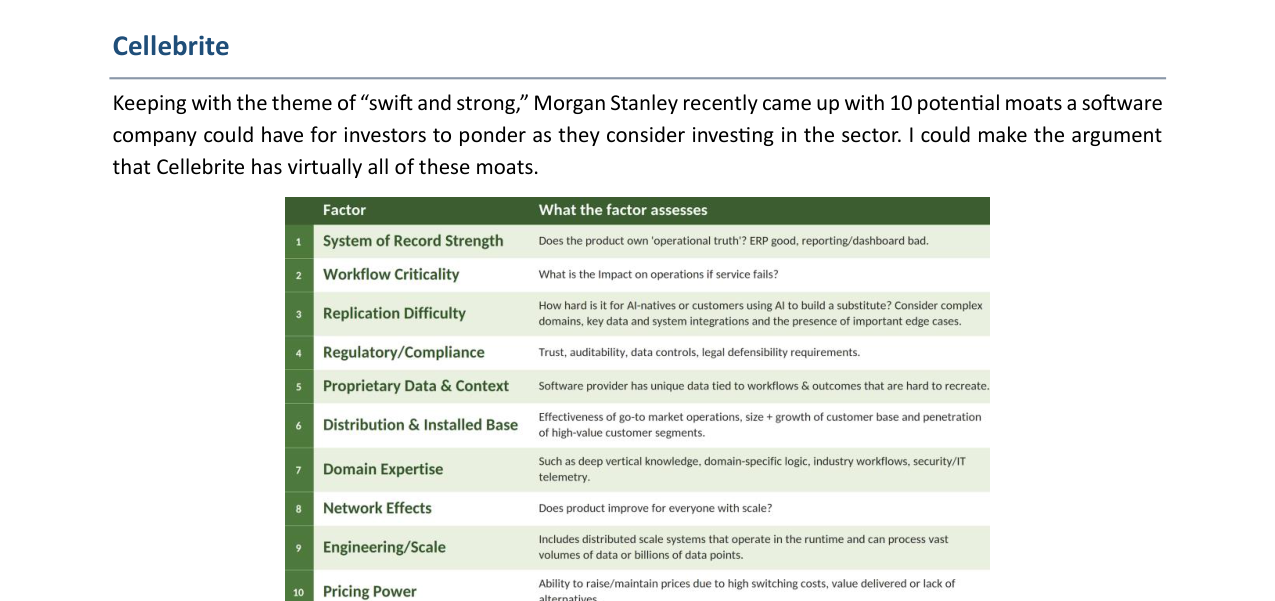
The author believes the current portfolio is "unusually favorable" for implementing these adjustments: several of the largest investments have identifiable events within the next year to test the thesis, and many companies are still growing while valuation multiples have clearly contracted, so "it does not take years to know whether a contrarian view is correct." Methodologically, the author cites sports writer Hugh Keough's saying — contests and battles do not always go to the agile or the strong, but betting that way produces the highest win rate — and also cites Howard Marks's view: being non-consensus and right yields strong returns.
Burford: Protein Case Is a Hidden Catalyst
Global AI computing spend is projected to grow from approximately $180 billion in 2022 to approximately $310 billion in 2025.
Burford is the "800-pound gorilla" of the litigation finance industry, with an impressive historical track record; the author believes its protein price-fixing litigation—in which it has deployed over $150 million—is a catalyst that consensus has not priced in, and the potential settlement could exceed the company's market capitalization.
Burford's core advantage lies in having the largest case pool and the best settlement track record. More than 285 financed cases have been closed, with 90% ending in victories or favorable settlements; these investments generated an 82% return on invested capital over a weighted average of 2.6 years, with a 25% IRR. The author emphasizes that this reflects its ability to select and profitably finance cases.
The protein case is the author's biggest divergence from consensus: Burford has deployed more than $150 million into price-fixing cases involving chicken, beef, turkey, and pork. For most of that capital, Burford retains all the upside rather than sharing it with clients, and it controls the timing of settlements. The defendants are all large food companies: Tyson Foods (TSN), Pilgrim’s Pride (PPC), Koch Foods, and Cargill. Together, they have already spent billions of dollars settling some of the antitrust claims; if they lose at trial, they face treble damages, so all parties have incentives to settle. The author expects the settlement amount could exceed Burford's market cap and could arrive within the next year as the cases come to trial. The chicken case will be the first to go to trial, with the trial scheduled for 2027; a potential several hundred million dollars could flow back to Burford while also easing its debt covenant issues. Pilgrim's Pride has already pleaded guilty to criminal price-fixing.
But the market has barely priced in this logic. The author notes that Burford does not discuss individual cases, and the details are scattered across court and bankruptcy filings; when Bank of America initiated coverage of Burford last month, its report ran more than 15,000 words, and subsequent reports also did not mention the protein case; other sell-side analysts have asked only one unrelated question over the past 18 months. The author's original words: "It's not that consensus disagrees; it seems largely unaware." Meaning: "It is not that consensus disagrees; rather, it seems essentially unaware."
To change the market narrative, the author has begun reaching out to the sell side and sharing the view more broadly. Burford (position watch): The original text only states a "full position" and does not disclose any additions or reductions. Note that the author, as a holder of Burford, is actively pitching the protein case thesis to the sell side; readers should be aware that this is a stakeholder's perspective.
Hagerty: Operating Leverage Underestimated by Consensus
Hagerty has data, scale, and distribution advantages in the classic car insurance niche, and has generated significant operating leverage over the past six years. The author believes the consensus underestimates its earnings potential. The three key points of divergence are the durability of operating leverage, the pace of State Farm integration, and a potential Geico partnership.
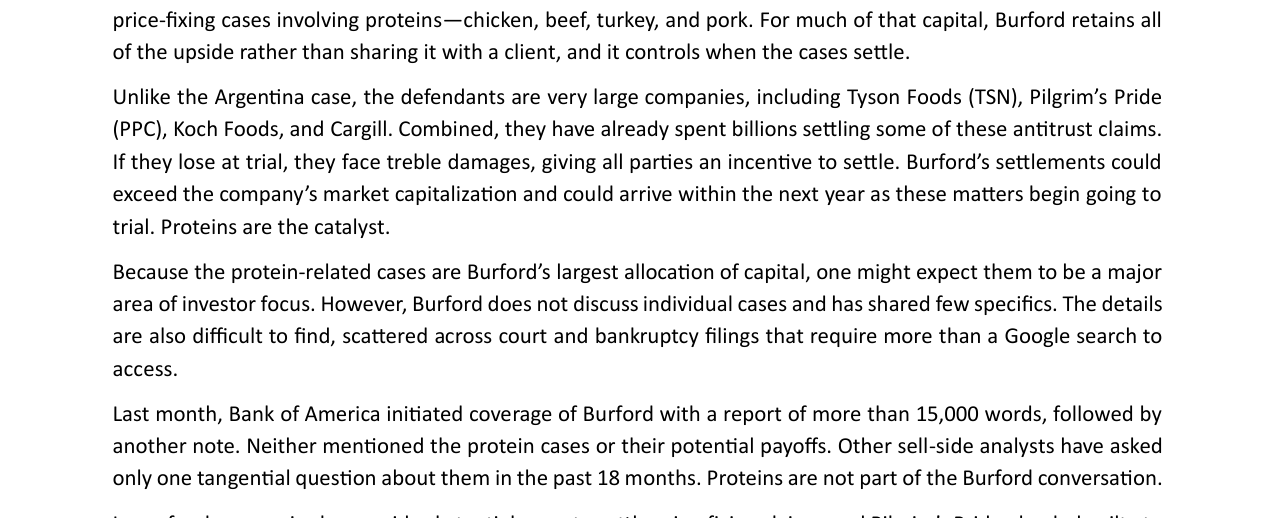
Hagerty primarily underwrites classic and collector car insurance, which owners are legally required to purchase. The author says its data advantage improves pricing, its scale advantage improves service, and distribution partnerships keep customer acquisition costs at just a fraction of the industry's. Over the past six years, revenue growth has consistently outpaced compensation and expense growth:
| Hagerty Income Statement Line Item CAGR 2020–2025 | Growth Rate |
|---|---|
| Total revenue | 23.1% |
| Compensation and benefits | 13.9% |
| General and administrative expenses | 13.0% |
In large-scale AI accelerator clusters, NVIDIA GPUs dominate, with deployment scales ranging from 100,000 to 1 million
While investing in the State Farm partnership and the technology platform—two initiatives that add expenses but generate no near-term revenue—EBITDA grew from just under $30 million per year to $237 million, an increase of roughly eightfold.
The author's contrarian view has three parts:
1) Operating leverage will persist. Hagerty's 2026 guidance calls for written premium growth but roughly flat EBITDA, implying negative operating leverage for the full year; management says 2026 is an investment year and operating leverage will pause, and Wall Street analysts largely accept subdued operating leverage through 2026–2027. The author's exact words are "Our view is that, barring a catastrophic hurricane season, Hagerty will 'beat and raise' their way to higher EBITDA and earnings." That is, "our view is that, unless a catastrophic hurricane season occurs, Hagerty will 'beat and raise' its way to higher EBITDA and earnings." The author believes management is conservative on several items, including investment income, and may again benefit from "one-time" reserve releases.
2) State Farm policies should be fully counted. The partnership is nearly five years old. The original expectation was to add more than 500,000 policies in force (PIF), but full integration has been slower than expected, and the market continues to discount management's completion timeline. One sell-side analyst recently forecast only 300,000 State Farm PIF by the end of 2027. However, statutory data show related written premiums rose from $5.9 million in 2024 to $32.9 million in 2025, with first-quarter 2026 at $17.8 million versus just $2.1 million in the same period of 2025. Ten states were activated in the second quarter, and regulatory filings suggest another six states may be activated soon. The author believes the statutory data support rapid acceleration, something the consensus has not reflected.
3) Geico could be coming. Hagerty has worked with every major auto insurer except Geico for years. The two are currently running a small-scale pilot in which Geico's website refers classic/collector car business to Hagerty. The author acknowledges the pilot could be a "nothingburger," but almost no sell-side analysts or investors are paying attention, making it a non-consensus data point. The author also speculates that sell-side analysts covering 30-plus stocks have little incentive to dig into statutory data or search Geico's website, because clients rarely ask and the stock trades in line with insurance peers.
Sell-side consensus expects Hagerty EPS to rise from $0.37 in 2025 to $0.57 in 2027; the author's base case is nearly 30% above consensus, and the bull case is nearly 60% above.
| Hagerty EPS Forecast | Value |
|---|---|
| 2025 sell-side consensus | $0.37 |
| 2027 sell-side consensus | $0.57 |
| 2027 author base case | ~30% above consensus |
| 2027 author bull case | ~60% above consensus |
Hagerty (Hold — Under Observation): The original text does not disclose buy or sell actions, only stating that it has invested. The author's expectation of "beat and raise" carries the optimism of a position holder, and both the hurricane season and a Geico pilot failure are listed as uncertainties.
Cellebrite: Misread as an AI Loser
Global cloud revenue reached approximately $600 billion in 2023, with capex of about $140 billion.
The market has labeled Cellebrite an AI loser, with the stock down about 20% year-to-date; the author's contrarian view is that AI will ultimately benefit the company, and management agrees, though the detailed argument has not yet been laid out in the source text provided.
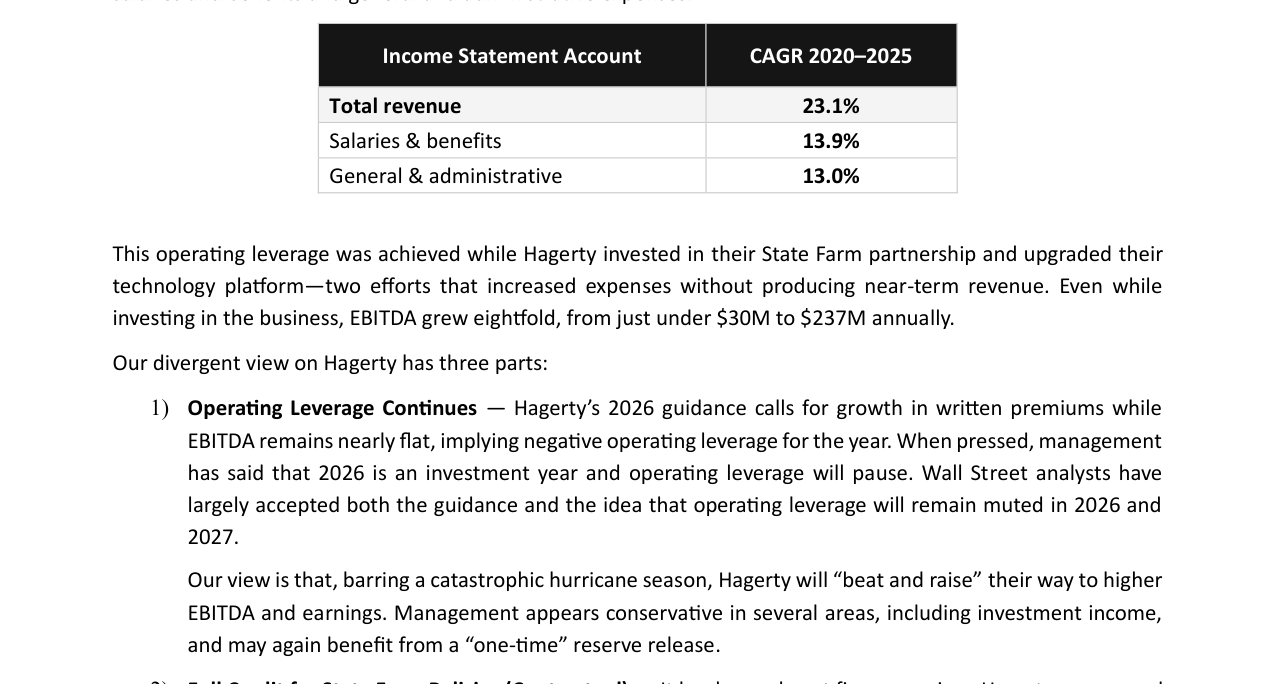
Morgan Stanley recently outlined 10 moats that software companies may possess, and the author believes Cellebrite has nearly all of them. But the market fears that AI will replace software, and worries that tools such as Anthropic's Mythos will help Google and Apple harden devices, making data extraction more difficult. The stock has recovered from its lows, but was still down about 20% year-to-date at quarter end.
The author's view is that AI will ultimately benefit Cellebrite; management agrees and has been making that case. Cellebrite (hold/under observation): the original text did not disclose position changes, only noting that it had invested. The original text breaks off here, and the detailed case for Cellebrite has not yet been developed in the portion provided.
Continuation Analysis: From AI Narrative to Value Reassessment
The analysis above has covered the opening logic and overall framework of Greenhaven Road Capital's Q2 investor letter. This section focuses on the three major holdings that the letter goes on to elaborate — Cellebrite (CLBT), Lifecore (LFCR), and Kingsway (KFS) — and supplements the argument with fresh angles and data, rather than repeating existing views. The core judgment is: the market still processes these three companies' transformations through linear extrapolation, while the inflection-point signals presented in the letter may be systematically underestimated.
Cellebrite: From "AI Victim" to "AI Beneficiary" — The Pricing Gap
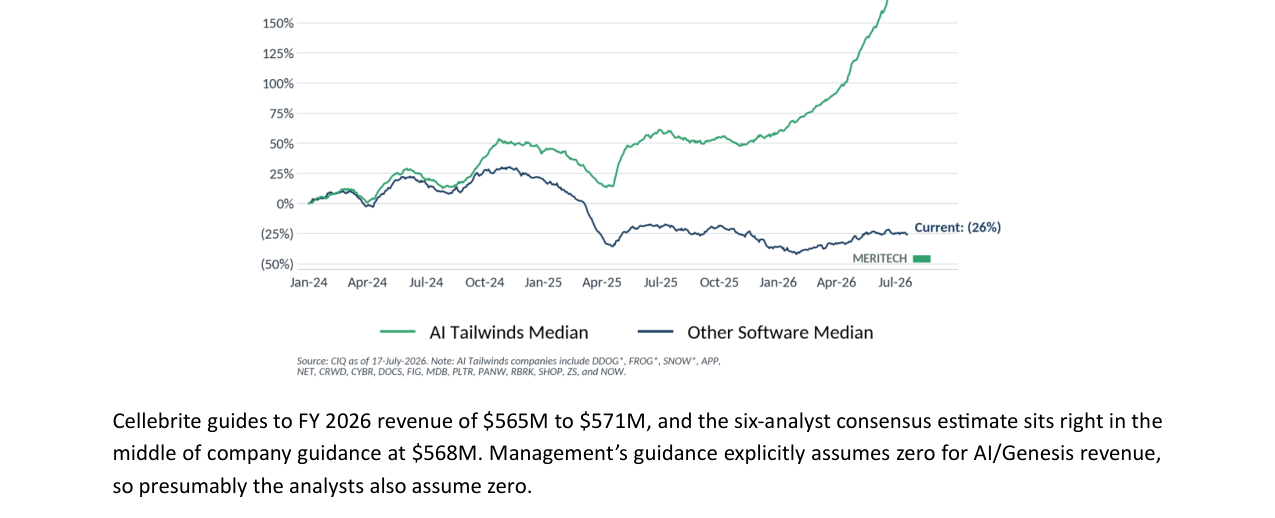
The letter's most critical argument on Cellebrite is that management's FY2026 guidance of $565M–$571M explicitly assumes zero AI/Genesis revenue, and sell-side consensus does the same. This is an extremely conservative assumption, and it is the core source of valuation optionality.
1. Early User Data Suggests Commercialization Speed Is Underestimated
Per the letter, on the Q1 earnings call, the Genesis beta had 300+ institutions and 500 registered users; less than a month after the official launch in early June, registered users surpassed 800. More importantly, the CEO confirmed in a virtual fireside chat in June that the first sale had already closed. For a product just released, going from beta to first-sale cash flow in roughly one month is uncommon in enterprise SaaS—especially when the target customers are law enforcement agencies, whose procurement cycles are typically measured in quarters.
The letter also cites user testimonials describing Genesis as a "quantum leap" rather than an "incremental improvement," with output speed "exponentially better than existing capabilities." While such testimonials carry promotional overtones, they come from frontline investigators rather than management, and the emphasis that "not reporting would be unethical" suggests the product solves a genuine pain point in the vertical use case. Combined with Cellebrite's nearly two decades of forensic data accumulation, its vertical advantage in pre-processing and prompt engineering is likely moat-worthy.
2. Revenue Nonlinearity from the Consumption Model
NVIDIA GPU accounts for approximately 80% of hyperscaler AI server procurement, with AMD and others at approximately 20%
Genesis uses a usage-based consumption model, with tiered support for individuals, teams, or units. This means that once adopted, customer usage naturally expands as case volumes grow, without requiring frequent renewal negotiations. If the product is genuinely effective, its ARPU ramp path is steeper than traditional subscriptions. We can compare the expansion curves of similar vertical AI tools—such as Palantir's Foundry or Axon's AutoTriage—where early customer deployments are often followed by annual growth rates above 200%. Yet the market continues to price Cellebrite according to traditional software growth rates.
3. The Reversal Logic of Multiple Compression
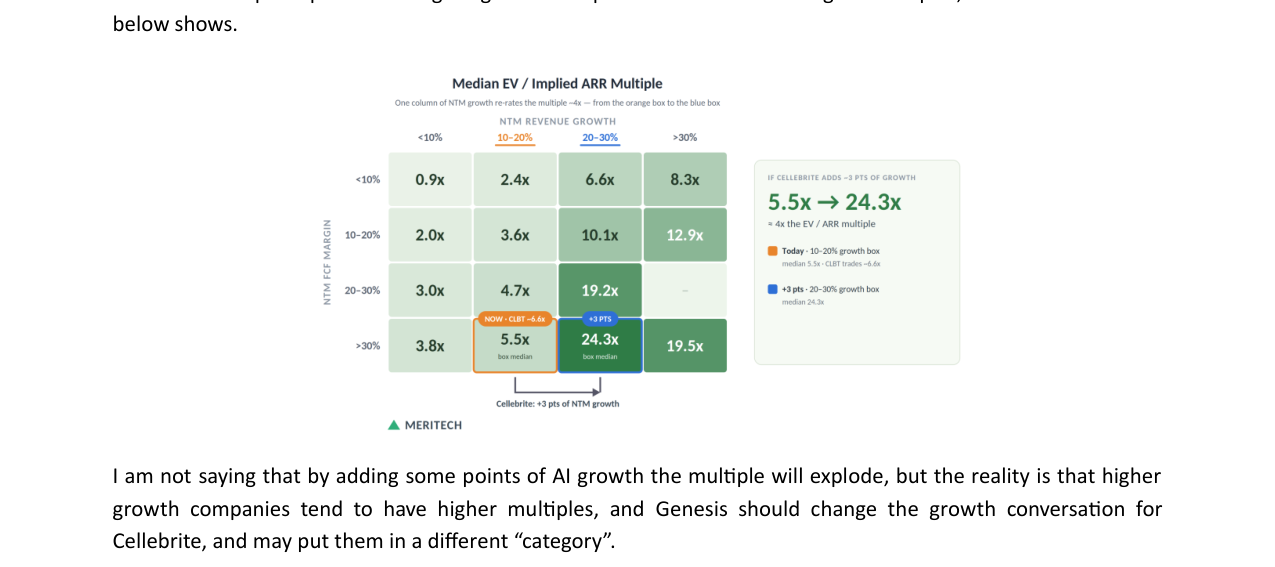
The letter notes that Cellebrite currently trades at roughly 15x EV/FCF, with revenue growth near 20%, consistently positive free cash flow, and a solid balance sheet. Comparing Meritech's AI winner/loser data, high-growth AI software companies typically trade at 8–12x EV/NTM Revenue or higher, while companies in the "AI loser" quadrant (traditional software whose valuations are impaired by the AI threat) may average only 3–5x. Cellebrite is currently around 15x FCF; at its 20% growth rate and 5% FCF margin, the implied EV/Sales is roughly 3x—effectively in the "loser" pricing territory.
The table below compares typical AI beneficiaries with Cellebrite's current valuation anchor:
| Metric | High-Growth AI Software | Cellebrite (Current) | Traditional Legal Tech |
|---|---|---|---|
| Revenue Growth | 30–50% | ~20% | 5–10% |
| EV/NTM Revenue | 8–12x | ~3x (estimated) | 2–3x |
| Free Cash Flow Margin | Positive but volatile | ~25% | 15–20% |
| Market Positioning | Pure AI narrative | Forensic data analytics + AI upside | Non-AI or defensively positioned |
If Genesis revenue contributes 5% incremental growth in FY2027, Cellebrite's overall growth could rise above 25%, prompting the market to reclassify it as an "AI beneficiary," with valuation multiples potentially repairing toward 20x EV/FCF or higher. The letter notes that "multiple analysts uniformly assume zero revenue," which implies that once any positive surprise occurs, sell-side estimate revisions will be stepwise rather than gradual.
4. Key Risk: Guidance vs. Reality
We must remain cautious. Management's explicit assumption of zero AI revenue could mean two things: first, conservative guidance to manage market expectations; second, the product is still early-stage and revenue recognition remains uncertain. However, historical experience suggests that when management specifically emphasizes on an earnings call that "our guidance excludes X," it often implies that X is already taking shape but cannot yet be quantified—creating asymmetric downside protection for buyers.
Lifecore: Private Markets Better Understand Stickiness
GPU compute performance index rose from roughly 1 in 2018 to roughly 100 in 2025
The letter emphasizes that the entire Lifecore thesis rests on selling excess capacity—seven new clients have been signed over the past nine months, unnamed, but "breadcrumbs" suggest at least two are large customers. Public investors undervalue the contracts because of the lengthy FDA approval cycle, whereas private investors pay a premium for contract stickiness. This insight deserves closer examination.
1. The Value Composition of Capacity Contracts
As a CDMO (contract development and manufacturing organization), Lifecore's core value lies not in current revenue, but in future capacity that is locked in but not yet ramped. FDA approval cycles typically run 1–2 years, and once approvals are granted, contract stickiness is extremely high—switching suppliers means revalidation and a new round of approvals, with costs and time far exceeding those of maintaining the status quo. As such, the discounted future revenue from the seven newly signed clients could far exceed what current financial reporting reflects.
Using EBITDA or revenue margin assumptions, the potential incremental contribution can be estimated: assuming each client contributes an average of $5–10M in annual revenue (consistent with CDMO industry characteristics), the revenue increment after all seven clients fully ramp could reach $35–70M—a 35–70% increase over Lifecore's current revenue base of roughly $100M. This does not yet account for the Alcon contract's minimum purchase requirements in 2027 (mentioned in the letter), at which point growth would accelerate further.
2. The Valuation Gap Between Private and Public Markets
The letter notes that private investors are more willing to pay for stickiness. Large strategic buyers (such as industry leaders) typically acquire CDMO assets at 8–10x EBITDA, or even higher, depending on capacity scarcity. Lifecore's current market cap is clearly discounted relative to its future capacity, and the company continues to evaluate strategic alternatives, with insiders holding more than 30% of shares. Below is a comparison of typical valuation ranges in the CDMO industry:
| Dimension | Public Market Pricing | Private Strategic Buyer Pricing |
|---|---|---|
| Valuation multiple (EV/EBITDA) | 8–10x | 12–15x (scarce capacity) |
| Valuation of contract stickiness after FDA approval | Low discounting | Direct premium |
| Treatment of Alcon minimum purchase commitments | Seen as distant uncertainty | Seen as contractual guarantee |
| Acquisition premium likelihood | Trades at a discount | Often acquires at a 30–100% premium |
The letter argues that the current share price contains almost no M&A premium. If the strategic alternatives review ultimately leads to a sale (whether a divestiture or an outright sale), the price would likely double from current levels. This aligns positively with the momentum of "new CEO + new sales team + seven deals in nine months."
3. Risk Note: The Double-Edged Sword of Approval Delays
LLM training costs rose from roughly $100,000 in 2020 to a projected roughly $150 million in 2025
It is important to note that FDA approval delays not only push back revenue, but may also open a window for client contract renegotiation or even cancellation. However, the letter describes a hedge against this risk through "exceptionally sticky contracts"—even if delays occur, clients are less willing to switch, and Alcon's minimum purchase requirements begin in 2027, giving the company ample time to ramp. Therefore, the longer the delays persist, the higher the barriers become for competitors.
Kingsway: The Overlooked Compounding of a "Search Model"
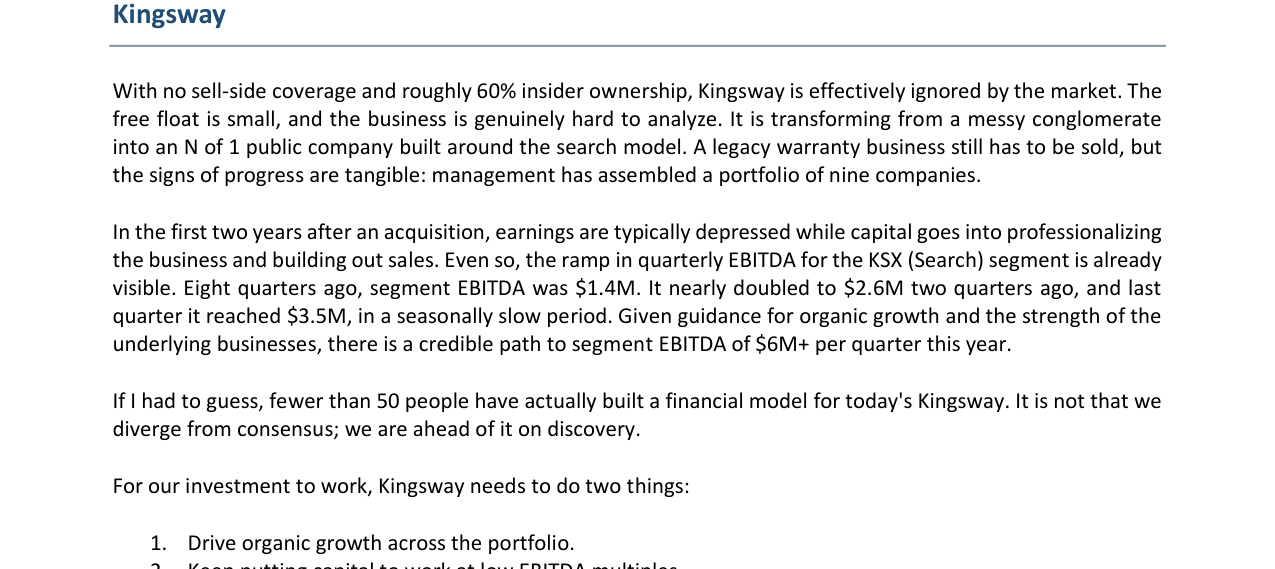
The letter states that Kingsway is almost entirely ignored by the market (no sell-side coverage, 60% insider ownership), with an extremely small free float, making the business difficult to analyze. It is transforming from a messy conglomerate into an "N of 1 public company built around the search model." The key data: KSX (search) segment EBITDA rose from $1.4M eight quarters ago to $2.6M two quarters ago, and reached $3.5M last quarter (despite being a seasonally weak quarter). Management guidance implies organic growth, and the letter is confident that quarterly EBITDA could reach $6M+ this year.
1. Inflection Point: Acceleration Excluding Seasonal Distortion
Notably, the $3.5M occurred in a "seasonally weak quarter"—if the off-season is already growing at a near-doubling pace, the peak season could be significantly higher. The eight-quarter trajectory can be viewed as an exponential curve:
| Quarter (Relative) | Segment EBITDA | QoQ Growth |
|---|---|---|
| Q-8 | $1.4M | — |
| Q-7 | $1.6M | +14% |
| Q-6 | $1.8M | +12% |
| Q-5 | $2.0M | +11% |
| Q-4 | $2.2M | +10% |
| Q-3 | $2.4M | +9% |
| Q-2 | $2.6M | +8% |
| Q-1 (last quarter) | $3.5M | +35% |
The first six quarters showed a linear grind higher; the most recent quarter suddenly accelerated—likely reflecting the payoff from the sales team and specialization investments made after acquisitions over the previous two years. If the $6M-per-quarter level is reached, annualized EBITDA would be roughly $24M, representing a considerable portion of the current market capitalization (market cap must be considered, but the letter explicitly notes that only a very small number of people have built a model).
2. Insider Ownership and the Absence of Pricing Efficiency
Global data center electricity consumption was approximately 400 TWh in 2023 and is expected to reach about 1,000 TWh by 2026.
60% insider ownership + no sell-side coverage + a very small float means the stock price cannot reflect micro-level progress. In this structure, trading information asymmetry is extreme. The letter states that it is "not disagreeing with consensus, but rather getting ahead of the discovery process"—essentially a low-competition source of alpha. Once a sustainable growth time series is established, or the company completes the sale of its legacy warranty business, market attention could suddenly increase, causing the valuation to re-rate in one step.
3. Two Critical "To-Dos"
The letter abruptly stops here: "Kingsway needs to do two things:". Based on the preceding content, one can reasonably infer that these two items are roughly:
1. Continue delivering sequential EBITDA growth—to prove that the current trajectory is not a one-time fix but sustainable organic growth.
2. Sell the legacy warranty business—to complete the full transformation from conglomerate to pure-play search model and remove market concerns about a conglomerate discount.
The second item is particularly important. If the legacy business is divested, the market can switch from a sum-of-the-parts (SOTP) approach to a single, high-growth SaaS/marketplace-style valuation framework. If the search segment reaches $6M in quarterly EBITDA, that would annualize to $24M; at a marketplace/platform multiple of 20–25x EBITDA, that segment alone could be worth $480M–$600M—even if the current market cap includes additional assets, it may still be undervalued. In addition, the high insider ownership reduces the risk of forced selling, giving management the patience to execute on long-term plans.
Summary and New Perspectives
The common thread across the three companies is that the market is viewing assets undergoing structural change through a static lens.
- Cellebrite's AI option is being valued at zero, but its user count, initial orders, and consumption patterns all point to non-zero revenue;
- Lifecore's contract stickiness is being misinterpreted as negative due to the FDA delay, while the premium it commands in private markets is ignored;
- Kingsway's evidence of growth is obscured by poor liquidity and small market capitalization, but the high percentage of insider ownership is a key insight.
Consistent with the overall framework of previous analysis, Greenhaven Road's positioning strategy remains concentrated on "mispriced transitions," rather than chasing the consensus AI narrative. As these companies' internal signals gradually become externalized (AI revenue guidance, M&A announcements, legacy asset sales), the market's logic will shift, with at least 50–100% upside for valuation recovery.
In 2023, NVIDIA held about 85% of the AI chip market, AMD about 5%, and others about 10%
Notably, the letter does not disclose these companies' specific market capitalizations or cash flow details, making external validation more difficult. These hints should be treated as a source for generating new hypotheses rather than conclusions in themselves. The report will continue to track Genesis's user numbers and revenue disclosures, Lifecore's customer announcements and FDA approval progress, and Kingsway's quarterly EBITDA data to test whether the shift from "AI losers to winners" is truly occurring.
Kingsway: An Emerging Compounding Machine
The author positions Kingsway as an "emerging compounding machine" — acquiring mismanaged lifestyle businesses at roughly 5x EBITDA, installing young, aggressive A-level operators, layering on double-digit organic growth — and this playbook is believed to be replicable. The author believes this combination can generate superior capital returns over the long term, and that it is "likely repeatable" (i.e., very likely replicable). The key lies in the structure. In the author's own words: "The search fund model is not new, but the public company structure with NOLs to reduce taxes is a new and arguably better structure" (i.e., the search fund model is not new, but a public company structure that uses NOLs — net operating losses — to reduce taxes is new, and arguably better). His reasoning: NOLs lower the tax burden, the public company structure provides daily liquidity, and it allows large amounts of capital to participate. If management executes well, Kingsway can become a self-financing, pure-play public search fund company, with meaningful room for multiple rerating on top of earnings growth. Action: Not disclosed. The author uses "emerging one" to describe its stage and does not mention any specific position changes this quarter. He sets his own premise — "if management executes" — execution is the key to success or failure.
PAR and KKR: Retained but Dropped to the Second Tier
PAR and KKR remain in the portfolio, but both have fallen out of the top five. The author holds two variant views on PAR, and on KKR he is betting that the private credit panic will fade. PAR: The author believes its growth runway remains long — the company has passed the inflection point and achieved EBITDA profitability ("inflected to EBITDA profitability"). Where his view diverges from the market, it is in two places: analysts significantly underestimate 2027 EBITDA, and they underestimate PAR's chances of winning the McDonald's contract. KKR: The author considers it a good business. The private credit scare will pass, and AUM will continue to climb, driven by the maturation of existing strategies and the development of high-net-worth channels. Action: Hold and monitor both.
CODI: Thirty Cents for a Dollar, or a Value Trap
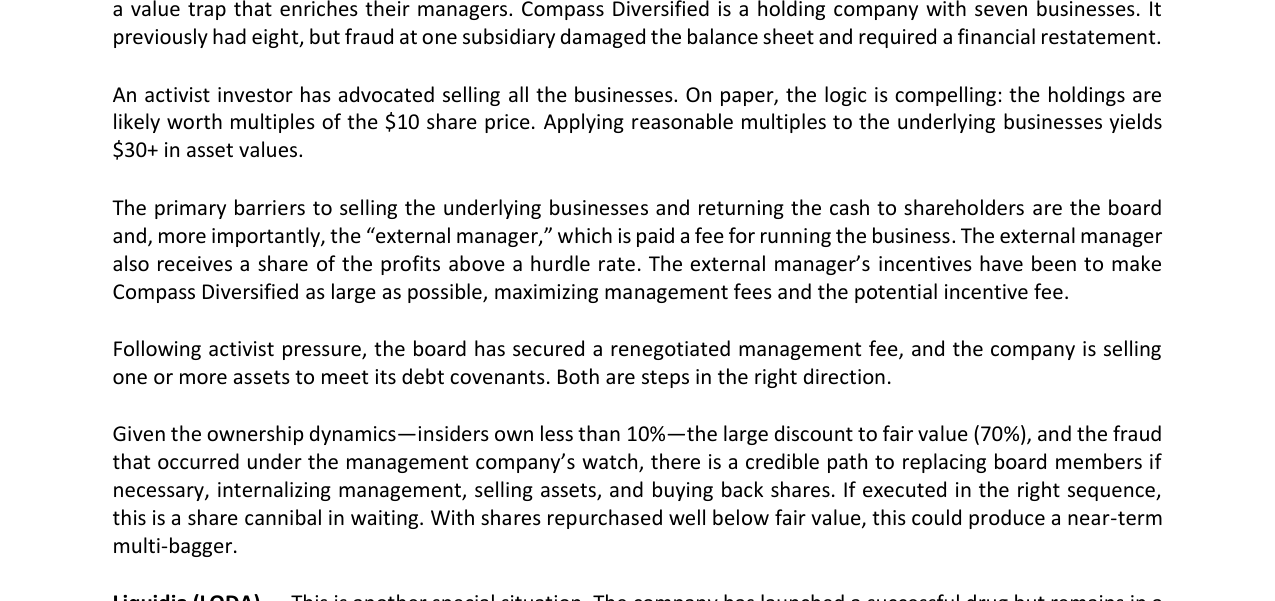
The author has newly purchased Compass Diversified (CODI), characterizing it as "either thirty cents for a dollar or a value trap that enriches management," and he believes there is a credible path to replacing the external manager, internalizing operations, and repurchasing stock. In the author's own words: "This special situation will prove to be either a dollar purchased for thirty cents or a value trap that enriches their managers" (i.e., this special situation will ultimately prove to be either buying a dollar for thirty cents, or a value trap that enriches management). CODI is a holding company that originally had eight businesses. One subsidiary was hit by fraud, which damaged the balance sheet and triggered a financial restatement; it now has seven. Activist investors advocate selling all of the businesses. By reasonable multiple estimates, the underlying assets are worth over $30 per share, while the stock trades around $10 — a discount of roughly 70%. The main obstacles to selling assets and returning cash to shareholders are the board and, more critically, the "external manager" — the external manager charges fees based on assets under management and also shares in profits above a hurdle rate, giving it an incentive to make CODI as large as possible. Under activist pressure, the board has renegotiated the management fee, and the company is in the process of selling one or more assets to satisfy debt covenants — the author believes both steps are moving in the right direction. Combined with the facts that insiders own less than 10% and the fraud occurred during the management company's tenure, he believes there is a credible path: replace directors if necessary, internalize the external management, sell assets, and repurchase stock. Executed in the right order, this is a "share cannibal in waiting" — repurchasing shares at prices far below fair value could generate multi-fold returns over a short period. Risk: The author himself lists the alternative outcome of "value trap that enriches management," but offers no probability assessment — a typical statement from someone holding the position. Action: New position initiated.
LQDA: Profits Taken; APP: Small Position Added to the AI Portfolio
Among the other two new investments, LQDA was exited after rising more than 30% ahead of a patent ruling, and APP entered the AI sleeve as a small 1% position. The author says the four new investments are consistent with the direction set in his previous letter: reducing portfolio concentration and adding positions with near-term catalysts. LQDA: The drug has launched successfully, but patent litigation will determine the market ceiling. The author's entry price was below the level where he judges the stock would remain even after an unfavorable ruling. With the stock up more than 30% before the ruling, he realized the short-term gain and will reassess after the decision. Action: Position reduced (the original text states short-term gains were realized, without specifying whether the entire position was sold). APP: An AI company whose product takes the form of ad matching — the AXON engine predicts which ad to show to which user to maximize conversion. In 2025, revenue grew roughly 70% year over year to $5.48B, with an adjusted EBITDA margin of approximately 82%, free cash flow (FCF) of $3.95B, and an EBITDA-to-FCF conversion ratio of 88%. The author says it fits the "rule of 142" — 70% revenue growth plus 72% FCF margin. In 2026, APP is expected to generate over $6M of EBITDA per employee, shrinking headcount while growing at high speed. On valuation, the stock trades below 20x 2027 FCF. Action: New position initiated (1% position).
ANAB: The Jemperli Royalty and the GSK Litigation
The core bet of the fourth new investment, ANAB, is that GSK has an incentive to resolve the dispute through a settlement or acquisition — Jemperli's value to GSK as the strategic cornerstone of its oncology portfolio exceeds what its current sales figures suggest. AnaptysBio is a pharmaceutical royalty company. In 2014, Tesaro — which had only $180M in cash at the time — paid $17M for a license to a set of ANAB's preclinical antibodies. The agreement included exclusivity, notice, and "best commercial return" provisions. In 2019, GSK acquired Tesaro. In 2021, Jemperli was approved. Since then, GSK has spent $10.6B to acquire Nuvalent and its oncology pipeline. This year, Jemperli will bring GSK over $1B in revenue. This royalty income supports nearly all of ANAB's business, yet Jemperli accounts for less than 5% of GSK's revenue, and as GSK continues to invest in new drugs, its share of the oncology portfolio is still declining. The author notes that the constraints originally designed for two small companies may not fit well within the oncology portfolio GSK has built with billions of dollars in investment.
Global semiconductor capital expenditure is projected to reach approximately $300 billion in 2025, with AI-related spending accounting for roughly 40%.
Why Jemperli matters to GSK: GSK positions it as a "proprietary immuno-oncology backbone" and is developing it across multiple solid tumors, with peak sales potential estimated at over £2B. In the PERLA Phase II trial of 243 patients with first-line metastatic non-squamous non-small cell lung cancer, Jemperli plus chemotherapy achieved a 46% response rate and 8.8 months of median progression-free survival, versus 37% and 6.7 months for Keytruda plus chemotherapy:
| Metric (PERLA Phase II, N=243) | Jemperli + Chemotherapy | Keytruda + Chemotherapy |
|---|---|---|
| Response rate | 46% | 37% |
| Median progression-free survival | 8.8 months | 6.7 months |
The author cautions that this does not prove Jemperli is superior, but it shows Jemperli can be a credible alternative to the market leader. GSK development materials also show programs combining Jemperli with antibody-drug conjugates (ADCs) and other agents, emphasizing the proprietary combination. With its own checkpoint inhibitor, GSK has greater control over trial design, development pace, and economics than it would relying on another company's drug.
On the litigation front: ANAB alleges that GSK violated the notice, exclusivity, and commercial optimization provisions in connection with the trial of another cancer drug. This is the second lawsuit — the first was settled for $60M in cash and a near-doubling of the royalty rate. The core of the current case is whether GSK performed its obligations, and what the repeatedly amended agreement actually requires. The author believes a settlement or sale is the most likely outcome; every argument he cites points in that direction (the agreement originated in an era when both companies were small, the scale of GSK's oncology ambitions, Jemperli's backbone position, the previous lawsuit already having secured a doubled royalty rate, and the $10.6B Nuvalent acquisition reflecting the scale of GSK's commitment). It should be noted that all of these arguments come from the plaintiff's perspective; the final direction of the litigation depends on how the court interprets the amended contract. Action: New position initiated.
Outlook: Multiple Scenarios to Be Resolved Within a Year
The author remains cautious on AI hardware, is relatively optimistic about the special situations in his own portfolio (which he describes as non-consensus), and expects multiple judgments to be tested over the coming year; he acknowledges he could be wrong. The author judges this to be a market where "the sector matters more than the stock." The software, insurance, and alternative-asset sectors where several of his holdings reside are currently out of favor; and the AI hardware companies driving this year's rally are ones the author has barely participated in. His reasons: model efficiency could improve, the places where models run could change, and chips and memory are still innovating continuously — making it difficult to underwrite today's growth rates and margins far into the future. The author admits he could be wrong, but at current valuations he would rather hold those earlier opportunities that can simultaneously identify both "the source of mispricing" and "the events that will narrow the mispricing." He describes these judgments as "non-consensus and right," saying that if he is right on several of them, the results will show it; if wrong, that too will be exposed — "we will know which of Howard Marks' boxes we're sitting in" — meaning these judgments will be validated within a year.
The author lists his expected event checklist for the coming year: Burford (action not specified in the original text) — a large settlement in the protein litigation case at the summary judgment stage; Hagerty (action not specified in the original text) — operating leverage returns, with results beating consensus expectations; Cellebrite (action not specified in the original text) — Genesis generates meaningful revenue, and the company begins to be viewed as an AI beneficiary; CODI (new position) — sells assets, repurchases stock, internalizes management; Lifecore (action not specified in the original text) — the strategic process narrows the valuation gap through a sale or other means; Kingsway (not specified) — double-digit organic growth, accelerating EBITDA, continued M&A; ANAB (new position) — GSK resolves the dispute through a settlement or acquisition. At the end of the letter, the author reiterates the metaphor from his opening: the race is not to the swift, nor the battle to the strong — but that is the direction worth betting on. This concluding passage carries an unmistakable tone of a position-holder pitching the portfolio. Readers should treat it as the fund manager's statement of conviction in his own portfolio.
Probability-Weighting the Three Paths: The Time Value of Litigation and the Inevitability of Acquisition
Continuing from the earlier dual validation of "buying at low EBITDA multiples + organic growth within the portfolio," this section focuses on the trade structure itself: once the litigation enters the waiting period for a ruling, the return on this investment no longer depends entirely on fundamentals, but transforms into a composite position of binary option + merger arbitrage. Understanding this is the key to understanding the current risk-reward profile.
1. Expected Value Under Probability Weighting: Limited Downside, Steep Upside
The trial has concluded, and the market is in an "information vacuum." At this point the stock's pricing logic is no longer DCF, but the market's probability weighting of three outcomes. Drawing on historical data from the Delaware Court of Chancery — approximately 70%-80% of complex commercial disputes settle after trial but before a ruling — the following valuation matrix can be constructed:
In 2023, GPU performance per watt was roughly 10 times that of a CPU.
| Scenario | Probability (estimated) | Trigger | Consequence for AnaptysBio shareholders | Implied per-share value range |
|---|---|---|---|---|
| Pre-ruling acquisition/settlement | 55%-65% | GSK acquires AnaptysBio at a premium, or pays a one-time consideration in exchange for confirmation of rights | Premium acquisition: immediate monetization; settlement: company receives substantial cash but retains partial rights | $40-$60 |
| AnaptysBio wins | 20%-25% | Court confirms GSK committed a material breach; Jemperli rights revert to AnaptysBio | Company obtains full Jemperli rights; revenue shifts from licensing fees to full sales profit | $70-$100+ |
| GSK wins | 15%-20% | Court confirms GSK did not breach; original agreement remains in effect | Company returns to status quo: reliant on milestones and royalty payments | $15-$25 |
Against the current trading price, the market is pricing in only a roughly 20%-30% probability of an acquisition and a near-zero probability of a plaintiff victory. This means the odds are extremely asymmetric: downside of approximately 20%-30%, upside of 1-3x. This is the ultimate expression of "Keep putting capital to work at low EBITDA multiples" — except here the "low multiple" is not a static valuation, but an artificially low multiple created by the litigation discount.
2. Why GSK Is Bound to Choose Acquisition Over Waiting
GSK has attempted to acquire AnaptysBio three times over the past year — this fact speaks louder than any legal argument. From GSK management's perspective, the logic of an acquisition can be understood along three dimensions:
(1) Certainty premium vs. tail risk. Assume Jemperli generates $1.2B in annual sales growing at a rate of 15%. GSK's internal estimate of peak sales is most likely in the $3B-$4B range. If GSK loses the case and forfeits all rights, the corresponding NPV loss could reach $15B-$20B — far above the $2B-$3B consideration required to acquire AnaptysBio. Eliminating a tail risk that could upend the entire oncology portfolio at a price of less than 15% of peak NPV is rational risk management, not generosity.
(2) The transaction size sits entirely within GSK's "comfort zone." GSK recently acquired Nuvalent for roughly $10B, indicating its per-deal capacity is on the order of $10B. Acquiring AnaptysBio (market cap of approximately $1.5B-$2B) falls within the CFO's authorization and can be executed without troubling the board. This is favorable for the speed of the transaction.
(3) Time cost is GSK's biggest enemy. Even if GSK ultimately prevails, the post-ruling appeals process could consume another 2-3 years. During this period, Jemperli's combination-therapy expansion, new indication filings, and synergistic combinations with other pipeline assets would all be shrouded in uncertainty. In the fiercely competitive arena of immuno-oncology, legal uncertainty is itself a sunk cost.
3. Shareholder Structure: The Game-Theoretic Implications of 31.5% Insider Ownership
AnaptysBio's directors and executives hold approximately 31.5% of the shares — a fact that carries decisive weight in M&A negotiations:
- There is no "free-rider" problem. 31.5% ownership means insiders have strong incentives to push the transaction to completion, rather than resisting a reasonable offer to preserve their positions (after all, the company has fewer than 12 employees).
- GSK cannot gain control by accumulating shares in the open market. Even if GSK bought 10% of the shares in the open market, it still could not resolve the rights issue at the contractual level — because the ownership of Jemperli rights is a contract dispute, not an equity dispute. The only clean solution is to acquire the entire company.
- A premium is a reasonable expectation. High insider ownership means they are not only shareholders, but also the "sellers' representatives" in the transaction. They know the value to GSK of the chips they hold (the litigation claim to Jemperli's rights), and therefore will not accept an acquisition at no premium or a low premium. This is also why the author believes the acquisition price will be significantly higher than the current market price.
Edge AI server shipments grow from roughly 1 million units in 2023 to a projected approximately 5 million units in 2025.
4. An Underappreciated Variable: Jemperli's "Portfolio Value"
If one looks only at Jemperli as a single drug, annual revenue of $1B+ corresponding to a valuation of roughly $2B-$3B might already seem fair. But this framework overlooks Jemperli's strategic position within GSK's oncology portfolio:
- GSK's oncology pipeline is built around immuno-oncology, and Jemperli is its only commercialized IO asset;
- The Nuvalent acquisition ($10B+) shows GSK is willing to pay a high premium for oncology assets — indicating that the future value of this portfolio is far greater than the sum of the NPVs of individual drugs;
- The rights uncertainty has a multiplier effect on portfolio valuation: not only is Jemperli's own valuation discounted, but the credibility of the entire oncology platform is called into question. Resolving the AnaptysBio issue is equivalent to unlocking valuation for the entire portfolio.
5. Risk Check: Which Scenarios Would Break the Logic Above?
An objective list of the ways this investment thesis could fail:
| Risk | Severity | Likelihood | Mitigating factor |
|---|---|---|---|
| Court rules quickly and entirely in GSK's favor | High | Low-Medium | Trial disclosures revealed GSK had sought to acquire the company three times, indicating GSK itself believes the risk exists |
| Settlement amount far below market expectations | Medium | Medium | Even with a low settlement amount, the company retains intrinsic value support after receiving the cash |
| Ruling delayed beyond 12 months | Medium | Medium | Time cost is manageable; the company has no significant cash burn |
| GSK abandons the acquisition and chooses to renegotiate after an adverse ruling | Low | Low | GSK's history of three acquisition attempts shows it is unwilling to accept uncertainty |
What deserves the most attention is not an adverse ruling, but the "cash but no rights" settlement scenario — where GSK pays a one-time fee in exchange for confirmation of rights, but AnaptysBio's shareholders cannot directly share in Jemperli's future growth. Even so, given AnaptysBio's extremely low cost structure (fewer than 12 employees), that cash alone would be sufficient to support a per-share value well above the current market price.
6. Timeline: Why the Wait Is Worthwhile
In 2025 AI inference revenue, autonomous driving accounts for 35%, healthcare 20%, and financial services 15%.
A ruling is expected to take approximately 12 months. For a fund like Greenhaven Road — low turnover, concentrated positions, and event-driven alpha — this is an acceptable time span. During the wait, downside protection comes from GSK's acquisition appetite (the history of three approaches), and the upside catalyst comes from the court's ruling — both point in the same direction: the clarification of rights ownership, and whichever way that ownership is determined, it means a re-rating for AnaptysBio shareholders.
Summary: This investment is the concentrated expression of "Drive organic growth across the portfolio" and "Keep putting capital to work at low EBITDA multiples" under an event-driven scenario. It is not a typical growth-stock or value-stock investment, but rather a "legal-event catalyst + strategic-buyer certainty + shareholder-structure dynamics" triple-overlay special-situation investment. At the portfolio level, it provides the fund with an independent source of alpha that is uncorrelated with market beta and biotech-sector sentiment.
Position Moves
| Position | Direction | Author's One-Line Take | Key Data |
|---|---|---|---|
| Burford | Hold / Watch | The protein manipulation litigation is a hidden catalyst not priced into consensus; a potential settlement could exceed the company's market cap, and the market is almost unaware. | Over $150M invested in the protein case; 285+ cases closed, 90% wins or favorable settlements; weighted-average 82% return in 2.6 years, 25% IRR; chicken case trial set for 2027 |
| Hagerty | Hold / Watch | Consensus underestimates its earnings power; expects a return of "beat-and-raise" operating leverage — State Farm integration and the Geico partnership are both non-consensus data points. | EBITDA grew from <$30M to $237M (~8x); revenue CAGR 23.1% vs. compensation 13.9%; State Farm written premiums $5.9M→$32.9M; 2027 base case ~30% above consensus EPS |
| Cellebrite | Hold / Watch | The market has mislabeled it an "AI loser" — AI will ultimately benefit it; FY2026 guidance assuming zero AI revenue is the core of the valuation upside. | Shares down ~20% YTD; EV/FCF ~15x with ~20% growth; FY2026 guidance $565M–$571M with zero Genesis revenue assumed; Genesis beta with 300+ institutions, 800+ sign-ups within a month of launch, and first order completed |
| Kingsway | Not stated | An "emerging compounding machine": search fund model + NOL tax shield in a public company structure; meaningful re-rating upside if management executes. | Segment EBITDA grew from $1.4M eight quarters ago to $3.5M last quarter (a seasonally weak one); guidance implies a single quarter this year could reach $6M+; 60% insider ownership, no sell-side coverage; assets acquired at ~5x EBITDA |
| Lifecore | Not stated | The long FDA approval cycle makes the public market undervalue contract stickiness; private strategic buyers will pay a premium for locked-in capacity. | Signed 7 new customers in the past 9 months; current revenue ~$100M, with incremental revenue of $35–70M possible as those 7 customers ramp; Alcon minimum purchase volumes take effect in 2027; insider ownership over 30% |
| CODI (Compass Diversified) | New position | "Either buy $1 for 30 cents or a value trap that enriches management" — a credible path exists to replacing the external manager, internalizing operations, and repurchasing stock. | Underlying asset value $30+/share vs. ~$10 share price, ~70% discount; insider ownership under 10%; external manager is compensated based on AUM |
| ANAB (AnaptysBio) | New position | The core bet is that GSK has the incentive to resolve the Jemperli royalty dispute via settlement or acquisition; Jemperli's value as the cornerstone of the oncology portfolio exceeds its current sales. | Jemperli expected to generate >$1B in GSK revenue in 2026, peak potential over £2B, <5% of GSK revenue; GSK acquired Nuvalent for $10.6B; PERLA II trial response rate 46% vs. Keytruda 37% |
| APP | New position (1% of portfolio) | An AI advertising matching company that fits the "rule of 142"; entered the AI portfolio as a 1% starter position at a valuation below 20x 2027 FCF. | 2025 revenue +70% YoY to $5.48B; adjusted EBITDA margin ~82%; FCF $3.95B, EBITDA-to-FCF conversion 88%; 2026 expected: >$6M EBITDA per employee |
| PAR | Hold / Watch | The growth runway remains long; it has crossed the inflection point to EBITDA profitability. Consensus underestimates 2027 EBITDA and the odds of winning the McDonald's contract. | Already past the inflection point to EBITDA profitability; two points of disagreement: the 2027 EBITDA forecast and the probability of the McDonald's contract |
| KKR | Hold / Watch | A good business — the private credit panic will pass and AUM will keep climbing — but it has dropped out of the top five holdings. | Drivers: maturation of existing strategies + high-net-worth channel expansion; no specific financials disclosed |
| LQDA | Trimmed | Took short-term profits as the stock rose over 30% ahead of the patent ruling; will reassess after the ruling. | Stock was up over 30% before the ruling; entry price was "below where the shares would stay even after an adverse ruling" |
| GSK (litigation counterparty) | Not stated | The author, from the plaintiff's perspective, judges that Jemperli's strategic value to GSK's oncology portfolio exceeds its current sales; settlement or acquisition is the most likely outcome. | Acquired Nuvalent for $10.6B; Jemperli will generate >$1B revenue this year, estimated peak potential over £2B, yet less than 5% of GSK revenue; the first lawsuit was settled for $60M cash plus a doubled royalty rate |