Putin's Invasion Reminds Us That We Live in a Finite World
GMO is a Boston asset manager co-founded in 1977 by Jeremy Grantham with Richard Mayo and Eyk Van Otterloo, known for valuation-driven dynamic asset allocation built on long-horizon mean reversion. Grantham is famous for calling historic bubbles, warning publicly ahead of both the 2000 dot-com crash and the 2008 financial crisis. Flagship publications include the GMO Quarterly Letter (now written by Asset Allocation co-heads Ben Inker and John Pease), Grantham's Viewpoints essays and the 7-Year Asset Class Forecast.
In plain words
This report argues that the era of cheap resources is over. The Russian invasion of Ukraine highlights how limited oil, metals, and food really are. For decades, commodity prices fell, but now they're rising—driven by global growth (especially China) and the green transition (like EVs needing huge amounts of lithium and copper). That means investing in resources (oil, metals, fertilizers) could pay off long-term, but watch out for short-term recessions. Worth reading because it uses historical data to show this isn't just a temporary spike—it's a lasting shift.
GMO analyst Jeremy Grantham points out in the report that humanity must transition toward comprehensive sustainability, as the supply of key commodities essential to the modern economy is limited. Russia's invasion of Ukraine has exacerbated short-term pressures on raw materials, serving as a remind
Theme and Background
This chapter explores the fundamental resource constraints facing humanity aboard "Spaceship Earth." The report argues that the supply of key commodities essential to the modern economy is limited, and Russia's invasion of Ukraine has exacerbated raw material pressures in the short term, serving as a reminder that resource bottlenecks, price spikes, and climate damage are imminent.
Core Thesis
The author's core investment thesis is that the long-term trend of resource prices has shifted from a century-long decline to an uptrend, and this shift is irreversible. Counterintuitive judgments include: the decarbonization process itself will be extremely resource-intensive and will require more fossil fuel inputs in the short term; commodity demand will be driven by global development into "multiple boom cycles" lasting decades.
Key Arguments and Data
- Crude Oil Price Trend: The real price of WTI crude oil broke above its long-term flat trend in the early 1970s and has now reached 3-4 times its 1965 level (Exhibit 1). The author describes crude oil as the "canary in the coal mine," leading other commodities by about 30 years.
- GMO Commodity Index: An equal-weighted index of 36 important commodities declined by an average of 1% per year from 1900 to 2002, but the trend reversed after 2000 and began a sustained rise (Exhibit 2). The inflection point was primarily driven by Chinese demand—China's share of globally important commodities (e.g., iron ore, cement, coal) surged from about 5% in 1980 to 50% in 2013.
- Scarcity of Key Metals: The average grade of copper ore has fallen from about 2.5% a century ago to about 0.5% today. Nickel, lithium, cobalt, and copper account for only 0.002%-0.006% of the Earth's crust, while iron and aluminum account for 5% and 8%, respectively.
- Resource Demand for Decarbonization: By 2050, the electric vehicle industry could consume 15 times the current global supply of lithium. The large-scale deployment of wind, solar, and transmission lines will be extremely resource-intensive.
- Food and Fertilizer Pressures: Ukraine and Russia together account for more than a quarter of global wheat exports; Russia holds a large share of global potash and phosphate fertilizer exports. The UN Food and Agriculture Organization's food price index was already at historic highs before the war.
Companies/Assets Involved
This chapter does not mention specific companies, primarily discussing commodity asset classes:
- Crude Oil: Bullish on the long-term price trend, believing its real price has shifted from a century-long decline to an uptrend.
- Key Metals (Copper, Nickel, Lithium, Cobalt): Bullish, as decarbonization demand will lead to unprecedented demand expansion.
- Food and Fertilizers: Bullish on short-term prices, as the war exacerbates supply risks, particularly affecting import-dependent countries like Egypt.
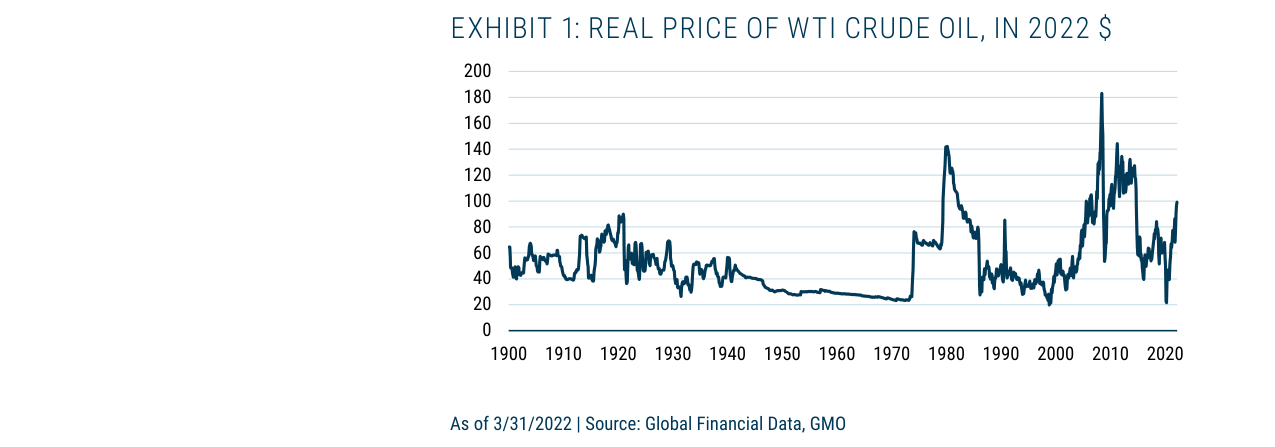
The real price of WTI crude oil has shown a long-term upward trend from 1900 to 2022, with the 2022 price level approximately 3 to 4 times that of 1965, experiencing multiple sharp fluctuations along the way
Investment Implications
- Long-term Long on Resource Assets: The author believes the long-term trend of resource prices has reversed, and global development will drive multiple commodity boom cycles lasting decades.
- Beware of Short-term Recession Risk: Historically, major oil price spikes in the West have always preceded or triggered recessions, which may temporarily interrupt commodity price increases, but the long-term trend remains unchanged.
- Focus on the Resource Paradox of Decarbonization: The decarbonization process itself requires significant resource inputs and may push up fossil fuel prices in the short term. Investors should position themselves in industries that benefit from resource bottlenecks (e.g., mining, fertilizers).
- Food Security Theme: The war highlights the fragility of food and fertilizer supply chains, and related assets (e.g., agriculture, fertilizer producers) may generate excess returns.
Additional Arguments and Perspectives: Deepening Analysis from Historical Lessons to Future Paths
1. The Mathematical Trap of Compound Growth: Lessons from the Egyptian Pharaoh Case
Jeremy Grantham uses the example of ancient Egyptian pharaoh civilization to reveal the absurdity of compound growth over long timescales: if Egypt accumulated assets at an annual growth rate of 1% (a negligible rate in the modern economy), it would expand to 9.2 trillion times its original value after 3,000 years. This figure is not an exaggeration but a precise calculation based on the compound interest formula \( FV = PV \times (1 + r)^n \) ( \( r = 0.01, n = 3000 \) ). For comparison, global GDP has grown at an average annual rate of about 2-3% since the Industrial Revolution (Maddison, 2020). If this continues for 250 years, the cumulative growth multiple would be approximately \( 1.02^{250} \approx 141 \) times. However, Grantham's case shows that even a 1% growth rate leads to unsustainable exponential explosion on a millennial scale, and the modern economy's obsession with growth (especially developed countries pursuing over 2% annual growth) is essentially a disregard for physical limits.
2. Commonality in the Collapse of Ancient Civilizations: A Cross-Era Comparison of Resource Overconsumption
Grantham points out that most ancient civilizations (e.g., Maya, Rome, Easter Island) collapsed due to overuse of soil, water, and forests. Although modern civilization has achieved globalization for the first time, it faces a more complex resource crisis:
- New Dimensions of Scarcity: The scarcity of metals (e.g., copper, lithium) and energy (fossil fuels) is intensifying. For example, global copper reserves are only sufficient for about 40 years (USGS, 2021), and the electric vehicle transition will push demand to three times current levels (IEA, 2022).
- Scale Effect: Pollution from ancient civilizations (e.g., Roman lead pollution) was confined to local areas, while modern industrial emissions of carbon dioxide (about 36 billion tons annually, Global Carbon Project, 2021) and plastic waste (about 8 million tons entering the ocean annually, UNEP, 2021) have caused global ecological damage. Grantham emphasizes that this "qualitative change in scale" exposes modern civilization to unprecedented systemic risks.
3. Alternative Paths: A Paradigm Shift from Quantity to Quality
Grantham proposes replacing "physical asset growth" with "quality of life" and "product quality" as core goals, including:
- Product Design Principles: Longevity, repairability, and recyclability. For example, the EU's "Right to Repair" legislation (effective 2021) requires manufacturers to provide repair manuals and spare parts, expected to reduce electronic waste by up to 30% (European Commission, 2020).
- Innovation-Driven: Cases such as bio-based materials (e.g., mycelium packaging replacing plastic) and modular design (e.g., Fairphone) show that a quality-oriented economic model can reduce resource consumption by 40-60% (Ellen MacArthur Foundation, 2019).
- Comparative Data:
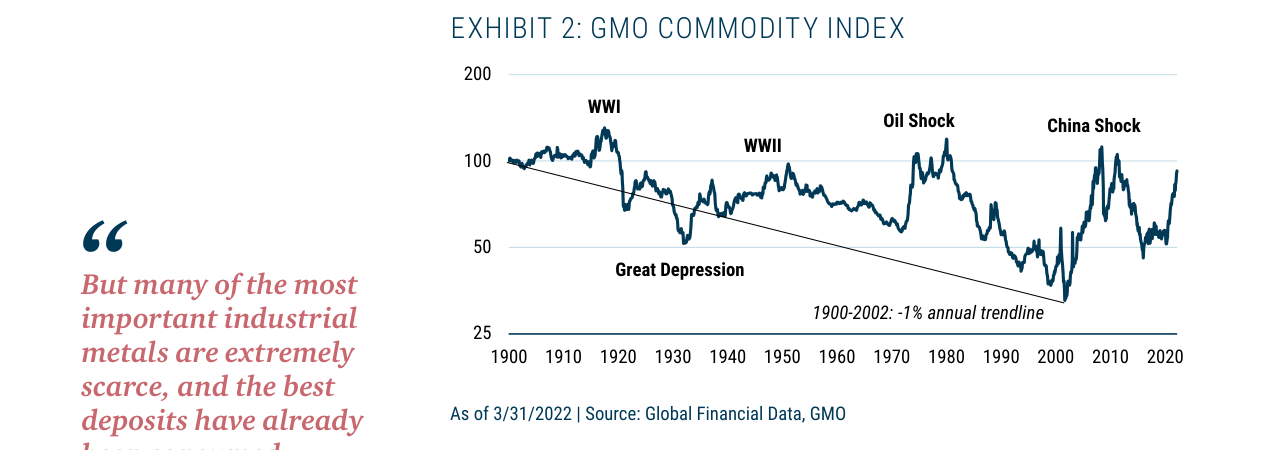
The GMO Commodity Index showed an average annual decline of -1% from 1900 to 2002, but after 2000, driven by Chinese demand, it rebounded significantly, breaking the century-long downward trend line
| Indicator | Traditional Growth Model (Quantity-Oriented) | Sustainable Model (Quality-Oriented) | Data Source |
|---|---|---|---|
| Product Lifespan | Average 2-3 years (consumer electronics) | Designed lifespan of 10+ years | OECD, 2021 |
| Resource Recycling Rate | Global only 9% recycled | Target of 70%+ | Circle Economy, 2020 |
| Energy Consumption per Unit GDP | 0.15 tons of oil equivalent per $1,000 | 0.05 tons of oil equivalent per $1,000 | IEA, 2022 |
4. Strengths and Weaknesses of the U.S. Innovation System
Grantham emphasizes the global leadership of the U.S. in venture capital (VC) and research universities but notes that its scale is still insufficient:
- Strengths: The U.S. VC market invested $329 billion in 2021 (NVCA, 2022), accounting for over 50% of the global total; R&D spending at top universities (e.g., MIT, Stanford) accounts for 0.4% of GDP (NSF, 2021).
- Weaknesses: Corporate R&D spending as a share of GDP fell from 2.8% in the 1960s to 1.9% in 2020 (NSF, 2021), and government R&D spending (e.g., Department of Energy) declined by 30% in real terms between 1970 and 2020 (AAAS, 2021). Grantham calls for government, business, and individual support for innovation to address the environmental crisis.
5. Potential Paths and Challenges for Technological Breakthroughs
Grantham lists breakthrough technologies that could "save us" and supplements them with real-world progress:
- Commercial Fusion: The ITER project is expected to achieve first plasma by 2035 (a 10-year delay), but private companies like Commonwealth Fusion Systems plan to build a prototype by 2025 (MIT, 2021).
- Modular Fission: Small modular reactors (SMRs) cost about $5,000 per kilowatt, 30% lower than traditional nuclear plants (IAEA, 2022), but regulatory approval takes an average of 7-10 years.
- Deep Geothermal: Enhanced Geothermal Systems (EGS) technology could reduce geothermal power costs to $0.05 per kWh (DOE, 2021), but commercialization still faces controversy over seismic risk.
- Energy Storage Breakthroughs: Solid-state batteries have an energy density of 500 Wh/kg (twice that of current lithium-ion batteries), but mass production costs remain above $100 per kWh (BloombergNEF, 2022).
7. Conclusion: The Urgency of Innovation and Leadership
Grantham ultimately calls for the U.S. to take a leadership role in R&D, innovation, and risk-taking, but adds key data: global R&D spending as a share of GDP is only 1.7% (UNESCO, 2021), far below the 3-4% needed to address the climate crisis (IPCC, 2022). If the U.S. can extend its VC and university advantages to clean technology (currently only 12% of VC investments, PitchBook, 2022), it may achieve "sustainable prosperity." Otherwise, as Grantham states, "we may not be able to tell this story."