Chinese SOE Debt
GMO is a Boston asset manager co-founded in 1977 by Jeremy Grantham with Richard Mayo and Eyk Van Otterloo, known for valuation-driven dynamic asset allocation built on long-horizon mean reversion. Grantham is famous for calling historic bubbles, warning publicly ahead of both the 2000 dot-com crash and the 2008 financial crisis. Flagship publications include the GMO Quarterly Letter (now written by Asset Allocation co-heads Ben Inker and John Pease), Grantham's Viewpoints essays and the 7-Year Asset Class Forecast.
In plain words
This report is about Chinese state-owned enterprise (SOE) bonds. Some recent defaults by companies like Huachen Automotive and Yongcheng Coal have scared investors. But the author argues these aren't real SOEs—they aren't directly controlled by the central government. Real SOEs (like State Grid or ICBC) rarely default. So don't panic-sell all SOE bonds. Instead, learn to tell which ones are truly backed by the government. This report is worth reading because it helps you avoid being misled by market fear and pick safer bonds.
GMO's research report updates its discussion on Chinese state-owned enterprise (SOE) debt, with the core argument being that SOE defaults are rare, but only under its strict definition of "true SOEs." The report points out that recent defaulters such as Huachen Automotive, Yongcheng Coal and Electri
Theme and Background
This chapter is the introduction to GMO’s white paper "Chinese SOE Debt: The Mystery of SOE Debt Updated," published in February 2021. The report aims to address market panic triggered by recent defaults of Chinese state-owned enterprises (SOEs), clarify GMO’s strict definition of "true SOEs," and reiterate its core investment thesis: under proper screening, defaults among SOEs are rare.
Core Thesis
The report’s core investment thesis is that the recent defaulting Chinese SOEs (e.g., Huachen Automotive, Yongcheng Coal and Electricity, Peking University Founder Group, Tsinghua Unigroup) are not "true SOEs" as defined by GMO, and thus these defaults do not represent a "systemic shift" in the market. GMO argues that through its proprietary "sovereign support probability" scoring system, it can identify quasi-sovereign entities closely tied to the sovereign, which carry no mispriced idiosyncratic default risk and offer healthy spreads and alpha relative to the sovereign.
Key Arguments and Data
- Characterization of Default Cases: The report explicitly states that recent defaulters such as Huachen Automotive, Yongcheng Coal and Electricity, Peking University Founder Group, and Tsinghua Unigroup are not directly or indirectly controlled by the central government through SASAC, Huijin, or the Ministry of Finance, and therefore do not qualify as "true SOEs."
- Scoring System: GMO ranks SOEs using the "GMO Proximity Score," from high to low. On the left, entities like China Development Bank are considered highly tied to the sovereign (analogous to Fannie Mae in the U.S.), while on the right, defaulting firms score extremely low.
- Rating Agency Issues: The report criticizes local rating agencies for assigning excessively high ratings (e.g., "AAA") to defaulting firms and cites a Financial Times article from December 15, 2020, titled "China suspends top rating agencies as defaults rattle markets," implying that investors should not rely on rating agencies.
Comparative Data (Based on Original Charts):
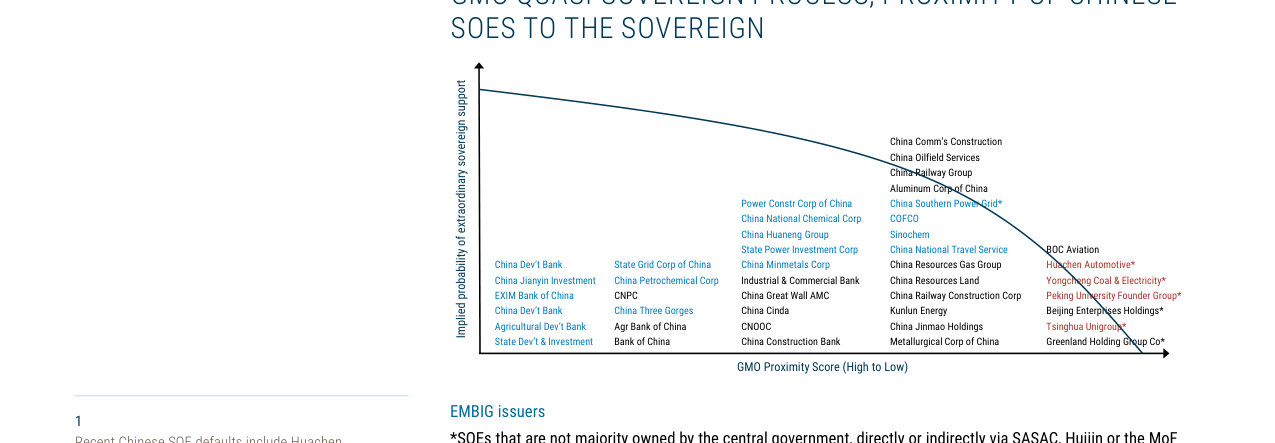
This chart displays GMO’s ranking of Chinese SOEs by proximity to the sovereign, with the horizontal axis ranging from high (left) to low (right) proximity. Entities on the left, such as China Development Bank and State Grid, are considered highly tied to the sovereign, while those on the right, such as Huachen Automotive, Yongcheng Coal, and Greenland Holdings, are recent defaulters deemed barely SOEs.
| Category | High Sovereign Support Probability (Left) | Low Sovereign Support Probability (Right/Default) |
|---|---|---|
| Representative Entities | China Development Bank, State Grid, China National Petroleum Corporation, Industrial and Commercial Bank of China | Huachen Automotive, Yongcheng Coal and Electricity, Peking University Founder Group, Tsinghua Unigroup |
| Ownership Structure | Direct/indirect control by central government via SASAC, Huijin, or Ministry of Finance | Not majority-controlled by central government |
| Default History | No recent defaults | Recent defaults have occurred |
Companies/Assets Involved
- China Development Bank: Considered a quasi-sovereign entity highly tied to the sovereign, analogous to Fannie Mae in the U.S.
- Huachen Automotive: A recent default case, deemed by GMO as "barely an SOE."
- Yongcheng Coal and Electricity: A recent default case with a very low score.
- Peking University Founder Group: A recent default case with offshore USD bonds (a CEMBI index constituent).
- Tsinghua Unigroup: A recent default case with offshore USD bonds (a CEMBI index constituent).
- Other High-Scoring Entities: State Grid, China National Petroleum Corporation, Industrial and Commercial Bank of China, China Construction Bank, China Railway Group, etc., all considered closely tied to the sovereign.
Investment Implications
- Specific Guidance for Investors: The report advises investors not to panic-sell all Chinese SOE bonds due to recent defaults. Instead, they should use independent research (rather than relying on rating agencies or historical support expectations) to screen for "true SOEs" highly tied to the sovereign. GMO believes its curated SOE portfolio can deliver healthy spreads and alpha relative to the sovereign, without mispriced idiosyncratic default risk.
- Risk Warning: The report emphasizes that investors must conduct their own research, as "definitions of SOEs may differ" and historical support expectations are unreliable.