Sovereign Contingent Bonds
GMO is a Boston asset manager co-founded in 1977 by Jeremy Grantham with Richard Mayo and Eyk Van Otterloo, known for valuation-driven dynamic asset allocation built on long-horizon mean reversion. Grantham is famous for calling historic bubbles, warning publicly ahead of both the 2000 dot-com crash and the 2008 financial crisis. Flagship publications include the GMO Quarterly Letter (now written by Asset Allocation co-heads Ben Inker and John Pease), Grantham's Viewpoints essays and the 7-Year Asset Class Forecast.
In plain words
This report looks at how emerging-market countries (like Honduras or Egypt) struggle with debt during global crises like COVID-19. Existing ways to reduce debt are too costly or complex. The author suggests a simple fix: add a 'defer payment' option to bond contracts, letting countries skip one or two interest payments during a crisis but pay them later. This is more practical than fancy ideas like GDP-linked bonds (where interest depends on economic growth). For everyday investors, it means checking bond contracts for such clauses, as they affect your risk of getting paid on time.
The GMO white paper argues that emerging market countries are facing a global crisis not of their own making, with some already experiencing external debt defaults. Traditional sovereign debt restructuring is costly for both creditors and debtors, while private sector participation in "comprehensive
Theme and Background
This chapter examines the debt distress faced by emerging market countries during global crises not of their own making (such as the COVID-19 pandemic) and the limitations of existing debt relief mechanisms. The report notes that the frequency of global crises is increasing (roughly once every 10–12 years), and the investment scope for emerging market sovereign bonds has expanded to nearly 100 countries, with localized crises becoming more frequent due to policy missteps and the threat of climate change.
Core Argument
The author's central thesis is that traditional sovereign debt restructuring is costly for both debtors and creditors, while "comprehensive" debt relief involving the private sector is difficult to advance due to institutional, practical, and reputational constraints. The report proposes drawing on the payment-in-kind (PIK) structure from the high-yield bond market by embedding a PIK option in bond contracts. This could serve as a simple, low-cost, self-regulating liquidity relief measure, supplementing assistance from multilateral and bilateral creditors.
Counterintuitive judgment: The author argues that most existing sovereign contingent obligation (SCO) instruments (such as GDP-linked bonds and hurricane clauses) are issued after a default, serving as "sweeteners" rather than preventive measures, and often target past crises rather than future risks. For example, Grenada's hurricane clause failed to cover a global pandemic.
Key Arguments and Data
- Crisis Frequency: Global crises occur every 10–12 years and are exacerbated by globalization and interconnectedness.
- Failure of Debt Relief Initiatives: The G20's Debt Service Suspension Initiative (DSSI) required private sector participation but was abandoned due to the following constraints:
- Institutional constraints: Lack of an international sovereign bankruptcy mechanism.
- Practical constraints: Bondholders and private creditor groups are large and fragmented, making collective action difficult.
- Reputational constraints: Many countries (e.g., B-rated Honduras, Bahrain, Egypt, and investment-grade Philippines, Mexico, Chile) value their long-term credibility with the financial community and could access market financing to address the pandemic; while countries with damaged reputations (e.g., Argentina, Ecuador) defaulted again.
- Historical SCO Cases:
- 1780: Massachusetts issued "depreciation notes" with interest linked to a basket of commodities.
- 1970s: Mexico issued oil-price-linked bonds.
- 1980s–1990s: Costa Rica, Bulgaria, and Bosnia issued GDP-linked warrants (increasing coupon rates when GDP exceeded a threshold).
- 2015: Grenada's debt restructuring included a "hurricane clause" providing debt relief during disasters.
- 2015–2016: The Bank of England team designed GDP-linked bonds, but they were not widely adopted.
Comparative Data Table:
| Instrument Type | Issuance Year/Country | Trigger Condition | Issuance Timing | Limitations |
|---|---|---|---|---|
| Depreciation Notes | 1780, Massachusetts | Commodity prices | Preventive | Historical case, not replicated |
| Oil-Price-Linked Bonds | 1970s, Mexico | Oil prices | Preventive | Specific to a single commodity |
| GDP-Linked Warrants | 1980s–1990s, Costa Rica, etc. | GDP exceeds threshold | Post-default | Served as "sweetener," not preventive |
| Hurricane Clause | 2015, Grenada | Hurricane | Preventive | Covers only natural disasters, not pandemics |
| GDP-Linked Bonds | 2015–2016, Bank of England design | GDP decline | Preventive | Not adopted by the market |
Companies/Assets Involved
- Sovereign States (Debtors):
- B-rated countries (Honduras, Bahrain, Egypt): Have good payment records and could partially access bond markets to address the pandemic.
- Investment-grade countries (Philippines, Mexico, Chile): Also utilized market financing.
- Countries with damaged reputations (Argentina, Ecuador): Chose to default again, highlighting the impact of reputational constraints on debt relief.
- Creditors: Include multilateral creditors (e.g., World Bank), bilateral creditors (e.g., export credit agencies), and private creditors (bondholders). The report emphasizes the difficulty of private creditor participation.
- G20: Promoted the DSSI plan, but private sector participation failed.
Investment Implications
- For Emerging Market Bond Investors: Traditional debt restructuring and comprehensive relief mechanisms are costly and inefficient. A PIK option could offer more flexible liquidity relief. Investors should monitor whether such clauses are embedded in bond contracts to assess repayment risk during crises.
- For Sovereign Bond Issuers: A preventive PIK structure could reduce default probability, maintain market reputation, and avoid a surge in financing costs after reputational damage. For example, the default cases of Argentina and Ecuador show that reputational loss can long-term affect market access.
- For Policymakers: Existing SCO instruments (e.g., GDP-linked bonds) are complex and have not gained market acceptance. A PIK structure is simpler and lower-cost, serving as a supplementary solution, but issues regarding trigger condition definitions and investor acceptance need to be addressed.
Core Barrier to Market Acceptance: The Dual Dilemma of Practicality and Complexity
Although instruments like GDP-linked bonds are theoretically attractive, their actual market acceptance is extremely low. GMO analysis attributes this to the combined effect of low practicality and high complexity. Specifically:
- Timing Contradiction: GDP data releases have significant lags (e.g., a 2020 recession would only be confirmed in 2021), while sovereign states need immediate debt relief during crises. This time mismatch renders the instrument nearly ineffective in crisis response.
- Calculation Complexity: Nominal GDP calculation involves real output, inflation indicators, and exchange rates (if denominated in USD), all of which are subject to manipulation risk. For example, Argentina has repeatedly adjusted its inflation statistics, reducing the credibility of its GDP data.
- Pricing Difficulty: Existing GDP warrants (e.g., Argentina and Greece cases) rely on Monte Carlo simulations, but historical data may diverge from future scenarios. For instance, Greece's 2002 GDP warrant paid far less than model projections due to an unexpectedly strong economic recovery.
- Clause Ambiguity: Preventive clauses (e.g., Grenada's hurricane clause) require precise definitions of trigger conditions (e.g., whether a Category 3 hurricane applies), increasing legal costs and execution uncertainty.
Comparative Data: The global issuance of GDP-linked bonds (as of 2020) was less than $5 billion, while the total outstanding emerging market sovereign bonds exceeded $3 trillion, representing a share of only 0.17%. In contrast, although the issuance of PIK bonds in the high-yield market has declined, there was still approximately $12 billion outstanding in 2020.
Simplified Solution: The Design Logic of Sovereign "Contingent Convertible Bonds" (Sovereign Coco)
GMO's proposed alternative combines features of high-yield market PIK/toggle bonds and bank subordinated contingent convertible (coco) bonds, with the core goal of maximizing simplicity and practicality:
- Pure PIK Mechanism: The issuer has the right to skip two consecutive coupon payments once during the bond's life, without triggering any external conditions (e.g., CDS spreads, GDP growth, or natural disaster parameters). Skipped coupon payments are automatically added to the principal, and future interest is calculated on the adjusted principal.
- Self-Regulating Mechanism: This option can be used only once, and the market constrains abuse through a "repeated game" mechanism. For example, if a country uses this option during a non-crisis period, its bond spreads would surge, significantly increasing future financing costs. Historical data shows that sovereign bond spreads typically react to defaults or delayed payments by more than 200 basis points (e.g., Ecuador's spreads rose from 600 bps to over 2,000 bps after its 2020 default).
- Financial Impact: From a net present value (NPV) perspective, if risk premium adjustments are ignored, bondholders suffer no loss regardless of when the option is used (only a delay in cash flows). Therefore, the additional yield required at initial issuance is extremely low (estimated at less than 50 bps).
Comparison with Existing Instruments:
| Feature | GDP-Linked Bonds | Traditional PIK Bonds | GMO Sovereign Coco |
|---|---|---|---|
| Trigger Condition | GDP growth, inflation, exchange rate | None (issuer's discretion) | None (issuer's discretion) |
| Usage Frequency | Calculated for each payment | Typically unlimited | Once (two consecutive periods) |
| Pricing Complexity | High (requires Monte Carlo simulation) | Low (based on credit spreads) | Low (based on credit spreads) |
| Legal Cost | High (requires detailed clauses) | Low (standardized clauses) | Low (standardized clauses) |
| Market Acceptance | Extremely low (<0.2% share) | Moderate (high-yield market) | To be verified |
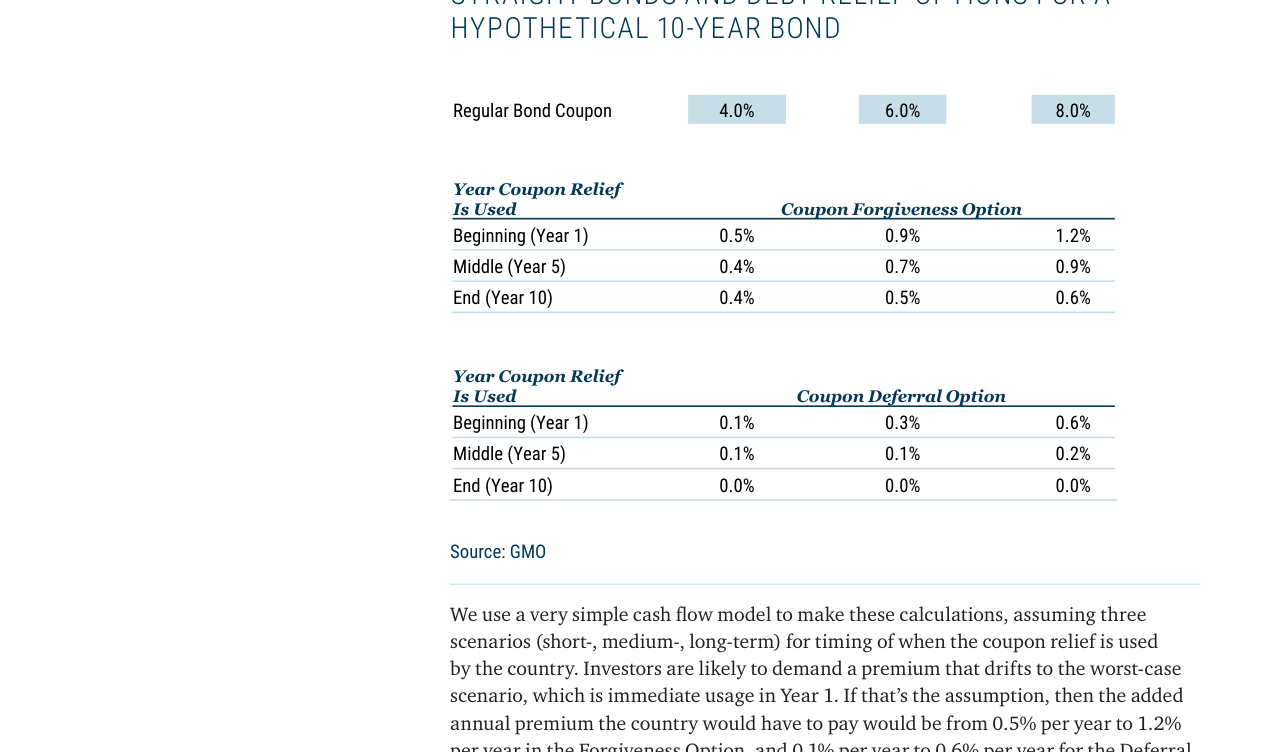
The table shows that for hypothetical 10-year bonds with coupon rates of 4.0%, 6.0%, and 8.0%, the additional yield premium required for using the Coupon Forgiveness Option in years 1, 5, and 10 is 0.5%–1.2%, 0.4%–0.9%, and 0.4%–0.6%, respectively, while the cost of the Coupon Deferral Option is significantly lower (0.0%–0.6%).
Practical Application Scenarios and Limitations
- Applicable Countries: Suitable for countries facing short-term liquidity crises but with manageable debt sustainability. For example, if Ecuador had this option in March 2020, it could have avoided default (its 2020 maturing bonds had principal and interest of about $1 billion, while the PIK option could have provided a six-month buffer). Belize capitalized coupons through a consent solicitation in 2020, incurring legal and advisory costs of approximately $5 million, which the GMO scheme could have entirely avoided.
- Inapplicable Countries: Limited effectiveness for countries with unsustainable debt (e.g., Lebanon, with a debt/GDP ratio over 170%) or questionable willingness to pay (e.g., Argentina, where political games have led to multiple defaults). These countries require principal write-downs rather than liquidity support.
- Potential Risks: The risk of political abuse is low (only one opportunity), but "moral hazard" must be considered—if the market expects a country to use the option, it could push up initial issuance spreads. However, historical data shows that "one-time deferred payment" clauses in sovereign bonds (e.g., similar clauses in Uruguay's 2012 "GDP-linked bond") did not lead to a significant increase in spreads.
Conclusion: A Paradigm Shift from "Theoretical Perfection" to "Practical Feasibility"
The core innovation of the GMO proposal lies in abandoning complex economic indicator linkages in favor of a simple mechanism based on issuer discretion. This design draws on the successful experience of bank coco bonds after the 2008 financial crisis (global issuance grew from $5 billion in 2009 to $120 billion in 2019) but removes their complex trigger conditions (e.g., capital adequacy thresholds). For the emerging market sovereign bond market, this "low-barrier, high-flexibility" instrument may have greater potential for adoption than GDP-linked bonds, especially in the context of the global liquidity crisis triggered by the COVID-19 pandemic.
Theme and Background
This section focuses on an extreme debt relief mechanism in sovereign bonds—the "Forgiveness Option." This mechanism allows the issuing country to skip two consecutive semi-annual coupon payments under specific conditions without providing any compensation to bondholders (i.e., without triggering PIK). The author places it at the far end of the spectrum from "liquidity relief" to "debt relief," analyzing its cost impact on the issuer.
Core Viewpoint
The author clearly concludes that the forgiveness option is a pure debt relief tool, carrying the highest cost for the issuer. Because it requires investors to bear the risk of principal loss, the issuer must compensate investors by paying a higher coupon premium, which significantly increases financing costs.
Key Arguments and Data
- Mechanism Definition: Allows the issuing country to skip two consecutive semi-annual coupon payments (i.e., no interest payment for one year) without generating any PIK (payment-in-kind) or subsequent recovery obligations.
- Cost Logic: Since investors face the risk of permanent loss of coupon payments, this option is regarded as "pure debt relief," and thus the additional yield premium the issuer must pay is the highest on the spectrum.
- Implicit Comparison: Compared to the PIK option (which allows deferred interest payments but accumulates interest), the forgiveness option offers no compensation, leading investors to demand a higher risk premium.
Companies/Assets Involved
This section does not mention specific companies or countries, focusing solely on sovereign bonds as the subject of analysis, with an emphasis on bond contract clause design.
Investment Implications
- For Issuers: The forgiveness option should only be used as a last resort in extreme circumstances, as its high financing costs may offset the short-term benefits of debt relief. It is advisable to prioritize lower-cost liquidity relief mechanisms such as PIK.
- For Investors: If a bond includes a forgiveness option, it is necessary to assess the alignment between the issuing country's credit risk and the premium compensation. A high premium may reflect the market's pricing of default probability, but investors must be wary of the risk of principal loss.
- Policy Recommendations: Sovereign bond design should avoid directly adopting pure relief clauses, instead opting for a gradual relief structure that can trigger PIK, balancing the issuer's liquidity needs with investor protection.
Theme and Background
This chapter examines the specific design, pricing, and feasibility of embedding a "Deferral Option" in sovereign bonds as a debt relief tool. This mechanism allows the issuing country to postpone interest payments to maturity under specific circumstances, serving as a compromise between a Capitalization Option and a Forgiveness Option. The report quantifies the premium that countries of different credit ratings would need to pay to obtain this option, using a hypothetical 10-year bond model.
Core Argument
The author argues that the Deferral Option strikes a balance between cost and flexibility—its cost is lower than that of a Forgiveness Option (full interest waiver) but higher than that of a Capitalization Option (interest capitalization). This mechanism is most attractive to sovereigns with moderate-to-weak credit quality (e.g., single-B rated), while for investment-grade countries, their "self-insurance" capacity may render the option less cost-effective. The author emphasizes that the Deferral Option is particularly suitable for addressing localized crises such as natural disasters or fiscal shocks, and that a large number of countries could have benefited from it this year.
Key Arguments and Data
The report calculates the additional yield (i.e., "insurance premium") required by investors under different scenarios using a cash flow model, assuming a 10-year bond term and that the issuing country can exercise the relief right in any two consecutive semi-annual periods. The model considers three exercise timings: early (Year 1), mid-term (Year 5), and at maturity (Year 10), and assumes investors price the bond based on the worst-case scenario (i.e., immediate exercise).
Table 1: Break-even Yield Differences Between Conventional Bonds and Debt Relief Options (Assuming 10-Year Bonds)
| Conventional Bond Coupon | Forgiveness Option (Exercised in Year 1) | Forgiveness Option (Exercised in Year 5) | Forgiveness Option (Exercised in Year 10) |
|---|---|---|---|
| 4.0% | 0.5% | 0.4% | 0.4% |
| 6.0% | 0.9% | 0.7% | 0.5% |
| 8.0% | 1.2% | 0.9% | 0.6% |
| Conventional Bond Coupon | Deferral Option (Exercised in Year 1) | Deferral Option (Exercised in Year 5) | Deferral Option (Exercised in Year 10) |
|---|---|---|---|
| 4.0% | 0.1% | 0.1% | 0.0% |
| 6.0% | 0.3% | 0.1% | 0.0% |
| 8.0% | 0.6% | 0.2% | 0.0% |
Key Data Interpretation:
- For an investment-grade country with a 4.0% coupon, the annualized premium for the Deferral Option is only 0.1% (worst-case scenario), while the Forgiveness Option requires 0.5%.
- For a single-B rated country with an 8.0% coupon, the Deferral Option premium is 0.6%, compared to 1.2% for the Forgiveness Option.
- If the exercise is delayed to Year 10, the Deferral Option premium drops to 0.0%, indicating that its cost is sensitive to short-term liquidity pressures.
Companies/Assets Involved
This chapter does not mention specific companies or sovereign bond names but analyzes sovereign issuers of different credit ratings through hypothetical cases:
- Investment-Grade Countries (4.0% Coupon): The author believes these countries have strong "self-insurance" capacity, making it highly likely they would pay a 0.1% premium for the Deferral Option, but their willingness to pay a 0.5% premium for the Forgiveness Option is questionable.
- Single-B Rated Countries (8.0% Coupon): These countries are highly likely to pay a 0.6% premium for the Deferral Option, while paying a 1.2% premium for the Forgiveness Option is "perhaps" feasible. The author further notes that such countries are more likely to choose the Capitalization Option (with near-zero cost).
Investment Implications
- Implications for Emerging Market Bond Investors: The Deferral Option provides investors with a quantifiable risk hedging tool. For investors holding single-B rated sovereign bonds, if the bond includes this clause, they need to assess whether the additional 0.6% premium adequately compensates for the potential risk of delayed interest payments. For investment-grade bonds, the 0.1% premium may be accepted by the market, but caution is warranted regarding the issuing country's potential misuse of the clause during extreme crises.
- Implications for Sovereign Issuers: Countries with weaker credit quality should prioritize the Deferral Option or Capitalization Option over the Forgiveness Option to reduce financing costs. The report recommends clearly defining the conditions for use in the contract (e.g., limited to natural disasters or fiscal shocks) to prevent moral hazard and enhance market trust.
- Implications for Policymakers: This mechanism can streamline the debt restructuring process, avoiding high legal and advisory fees. The author believes that market forces are sufficient to discipline irresponsible issuers, thus no additional regulatory intervention is needed.