Fear and the Psychology of Bear Markets
GMO is a Boston asset manager co-founded in 1977 by Jeremy Grantham with Richard Mayo and Eyk Van Otterloo, known for valuation-driven dynamic asset allocation built on long-horizon mean reversion. Grantham is famous for calling historic bubbles, warning publicly ahead of both the 2000 dot-com crash and the 2008 financial crisis. Flagship publications include the GMO Quarterly Letter (now written by Asset Allocation co-heads Ben Inker and John Pease), Grantham's Viewpoints essays and the 7-Year Asset Class Forecast.
In plain words
This piece explains how fear makes investors act irrationally in bear markets. It cites an experiment where people with brain damage who can't feel fear invested about 85% of the time in a favorable coin-flip game, while normal people dropped to 40% after a loss—even though the odds were in their favor. For regular investors, the takeaway is that fear during market downturns stops you from buying at low prices, and you need rational analysis (like checking if valuations are cheap) to override it. Worth reading because it uses science to show why 'be greedy when others are fearful' is so hard to follow.
GMO Research Report: Fear and the Psychology of Bear Markets, authored by James Montier on March 25, 2020, explores the role of fear in bear markets. The core argument is that markets are driven by fear and greed, but the human brain's emotional system (X-system) takes precedence over the cognitive
Theme and Background
This chapter focuses on the dominant role of fear in bear markets. Author James Montier points out that the pendulum of market sentiment has swung from greed to fear, and the physiological mechanism by which the human brain's emotional system (X-system) takes precedence over the cognitive system (C-system) causes investors to systematically miss opportunities after declines. Currently, global market valuations have compressed significantly (Shiller P/E at low levels), but fear hinders rational buying.
Core Views
- Fear is the most destructive irrational force in bear markets: After suffering losses, investors drastically reduce risk-taking due to fear, even abandoning investment opportunities with positive expected value.
- Emotional responses far outpace rational analysis: The X-system (emotional system) reacts about three times faster than the C-system (cognitive system), allowing fear to dominate behavior before rational assessment intervenes.
- Counterintuitive insight: Brain-damaged patients unable to feel fear exhibit superior investment behavior (nearly 85% participation rate), while normal individuals see participation rates plummet to around 40% after losses—fear itself is the root of poor decisions, not rational calculation.
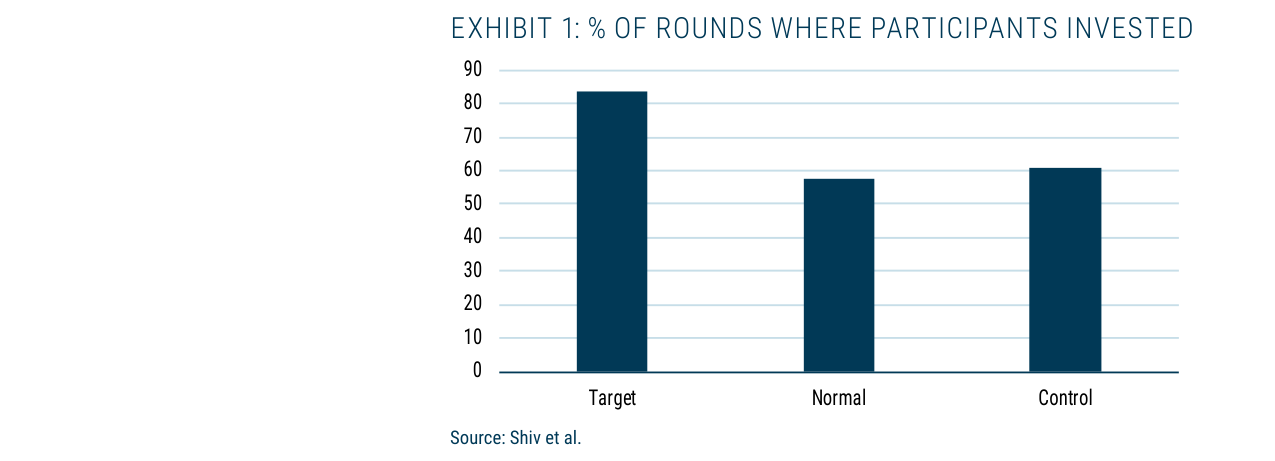
The Target group, unable to feel fear, invested at a rate of approximately 85%, while the Normal and Control groups invested at only about 60%
Key Arguments and Data
1. Shiv et al. (2005) Coin Toss Experiment:
- Game rules: 20 rounds of coin tosses, with $1 invested per round. Heads wins $2.50 (net profit of $1.50), tails loses $1. Expected value per round is $1.25, total expected value $25 (starting capital $20).
- Optimal strategy: Invest every round, as there is only a 13% probability of a final return below $20 (the outcome of not participating).
- Group results:
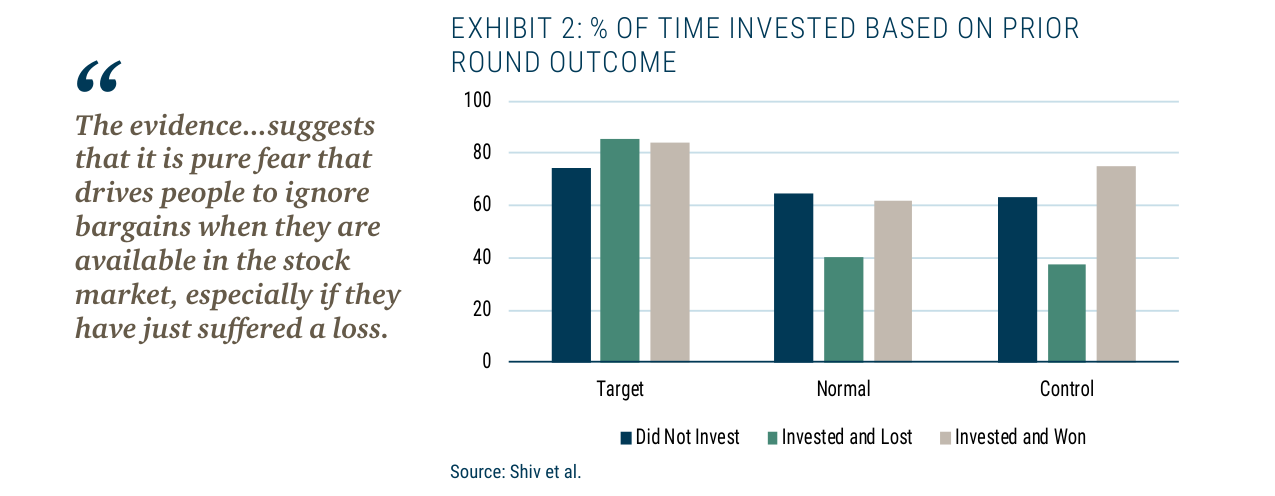
After experiencing losses, the Normal and Control groups' subsequent investment rates plummeted to about 40%, while the Target group remained at approximately 85%
| Group | Characteristics | Investment Rate Across All 20 Rounds | Investment Rate in Round After a Loss |
|---|---|---|---|
| Target Group | Brain damage preventing fear | Approximately 85% | Approximately 85% |
| Normal Group | Normal individuals | Approximately 60% | Approximately 40% |
| Control Group | Other brain damage (not affecting emotions) | Approximately 60% | Approximately 40% |
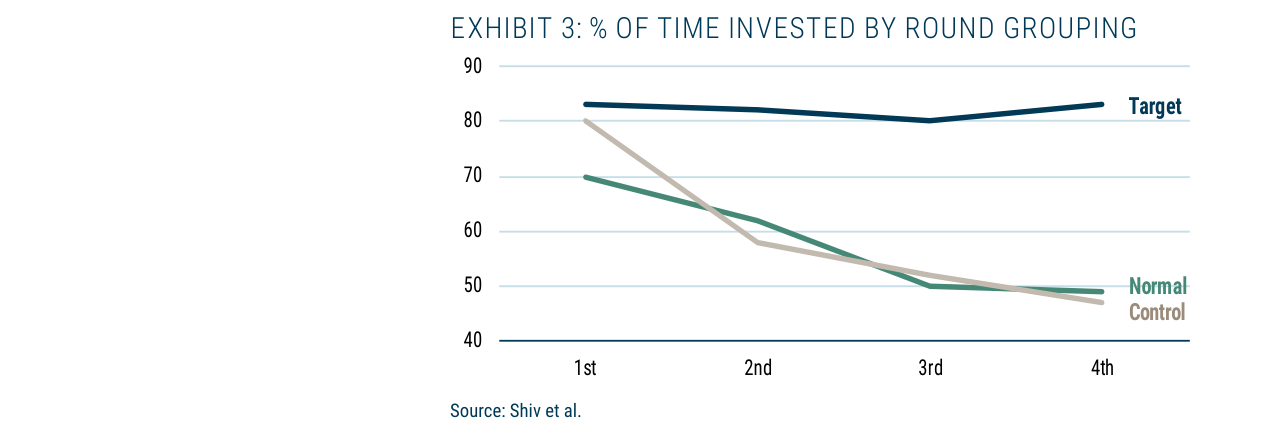
As the game progressed, the Normal and Control groups' investment rates steadily declined from about 70% to around 50%, while the Target group remained stable above 80%
2. Conservative Trend Over Time:
- Dividing the 20 rounds into four 5-round intervals, the Normal and Control groups' investment rates declined segment by segment (from about 70% to around 50%), while the Target group remained stable (approximately 85%).
- This indicates that fear has a cumulative effect: memories of earlier losses continuously suppress subsequent risk appetite.
3. Current Market Valuation Context:
- The report cites Exhibit 4, showing that as of March 19, 2020, Shiller P/E ratios for the U.S., World ex-U.S., and Emerging Markets were at historically low levels (specific values not listed in the text, but the chart indicates levels below long-term averages).
Companies/Assets Involved
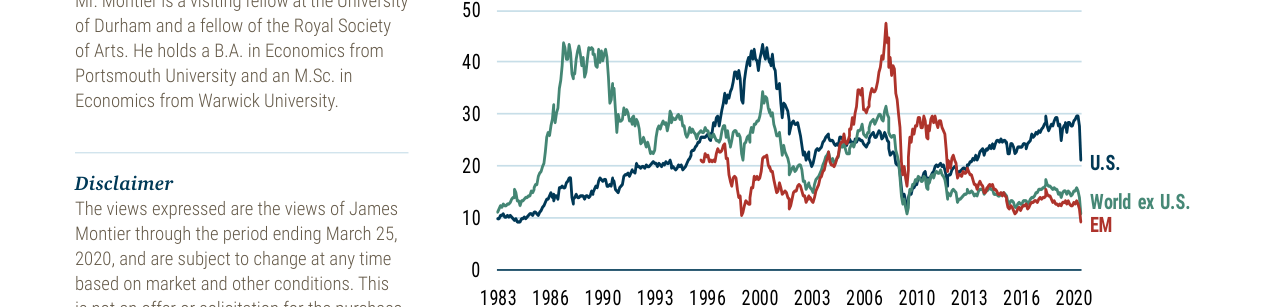
As of March 2020, the U.S. Shiller P/E ratio was approximately 30x, significantly higher than the World ex-U.S. and Emerging Markets levels of about 15x
- No specific companies mentioned. This chapter is a behavioral finance analysis and does not involve individual stock recommendations.
- Cites Sir John Templeton's famous quote: "The time of maximum pessimism is the best time to buy," suggesting that the current period is a window of opportunity for value investors.
Investment Implications
- "Discounts" in bear markets represent positive expected value opportunities, but fear prevents investors from capitalizing on them. The author explicitly states: "Stock market discounts are the only kind of discount that nobody likes—except for us steadfast value investors."
- Investors should actively suppress the rapid response of the emotional system: Recognizing that fear after losses leads to irrational conservatism, they must use the C-system (rational analysis) to counter the X-system (emotional impulses).
- The current low-valuation environment globally (low Shiller P/E) is a buy signal, but short-term volatility must be endured. The author quotes Lincoln's "This too shall pass" to remind investors to maintain a long-term perspective.